Tag: gdp
Trump's Weak Economy Grew 1.5 Percent In First Half Of 2025

Trump's Weak Economy Grew 1.5 Percent In First Half Of 2025

Some folks have gotten a bit carried away with the revisions that put the second quarter growth rate at 3.8 percent. That does look impressive in isolation, but it is important to remember the economy shrank at a 0.6 percent rate in the first quarter.

That puts the average at 1.6 percent for the first half of the year. That’s not terrible but it is hardly cause for celebration. Remember, the economy grew 2.4 percent last year and the vast majority of forecasters expected growth at this rate to continue.

And we really do need to look at the two quarters together. Just as unusual factors were responsible for the fall in GDP we saw in the first quarter, they are also responsible for the strong growth reported for the second quarter.

To take the most notable example, the lower trade deficit added 4.83 percentage points (PP) to growth in the second quarter. A pre-tariff surge in the trade deficit subtracted 4.63 PP from growth in the first quarter. Only a devoted Trumper would focus on the second quarter number without mentioning the first quarter jump in the trade deficit.

Moving beyond the irregular numbers, we get that non-residential fixed investment added 0.98 PP to growth in the second quarter after adding 1.24 PP in the first quarter. The first quarter growth was partly due to pre-tariff stockpiling but the second quarter growth on top of this indicates we are looking at something sort of real. This is the AI boom. If that turns into a bust, we will see this growth quickly reversed.

Consumption accounts for the bulk of GDP and here the story is pretty blah. The second quarter’s growth rate was a healthy 2.5 percent, accounting for 1.68 PP of the quarter’s growth. But this followed a growth rate of just 0.6 percent in the first quarter, leaving an average of rate of 1.6 percent for the first half. That’s not horrible, but certainly not great.

We also have seen evidence that the growth in consumption has been concentrated among higher income people who are spending their stock gains. That is consistent with my simple measure of looking at real spending at fast food restaurants. I consider this useful since it’s unlikely that rich people increase their consumption of fast food because their stock portfolio is worth more.

And spending on fast food has to rank as largely a discretionary purchase. It is one thing that is relatively easy to cut back on if a family has to tighten its belts. Real spending at fast food restaurants was just 0.3 percent higher in the second quarter than the average for 2024. That doesn’t look like most people are feeling good about the economy.

Today, we will get new data on consumption for August, along with revisions for prior months’ data. Maybe that will show a different story, but for now, it looks like we have a weak economy that is being sustained by the AI boom. That boom could go on for a while and keep the economy moving forward, but it may not.

Reprinted with permission from Dean Baker.
Economy

Ignore Trump's Distractions -- This Is His Economy Now

Many people have complained about New York Times headlines, with reason. All too often an equivocating, sanewashing headline belies the excellent reporting that follows. But yesterday the Times got it right about the first-quarter decline in GDP: “Trump boasts about the economy, but says weak data is Biden’s problem.”

There will be much more of this as the data get worse, which they will. (I’m going to keep treating “data” as plural unless it refers to a Starfleet commander.) In fact, I worry a lot about Trump putting pressure on the statistical agencies to report better numbers. He has already said that reports of rising prices are “fake news”.

For now, however, it’s important to be clear that the bad news is all on Trump’s head, and we mustn’t let him get away with claiming otherwise.

It’s true that most of the time presidents have much less impact on the economy than many people believe. It’s also true that a president’s policies usually don’t have large economic effects in the first few months of their administration.

But Trump’s policies have been so extreme that they are already making the economy visibly worse. In particular, expectations of high tariffs began distorting business decisions even before the tariffs went into effect. If you look at the GDP numbers released yesterday, you see a huge surge in imports coupled with a large surge in inventories. Both of these clearly reflected businesses “front-running” expected tariffs, racing to buy as much from China in particular as they could before the tariffs went into effect.

And the effects of Trump’s policies will become even clearer, and even worse, over the next few months. Those insanely high tariffs on China have led to a collapse in shipments from China to the United States, which will soon be reflected in soaring prices and, probably empty shelves.

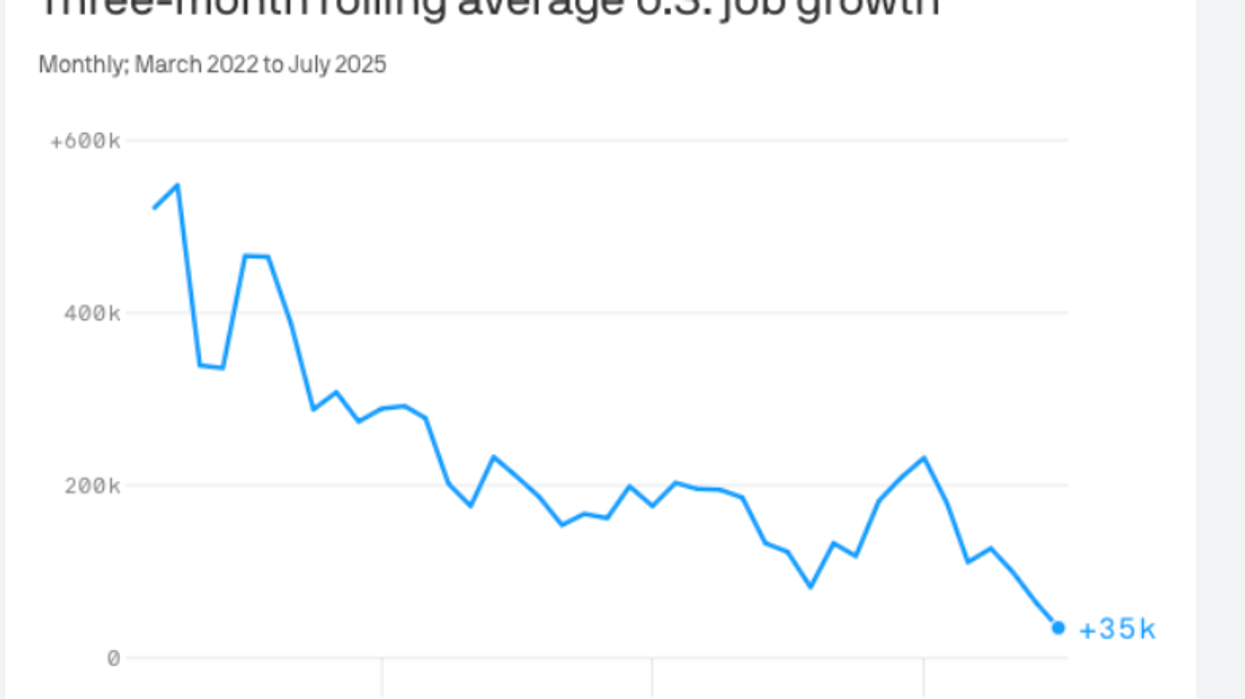
We’re also already seeing signs of Trump’s policies causing broad economic weakness:

Trump himself seems to be aware that he’s causing major supply-chain disruptions.

“You know, somebody said, ‘Oh, the shelves are going to be open,’” Mr. Trump said. “Well, maybe the children will have two dolls instead of 30 dolls, you know? And maybe the two dolls will cost a couple of bucks more than they would normally.”

OK, having Trump come out as a critic of consumerism and proponent of the higher, spiritual side of life wasn’t on my bingo card.

What I and everyone else did expect was that when the economy turned bad, Trump would refuse to accept responsibility and blame his predecessor. And right on cue, that’s what is happening.

So this is a good time to remember that Trump actually inherited a very good economy, one that was outperforming all its peers. From The Economist, last October:

When Trump moved into the White House, America had historically low unemployment and inflation only slightly above the Federal Reserve’s (arbitrary) target of 2 percent. Look at the “misery index,” the sum of inflation and unemployment — a crude but usually pretty good measure of how the economy is doing. As of January that index was quite low by historical standards:

Were there deep underlying problems, reasons to believe that the appearance of prosperity was somehow misleading? No. I’ll probably write at some point about claims by Trump’s minions that the Biden economy was somehow bad despite low unemployment and inflation combined with rising real wages. But for now let me just say that none of these claims stands up to even casual scrutiny.

In short, pay no attention to Trump’s excuses. The U.S. economy was in good shape when he came in. If everything is going to hell — which it is — he has nobody but himself to blame.

Paul Krugman is a Nobel Prize-winning economist and former professor at MIT and Princeton who now teaches at the City University of New York's Graduate Center. From 2000 to 2024, he wrote a column for The New York Times. Please consider subscribing to his Substack, where he now posts almost every day.

Reprinted with permission from Paul Krugman.


Joe Biden

Biden's America Is Doing Fabulously Well, In Fact

Life is not perfect in Joe Biden's America, but when was it ever perfect? Just looking at the numbers, though, things are pretty great.

Stock prices are hitting record highs. Unemployment is at its lowest level in 50 years. Violent crime — murder, rape, aggravated assault and robbery — has dropped to a near 50-year low. The net worth of American households stands at record levels.

Higher prices remain a concern for many, but inflation has much moderated. Inflation last month was zero, and some prices are coming down. For example, the average price of gasoline, which hit $5.816 a gallon two years ago, is now down to $3.452.

The U.S. economy is, in The Wall Street Journal's words, "the envy of the world." Since shortly before the pandemic, the real GDP has grown 9.4 percent. By contrast, Britain's has risen just one percent, and in Germany and Japan, it's up less than one percent.

Jamie Dimon, the boss at JP Morgan, has called the booming American economy "unbelievable" with the average consumer "much wealthier than before."

And that's why the world's investors are flooding into American markets.

"The US has the biggest and most innovative companies with strong earnings growth but profit also from its safe haven status," explained Ulrich Urbahn, an analyst at Hamburg-based Berenberg Bank.

Meanwhile, the U.S. is taking on China as the world's producer of green energy and microchips. This didn't just happen. America is charging ahead in this competitive race because of Biden's three big invest-in-America bills.

After recently observing the massive factory construction in Georgia, BBC economics editor Faisal Islam wrote, "In 20 years of reporting around the world, what I have seen in the US over the past year can only compare to what I saw in China in the mid-2000s."

Granted, many Americans feel pressed by prices at the supermarket or McDonald's. In reality, inflation had been a worldwide phenomenon.

That may account for consumer sentiment numbers that reflect unwarranted pessimism (though there's been some improvement). Consumer behavior in the real world suggests otherwise. Americans are continuing to spend at levels that baffle economists.

No one who follows news delivered straight can believe that the economy was better under Donald Trump. There's hardly a number to support that claim. It's a tribute to the ex-president's powers to con that much of the public thinks the four-time bankrupt is an economic wizard.

We know that Trump can put on a show. But the show of late has turned more bizarre than entertaining — witness his crazy verbal meanderings about electric boats and sharks, one of which bit off a "young lady's leg."

Trump recently spoke to corporate bigwigs at a Business Roundtable meeting in New York. Some in attendance had been predisposed to Trump based on his talk of tax cuts and looser regulations.

But they were shocked by his mental confusion. "Trump doesn't know what he's talking about," one CEO told Andrew Sorkin, host of CNBC's Squawk Box.

Several of them, Sorkin reported, "said that [Trump] was remarkably meandering, could not keep a straight thought [and] was all over the map." He offered few details on how he would reduce taxes and cut back on business regulations.

Trump recently quoted his doctor who years ago said he was mentally competent, but he mangled the doctor's name. And no, Donald, World War II is in the past, not the future.

The numbers say the U.S. economy is amazingly strong under Biden. And the non-economic numbers are not too shabby either. The murder rate, for one, is well below pre-pandemic levels -- that is, when Donald Trump was president.

Face it, Biden's America is doing fabulously well.

Reprinted with permission from Creators.

Biden Economy Surpasses Goals Set By Trump

Biden Economy Surpasses Goals Set By Trump

Not since The Karate Kid was playing in movie theaters and Wendy's introduced its "Where’s The Beef?" ad campaign, has the U.S. economy seen such rapid growth.

America's real gross domestic product, a snapshot of a country’s economic output, increased by 6.9% in the last quarter of 2021, according to newly released figures from the U.S. Department of Commerce.

The average GDP was 5.7% during President Joe Biden's first year in office — the fastest economic growth the country has seen since 1984.

"The GDP numbers for my first year show that we are finally building an American economy for the 21st Century, with the fastest economic growth in nearly four decades, along with the greatest year of job growth in American history," Biden said in a statement on Thursday. "And, for the first time in 20 years, our economy grew faster than China's."

This week's report confirmed that the country is seeing faster job growth under Biden than under the last three Republican presidents combined, according to Simon Rosenberg, founder of the liberal think tank NDN.

When he was in office, President Donald Trump often boasted about stimulating "the greatest economy in the HISTORY of America." In reality, Trump oversaw the worst drop in real GDP in American history, largely because of his administration's botched response to the COVID-19 pandemic.

Trump once bragged about 3% growth, calling it "one of the great gifts to the middle-income people that they've ever gotten for Christmas."

"The economy now is at 3%," he told reporters in 2017. "Nobody thought it would be anywhere close. I think it could go to 4, 5, and maybe even 6%, ultimately."

Trump's prediction did ultimately come true — under a Biden presidency.

President Barack Obama also surpassed Trump's quarterly growth rates, reaching a quarterly rate of 5.2 percent in the middle of 2014.

The U.S. added more than six million jobs during Biden's first year in office. Trump, by contrast, presided over the loss of nearly 10 million jobs amid the COVID-19 pandemic.

Of the 42 million jobs created since 1989, almost all of them — a staggering 95 percent — have been added during Democratic presidencies, Rosenberg added.

Whether it's real GDP, employment, stock prices, or income, nearly every economic indicator reveals what Trump himself admitted to CNN's Wolf Blitzer in 2004: "The economy does better under the Democrats."

Behind 2021's robust economic recovery is Biden's $1.9 trillion American Rescue Plan, which sent $1,400 relief checks to most Americans, expanded unemployment benefits, and invested in state and local governments, small businesses, and health care.

A December report from the Roosevelt Institute found that the American Rescue Plan spurred massive job growth while protecting the economy from the pandemic's worst effects.

Democrats in Congress passed the measure last March, over the opposition of every Republican in Congress. Since then, some of the same Republican lawmakers who voted against the American Rescue Plan have taken credit for the public projects it funded.

"It's amazing how Democrats are creating economic growth and didn't have to hand out trillions in tax cuts to big corporations and the wealthy!" Rep. Gwen Moore (D-WI) tweeted on Thursday. "Instead, we supported funding to open schools, get Americans vaccinated, and people back to work. Trickle-down economics is a myth."

Reprinted with permission from American Independent

Shop our Store

Headlines

Editor's Blog

Corona Virus

Trending

World