Tag: great recession
President Trump

Crashing Out: Consumer Confidence Falls To Lowest Level Since Great Recession

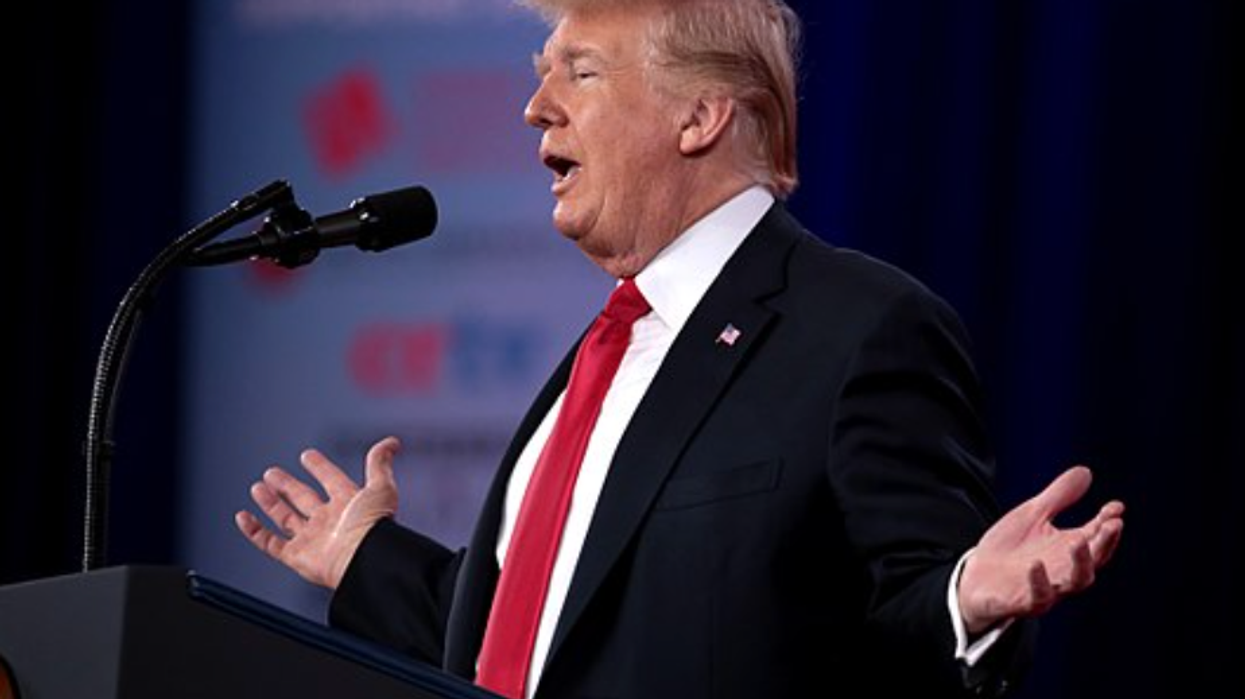
Consumer sentiment in the United States continued its sharp plunge this month under President Donald Trump as Americans grew increasingly concerned about the prospect of a job-destroying recession in the near future—fears fueled in large part by the administration's erratic tariff policies.

The University of Michigan's Surveys of Consumers, released Friday, found that U.S. consumer sentiment plunged 11 percent at the start of April compared to last month, a decline that was "pervasive and unanimous across age, income, education, geographic region, and political affiliation."

That's according to the survey project's director, Joanne Hsu, who said that "sentiment has now lost more than 30 percent since December 2024 amid growing worries about trade war developments that have oscillated over the course of the year."

Friday's assessment shows that overall consumer sentiment has fallen to its second-lowest level since the early 1950s.

"Consumers report multiple warning signs that raise the risk of recession: expectations for business conditions, personal finances, incomes, inflation, and labor markets all continued to deteriorate this month," said Hsu. "The share of consumers expecting unemployment to rise in the year ahead increased for the fifth consecutive month and is now more than double the November 2024 reading and the highest since 2009."

"This lack of labor market confidence," Hsu added, "lies in sharp contrast to the past several years, when robust spending was supported primarily by strong labor markets and incomes."

"President Trump isn't executing an economic agenda, he's piloting a kamikaze mission."

Lindsay Owens, executive director of the Groundwork Collaborative, said in a statement that "the scariest part of today's plunging consumer sentiment numbers is that we might be looking at the high-water mark."

"The president's reckless trade policies have roiled markets, shattered retirement accounts, and halted shipping orders. We could be looking at price spikes, shortages, and even a recession in the weeks and months to come," said Owens. "Worst of all, while consumers are bracing for impact, Congress is gutting the safety net they'll need to rely on if the economic devastation continues. President Trump isn't executing an economic agenda, he's piloting a kamikaze mission."

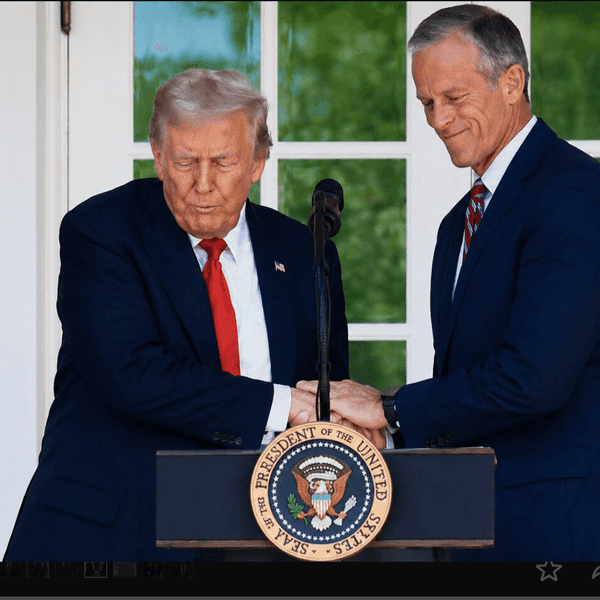
Trump himself has admitted that his tariffs, which he partially paused for 90 days earlier this week, could spark a recession.

The Wall Street Journal reported that the president "told advisers that he was willing to take 'pain'" and "privately acknowledged that his trade policy could trigger a recession but said he wanted to be sure it didn't cause a depression."

While Goldman Sachs withdrew its recession forecast after Trump announced the partial tariff pause, Moody's chief economist Mark Zandi told Fortune that he took "no solace in the president’s announcement to delay the reciprocal tariffs for 90 days."

"Even if the administration can cut a few deals during this period, it will leave us with significantly higher tariffs, which are tax increases on American consumers and businesses," said Zandi. "This will weigh heavily on the U.S. and global economies and likely result in a recession."

"To what end?" he asked. "There will be no boost to investment in the U.S. The trade deficit will be no smaller. And there won't be any reliable increase in government revenues. It is impossible to fathom why the world is being put through all this unnecessary drama."

Reprinted with permission from Alternet.

What Happened During America’s Last Trillion-Dollar Bailout

What Happened During America’s Last Trillion-Dollar Bailout

Reprinted with permission from ProPublica.

Never in U.S. history has there been a moment like this: Trillion-dollar proposals are pouring forth from Capitol Hill in a mad bid to save the economy from the ravages of a pandemic.

On the other hand, 2008, when toxic mortgage assets made “bailout” a political buzzword, wasn’t so long ago.

Back then, Congress, to revive a financial system paralyzed by devastating mortgage losses, opened the nation’s wallet wide, passing a $700 billion bailout. The following year, as unemployment rose, credit froze and public coffers dried up, it kicked in $840 billion more in a stimulus bill designed to save and create jobs and jump-start consumer spending. Of course, these helicopter drops of taxpayer cash seemed ripe for waste and fraud, so we decided to track where the money went.

What we learned from dogging those massive efforts provides some important lessons for today’s crisis. Many of the proposals lawmakers put forth this week — a grab bag of rescues for affected industries, broad loan programs and cash payments — the U.S. tried not too long ago.

Here’s a key takeaway: The reason we can easily update you on the pitfalls of the 2008-09 bailout is … it never actually ended. (And guess who keeps updating ProPublica’s Bailout Tracker?) Massive interventions have a way of leaving a mark. The government took over Fannie Mae and Freddie Mac, the giant mortgage finance entities, in 2008, and they remain in conservatorship. Tens of millions each month are still going out under the Troubled Asset Relief Program, the bailout’s misleading moniker, through next year. (We’ll get back to what TARP ended up doing in a bit.)

So, while a crisis provoked by a rampaging global virus certainly looks a lot different from one caused by toxic mortgage assets, the proposed solutions already on the table really aren’t.

President Donald Trump’s marquee proposal, also embraced by some Democrats, is a $500 billion plan to send stimulus money to American taxpayers as soon as early April. But history shows that the much-anticipated cash relief might not come as fast, or end up as well targeted, as the Trump administration is promising.

The Bush administration tried a similar stimulus measure in February 2008 when it sent $600 tax rebate checks to middle-class workers, with additional money for parents with children. But workers didn’t get them for three to five months — much longer than the two to three weeks Treasury Secretary Steven Mnuchin is currently promising.

When the checks did arrive, people didn’t run out and buy things. Most of the money was saved or used to pay down debt.

When President Barack Obama took over, he pitched a much larger, but ultimately insufficient stimulus package, designed around “shovel-ready” projects, safety net spending and investments in clean energy. Many people forget that the biggest item was a middle-class tax cut. But instead of sending checks, the administration chose to dribble the money out in paychecks at about $10 a week over two years, hoping that this way consumers would spend more of it. They didn’t.

There’s even more reason to believe that the proposed stimulus checks will be saved this time.

By definition, stimulus programs aim to get people to go out and spend, creating demand that creates jobs. But to slow the spread of the coronavirus, government officials are telling, and in some places ordering, people to stay home. Extra money would certainly help workers who’ve lost their jobs or seen their hours cut. It might even encourage people stuck at home to buy new laptops and TVs, helping foreign manufacturers and domestic warehouse workers and truckers. But as popular as tossing cash from helicopters might be, lack of money is not the reason people with jobs aren’t spending right now.

Economic studies have shown there may be more efficient ways to spend $500 billion to aid those in need, such as expanding food assistance, unemployment benefits and other safety net programs as well as incentives to stem the tide of layoffs.

One of the most effective programs from Obama’s stimulus package was a $50 billion fund to shore up state and local budgets, which has been credited with saving the jobs of more than 300,000 teachers and support staff. Sending money to local governments could help down the line as tax revenues plummet along with the economy.

The Trump administration and Congress could do something similar with private businesses now, encouraging them to pay their workers during shutdowns, as Honda has pledged to do.

One proposal floated in a recent Treasury Department memo obtained by The Washington Post is a program that would guarantee $300 billion in loans to help small businesses meet payroll for eight weeks.

But policymakers should also consider the success that Germany had during the last recession with a program known as “work sharing.”

The idea is that businesses will eventually need to ramp up again whenever this especially unpredictable crisis is over. Under work sharing, instead of laying workers off, employers reduce hours, and the government pays partial unemployment benefits to make up for lost wages. For some workplaces, such a program could also achieve the goal of social distancing or allow people a way to balance the new child care and teaching demands caused by school closures.

But according to the National Conference of State Legislatures, more than 20 states don’t offer work sharing programs.

There’s also a lesson from the bailout about what happens when Congress hands an administration broad authority without clear direction or restrictions.

One clear lasting legacy of the 2008-09 bailout is a chronically flawed mortgage modification program, one launched with the promise of saving millions of people from foreclosure, but characterized by ongoingchaos, lax enforcement of its rules and failure. The program was rolled out months after the Treasury Department had quickly pumped hundreds of billions into banks with few strings attached.

This happened because, with pressure to act quickly in 2008, Congress gave the Treasury Department broad discretion to essentially make things up as it went. That’s how — and why — even though the TARP was conceived as a giant program to buy up toxic mortgage assets, the government almost immediately abandoned that idea. Instead, the Treasury Departments of both Bush and Obama spun out an array of programs, successfully bailing out AIG, large banks and the auto industry — and only later launched a notably unsuccessful program for homeowners. (For a rundown of who paid the money back, see here.)

It’s the kind of freedom Trump’s Treasury Department appears to covet: Its recent proposal suggests giving it the authority to send $50 billion to the airlines and $150 billion to “other severely distressed sectors,” with the Treasury determining the “appropriate interest rate and other terms and conditions.”

The TARP had relatively robust oversight built in, and it’s an aspect that should be repeated, said Neil Barofsky, who served as the special inspector general for the TARP from 2008 to 2011.

“You cannot push out $1 trillion without scandal. There’s going to be crime, there’s going to be fraud,” he said. “But with strong and effective oversight, you can limit it.”

Not only did the TARP have Barofsky’s office, but there was also the Congressional Oversight Panel, which was headed by a Harvard professor named Elizabeth Warren. The SIGTARP, as Barofsky’s office was known, released scathing reports and brought criminal cases against bankers who’d lied on their bailout applications, while Warren’s panel publicly raked Treasury Secretary Timothy Geithner over the coals for being too generous to banks while doing far too little for ordinary people.

Whatever proposals are ultimately adopted, taxpayers should be able to see how the government is spending their money. In 2009, Obama’s stimulus package created an accountability and transparency board, requiring any entity that received contracts, grants or loans to file quarterly reports that were posted publicly on a government website.

Extending the idea to all federal spending was supported by people as far apart politically as then-Vice President Joe Biden and former Rep. Darrell Issa, R-Calif., who chaired the House oversight committee. Some provisions made it into law, but the larger effort failed to get traction, and the board and its website shut down in 2015. Perhaps it’s time to resurrect the idea. Without adequate testing, we may not know the full reach of COVID-19; but at least should be able to track the money spent to respond to the crisis it’s leaving behind.

Do you have access to information about the government’s response to the economic fallout from the coronavirus that should be public? Email Michael Grabell at michael.grabell@propublica.org and Paul Kiel at paul.kiel@propublica.org. Here’s how tosend tips and documents to ProPublica securely.


A Bitter Political Summer In Wisconsin

A Bitter Political Summer In Wisconsin

MADISON, Wisc. — The fields of corn growing across the state looked knee-high by the Fourth of July, as they say here, but politics is parched in the heartland as Wisconsin prepares for another furious showdown in this fall election harvest. Call it a civil war, that’s what it feels like.

I knew this place as a girl. I love Wisconsin, but don’t know it anymore.

The blue-leaning state is already a major battleground in play in 2016, with presumptive presidential nominees Hillary Clinton and Donald Trump vying for very different voter bases. Clinton will court the two cities, Madison and Milwaukee, while Trump may concentrate on the rest of the state, branding and sneering at the city folk as elites and eggheads. He is the champion of making people hate each other, after all. And she is head girl of the elite.

Trump did not do well here in the primary, however, and the chair of the University of Wisconsin political science department, David Canon, expects Clinton to do “marginally better against Trump than the national result.”

South of the state capital, two native sons from the small, depressed town of Janesville, Republican House Speaker Paul Ryan and Democrat Russ Feingold, perfectly illustrate how far apart the two parties are.

Ryan, every inch the company man whose conscience cowers at Trump, can’t keep a neat House of Representatives. He has an unruly bunch of Republicans in the majority, and Democrats are beginning to show spirit, as they did staging a House sit-in on gun violence, which made Ryan fighting mad.

As senator, Feingold was the only one to vote against the Patriot Act. Bully for him. He’s running for the seat he lost in the tea party tempest six years ago.

For many — those who see Wisconsin as an enlightened state that produced Thornton Wilder, the playwright of the classic “Our Town,” dissenters who remember the campus anti-Vietnam War movement started on the shores of Lake Mendota and intellectuals who dwell on tree-shaded streets named after universities — there is a profound gulf with the rest of the largely rural small-town fabric of the state. Green Bay, for example, could not be more different than liberal, urbane Madison and the diverse, sturdy patchwork of Milwaukee.

Wisconsin can never be taken for granted, but current waters seem especially turbulent. In her insightful new book, “The Politics of Resentment,” Katherine J. Cramer, a professor at the University of Wisconsin, interviews working-class people from the rural reaches of Wisconsin. She struck up conversations with some people at gas stations. She explains clearly how forgotten and ignored they generally feel, caught in an economic cauldron with hourly wage work or health care costs that make life harder to get by since the Great Recession hit eight years ago.

The economic downturn that President Obama inherited from the “war president” George W. Bush has left fingerprints on so many houses and families. As Cramer shows, people are still struggling and they resent others with more privilege and access to new rules in an ethereal economy. The Obama “recovery” has Wisconsinites asking, “what recovery?” When Trump speaks of free trade and lost jobs, he strikes a chord.

Like the Mississippi River that runs along its border, Wisconsin captures the cross-currents of the national stage better than anywhere. With hard-charging right-wing Gov. Scott Walker set to speak at the Republican National Convention, the state’s civil war will be on display. Walker is hostile to a pride and joy, the University of Wisconsin, bleeding under budget cuts, and to public employee unions.

The Progressive Party was founded here, about 100 years ago, to stand for fairness and squareness in the Midwestern tradition, especially toward the giant monopolies like Standard Oil. Collective bargaining was practically invented here. Senator John F. Kennedy served on a committee that chose Robert La Follette, a Progressive, as one of the greatest in Senate history.

But never forget that Communist witch-hunter Joseph McCarthy, the senator who first exploited the anti-intellectual, paranoid and nativist steaks in American politics, also started here.

A remnant of the real Civil War hangs around Madison’s heart. It’s a comfort that famed Camp Randall, the UW football stadium, began as a place on the right side of the Civil War. Here Confederate war prisoners learned the Union was not for quitting.

Somehow that makes things better.

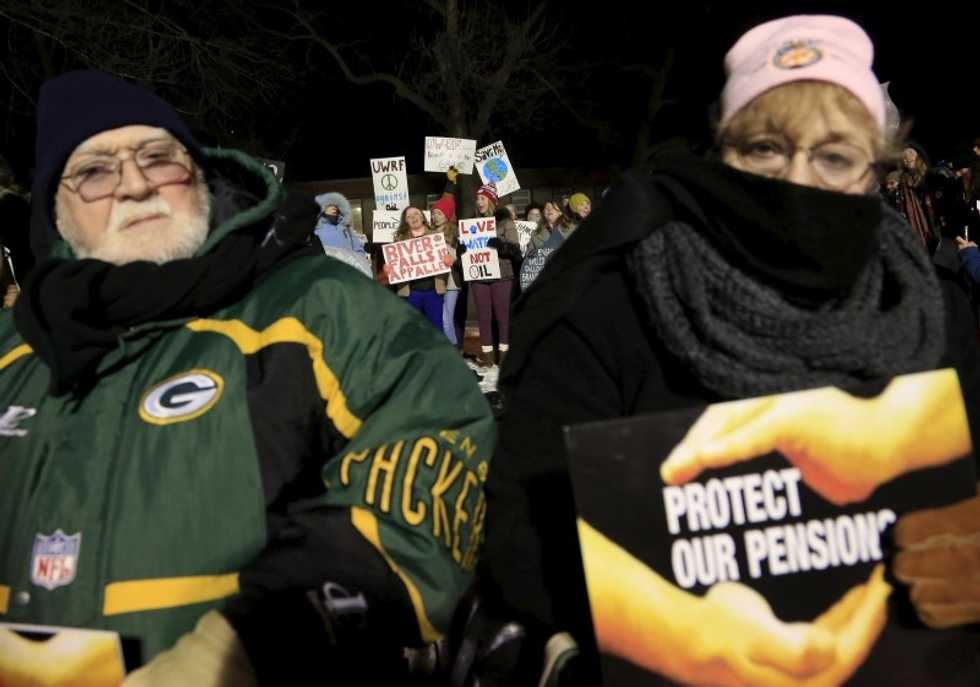
Photo: Unions workers (front) and various supporters hold up signs before a U.S. Democratic presidential candidates debate in Milwaukee, Wisconsin, United States February 11, 2016. REUTERS/Darren Hauck

Clinton Knocks Trump For Cheering Housing Bubble Burst

Clinton Knocks Trump For Cheering Housing Bubble Burst

Democrat Hillary Clinton, seeking to dampen Republican presidential candidate Donald Trump’s growing appeal with working-class voters, on Tuesday accused him of having cheered on the 2008 housing market crash.

Clinton’s campaign released an ad with audio that the presumptive Republican nominee recorded in 2006 for his now-defunct Trump University venture. Trump, a billionaire real estate developer, in remarks on a “bubble burst,” said: “I sort of hope that happens because then people like me would go in and buy” property and “make a lot of money.”

Clinton’s campaign and her surrogates used the recording to argue that she would take better care of the U.S. economy. Clinton is seeking to blunt the inroads that Trump has been making with voters in crucial states such as Florida and Ohio.

Trump defended his comments on Tuesday evening at a rally in Albuquerque, New Mexico, saying buying when the housing market was down showed smart dealmaking skills that he would bring to the White House.

“I’m a businessman, that’s what I’m supposed to do,” Trump said. “I feel badly for everybody. What am I going to do? I’m in business.”

The New Yorker also impersonated Clinton on the campaign trail, who he said “screams,” and said other big names in business did similar deals as he did before the housing crisis.

Trump has never held elected office and often touts his history as a businessman in response to accusations that he is unprepared to assume the presidency.

Anti-Trump protestors and police clashed outside the Albuquerque convention center on Tuesday when protestors tried to storm the center, calling for an end to the Trump rally.

Albuquerque police said on Twitter that protestors threw rocks and bottles and a door to the facility appeared to have been hit with something. Police said the only arrests so far had been inside the rally, where Trump was interrupted multiple times by protestors.

Opinion polls in key states show Clinton, the front-runner for the Democratic nomination, and Trump in a tight race ahead of the Nov. 8 U.S. presidential election. Nationally, Trump has been rising in polls to pull roughly even with Clinton.

U.S. Senator Elizabeth Warren, a Democrat who is a favorite of financial reformers, bashed Trump in prepared remarks released ahead of a speech in Washington on Tuesday. Trump’s 2006 comments, she said, amounted to rooting for “people to get thrown out on the street.”

“The rest of us were horrified by the 2008 financial crisis,” Warren said in the comments. “But Donald Trump was drooling over the idea of a housing meltdown – because it meant he could buy up a bunch more property on the cheap.”

Warren also criticized Trump for saying in a Reuters interview last week that the 2010 Dodd-Frank financial oversight law, enacted in response to the crisis, made it hard for bankers to operate.

“Let me find the world’s smallest violin to play a sad, sad song,” Warren said. “Can Donald Trump even name three things that Dodd-Frank does? Seriously, someone ask him.”

Trump did not directly respond to Warren’s comments on Tuesday, but he called her a “total failure” as a U.S. senator during the rally.

Clinton surrogates from Ohio and Florida held a conference call with reporters about Trump’s housing statements. Her campaign hosted related events in Virginia, Pennsylvania, New Hampshire, Iowa, Colorado and Nevada, which will all be battlegrounds in November’s general election.

“How could Trump possibly champion the collapse of the housing market and our economy?” U.S. Representative Tim Ryan of Ohio said on the call.

Clinton is still fighting on two fronts as she seeks to wrap up her primary battle with Democratic rival Bernie Sanders, a U.S. senator from Vermont.

Clinton and Sanders both campaigned on Tuesday in California, which is among six states holding Democratic nominating contests on June 7. California, the most populous U.S. state, has more Democratic delegates than any other state, and Sanders has invested heavily there.

Clinton needs a solid win in California for a strong finish heading into her party’s national convention in July and to dispel questions about whether she can unite the party after a drawn-out, increasingly bitter primary race.

Clinton on Monday turned down an invitation by Fox News to debate Sanders in California despite having agreed previously to a May debate. Her campaign said Clinton’s time would be better spent meeting directly with California voters. Sanders said her refusal was an insult to California voters.

Sanders on Tuesday requested that the state of Kentucky review his loss there last week to Clinton by fewer than 2,000 votes. Kentucky’s secretary of state, Alison Grimes, said in a statement that the state will recanvas the results at all 120 county boards of election.
Additional reporting by Alana Wise and Doina Chiacu in Washington and Emily Stephenson in Albuquerque, New Mexico; Editing by Jonathan Oatis, Leslie Adler and Michael Perry

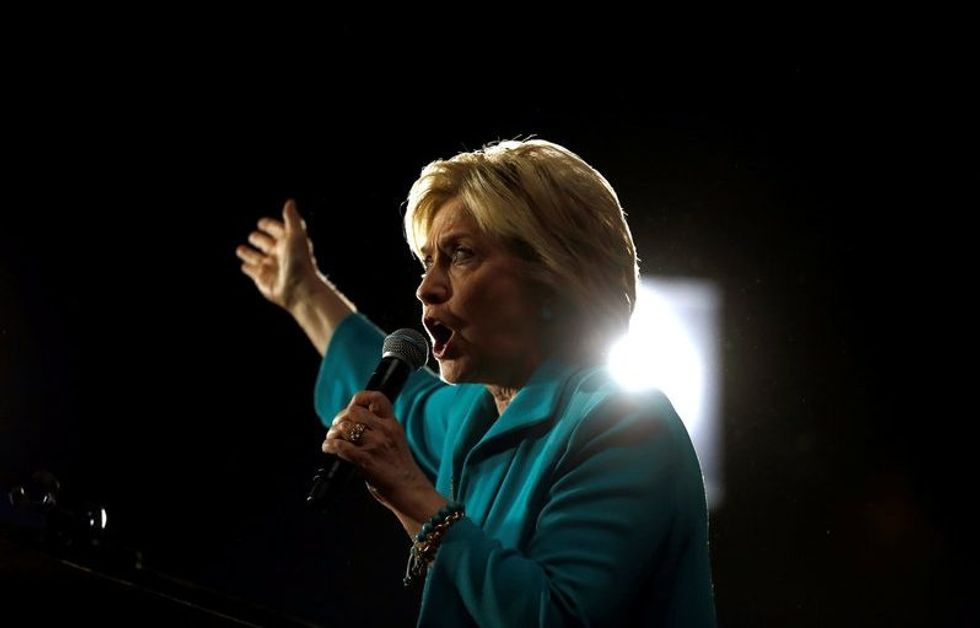
Photo: U.S. Democratic presidential candidate Hillary Clinton speaks at the IBEW union hall in Commerce, California, U.S., May 24, 2016. REUTERS/Lucy Nicholson

Shop our Store

Headlines

Editor's Blog

Corona Virus

Trending

World