As the 2014 midterms draw nearer, the Republican Party has developed a simple, Costanza-esque plan for the election season: Nothing.
The theory, which is reportedly being pushed by House Speaker John Boehner (R-OH) over the objections of some House members, goes as follows: As the rollout of the Affordable Care Act continues, Republicans should fade to the background and watch it “collapse under its own weight,” as Rep. Paul Ryan (R-WI) is prone to saying. That will allow Republicans to eliminate any distractions as they relentlessly hammer Democrats over the law’s failures, on the way to maintaining their House majority and winning the net six seats needed to take control of the Senate.
The Republican strategy makes some sense on its face — after all, no issue fires up Republican loyalists quite like the Affordable Care Act, and there’s no question that the law’s troubled rollout has been a massive political headache for Democrats.
But there’s a question that should keep every Republican strategist up at night: What happens if health care reform isn’t the electoral albatross that Republicans assume?
It’s not an unrealistic proposition. After all, despite the massively publicized problems with the launch of the law, the percentage of Americans who want it scaled back or repealed has hardly changed over the past two years. There are more reasons to be optimistic that the law will work as intended than there have been at any point since its rollout. Americans still have no faith in the Republican Party to create a constructive alternative. And, crucially, at least one poll suggests that the public is more concerned with job creation, gun reform, and immigration reform — bread-and-butter issues for Democrats — than with reducing the deficit or repealing Obamacare (the central tenets of the GOP platform, such as it exists).
In fact, according to the final Democracy Corps battleground survey of 2013, Republicans may actually pay a political price for their unyielding attacks on the health care reform law. As pollster Erica Seifert put it, “battling on Obamacare is [Republicans’] weakest case for re-election. In fact, it undermines it.”
So if the Affordable Care Act doesn’t crash and burn, destroying the Democratic Party with it, what is the Republican Party’s plan B?
It appears that their guess is as good as yours.
Speaker Boehner has reportedly been trumpeting the results of a recent survey finding that the public now primarily blames President Obama for the nation’s economic problems, rather than the policies of his predecessor.
“Since he can’t blame George W. Bush anymore, the president has chosen to talk about rising income inequality, unemployment, and the need to extend emergency unemployment benefits,” Boehner told House Republicans, according to The Hill. “After five years in office, Barack Obama still doesn’t have an answer to the question: Where are the jobs?”
The problem for Boehner is twofold: First, Americans very clearly want to have the conversation that President Obama has begun. Second, if Republicans have an answer to the “where are the jobs?” question, they are keeping it awfully close to the vest.
The Republican Party’s official “Plan for Economic Growth & Jobs” is incredibly thin on details. In fact, with the exception of repealing Obamacare — and replacing it with yet-undefined “patient-centered reforms” — it does not offer a single specific policy prescription. (By contrast, the White House jobs page leads directly to a description of the American Jobs Act, which, regardless of what one thinks of its merits, is undisputably an actual plan.)
The GOP has similar problems discussing other top issues of the day. Tacit in Boehner’s barb about President Obama distracting Americans with a discussion of inequality is the fact that Republicans have few productive ideas to add to the conversation. Immigration reform is similarly treacherous territory for the party. As is any conversation on “reforming” Social Security or Medicare.
It’s not as though Republicans aren’t aware of the issue; after the 2012 presidential election, the Republican National Committee made a concerted effort to change its image from that of a party that’s only “talking to itself” (it has not been going well, by the way).
Perhaps in an attempt to fill out its pitch to voters, on Thursday the Republican National Committee tweeted a link to a “campaign strategy survey,” urging its followers to “tell us your top issues” so the party can “win big in 2014.”
In a reflection of the party’s priorities, however, question one — “Which of the following should be the top priority for the Republican Party in the next 18 months?” — offers a choice between “Elect principled conservatives to the U.S. House and U.S. Senate,” “Rally a grassroots movement,” “Stop the liberal agenda by defeating Democrats,” and “Unite the party.” In other words, the “strategy” isn’t exactly technocratic.
It’s entirely possible that Republican predictions are right, and merely opposing Democrats — with a specific focus on their health care reforms — will be enough to carry them through the midterm elections. After all, the map and the electorate (which history suggests will be smaller, older, and whiter than 2012) favor the GOP. But if they’re wrong, and Obamacare does not ruin the Democrats, then Republicans could be in serious trouble. Because unless they have a major surprise up their sleeves, this is the only card they have to play.
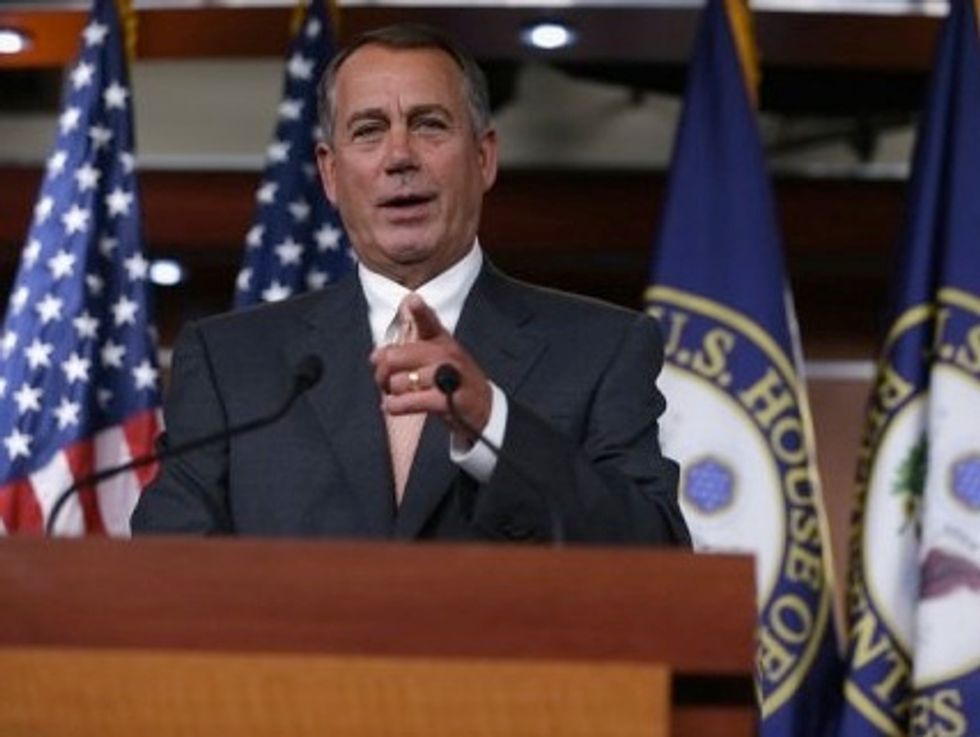
AFP Photo/Alex Wong