Tag: social security
Stupid Rich: Elon Musk Spews Idiocy On Universal Income And Social Security

Stupid Rich: Elon Musk Spews Idiocy On Universal Income And Social Security

I have no idea how smart or stupid Elon Musk actually is. Unlike Donald Trump, I don’t do IQ testing. But like everyone else in the world, I can evaluate the logic of the things he says. And there ain’t much there.

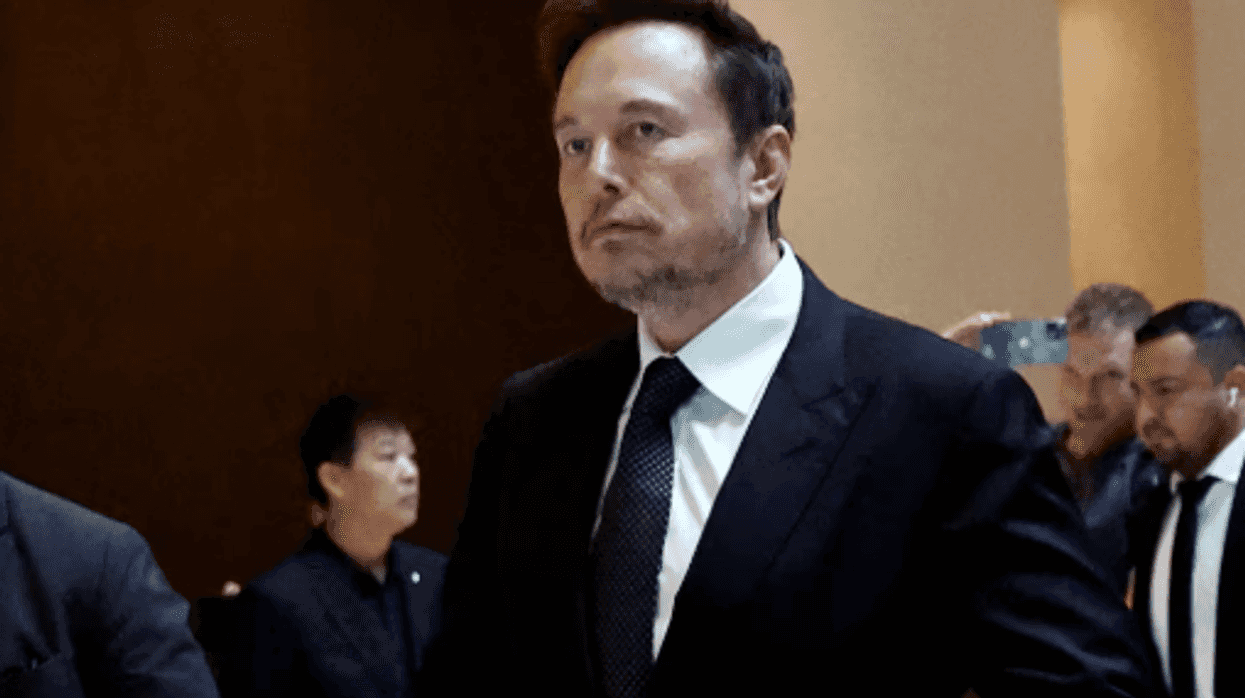
Apparently, Musk is now babbling something about how we need the government to provide a universal high income because AI will take all the jobs. The idea of universal high income is a contrast with the universal basic income plan that many have put forward, which would ostensibly provide enough money for people to afford basic necessities. Musk is saying that the income provided by a government payment should be enough to support a comfortable standard of living.

If it’s not obvious to everyone already, these views are 180 degrees at odds with each other. If we have enough money sitting around to pay people a universal high-income, then we surely have enough money to pay people the Social Security and Medicare benefits they are expecting and paid for. It’s probably also worth mentioning that if we really thought that we need to reduce the deficit, we could tax people like Musk more and/or reduce the size of the government contracts we are giving him.

Anyhow, we have Elon Musk simultaneously saying that we are richer than we can possibly imagine and that we are so poor we can’t pay the basic benefits that tens of millions depend upon to support them in retirement or due to disability. This isn’t the first time Musk has spewed utter nonsense.

Last year, when he was playing DOGE master, he insisted that 20 million dead people were getting Social Security benefits. While one dead person was uncovered, the other 19,999,999 are still free. The claim is utterly absurd on its face.

There surely are a small number of cases where a few checks get sent out after someone dies. These would barely make a dent in the cost of the program. Furthermore, much of the money is later recovered.

Musk also has repeated lunatic claims about millions of non-citizens voting. This claim, which Donald Trump also likes to make, defies common sense at both ends. The overwhelming majority of non-citizens in the country want, first and foremost, to be able to stay here to work and ultimately to gain legal citizenship.

How many of these people would risk everything to cast a vote in an election? In every election, there are tens of millions of citizens who have every right to vote, who decide it’s not worth their time. Elon believes that there are millions of non-citizens who would risk everything to cast an illegal vote?

On the other side, we have had Republicans yelling about non-citizens voting for more than a quarter-century. In all that time, maybe they have found a few dozen non-citizen voters. (There is a larger number, although still very small, who seem to have mistakenly registered. The overwhelming majority of these people never cast a vote.) We know that Trump and his crew are not very sharp, but if there were really millions of non-citizens voting in every election, even they would be competent enough to find ten or twenty thousand.

But getting back to the basic economics, what does Musk think he’s saying when he says the government will go bankrupt? The government prints the currency it spends. There is a story where we could be spending and printing so much money that we get runaway inflation, but we are obviously very far from that now, even with the burst of inflation from Trump’s tariffs and war. And even runaway inflation is not bankruptcy. Does our DOGE master really know that little about government finance?

Musk obviously runs off his mouth to advance whatever goal suits him at the time. Whatever he may think about the world, his comments often make no sense and are frequently contradictory. They do not deserve to be taken seriously.

The famous line, “if you’re so rich, how come you’re not smart,” could have been written for Elon Musk.

Dean Baker is a senior economist at the Center for Economic and Policy Research and the author of the 2016 book Rigged: How Globalization and the Rules of the Modern Economy Were Structured to Make the Rich Richer. Please consider subscribing to his Substack.
Trump Accounts Are A Sick Joke, Not A Replacement For Social Security

Trump Accounts Are A Sick Joke, Not A Replacement For Social Security

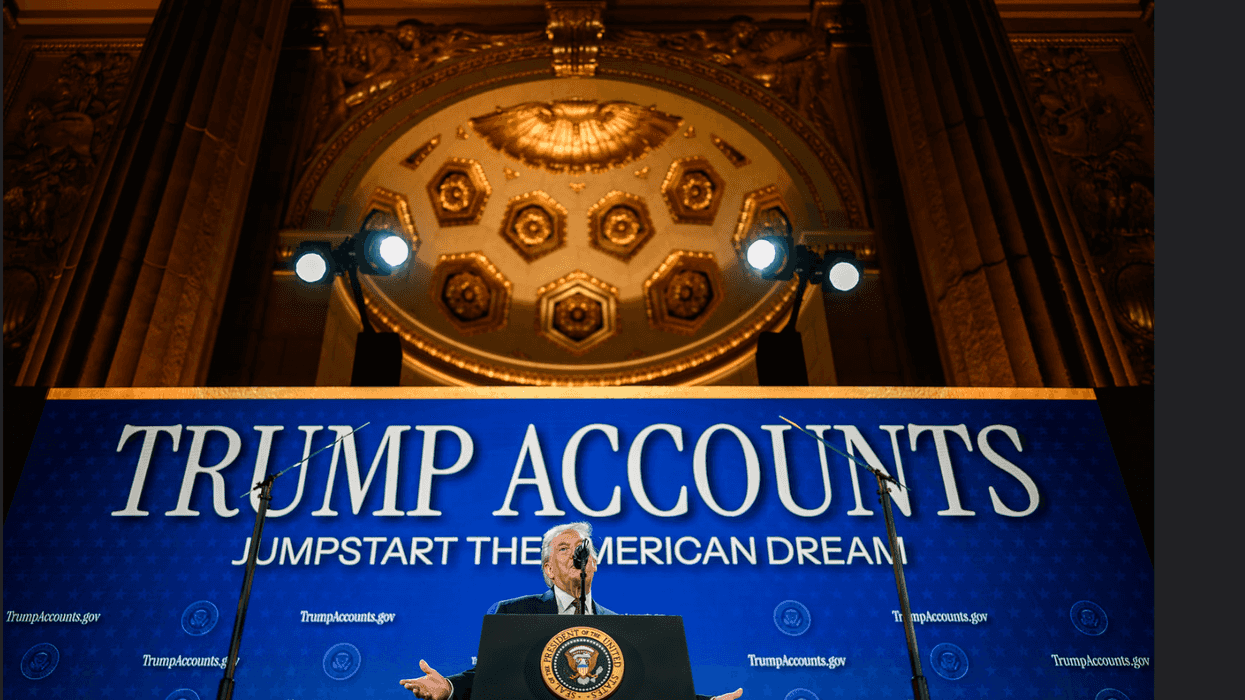
Many of the Trump crew seem to be delusional about Trump accounts. They claim to believe that they will replace Social Security. It shouldn’t be a surprise to us that many supporters of Trump are out of touch with reality, but that is not a reason for the rest of us to take their nonsense seriously.

Let’s keep our eyes on the ball. This is not three-dimensional chess; it is an account for newborn kids in which the government deposits $1,000. Parents or other relatives can add to it each year, like they can add to an education savings accounts in most states. The amount people contribute to the account is deducted from their taxable income. Also, the money accumulated in the account is not taxed until it is withdrawn.

Some people take advantage of these accounts; most don’t. The reason is that most people don’t have an extra $1,000 or $5,000 or whatever to contribute to a Trumo account. Furthermore, the tax benefit is not a very big deal to most moderate and even middle-income people.

The overwhelming majority of households are in the 12 percent bracket or below. More than a fifth are in the zero bracket, meaning they pay no income tax and would get no benefit from tax-advantaged accounts.

Furthermore, even if they wanted to put money in a tax-advantaged account, why would they choose a Trump account rather than an education savings account or an IRA? Money in existing tax-advantaged accounts can be withdrawn, albeit with a penalty. Money in a Trump account can only be accessed by the kid when they turn 18.

This brings us to the sick joke part of the Trump account story. Trump and Congressional Republicans have been gleefully cutting Food Stamps, housing assistance, Medicaid, and the subsidies in the Obamacare exchanges. As a result, tens of millions of people will be denied benefits that they previously depended upon.

Many of these people will end up hungry, homeless, and/or unable to obtain needed medical care. This means two or three years from now, there are likely to be tens, or even hundreds, of thousands of kids with $1,000 in their Trump accounts who are living on the streets, going hungry, or unable to get necessary medical care because Trump has cut the programs their families depend upon.

This will make for great photo ops. Maybe Trump can have some homeless kids over to the White House, or even Mar-a-Lago, and they can talk about living in the streets of Chicago in winter, or the needed surgery that they can’t afford, but they still have $1,000 in their Trump account. Then Trump and his entourage can all say how great that is!

The other part of the story is the nutty illusion about how rapidly these accounts will grow. The Trump gang likes to say they will grow 10% a year. Amazingly, many who are not on Team Trump are prepared to accept this nonsense.

The 10% rate of return is based on looking at the past, where stocks have yielded somewhere close to a 10% rate of return over the last eight decades. But this is a case of incredibly bad induction, sort of like the person who falls off an 80- story building and says as they pass the 60th floor, the 59th floor, and the 58th floor, “so far so good.”

The simple and obvious point that people who make this inference miss is that the stock market was valued far lower relative to corporate earnings in prior decades than is the case today. Through most of the decades of the 40s, 50s, 60s, and 70s, the price-to-earnings ratio (PE) was generally in the low teens and often considerably lower. When the PE is low, and the economy is growing relatively rapidly, it’s possible for the stock market to generate 10 percent nominal returns, or seven percent real (inflation-adjusted). That’s somewhat oversimplifying the inflation story, but it doesn’t affect the argument.

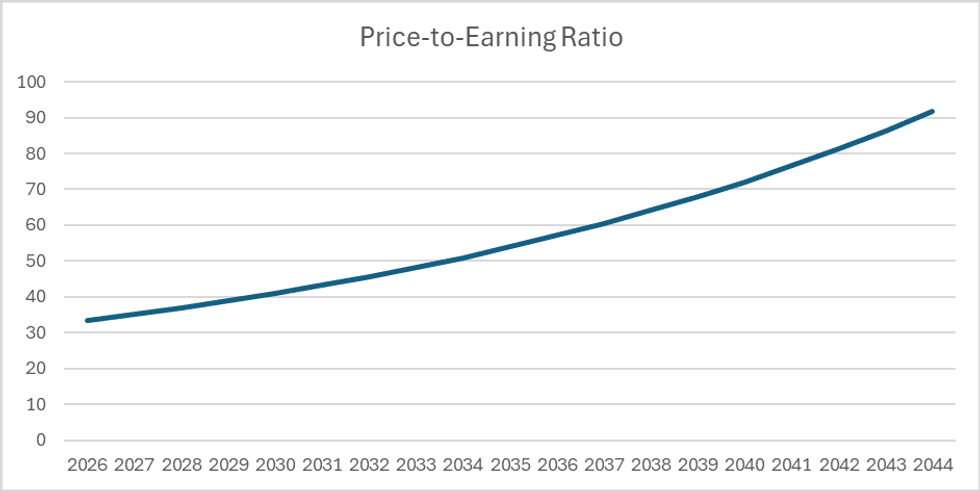
Today, the PE is over 30, and the economy is projected to grow roughly 2.0 percent a year going forward. In that world, the only way to generate the historic seven percent real rate of return is with an ever-rising price-to-earnings ratio.[1]

The Trumper’s story gives us a PE of almost 92 when today’s newborns turn 18 in 2044.[2] If we want to ask what happens if they hold their money until they hit the Social Security normal retirement age of 67, the PE will be over 2000. A Trump administration economist may be able to make this sort of projection with a straight face, but not many other people could.

Is there a way around this story? Well, the after-tax profit share of GDP could rise further, as it has been doing for the last quarter century. This would be a bleak story for the rest of us, since it would likely mean wages are shrinking. It would also have to almost triple in the next 18 years to keep the PE constant. This is close to unimaginable and a truly horrible story, even if it were. For what it’s worth, the Congressional Budget Office projects the profit share will fall in the next decade.

People could invest their Trump accounts overseas. China is having far more rapid growth than the United States, so perhaps people can get closer to 7.0 percent real returns there. Maybe this is what the Trump gang has in mind.

If we look at the actual returns that people can expect in their Trump account, it will be close to 3.0 percent a year in real terms, assuming that they are not ripped off badly on fees by one of Trump’s Wall Street friends. That will give today’s newborn $1,700, adjusted for inflation, when they turn 18.

Somehow, I don’t think this will lead people to discard Social Security. But I could be mistaken.

[1] I wrote about this issue in a paper with Brad DeLong and Paul Krugman 20 years ago in the context of the Bush Social Security privatization drive.

[2] The data for after-tax corporate profits Bureau of Economic Analysis, National Income and Product Accounts, Table 1.12, Line 15. The data for the valuation of the stock market comes from the Federal Reserve Board’s Financial Accounts of the United States Financial Accounts, Table L.2, Line 38, plus Table l.108, Line 20. The 2.0% GDP growth projection is from the Congressional Budget Office’s Long-term Budget Projections. The projection assumes that companies pay out 60 percent of their profits as either dividends or share buybacks, and the rest of the seven percent real return is made up through capital gains.


Dean Baker is a senior economist at the Center for Economic and Policy Research and the author of the 2016 book Rigged: How Globalization and the Rules of the Modern Economy Were Structured to Make the Rich Richer. Please consider subscribing to his Substack.

Censored Social Security Probe Showed How DOGE Damaged Agency Services

Censored Social Security Probe Showed How DOGE Damaged Agency Services

A Social Security advocacy organization on Thursday blasted the Trump administration for covering up damaging information contained in an inspector general report released in December.

According to The Washington Post, a report from the Social Security Administration’s (SSA) inspector general about call wait times for beneficiaries was altered to make it seem as though wait times to speak to representatives had been reduced to under 10 minutes per call.

"An unpublished draft of the report... showed that the inspector general had planned to report another metric—called the ‘total wait time’—to measure the overall time it takes for callers to be connected with an SSA employee,” the Post explained. “According to that draft report, in 2025 total wait time averaged 46 minutes to over two hours.”

The Post added that this “information was deleted from the draft after the agency reviewed it before publication.”

Nancy Altman, president of Social Security Works, responded to the report by saying that “now we know why [President Donald] Trump fired the inspector general at Social Security,” noting that the SSA IG was one of several fired across multiple agencies at the start of Trump’s second term.

Altman then argued that the attack on inspectors general was part of a broader effort by the Trump administration to dismantle government transparency all together.

“Inspectors general are the American peoples’ eyes and ears in these agencies,” said Altman. “The Trump administration is undermining that oversight at every turn. Under this administration, the IG has no ability to conduct independent oversight. There is no meaningful check on the Trump administration’s Social Security sabotage.”

Democratic communications consultant Jesse Lee linked the damage to the SSA documented in the draft IG report to efforts by Elon Musk’s Department of Government Efficiency (DOGE), which went on a firing spree of federal workers last year.

“So DOGE did a smash and grab at the Social Security Administration, breaking into the most sensitive data, firing phone and in-person case workers,” Lee wrote. “Trump appointee waved around an IG report claiming wait times were fine—after burying the real report saying they were up to two hours.”

Reprinted with permission from Alternet


To Enrich His Cronies, Trump Will Make Homes Even More Expensive

To Enrich His Cronies, Trump Will Make Homes Even More Expensive

In Washington no bad idea stays dead for long. Therefore it should not be surprising that Donald Trump is planning to move forward with plans to privatize Fannie Mae and Freddie Mac, the mortgage giants that have been in government conservatorship for almost two decades.

As with many of Trump’s moves, it is not clear what problem this is meant to solve. During the time they have been in conservatorship, Fannie and Freddie have been securitizing mortgages at a low cost and have not experienced any substantial management problems.

There is of course one problem that privatizing Fannie and Freddie would solve. It would be yet one more way that the financial industry could run up profits and salaries for top executives at the expense of the rest of us.

The Congressional Budget Office calculated that having private institutions replace Fannie and Freddie in their current form would add roughly 20 basis points, or 0.2 percent, to the cost of securitizing mortgages. With around $1 trillion in mortgages securitized each year, that would come to $2 billion annually. That is not a lot in the context of the federal budget (only 0.03 percent), but it is four times the annual appropriation for the Corporation for Public Broadcasting that got Trump so upset.

And in the case of privatizing Fannie and Freddie, we would get nothing for it except a less efficient mechanism to securitize mortgages. The idea is similar to the plan to privatize Social Security. Social Security is an extremely efficient public system, but many people in the Trump administration see the opportunity to generate trillions of dollars in fees for the private sector by turning it into a private system.

As with a privatized Social Security system, privatizing Fannie and Freddie would expose the country to needless risk. The basic problem is that it would allow a private corporation to operate with a government guarantee against losses. Such a guarantee would give a private securitizer an enormous incentive to securitize bad mortgages to increase volume and make more profits. That is what happened with the housing bubble and the subsequent collapse and financial crisis in 2008 and 2009.

If a private securitizer is carefully regulated, it can limit the risk of reckless lending. But does anyone really believe that the Trump administration would carefully regulate the financial industry?

The basic story line here is that in order to give his campaign donors in the financial industry even more money, Trump is planning to privatize a perfectly well-functioning public system for securitizing mortgages. Doing so would almost certainly increase the cost of mortgages for homebuyers; the only question is by how much. And it raises the risk for future financial crises and government bailouts.

Making the financial sector less efficient to hand more money to contributors is very much front and center in the Trump administration. It’s the same rationale behind Trump’s decision to promote cryptocurrency—which is making Trump and his friends tens of billions of dollars—as opposed to letting the Federal Reserve Board issue a digital currency, which would save Americans tens of billions of dollars in bank and credit card fees.

Eviscerating the Consumer Financial Protection Bureau followed the same pattern. Trump is giving a green light to his finance buddies to find ever more creative ways to rip off businesses and the general public.

It’s in that context that we all should understand Trump’s drive to privatize Fannie and Freddie. How could anyone oppose it?

Dean Baker is a senior economist at the Center for Economic and Policy Research and the author of the 2016 book “Rigged: How Globalization and the Rules of the Modern Economy Were Structured to Make the Rich Richer.” A version of this column originally appeared on his Substack site.

Money Trail is a fiscally sponsored project of the Alternative Newsweekly Foundation, a 501(c)(3) public charity, EIN 30-0100369. Donations are tax-deductible to the extent allowed by law.

Reprinted with permission from The Money Trail.

Shop our Store

Headlines

Editor's Blog

Corona Virus

Trending

World