Tag: wind power
Behind Trump's Attacks On Clean Energy Lie Corruption -- And Masculine Insecurity

Behind Trump's Attacks On Clean Energy Lie Corruption -- And Masculine Insecurity

We are now in a global fossil fuel crisis. With oil and liquefied natural gas from the Persian Gulf unable to reach international markets due to Iran’s blockade of the Strait of Hormuz, hydrocarbon prices have been soaring around the world and widespread shortages are emerging. Anyone who thought that the U.S. would be insulated from this dire picture thanks to its large domestic oil production has had a rude awakening: the average retail price of gasoline has risen more than $1 per gallon over the past month, while the price of diesel is up $1.60.

But the Trump administration hasn’t allowed these short-run distractions to divert it from its long-run goals: It remains deeply committed to killing renewable energy, especially wind power, and increasing America’s reliance on fossil fuels.

True, some of the administration’s attacks on wind power have failed: Its efforts to throttle offshore wind development by ordering developers to stop work on projects that are already underway have repeatedly been overruled by the courts. But the administration is continuing to block development of onshore wind and solar power by freezing the issuance of federal permits.

And on Monday the Interior Department unveiled a new tactic in its war on wind: It announced that it will pay TotalEnergies, a French energy giant, almost $1 billion to not produce energy — specifically to abandon its plans to build two large wind farms off the East Coast.

To understand the Trump administration’s motives in its campaign to kill renewable energy, one must realize that this campaign is both economically self-destructive and, despite the best efforts of the fossil fuel industry, deeply unpopular.

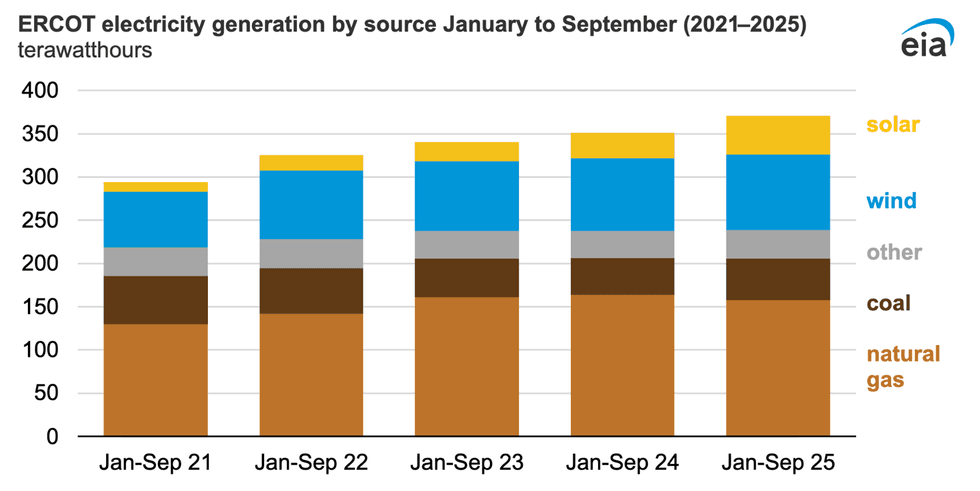
Fifteen years ago wind and solar power were still relatively marginal energy sources, which those hostile to their development could portray as unproven and uneconomic. Today they are major contributors to energy supply in many nations — and in some U.S. states. Perhaps most notably, as the chart at the top of this post shows, renewables — mostly wind, but with a growing role for solar — now account for more than a third of electricity generation in Texas, America’s largest producer of electricity and not exactly a state run by environmental extremists.

Even more impressively, renewables have dominated the growth in Texas’s electricity generation in recent years:
You almost have to admire the administration’s persistence, its determination to turn back the clock on energy even though renewables are big business, its tenacity in trying to block new, secure energy sources even in the face of a global energy crisis. But what’s this all about?

The administration has argued that offshore wind farms are a threat to national security, supposedly interfering with radar. But that doesn’t explain the efforts to block onshore wind and solar, and the courts have remained unconvinced. In announcing the buyoff of TotalEnergies, the Interior Secretary claimed that wind power is expensive and unreliable; but in that case why is it necessary to pay private companies not to develop it?

Campaign finance is part of the story. At this point, political contributions from fossil fuel companies go almost entirely to the GOP, while alternative energy favors Democrats.

Beyond campaign finance, fossil fuel interests, especially but not only the Koch brothers, have spent many decades promoting hostility to renewable energy and any effort to mitigate climate change. They have done so by every means possible, including faux environmentalism. When Donald Trump makes bizarre claims about how wind power is massacring birds and “driving whales crazy,” he’s getting his fantasies, whether he knows it or not, from the fossil-fuel propaganda machine.

Now, this long-term project has had limited success at moving the broader public, which remains favorably disposed toward renewable energy. In fact, as late as 2020 large majorities of rank-and-file Republicans held favorable views of both solar and wind power. Those views have shifted against renewables in Trump’s second term, but even now they aren’t nearly as extreme as the views of the Trump administration. And according to Pew, a substantial majority of Americans still believes that promoting wind and solar is “a more important priority” than promoting fossil fuel production.

But the right-wing elite is completely anti-renewable.

In large part this reflects long-term indoctrination by fossil-fuel backed think tanks and media. In addition, however, to make sense of the right-wing elite’s intense hostility to renewable energy one needs to think about psychology (psychology that the fossil fuel cabal exploits.)

Bear in mind that on the political right wind and solar power are routinely condemned as “woke.” Real men burn stuff.

What this reflects, I believe, is a common factor underlying many right-wing obsessions. Why cling to fossil fuels in the face of a technological revolution in energy? Why valorize “warrior ethos” and bulging biceps in an age of drone warfare? Why build economic policy around a doomed attempt to bring back “manly” jobs? At a deep level, I’d argue, it’s about nostalgia for an imagined past in which brawn mattered more than brains, combined with, yes, a hefty dose of insecure masculinity.

The world keeps declining to cooperate with these macho dreams. Tariffs aren’t bringing back blue-collar jobs. Setting out to “destroy the enemy as viciously as possible” — as Pete Hegseth said Tuesday — isn’t winning an easy victory over Iran. And turning our back on the energy revolution, even paying the private sector to reject new technology, means both making America less secure and ceding the future to other countries that aren’t ruled by MAGA’s obsessions.

But that appears to be a price both fossil fuel interests and the Trump administration are willing to pay.

Paul Krugman is a Nobel Prize-winning economist and former professor at MIT and Princeton who now teaches at the City University of New York's Graduate Center. From 2000 to 2024, he wrote a column for The New York Times. Please consider subscribing to his Substack.

Reprinted with permission from Paul Krugman.
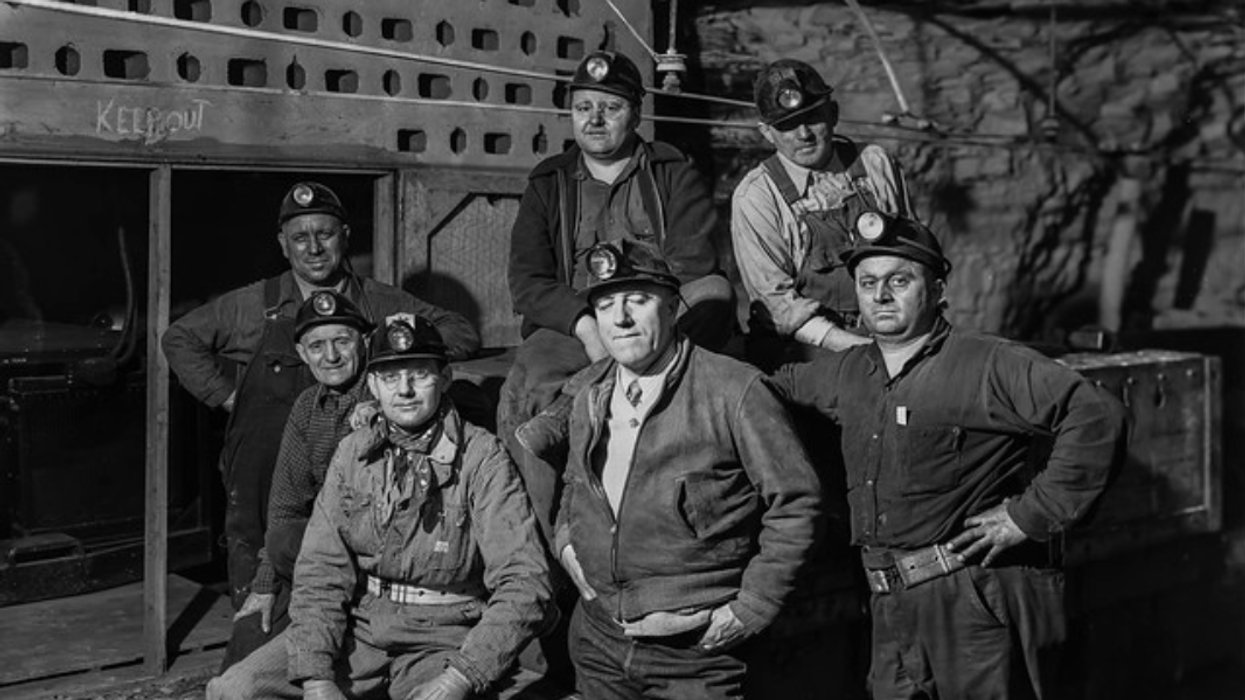
What's Behind Trump's Doomed Effort To Revive The Coal Industry?

What's Behind Trump's Doomed Effort To Revive The Coal Industry?

I’ve just gotten back from the Netherlands, which is famous for its picturesque windmills. But wind power in Holland is more than a historical curiosity. There are also modern wind turbines almost everywhere you look, both onshore and off. And the ground is covered with dead birds and whales.

OK, not really. Wind power is, in fact, far cleaner and safer than burning fossil fuels. And I personally like the sight of wind turbines. After all, I value the comforts of modern civilization and find it reassuring to see the power needed to provide those comforts generated without harmful emissions.

But Donald Trump, as everyone knows, hates wind power and loves coal. Both passions are deeply irrational. Yet they are shaping policy.

Trump is doing his best to kill wind power, going so far as to order work halted on a mostly completed wind farm off the coast of Rhode Island. (Orsted, the Danish company behind the project, has sued and gotten the stop-work order lifted.)

And the administration is trying to revive coal, opening federal land for mining, removing pollution limits and providing hundreds of millions of dollars in subsidies. But why?Administration officials would have you believe that coal mining is an economically viable industry that has been sabotaged by liberals. On Monday Chris Wright, the energy secretary, declared — in a weirdly dated culture war cliché — that coal is “out of fashion with the chardonnay set in San Francisco, Boulder, Colorado, and New York City.”

The truth, however, is that coal is a dying industry for very good reasons, and anti-wokeism is unlikely to revive it.

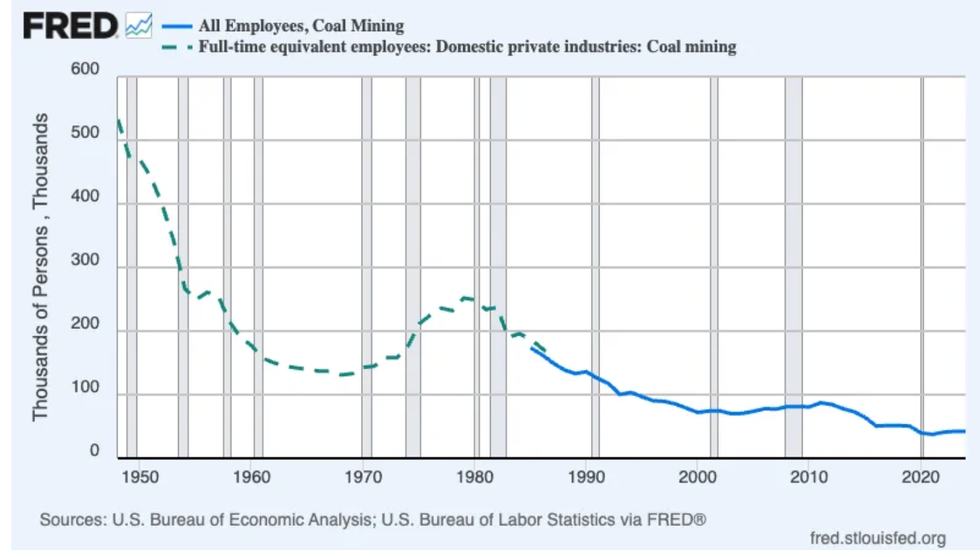
Coal stopped being a significant source of jobs decades ago:

At this point there are only around 40,000 coal miners left. In case you’re wondering, vineyards and wineries employ around 130,000 people, three times as many as the coal industry.

Where did all the coal jobs go? The answers may surprise you.

As you can see in the chart above, there was an epic decline in coal employment between 1950 and the 2000s, from half a million miners to around 80,000. But this employment decline didn’t reflect an economy turning away from coal. In fact, use of coal to generate electricity rose steadily over the whole period, peaking in 2008:

So what happened to all the coal jobs? Basically, workers were displaced first by giant power shovels (strip mining), then by explosives used to blow the tops off mountains, exposing the coal beneath. By using these techniques, in 2008 coal companies were able to produce twice as much coal as they did in 1950, while employing 80 percent fewer workers.

Coal consumption finally did start declining after 2008. But if you look at the chart above, you can see that until recently coal was mainly replaced, not by renewable energy, but by natural gas — which became cheap and abundant thanks to the rise of fracking.

Solar and wind power have finally become important sources of energy in recent years. But the reason they have grown rapidly while coal has declined isn’t that the chardonnay set considers coal unfashionable. It’s the simple fact that coal is no longer cost-competitive, while wind and solar are.

Needless to say, Trump and company aren’t going to acknowledge these facts. They may not even be aware of them. In his speech at the U.N. General Assembly, Trump declared that the Chinese sell a lot of wind turbines to the rest of the world, “but they barely use them.” Ahem:

For the rest of us, however, the important thing to understand is that none of the ostensible justifications for promoting coal make sense. It’s not about saving jobs: Coal mining as a way of life vanished decades ago, not because chardonnay-sipping liberals sneered at it, but because corporations replaced miners with machines and explosives. It’s not about reducing energy prices: Trying to keep coal alive will make energy more expensive, not less.

What it’s really about is culture war. Trying to bring back coal is all about owning the libs. And if it damages the environment, well, from MAGA’s point of view that’s a plus.

Reprinted with permission from Substack.

Real Men Burn Stuff! Trump's Stupid War On Renewable Energy

Real Men Burn Stuff! Trump's Stupid War On Renewable Energy

“We wanted flying cars, instead we got 140 characters.” That famous 2011 quip from the venture capitalist Peter Thiel still resonates, even though Thiel himself has become a deeply malignant force in American politics. I’ll write soon about the madness of the Trumpist tech bros, but for today let me focus on Thiel’s original insight — that everyone, venture capitalists included, had come to focus far too much on digital technology, neglecting the possibilities of breakthroughs in technologies that deal with the physical world.

Yet here’s the irony: In the years since Thiel’s lament we have, in fact, seen revolutionary progress in one fundamental physical-world technology, energy production. Yet the people Thiel and his buddies helped put in power are doing all they can to reverse that progress and send America back into the energy Dark Ages.

Most critiques of the One Big Beautiful Bill have focused on the way it explodes the budget deficit while imposing immense hardship on lower-income Americans. Yet energy policy is also an important component of the OBBB, which basically tries to roll back the rise of solar and wind power — sources that have accounted for more than half the worldwide increase in electricity generation since 2015.

To understand how self-destructive that effort is, you need to know three things about the economics of renewable energy.

First, there are powerful environmental reasons to favor renewables over fossil fuels where possible. Reducing greenhouse gas emissions is the most important, because climate change is an existential threat. But even aside from climate concerns, the air pollution created by burning fossil fuels takes a major toll on health and productivity, which solar and wind don’t.

Second, a transition to renewables, which might have seemed like pie-in-the-sky, hippy-dippy stuff a generation ago, is now not just feasible but the only sensible energy strategy. Here’s a chart showing estimates of the levelized cost of electricity generation (LCOE), adjusted for inflation, for a variety of renewable energy technologies, compared with the costs of power from fossil fuels. I’m aware that LCOE is an imperfect measure, but the results are still astonishing:

We’re talking in particular about a 90 percent decline in the real cost of power from solar panels and a 70 percent decline in the cost of wind power. This isn’t just progress, it’s a revolution.

And — my third point — the revolution isn’t over. Some technological leaps involve one big idea, which takes time to implement but is basically a once-and-done deal — which seems to be the case, to take an example I’ve studied, for freight containerization. Progress in renewable energy, however, has involved a continual process of “learning by doing,” in which efficiency keeps rising and costs falling as the industry expands. This is exactly the kind of situation in which government subsidies — like the clean-energy tax credits instituted by the Biden administration — can accelerate progress and boost overall economic growth.

But the OBBB killed those tax credits. And the Trump administration has been taking executive action to stall renewable development, for example, by halting federal approvals for wind farms. In general, MAGA clearly wants to move us back to burning gas, oil and above all coal. Why?

Campaign contributions no doubt play a role. Fossil fuel industries donate almost exclusively to Republicans. But renewables are also big business these days, and especially in red states. Texas, in particular, is by far the nation’s largest producer of wind power and gets a larger share of its electricity from renewables than any other state. Why would the G.O.P. want to demolish a key pillar of economic success in its biggest source of electoral votes?

Honestly, I think this is a case where the usual logic of money-driven policy is trumped (Trumped?) by irrational, psychological — you might even say psychosexual — issues.

We know that Trump himself has a weird thing against wind power, insisting that wind turbines massacre birds and kill whales. This appears to stem from the refusal of the Scottish government to cancel an offshore wind farm he thought ruined the view from one of his golf courses.

But it’s not just Trump. There is, it turns out, a strong link between the manosphere — the online movement promoting “masculinity,” misogyny and opposition to feminism — and anti-environmentalism. For example, in 2023 Jordan Peterson convened a high-profile conference to declare that concerns about climate change are a “conspiracy run by narcissistic poseurs.”

If you think about it, this makes sense — not intellectually but emotionally. Don’t concern about the environment and advocacy of “clean energy” sound kind of, well, feminine? Real men burn stuff and don’t worry if the process is dirty.

And manosphere-type attitudes are clearly widespread in MAGA. One of the main arguments Trump officials and supporters have made for tariffs is that they will bring back “manly” jobs in manufacturing. (They won’t, but that’s another story.) The same notion underlies the doomed attempt to revive the coal industry.

But here’s the thing: MAGA and the manosphere may hate clean energy, but they won’t be able to stop the rise of renewables. All they can do, possibly, is stop the rise of renewables in the United States. Other nations, China in particular, are making huge investments in wind and solar power, because they understand what Trump and his allies refuse to acknowledge — that this is the only way forward.

So while MAGA’s attempt to strangle clean energy will increase the risks of global climate catastrophe, it will also increase the risks of U.S. economic stagnation, forcing our nation to remain wedded to obsolete energy technologies while other countries march into the future.

Paul Krugman is a Nobel Prize-winning economist and former professor at MIT and Princeton who now teaches at the City University of New York's Graduate Center. From 2000 to 2024, he wrote a column for The New York Times.

Reprinted with permission from Substack.

'More Than A Little Stupid': Republicans Try To Kill Renewable Energy

'More Than A Little Stupid': Republicans Try To Kill Renewable Energy

Wyoming is the second windiest state, after Nebraska. It's obvious why the wind power industry is investing $10 billion there. And it's hard to see why any state politician would oppose this. But some have. Wyoming is one of those fossil-fuel producing states in which so-called conservatives feel obligated — or are paid — to stop competition from clean energy. Texas is another.

Wyoming State Sen. Larry Hicks proposed a temporary ban on renewable energy projects. "It does one thing: puts a moratorium on wind and solar for the next five years," he said. "It's a simple little bill."

A "simple," five-year plan? How do you say, "Aw, shucks" in Russian?

Hicks swiftly diverted blame to California: "Our friends on the 'left coast' with their renewable portfolio demands, eliminating fossil fuels and moving in a direction that's unsustainable."

We can't untie this knot of confused ideology. But let's point out that renewable energy is the only kind of energy that is, by definition, sustainable. Wyoming may have coal, oil and gas. But it has wind forever.

This hostility toward wind power is even weirder in Texas. Texas harvests more electricity from wind than any other state, or nearly 28 percent of all wind-generated electricity in the U.S. In one recent week, nearly half of Texas's electricity came from solar and wind power.

The key for these renewables is batteries that can store power when the wind doesn't blow or the sun doesn't shine. Texas has been crowned "ground zero" for a U.S. battery boom. Last year it switched on more power stored in batteries than California did.

Texas was expected to double its storage capacity this year — that is, until Donald Trump slapped huge tariffs on China. More than two-thirds of imported batteries come from China.

In March, the Texas Senate passed a mandate that half of all new power capacity come from sources other than battery storage. In other words, at least 50 percent of all new power plant capacity had to be produced from coal, natural gas, and oil. (The natural gas industry needed propping.)

Back in Wyoming, lawmakers wedded to fossil fuels are complaining that large wind and solar projects are fundamentally changing the look of Wyoming's wide-open spaces. That's ignoring the aesthetics of Wyoming's coal pits, wide open craters that stretch for miles.

Wyoming is over 63 times the size of Rhode Island, with less than half the population of the Ocean State. There are dozens of wind turbines in Rhode Island, onshore and off. More are planned with minimal complaint. Wyoming could easily accommodate new wind projects under its big sky.

There does exist public support for clean energy in Wyoming, which is why Hicks' initiative failed. Gov. Mark Gordon tried to bridge the differences by endorsing an "all of the above energy strategy." He wants to keep Wyoming as "the energy state" but also to address climate change by developing clean renewables.

The far-right Freedom Caucus went after Gordon for acknowledging climate change. It introduced a bill designed to stop the state from pursuing any carbon reduction targets and titled it "Make Carbon Dioxide Great Again."

A pragmatic Republican, Gordon called such proposals as "a little bit stupid."

The bottom line is that Wyoming continues to develop wind energy projects. The Sierra Madre Wind Energy Project, now under construction near Rawlins, will be the nation's largest wind farm.

Much of what happens from here on in depends on Washington. The recently passed House bill strips away subsidies for renewables. How it fares in the Senate remains to be seen. Suffice it to say, slowing America's move to cleaner and also cheaper energy is more than a little bit stupid.

Froma Harrop is an award-winning journalist who covers politics, economics, and culture. She has worked on the Reuters business desk, edited economics reports for The New York Times News Service and served on the Providence Journal editorial board.

Reprinted with permission from Creators.

Shop our Store

Headlines

Editor's Blog

Corona Virus

Trending

World