Tag: party identification
Hey! 'Liberal' Is No Longer A Four-Letter Word As Democrats Surge

Hey! 'Liberal' Is No Longer A Four-Letter Word As Democrats Surge

It’s a tale as old as politics itself: The party out of power gains support as frustration with the party in power mounts. Under an administration as chaotic, incompetent, and cruel as Trump’s, those dynamics are supercharged.

A major new Gallup survey finds dramatic gains for Democrats—and for the word “liberal,” a label that’s been demonized for decades.

The topline result is familiar: Americans who identify as “independent” continue to outnumber those who call themselves Democrats or Republicans. As has long been the case, though, that distinction is mostly meaningless. The number of true independents—people who don’t lean toward either party—is small (just 10%, according to Gallup), and they tend to be the least politically engaged.

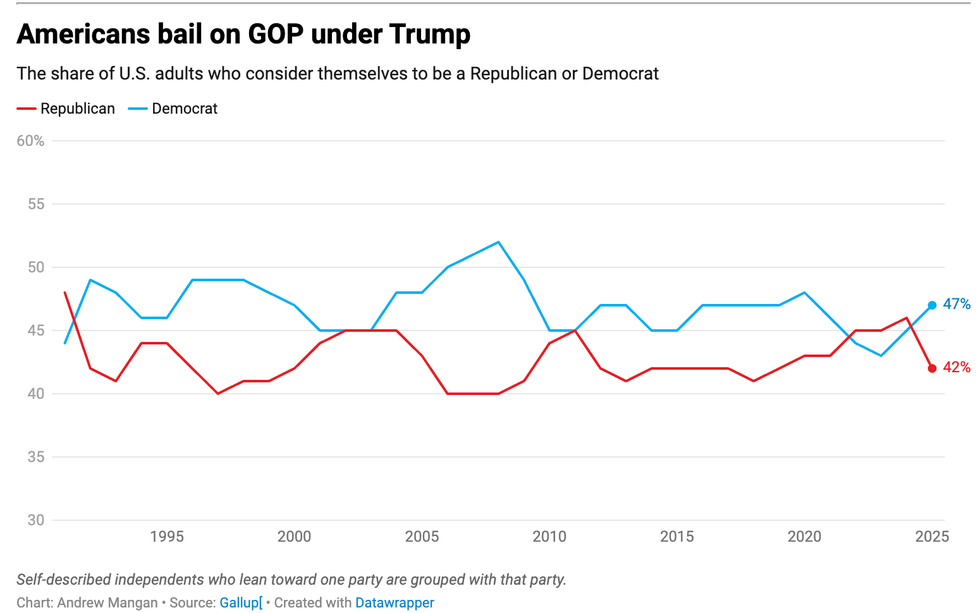
Once Gallup asks those independents which party they lean toward, the story snaps into focus. Democrats and Democratic-leaning independents now outnumber Republicans and Republican-leaners by 5 percentage points, 47% to 42%. A year ago, Republicans held a narrow edge, 46% to 45%.
..


That alone is striking, but it still understates the scale of the shift.

As Gallup notes, Republicans held a 4-point advantage in party affiliation in the fourth quarter of 2024, during the final days of the presidential campaign and much of Trump’s transition. But that lead vanished in the first quarter of 2025. By the second quarter, Democrats had pulled ahead by 3 points. That advantage grew to 7 points in the third quarter and 8 points in the fourth.
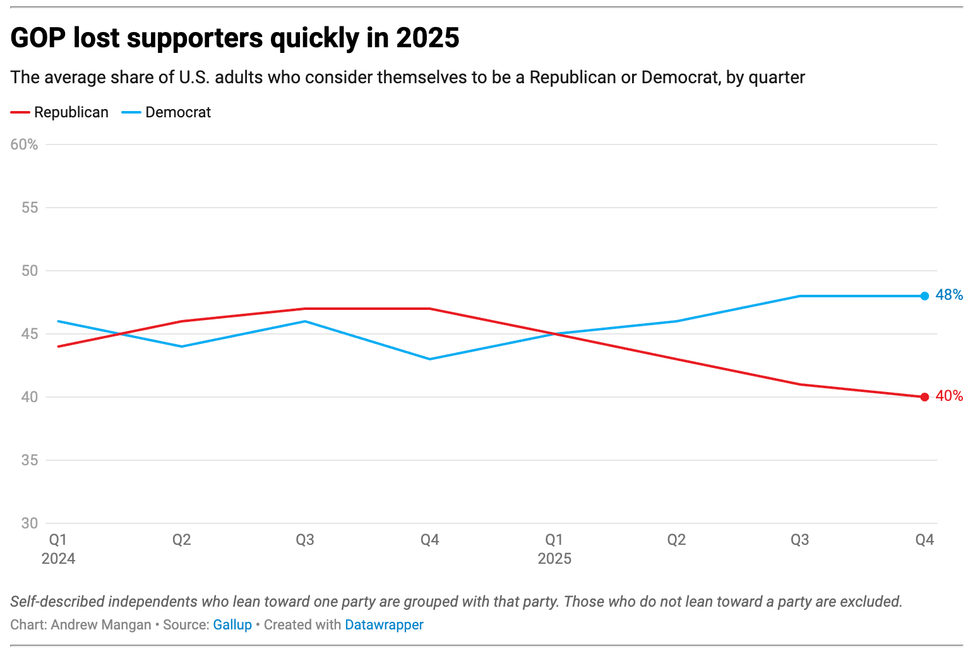

Yup, Democrats are approaching a double-digit lead in party affiliation.

At the same time, something else important is happening. Despite the rise in people calling themselves independents, fewer Americans are identifying as “moderate.” Instead, more people are comfortable calling themselves liberal.
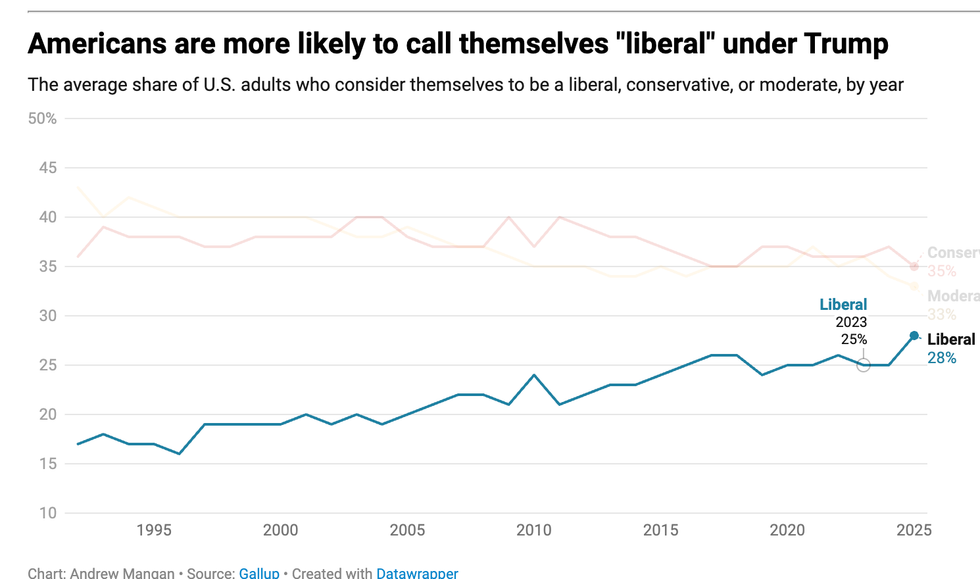
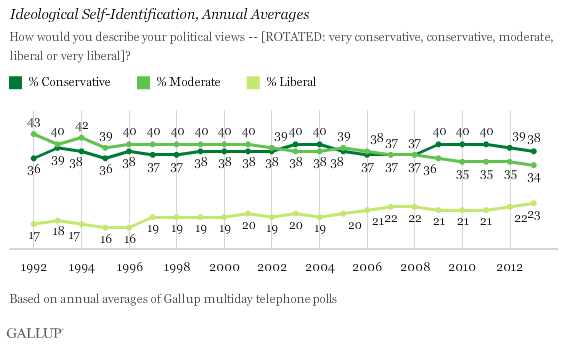
In 1996, at the low point for the label, just 16% of Americans identified as liberal. Today, that number stands at 28%. Meanwhile, the share of Americans identifying as conservative—generally stuck in the high 30s to low 40s for decades—has slipped to 35%.

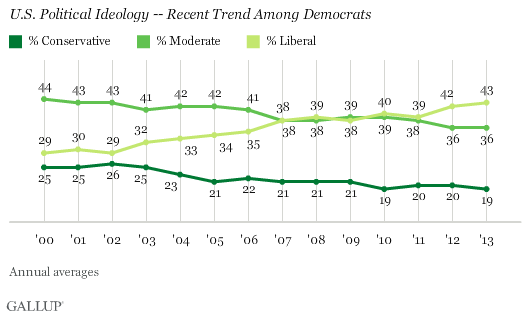
Among self-identified Democrats, the shift is even more dramatic. A record 59% now identify as liberal. Republicans, for their part, have aggressively purged moderates from their coalition, with conservatives now dominating their party by a lopsided 77% to 20%.

Gallup’s conclusion is straightforward. Negative evaluations of a president’s performance tend to push a subset of voters—especially independents with weaker partisan attachments—toward the opposition party.

“This dynamic has led to frequent changes in the party power structure in Washington in recent federal election cycles, with the incumbent president’s party losing control of the presidency or one house of Congress in each of the past six presidential or midterm elections,” Gallup says.

As CNN data analyst Harry Enten notes, the Democratic advantage is even larger than during the massive blue wave of 2018:


It’s going to be amazing when we clean house this November.

Markos Moulitsas is founder and editor of the blogging website Daily Kos and author of three books.

Reprinted with permission from Daily Kos
'It's A Tsunami!' CNN Analyst Says Democratic Lead Dooms GOP In Midterm

'It's A Tsunami!' CNN Analyst Says Democratic Lead Dooms GOP In Midterm

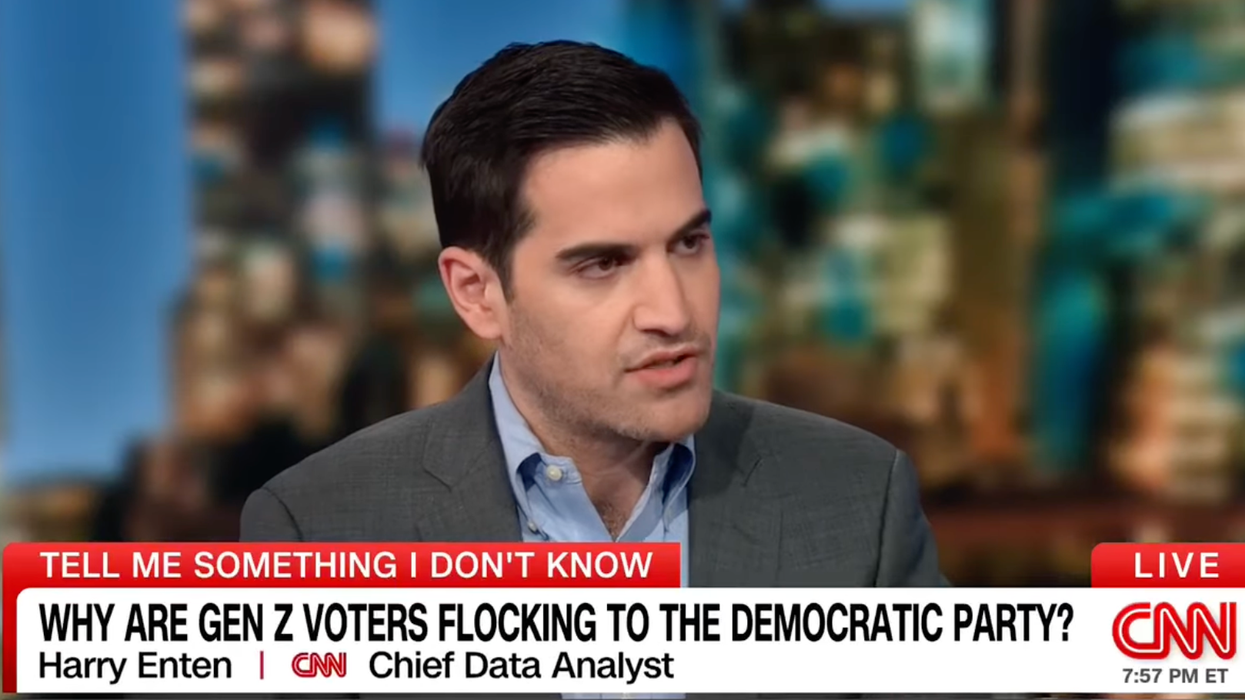
CNN data analyst Harry Enten reports Democrats are enjoying a rare double-digit lead ahead of the midterms that is all but guaranteeing them control of the House after November.

“Take a look at party identification — those who identify as Democrats or Republicans — and look at the margin that Democrats have now versus where it was a year ago,” said Enten, referring to young adults in the "Gen Z" cohort between the ages of 18 and 29. “It goes from plus six points in 2024 to plus 20 points [in 2025].”

Enten said this is the generation that’s becoming a bigger size of the electorate with each year, and they are moving not just away from the Republican party but specially away from President Donald Trump.

“This is not just about party identification,” said Enten. “I mean, look at the hard results on the ground. Look at Trump's net approval rating among Generation Z and compare it where we were at the beginning of 2025.”

In 2024, Trump had Generation Z’s approval by plus ten points, and had made gains among Generation Z going from 2020 to 2024.

“Now he is 32 points underwater,” said Enten. “That is a 42-point swing in less than a year. So, what we're seeing in party identification isn't just staying there. It's moving over and affecting how Generation Z feels about the president himself.”

“It's a stampede,” said CNN host Erin Burnett. “It's a tsunami!”

“It’s huge,” agreed Enten, “but I'll tell you something you don't know: Why is party ID so important? I mentioned that Democrats gained amongst them overall on party ID. If in fact their lead, which they currently have, holds until the midterm election — I went back and looked at every single midterm election since 1982, when Democrats hold the lead on party identification, they go on, in fact, to gain House seats.”

“They only need to gain a few house seats in order to gain control,” said Enten. “So, at this point, the Democrats lead on party identification bode very, very well for the midterm elections 100 percent of the time since 1982.”


Poll: Number Of Liberal Americans Hits All-Time High In 2013

The percentage of Americans who describe themselves as “liberal” has reached an all-time high, according a Gallup poll released Friday.

The poll finds that 23 percent of Americans self-identify as liberal, the highest such number since Gallup began measuring ideology in the current format in 1992.

That figure, while rising, still lags far behind the number of self-identified conservatives; a 38 percent plurality of Americans say they are conservative, while 34 percent self-identify as moderate.

Gallup Poll

The rise in liberal identification has been led by Democrats — 43 percent of Democrats now consider themselves liberals, up from just 29 percent at the beginning of the George W. Bush administration in 2000. The number of self-described moderate Democrats has fallen 8 percent since 2000, and the number of conservative Democrats has fallen 6 percent.

Gallup Poll Democrats

In what may be a contributing factor to the nation’s increasingly polarized politics, the number of self-described moderates has steadily fallen over the past two decades; 34 percent now use the term to describe their politics, representing an all-time low in the poll.

Thsi is the second Gallup poll this week to illustrate the nation’s changing political attitudes; a survey released Wednesday found that fewer Americans now self-identify as Republicans than at any point in the past three decades.

Shop our Store

Headlines

Editor's Blog

Corona Virus

Trending

World