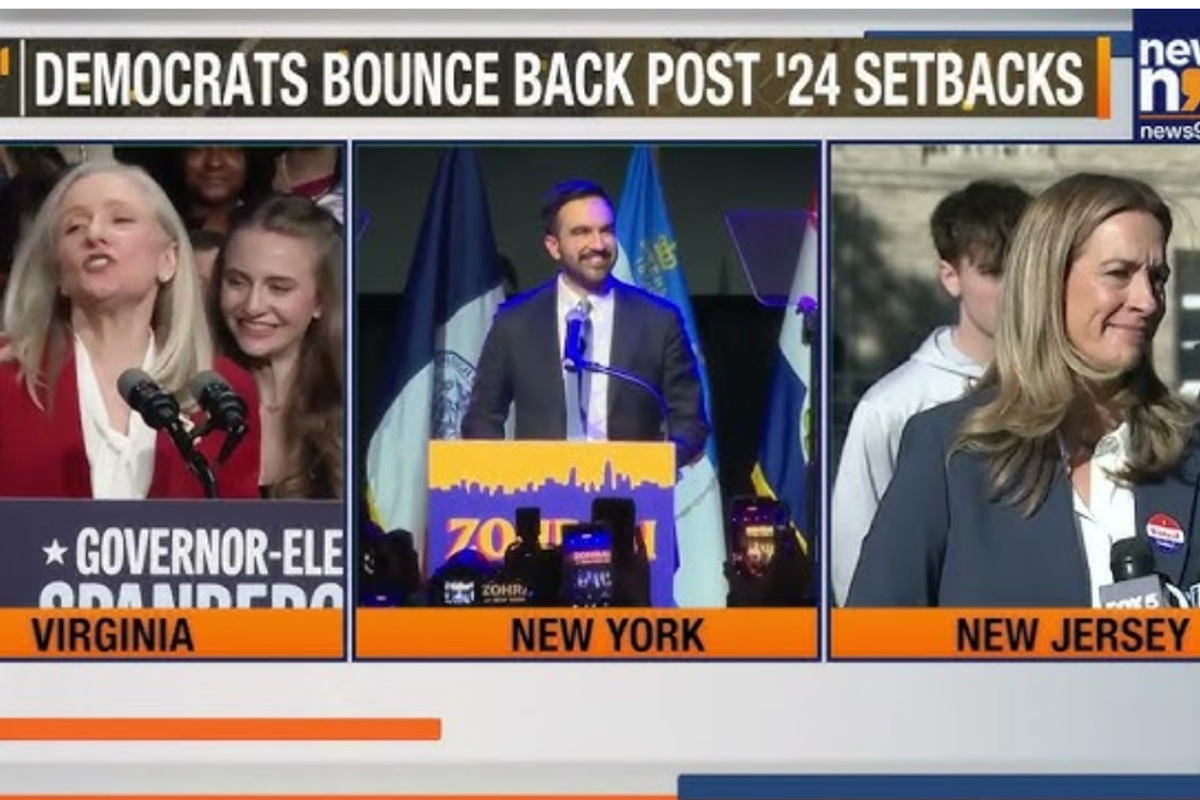
Screenshot of Election Night coverage on November 4, 2025
It’s a tale as old as politics itself: The party out of power gains support as frustration with the party in power mounts. Under an administration as chaotic, incompetent, and cruel as Trump’s, those dynamics are supercharged.
A major new Gallup survey finds dramatic gains for Democrats—and for the word “liberal,” a label that’s been demonized for decades.
The topline result is familiar: Americans who identify as “independent” continue to outnumber those who call themselves Democrats or Republicans. As has long been the case, though, that distinction is mostly meaningless. The number of true independents—people who don’t lean toward either party—is small (just 10%, according to Gallup), and they tend to be the least politically engaged.
Once Gallup asks those independents which party they lean toward, the story snaps into focus. Democrats and Democratic-leaning independents now outnumber Republicans and Republican-leaners by 5 percentage points, 47% to 42%. A year ago, Republicans held a narrow edge, 46% to 45%.

..
That alone is striking, but it still understates the scale of the shift.
As Gallup notes, Republicans held a 4-point advantage in party affiliation in the fourth quarter of 2024, during the final days of the presidential campaign and much of Trump’s transition. But that lead vanished in the first quarter of 2025. By the second quarter, Democrats had pulled ahead by 3 points. That advantage grew to 7 points in the third quarter and 8 points in the fourth.
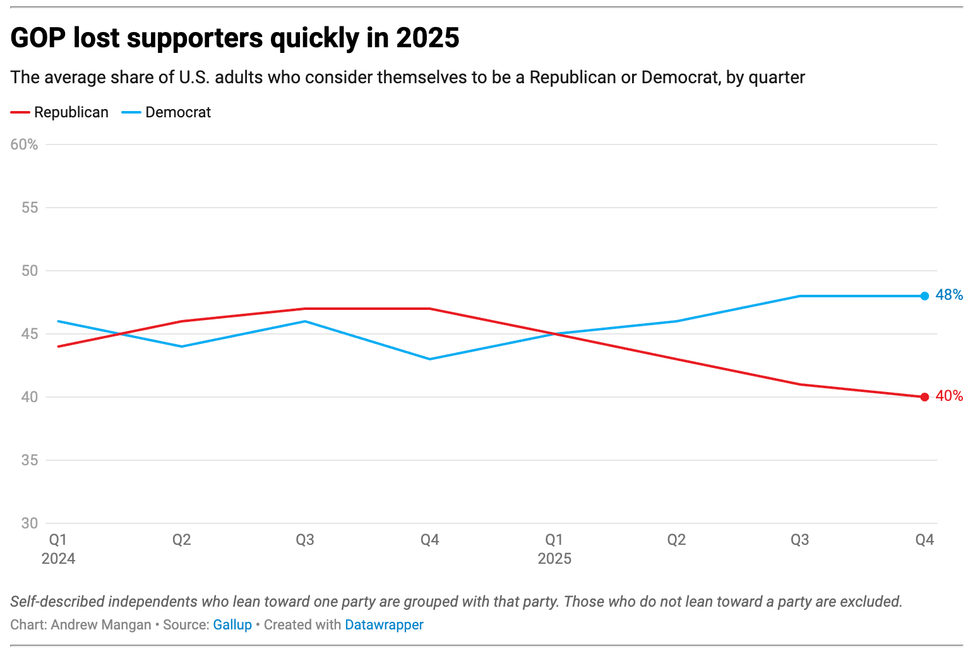
Yup, Democrats are approaching a double-digit lead in party affiliation.
At the same time, something else important is happening. Despite the rise in people calling themselves independents, fewer Americans are identifying as “moderate.” Instead, more people are comfortable calling themselves liberal.

In 1996, at the low point for the label, just 16% of Americans identified as liberal. Today, that number stands at 28%. Meanwhile, the share of Americans identifying as conservative—generally stuck in the high 30s to low 40s for decades—has slipped to 35%.
Among self-identified Democrats, the shift is even more dramatic. A record 59% now identify as liberal. Republicans, for their part, have aggressively purged moderates from their coalition, with conservatives now dominating their party by a lopsided 77% to 20%.
Gallup’s conclusion is straightforward. Negative evaluations of a president’s performance tend to push a subset of voters—especially independents with weaker partisan attachments—toward the opposition party.
“This dynamic has led to frequent changes in the party power structure in Washington in recent federal election cycles, with the incumbent president’s party losing control of the presidency or one house of Congress in each of the past six presidential or midterm elections,” Gallup says.
As CNN data analyst Harry Enten notes, the Democratic advantage is even larger than during the massive blue wave of 2018:
It’s going to be amazing when we clean house this November.
Markos Moulitsas is founder and editor of the blogging website Daily Kos and author of three books.
Reprinted with permission from Daily Kos
- Why Dr. Seuss Would Have Despised His Right-Wing 'Defenders' ›
- Rout Of 'The Maple MAGA' Shows How To Defeat Trump ›
- Poll: Number Of Liberal Americans Hits All-Time High In 2013 ›