Tag: raul castro
Right-Wing Media Joins White House Push For Regime Change In Cuba

Right-Wing Media Joins White House Push For Regime Change In Cuba

Right-wing media figures are helping administration officials lay the groundwork for regime change in Cuba in what would potentially be the latest unprovoked act of military aggression by the Trump White House.

MAGA media figures have long embraced a Trumpy version of the Monroe Doctrine, the notion that the United States has the right to exert dominance over the Western Hemisphere. As the second Trump administration has pursued more openly imperialist ambitions, many conservative pundits have cheered on the White House every step of the way, including when the administration started to threaten Cuba.

If Trump does attack Cuba, it may be an attempt to replicate what he sees as the successful operation to capture Nicolás Maduro, the former president of Venezuela — in contrast to the administration’s increasingly unpopular war on Iran.

On May 20, deputy chief of staff Stephen Miller appeared on Fox News’ Jesse Watters Primetime to discuss the Justice Department’s indictment of former Cuban President Raúl Castro.

“Today, finally, accountability is coming for Castro,” Miller said, before offering the administration’s case for escalation.

“Cuba, positioned just a 45-minute flight from American shores, has been a staging ground for America's adversaries for decades,” Miller said. “It is the last outpost of communism. It is the last outpost of the Cold War. American presidents for generations have tried to deal with the problem, the threat of this communist foothold just miles away from American shores.”

“And President Trump,” Miller argued, “has brought us closer than ever to the day when Cuba will be free and when Cuba will no longer be a threat to America but Cuba will be a friend and partner to America, which is essential for our national security.”

Watters responded: “Absolutely, and it will be a historic achievement if that does happen.”

A week earlier, Fox’s Sean Hannity interviewed Secretary of State Marco Rubio, a longtime advocate for regime change in Cuba, aboard Air Force One.

“It’s my personal opinion, you cannot change the economic trajectory of Cuba as long as the people who are in charge of it now are in charge of it. That’s what’s going to have to change,” Rubio said.

Hannity agreed and speculated about the possibilities for U.S. capital to flood the country. “If these people are not in charge, I mean, I can envision American wealth and companies — it could become the destination.”

Amid a report that the Cuban government was considering using drones to attack the U.S. base at Guantanamo Bay or Key West, Florida, MAGA streamer Benny Johnson speculated the leaked intelligence could be a “pretext” for launching a war — though he appeared to support the administration’s overall goal.

“I don't buy this,” Johnson said. “Right? Like, why would Cuba ever consider doing this unless it was a false flag — unless it's a false flag that's getting set up by the American administration, and that's what I believe that this is.”

Despite acknowledging the intelligence could be false, Johnson concluded the segment by seemingly endorsing military action.

“Expect this to pop off any day now,” he said. “Hopefully, Iran signs a peace deal, and then we can get Cuba done, as they say.”

For months, some of the loudest voices suggesting regime change in Cuba have come from right-wing Spanish-language media, a trend that has continued into May.

On May 5, Fox Noticias host Andrea Linares said that before there could be any foreign investment in Cuba, “there would have to be a total regime change.”

On May 19, Augustin Acosta, co-host of Actualidad Radio's Cada Tarde, argued that if Trump “believes he can fix Cuba while leaving the regime in power, the president is either completely wrong or has started to lose his mind.”

“In Cuba there is nothing that can be fixed — absolutely nothing that can be fixed — while leaving the dictatorship in power,” Acosta added. “That is absolutely impossible.”

Still, there are already some signs of discontent in right-wing media. Newsmax host Rob Finnerty questioned the wisdom of “another foreign entanglement” in addition to the Venezuela operation and the Iran war, which has caused gas prices to skyrocket across the country.

“According to two new polls — and say what you want about the polling, but it's not good,” Finnerty said. “People are clearly losing their patience.”

He added: “I think people struggle with how this is America First when gas is $4.55 a gallon right now.”

Reprinted with permission from Media Matters

In Cuba, Trump’s Hostility Serves Russia — Not The United States

In Cuba, Trump’s Hostility Serves Russia — Not The United States

HAVANA — The presidency of Donald Trump is teaching millions of Cubans — along with people around the world – to see the United States as a symbol of disappointment rather than hope. Within a few months, his abusive attitude toward Cuba has nearly reversed the diplomatic, cultural, and humanitarian opening initiated by his predecessor.

Trump’s angry and unthinking policy represents in microcosm his generally malignant impact on American interests abroad. And it is yet another occasion when his actions have clearly advanced the fortunes of a hostile foreign power. 

Yes, that means Russia. 

Today the U.S. Embassy on Havana’s shoreline boulevard, the Malecon, is virtually silent, its staff reduced from a barely adequate 54 to a pitiful 14 (not counting the Marine guards who provide security). Five are State Department officials and nine are support staff. Our current ambassador Philip Goldberg is a seasoned diplomat, but he arrived only a week ago to serve in acting status for an indeterminate tour. With almost no consular staff on hand, the embassy can do nothing for the Cuban people, who yearn for the thousands of visas our government agreed to provide. For despite decades of ideological hostility, the United States and American people remain extraordinarily popular here.

 Not far away from the crippled American outpost, however, stands the Russian embassy — a looming, hideous edifice that resembles an upraised middle finger in an otherwise charming neighborhood.

Never much liked by Cubans even during the Soviet period, when they provided enormous aid and trade benefits as a political ally, the Russians fell out of favor altogether when the Communist empire imploded. Yet over the past year or so, Russia has become very active again here, making lots of deals with the Cuban government. Where Venezuela was once the ally that sent discounted oil to Havana, the Russian Federation has stepped up, perhaps because its energy sector intends to exploit Cuba’s undersea petroleum deposits.

And since Trump’s election, Russian agencies and companies have negotiated technology, defense, and commercial agreements with the Cubans, including an ambitious $2 billion scheme to rebuild the island’s decrepit railroad system. In short, the Russians are emphatically back, only 90 miles from Key West, where the withering of American influence will encourage whatever mischief they mean to create not only in Cuba itself but in the United States and throughout Latin America.

The timing is perfect, too. President Raul Castro is scheduled to cede power within months to a successor from a new generation, a wrenching change for a country ruled by Castros since 1959.

Underlining this opportunity for the Kremlin, of course, was the American reaction to an apparent assault on our personnel in Havana last year, which inflicted pain, panic, and medical injuries via means that remains mysterious.  A lengthy investigation by American law enforcement and intelligence agencies has yet to determine what caused the illnesses that afflicted Americans and Canadians at several locations, including hotels and residences.  And the exhaustive, highly technical investigation has also failed to find a culprit.

Naturally Trump has blamed the Cubans, although they offered unprecedented cooperation in the probe and there is no substantive evidence of their guilt. The lack of proof hasn’t dissuaded either the president or Secretary of State Rex Tillerson from retaliating with a travel warning that discourages American tourism and the expulsion of more than a dozen Cuban diplomats.

Those actions have badly undermined the nascent détente with Havana. Which may well have been Trump’s aim from the beginning, since he aims to undo all of Obama’s achievements regardless of merit and constantly stokes the prejudices of every Republican voting bloc. Meanwhile, he is harming ordinary Cubans in every possible way.

No doubt the strange assault on U.S. personnel in Cuba is genuinely disturbing to Tillerson, who has convened an Accountability Review Board to assess the department’s response. While the former ExxonMobil executive has decimated and mismanaged the diplomatic corps in ways that must also please his old friends in Moscow, his safety concerns are understandable.

But it is important to observe  – as Sen. Patrick Leahy (D-VT) did during a visit to Cuba this week – that Canada has maintained a fully functioning embassy in Havana, although Canadian personnel were also affected by the mystery ailment. At a press conference on Wednesday, Leahy rightly urged the State Department to restore full staffing at the U.S. embassy, where plenty of our dedicated Foreign Service officers are still eager to serve.

We don’t know who is behind the troubling incidents in Havana, but the perpetrators’ agenda is all too obvious, whether they are acted on behalf of a foreign power or a renegade element in the Cuban state or both.  They aim to drive the United States and Cuba apart at a crucial moment. Our government should stop acting as their hapless pawn.

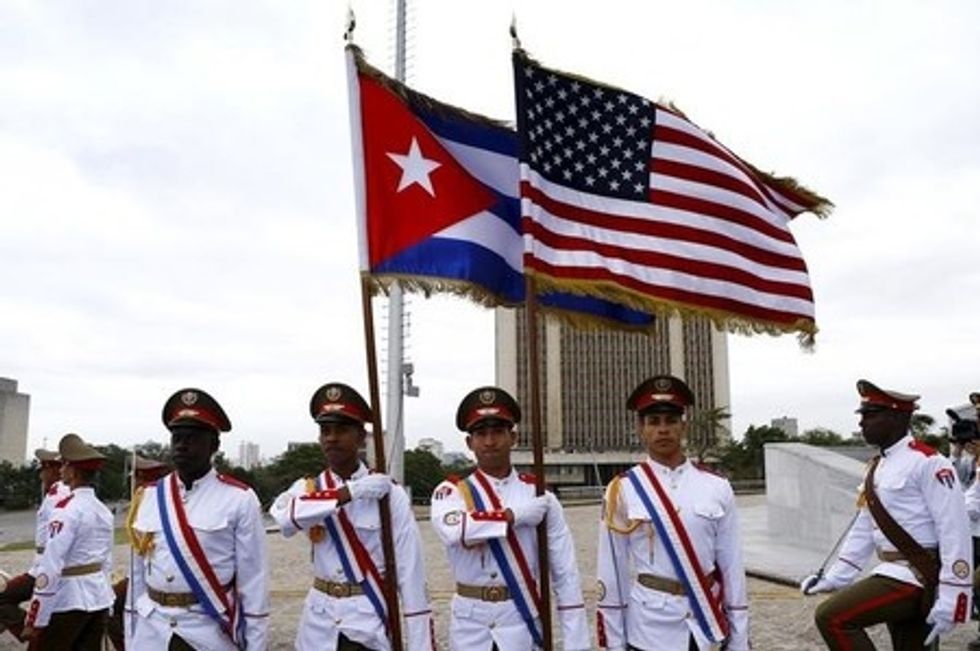
IMAGE: Honor guards carry the U.S. and Cuban flags during a wreath laying ceremony by U.S. President Barack Obama at the Jose Marti monument in Revolution Square in Havana, Cuba March 21, 2016. REUTERS/Ivan Alvarado

Former Cuban Leader Fidel Castro Dies At 90

Former Cuban Leader Fidel Castro Dies At 90

HAVANA (Reuters) – Fidel Castro, the Cuban revolutionary leader who built a communist state on the doorstep of the United States and for five decades defied U.S. efforts to topple him, died on Friday. He was 90.

A towering figure of the second half of the 20th Century, Castro stuck to his ideology beyond the collapse of Soviet communism and remained widely respected in parts of the world that had struggled against colonial rule.

He had been in poor health since an intestinal ailment nearly killed him in 2006. He formally ceded power to his younger brother Raul Castro two years later.

Wearing a green military uniform, a somber Raul Castro, 85, appeared on state television on Friday night to announce his brother’s death.

“At 10.29 at night, the chief commander of the Cuban revolution, Fidel Castro Ruz, died,” he said, without giving a cause of death.

“Ever onward, to victory,” he said, using the slogan of the Cuban revolution.

Tributes came in from allies, including Indian Prime Minister Narendra Modi and Venezuela’s socialist President Nicolas Maduro, who said “revolutionaries of the world must follow his legacy.”

Although Raul Castro always glorified his older brother, he has changed Cuba since taking over by introducing market-style economic reforms and agreeing with the United States in December 2014 to re-establish diplomatic ties and end decades of hostility.

Fidel Castro offered only lukewarm support for the deal, raising questions about whether he approved of ending hostilities with his longtime enemy. Some analysts believed his mere presence kept Raul from moving further and faster, while others saw him as either quietly supportive or increasingly irrelevant.

He did not meet Barack Obama when the latter visited Havana earlier this year, the first time a U.S. president had stepped foot on Cuban soil since 1928.

Days later, Castro wrote a scathing newspaper column condemning Obama’s “honey-coated” words and reminding Cubans of the many U.S. efforts to overthrow and weaken the Communist government.

The news of Castro’s death spread slowly among Friday night revelers on the streets of Havana. One famous club that was still open when word came in quickly closed.

Some residents reacted with sadness to the news.

“I’m very upset. Whatever you want to say, he is a public figure that the whole world respected and loved,” said Havana student Sariel Valdespino.

But in Miami, where many exiles from Castro’s Communist government live, a large crowd waving Cuban flags cheered, danced and banged on pots and pans.

Castro’s body will be cremated, according to his wishes. Cuba declared nine days of mourning, during which time the ashes will be taken to different parts of the country. A burial ceremony will be held on Dec. 4.

The bearded Fidel Castro took power in a 1959 revolution and ruled Cuba for 49 years with a mix of charisma and iron will, creating a one-party state and becoming a central figure in the Cold War.

He was demonized by the United States and its allies but admired by many leftists around the world, especially socialist revolutionaries in Latin America and Africa.

Nelson Mandela, once freed from prison in 1990, repeatedly thanked Castro for his firm efforts in helping to weaken apartheid.

In April, in a rare public appearance at the Communist Party conference, Fidel Castro shocked party apparatchiks by referring to his own imminent mortality.

“Soon I will be like all the rest. Our turn comes to all of us, but the ideas of the Cuban communists will remain,” he said.

Castro was last seen by ordinary Cubans in photos showing him engaged in conversation with Vietnamese President Tran Dai Quang earlier this month.

Transforming Cuba from a playground for rich Americans into a symbol of resistance to Washington, Castro crossed swords with 10 U.S. presidents while in power, and outlasted nine of them.

He fended off a CIA-backed invasion at the Bay of Pigs in 1961 as well as countless assassination attempts.

His alliance with Moscow helped trigger the Cuban Missile Crisis in 1962, a 13-day showdown with the United States that brought the world the closest it has been to nuclear war.

Wearing green military fatigues and chomping on cigars for many of his years in power, Castro was famous for long, fist-pounding speeches filled with blistering rhetoric, often aimed at the United States.

At home, he swept away capitalism and won support for bringing schools and hospitals to the poor. But he also created legions of enemies and critics, concentrated among the exiles in Miami who fled his rule and saw him as a ruthless tyrant.

“With Castro’s passing, some of the heat may go out of the antagonism between Cuba and the United States, and between Cuba and Miami, which would be good for everyone,” said William M. LeoGrande, co-author of a book on U.S.-Cuba relations.

However, it is not clear if U.S. President-Elect Donald Trump will continue to normalize relations with Cuba or revive tensions and fulfill a campaign promise to close the U.S. embassy in Havana once again.

Castro’s death – which would once have thrown a question mark over Cuba’s future – seems unlikely to trigger a crisis as Raul Castro is firmly ensconced in power.

In his final years, Fidel Castro no longer held leadership posts. He wrote newspaper commentaries on world affairs and occasionally met with foreign leaders but he lived in semi-seclusion.

Still, the passing of the man known to most Cubans as “El Comandante” – the commander – or simply “Fidel” leaves a huge void in the country he dominated for so long. It also underlines the generational change in Cuba’s communist leadership.

Raul Castro vows to step down when his term ends in 2018 and the Communist Party has elevated younger leaders to its Politburo, including 56-year-old Miguel Diaz-Canel, who is first vice-president and the heir apparent.

Others in their 50s include Foreign Minister Bruno Rodriguez and economic reform czar Marino Murillo.

The reforms have led to more private enterprise and the lifting of some restrictions on personal freedoms but they aim to strengthen Communist Party rule, not weaken it.

A Jesuit-educated lawyer, Fidel Castro led the revolution that ousted U.S.-backed dictator Fulgencio Batista on Jan 1, 1959. Aged 32, he quickly took control of Cuba and sought to transform it into an egalitarian society.

His government improved the living conditions of the very poor, achieved health and literacy levels on a par with rich countries and rid Cuba of a powerful Mafia presence.

But he also tolerated little dissent, jailed opponents, seized private businesses and monopolized the media.

Castro’s opponents labeled him a dictator and hundreds of thousands fled the island.

“The dictator Fidel Castro has died, the cause of many deaths in Cuba, Latin American and Africa,” Jose Daniel Ferrer, leader of the island’s largest dissident group, the Patriotic Union of Cuba, said on Twitter.

Many dissidents settled in Florida, influencing U.S. policy toward Cuba and plotting Castro’s demise. Some even trained in the Florida swamps for the disastrous Bay of Pigs invasion.

But they could never dislodge him.

Castro claimed he survived or evaded hundreds of assassination attempts, including some conjured up by the CIA.

In 1962, the United States imposed a damaging trade embargo that Castro blamed for most of Cuba’s ills, using it to his advantage to rally patriotic fury.

Over the years, he expanded his influence by sending Cuban troops into far-away wars, including 350,000 to fight in Africa. They provided critical support to a left-wing government in Angola and contributed to the independence of Namibia in a war that helped end apartheid in South Africa.

He also won friends by sending tens of thousands of Cuban doctors abroad to treat the poor and bringing young people from developing countries to train them as physicians

Born on August 13, 1926, in Biran in eastern Cuba, Castro was the son of a Spanish immigrant who became a wealthy landowner.

Angry at social conditions and Batista’s dictatorship, Castro launched his revolution on July 26, 1953, with a failed assault on the Moncada barracks in the eastern city of Santiago.

“History will absolve me,” he declared during his trial for the attack.

He was sentenced to 15 years in prison but was released in 1955 after a pardon that would come back to haunt Batista.

Castro went into exile in Mexico and prepared a small rebel army to fight Batista. It included Argentine revolutionary Ernesto “Che” Guevara, who became his comrade-in-arms.

In December 1956, Castro and a rag-tag band of 81 followers sailed to Cuba aboard a badly overloaded yacht called “Granma”.

Only 12, including him, his brother and Guevara, escaped a government ambush when they landed in eastern Cuba.

Taking refuge in the rugged Sierra Maestra mountains, they built a guerrilla force of several thousand fighters who, along with urban rebel groups, defeated Batista’s military in just over two years.

Early in his rule, at the height of the Cold War, Castro allied Cuba to the Soviet Union, which protected the Caribbean island and was its principal benefactor for three decades.

The alliance brought in $4 billion worth of aid annually, including everything from oil to guns, but also provoked the 1962 Cuban Missile Crisis when the United States discovered Soviet missiles on the island.

Convinced that the United States was about to invade Cuba, Castro urged the Soviets to launch a nuclear attack.

Cooler heads prevailed. Soviet leader Nikita Khrushchev and U.S. President John F. Kennedy agreed the Soviets would withdraw the missiles in return for a U.S. promise never to invade Cuba. The United States also secretly agreed to remove its nuclear missiles from Turkey.

When the Soviet Union collapsed in 1991, an isolated Cuba fell into an economic crisis that lasted for years and was known as the “special period”. Food, transport and basics such as soap were scarce and energy shortages led to frequent and long blackouts.

Castro undertook a series of tentative economic reforms to get through the crisis, including opening up to foreign tourism.

The economy improved when Venezuela’s late socialist leader Hugo Chavez, who looked up to Castro as a hero, came to the rescue with cheap oil. Aid from communist-run China also helped, but Venezuelan support for Cuba has been scaled down since Chavez’s death in 2013.

Plagued by chronic economic problems, Cuba’s population of 11 million has endured years of hardship, although not the deep poverty, violent crime and government neglect of many other developing countries.

Cubans earn on average the equivalent of $20 a month and struggle to make ends meet even in an economy where education and health care are free and many basic goods and services are heavily subsidized.

For most Cubans, Castro has been the ubiquitous figure of their entire life.

Many still love him and share his faith in a communist future, and even some who abandoned their political belief still view him with respect.

“For everyone in Cuba and outside his death is very sad,” said Havana resident Luis Martinez. “It is very painful news.”

(Reporting by Daniel Trotta and Marc Frank; Editing by Frank Jack Daniel, Kieran Murray and Hugh Lawson)

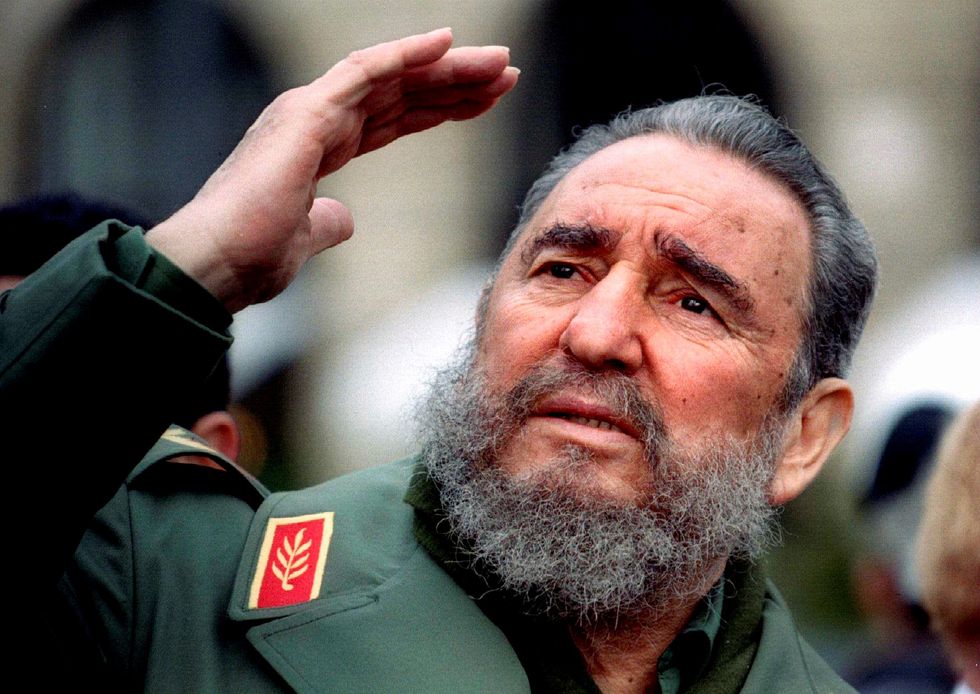
IMAGE: Cuba’s President Fidel Castro gestures during a tour of Paris in this March 15, 1995 file photo.   REUTERS/Charles Platiau/Files

Cuba: First Obama, then Mick Jagger

Cuba: First Obama, then Mick Jagger

The unstoppable transformation of Cuba accelerates this week with the arrival of two of the world’s most famous people: Barack Obama and Mick Jagger.

On Sunday, Obama landed in Havana aboard Air Force One. The first U.S. president to visit the island in 88 years, he’ll meet with Cuban officials and dissidents, and give a speech before a crowd of 1,000 at the Gran Teatro Alicia Alonso.

Jagger and the Rolling Stones, who have their own very nice jet, fly in a few days later to perform a free concert at Ciudad Deportiva. More than 400,000 fans are expected to show up.

Obviously, this is not Fidel Castro’s Cuba anymore.

An American president is being welcomed, and his words are expected to be broadcast directly to the Cuban people. Such a thing was inconceivable not so long ago.

No less historic is the Cuban regime allowing huge throngs to gather and rock out. In the past, such masses were usually assembled to hear one of Fidel’s gruelingly long speeches, or to celebrate some foggy anniversary of the revolution.

On March 6, a huge electronic-dance music concert was staged near the U.S. Embassy on Havana’s waterfront. The headliners were Diplo, a wildly popular American DJ, and his group Major Lazer. News reports estimated the ecstatic crowd at 450,000.

Cuba is opening up, and loosening up. It’s far from being a free country, but the people are finding more freedom in their daily lives.

Thousands still flee because the economy is in shambles, but those who stay are mostly optimistic about the promise of good relations with the United States. I heard this often while I was in Havana in November.

Obama’s visit has been condemned by hardliners in this country, but their day has passed. The U.S. embargo, a stupendous 50-year flop, is destined to be mothballed by a future Congress.

The isolation of Havana is unofficially over. Done.

American tourists are streaming in. Charter flights are packed with Cuban Americans coming to visit relatives. Major airlines are jockeying to schedule daily flights. The cruise lines are locking up harbor space.

And major American banks and companies are lined up and waiting to do business.

Nothing will bring more dramatic change to Cuba than open commerce and contact with the United States. It won’t lead to instant democracy, but the impact on many working people there will be life-changing.

What’s happening now between the two countries was inevitable. Obama has certainly pushed the detente process along but — to steal a line from Jagger and Keith Richards — time was on his side.

Fidel is frail and no longer in command. Most younger Cuban-Americans here favor friendlier relations.

And, not least importantly, major U.S. corporations with heavy political clout are lobbying for trade opportunities.

But even with a flood of U.S. dollars, Cuba will look the same for a long time. Solving its cash crisis and rebuilding its decrepit infrastructure could take decades.

A more intangible change will happen faster, the energy of hope.

Obama’s itinerary in Havana includes meetings with American corporate executives, Cuban entrepreneurs and Cuban Americans whom he has invited on the trip. He’ll also attend a baseball game between the Tampa Bay Rays and the Cuban national team.

The president isn’t scheduled to sit down with Fidel, but he and Raul Castro will meet on Monday for a discussion that will include the serious and prickly subject of human rights.

Cuban citizens who speak out against the communist government still get thrown in jail. It’s naive to think that stern words from Obama, or any foreign leader, will suddenly sway Cuban leaders to be tolerant of dissent.

On the other hand, it’s hard to imagine any new U.S. strategy having less influence on human-rights reform than the embargo has.

Obama’s trip, which culminates with a state dinner at the Revolutionary Palace, is bound to affect the people of Cuba more than the government’s policies. The sight of an American president riding along the Malecon — the very idea of it — must be mind-boggling and surreal, after half a century of estrangement.

For Cubans, long accustomed to disappointment and dashed hopes, their world finally seems to be moving forward.

On Tuesday, they’ll watch Air Force One take off from the island.

And on Friday they’ll go to a sports stadium and listen to Mick Jagger sing about satisfaction, of all things.

Who would have imagined it?

(Carl Hiaasen is a columnist for the Miami Herald. Readers may write to him at: 1 Herald Plaza, Miami, Fla., 33132.)

(c) 2016, The Miami Herald Distributed by Tribune Content Agency, LLC.

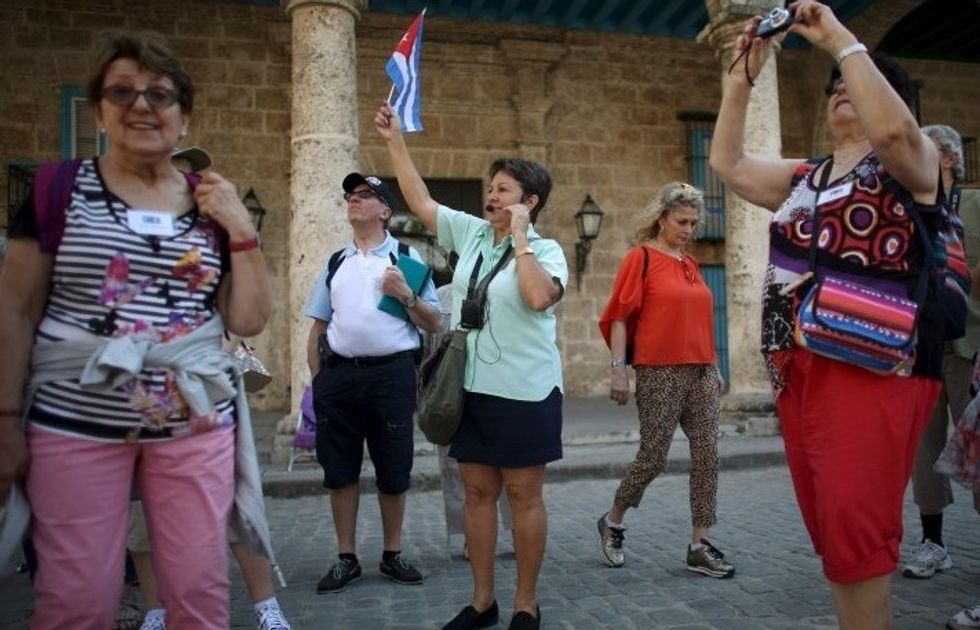
Photo: A tour guide (C) raises a Cuban national flag to regroup foreign visitors she is taking through Old Havana March 16, 2016. REUTERS/Alexandre Meneghini 

Shop our Store

Headlines

Editor's Blog

Trending

World