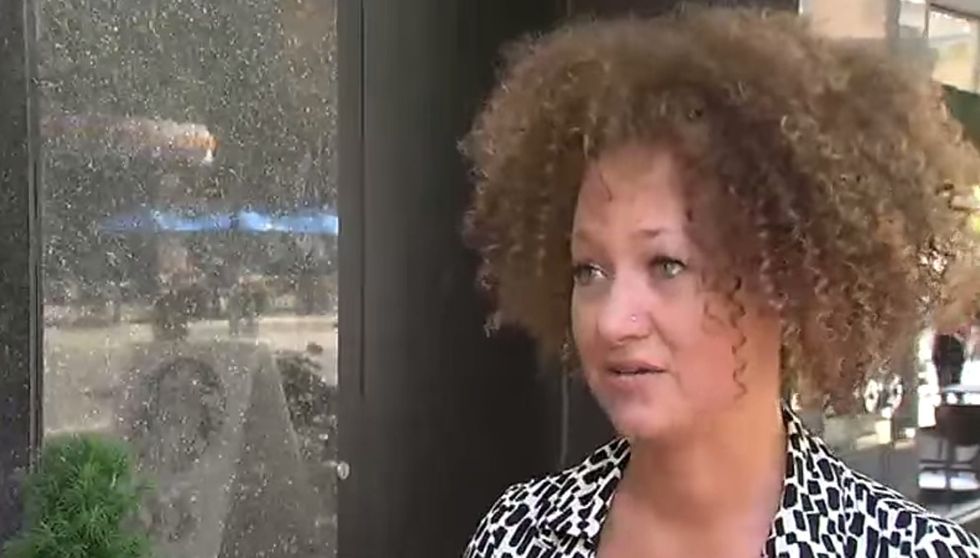
A white daughter is born to white parents. At some point, she identifies with being black. As a young woman, she changes her appearance, her skin, her hair and she begins referring to herself as mixed race. She is later assumed to be African-American. She ultimately rises to the head of an NAACP chapter in Spokane, Washington, until her past is revealed and, at 37, she resigns amid scandal.
When I first heard this story — the strange tale of Rachel Dolezal — it raised my eyebrows. Many folks are born into one religion, yet convert to another, or are born in one country but become citizens of another, or learn in one language but speak in another. The finished human product may not always resemble what the birth certificate predicted.
Still, there used to be certain things you were just, well, stuck with. Skin color was one of them.
Today, it seems, what you feel trumps what science says you are. In fact, with the aid of a flexible English language, certain words have become a virtual science by themselves.
If you call yourself something, it can be so.
Rachel Dolezal went from calling herself white to, at least at one point recently, calling herself black. Despite protests from her Caucasian parents, who seem bewildered by her gene denial, she continues to tell a crooked story. When she was younger, she sued a university for allegedly discriminating against her because she was white (so it served her purpose then) but this past week, on NBC, she said, “Well, I definitely am not white. Nothing about being white describes who I am.”
Except for her born skin color, which is the only thing that counts in defining her race. Dolezal sees “being white” as an experience, or an attitude, or a way of acting, which she rejects. (This, by the way, is as insulting to white people as when bigots suggest there is a “black” way of acting.)
But while rejecting biological details because you don’t feel that way, or don’t want to think of yourself that way, may be satisfying to the individual, it does create issues for society.
Let’s start with the simple ones.
A Fox News commentator, Andrea Tantaros, in response to the stories of Dolezal and Caitlyn Jenner, asked, “If I self-identify as a cat, a feline, do I have to pay income taxes?” It’s a comical suggestion, but not so funny in these changing (or is it changeling?) times.
For example, what would the rules be if a military draft were reinstated — and only young men were sent into combat? Would a biological man identifying as a woman be exempt? If so, might not many men falsely claim this?
If scholarships are offered for African-American students, would the next Rachel Dolezal qualify because she identifies as one? And how do you keep a census? How do you study trends? How to do track medical data of certain ethnic groups?
These are real and often serious questions.
Add to this the case of people who want to identify one way today and another way tomorrow. Sound crazy? Why? If biological definitions are merely “assigned” to you at birth, you can accept or reject them whenever you choose.
Dolezal interviews in a calm and steady voice, as if to say, “What’s the fuss about?” This despite fibbing about being born in a teepee or living in South Africa. Critics have labeled her everything from a nutcase to a pathological liar.
I wonder whether it’s not something else. I wonder whether it’s not our me-first culture which teaches that how we feel is all that matters. It’s woven into the sky-high divorce rate, the explosion of antidepressant drugs, the celebration of ego without much accomplishment.
And now it’s entangled in genetics. If we feel something deeply enough, that can make it so — even being a different race. Dolezal told NBC she cried when she read about Caitlyn Jenner, saying, “I resonated with some of the themes of isolation, of being misunderstood.”
I’m no scientist, but aren’t those feelings?
The shame of it is, by most accounts, Dolezal was doing a good job at the Spokane NAACP before stepping down. Why couldn’t she have done so as a white woman? It’s nonsense to think that your skin has to be the same color as someone else’s to help them.
Maybe that’s the only positive takeaway in this bizarre story. You don’t need to be black to care about black causes, or white to care about white. Most of those causes are, at their core, about being human. If we accepted how much we all fit in that category, there might not be such a rush to deny the others.
Screenshot via KXLY.