Tag: mail-in voting
If You Love Democracy, Prepare Now To Defend Free Elections In 2026

If You Love Democracy, Prepare Now To Defend Free Elections In 2026

Democrats and other democracy well-wishers are spilling gallons of ink and a profusion of pixels on the question of whether ending the government shutdown was a blunder or not. I submit that either way, it won't matter very much if at all in 12 months — and the 2026 elections are where our attention needs to pivot right now.

After the most depressing year in American politics of my lifetime, the 2025 election results were like a defibrillator shock to a moribund body. The landslide percentages achieved by Abigail Spanberger and Mikie Sherrill; the record-smashing turnout in New York City; the huge Democratic gains in the Virginia House of Delegates; the sweep of three state supreme court seats in Pennsylvania; the lopsided results in obscure Georgia races, like for the public service commission; and the success of the California redistricting plan (a response to Texas' naked gerrymander) all point to the fact that the electorate — unlike CEOs, partners in major law firms, university presidents and media companies — is not surrendering to President Donald Trump.

Coming on the heels of the massive No Kings demonstrations across the nation, last week's elections are reminders that voters are the final bulwark against despotism.

Of course, these races should not be overinterpreted. Democrats tend to turn out in greater numbers for off-year contests than Republicans; the GOP's Virginia gubernatorial candidate was off-putting; and Democrats ran disciplined campaigns. But the biggest drag on Republicans was something that felled Kamala Harris and is unlikely to change markedly by this time next year: prices remain high. Millions of non-MAGA voters supported Trump because they believed his promise to restore the 2019 economy. That he cannot do, and wouldn't be able to accomplish even if he refrained from the boneheaded tariffs that are his delight.

Over the course of the past year, the question I've had the most difficulty responding to was also the one that was most often asked: What can I, as a citizen, do to counter this descent into authoritarianism? The No Kings rallies were one answer. The 2025 elections were another. And now, the next step is coming into focus.

The Trump team will also certainly attempt to rig the midterm elections while falsely claiming the elections are rigged against Trump. They have already begun. The mid-decade gerrymanders that the president has demanded of red states are a brazen effort to skew election results. It's Trump's style to do the corrupt things openly, so that they almost seem above board.

A president who pulled every lever, jiggled every handle and applied every kind of pressure he could think of, up to and including inciting a riot to prevent his successor from taking office deserves no benefit of the doubt about what he might attempt in 2026. Let's not forget that Trump entertained the possibility of using the military to confiscate ballot boxes in close states.

Still perseverating about the "stolen" 2020 election, Trump is already posting on Truth Social that he detects similar fraud in 2026: "No mail-in or 'Early' Voting, Yes to Voter ID!" he wrote. "Watch how totally dishonest the California Prop Vote is! Millions of Ballots being 'shipped.' GET SMART REPUBLICANS, BEFORE IT IS TOO LATE!!!"

The Justice Department sent "monitors" to polling sites in California and New Jersey, which may have been nothing, or it may have been a dry run for deploying large numbers of federal officials to intimidate voters. Since 2020, Trump has been able to install election deniers in key federal posts, most importantly as attorney general, and has created a new, MAGA-inflected paramilitary force in ICE. It is no stretch to imagine ICE agents snatching people from voting queues and thereby deterring U.S. citizens who speak with an accent or have dark skin from exercising their right to vote. God knows, they've already pulled any number of citizens into their unmarked vehicles and held them for hours.

Everyone can participate in the pushback. Thankfully, elections are local and state affairs, not federal, which means the Trump administration has limited power to interfere with the way votes are cast. Still, leave nothing to chance. Sign up to be an election worker. The turnover rate has increased since 2020, with 2 in 5 election workers leaving the job. Contact groups concerned with election integrity, like Protect Democracy, the Campaign Legal Center, the Brennan Center for Justice, the NAACP, States United Democracy Center, Society for the Rule of Law (especially if you have a law degree) or the Fair Elections Center. Contact your state representatives and senators to inquire about funding for election security measures. File Freedom of Information Act requests as American Oversight has done to discover if the Trump administration is preparing military or other deployments at election time next year.

We've witnessed what unified Republican control of the government has meant over the past 11 months. Winning back the House and, who knows, maybe even the Senate, is the whole ballgame now.

Mona Charen is policy editor of The Bulwark and host of the "Beg to Differ" podcast. Her new book, Hard Right: The GOP's Drift Toward Extremism, is available now.

Reprinted with permission from Creators


Trump Issues New Executive Order On Election Procedures To 'Rig Midterms'

Trump Issues New Executive Order On Election Procedures To 'Rig Midterms'

On Tuesday, President Donald Trump issued a new executive order targeting voter eligibility and voting by mail. Various experts, journalists and commentators are now concerned that Trump may be attempting to put his thumb on the scale ahead of next year's midterm elections.

According to the Washington Post, the order "could prevent millions of Americans from voting" if it passes legal muster. Notably, the order mandates that states require voters provide a "government-issued documentary proof of citizenship" upon registering to vote, and that only Real ID drivers' licenses and passports are accepted, whereas birth certificates alone are not sufficient. The order would also ban states from counting mailed ballots that arrive after Election Day, which would be a significant curtailing of voting by mail (states allowing vote-by-mail typically count ballots after Election Day provided that they were postmarked on or before Election Day).

SiriusXM host Dean Obeidallah accused Trump of "trying to rig [the] 2026 election" with the order, and argued that "banning birth certificates is RIGGING!" Alexei Koseff, who covers the California state capitol for CalMatters, said the order has "huge implications" for residents of the largest state in the union, given how much of the Golden State votes by mail. Ottawa,

Canada-based radio journalist Andy Pinsent observed: "When this is inevitably shut down by the courts, the [White House] will posture that 'radical judges want illegal immigrants to vote.'" And author Mitchell Plitnick flatly asserted: "The order is illegal. This is Trump testing to see if he can get away with it. Win or lose, you can bet this is only the first volley in a campaign to undermine free and fair elections."

"When they said 'voter fraud' it meant they wanted to do it," University of Iowa associate sociology professor Victor Ray wrote on Bluesky.

When combing through the full text of the executive order itself, Harvard Law Cyberlaw Clinic instructor Alejandra Caraballo noticed one line that stood out to her. The order stipulates that the Department of Homeland Security will coordinate with the administrator of the Department of Government Efficiency (DOGE) — which is unofficially led by Tesla and SpaceX CEO Elon Musk — to "review each state's publicly available voter registration list and available records concerning voter list maintenance activities."

"Elon Musk would now be in charge of the databases determining voter eligibility," Caraballo wrote.

"I don't say that the law won't stop this and elections won't matter because I'm a doomer. I'm saying this so people understand the moment we're in. We're no longer a democracy," she continued. "People need to accurately diagnose the problem before they can fix it and waiting for the courts or elections isn't it."

Reprinted with permission from Alternet.

Trump’s Amateur Sleuths Poised To Decry Another 'Stolen Election'

Trump’s Amateur Sleuths Poised To Decry Another 'Stolen Election'

As Republican candidates, parties and groups are poised to legally challenge election results where they have lost or lag behind in the preliminary results, a parallel effort is underway in pro-Trump circles that likely will fabricate propaganda about illegitimate elections.

Candidates have long been able to challenge voters and ballots after Election Day during the vote count reconciliation process – called the canvass – which is before results are certified and recounts occur. But the efforts in Trump circles stand apart from these legal processes.

Trump Republicans and their allies are poised to gather “evidence” that frequently is not legally admissible in determining election outcomes, but can be exploited by propagandists to create distrust about voting, election officials, and the accuracy of voting systems.

“In some states, election deniers motivated by false claims of widespread fraud in the 2020 election are engaging in their own deeply flawed investigations to substantiate myths of widespread voter fraud,” reported the Brennan Center for Justice at New York University Law School in a research paper released on Friday. “They have organized to engage in practices like amateur data matching with voter rolls, door-to-door canvassing to compare residents’ statements with voter records, and surveillance of mail ballot drop boxes. These error-ridden practices can disenfranchise eligible voters and strain election official resources.”

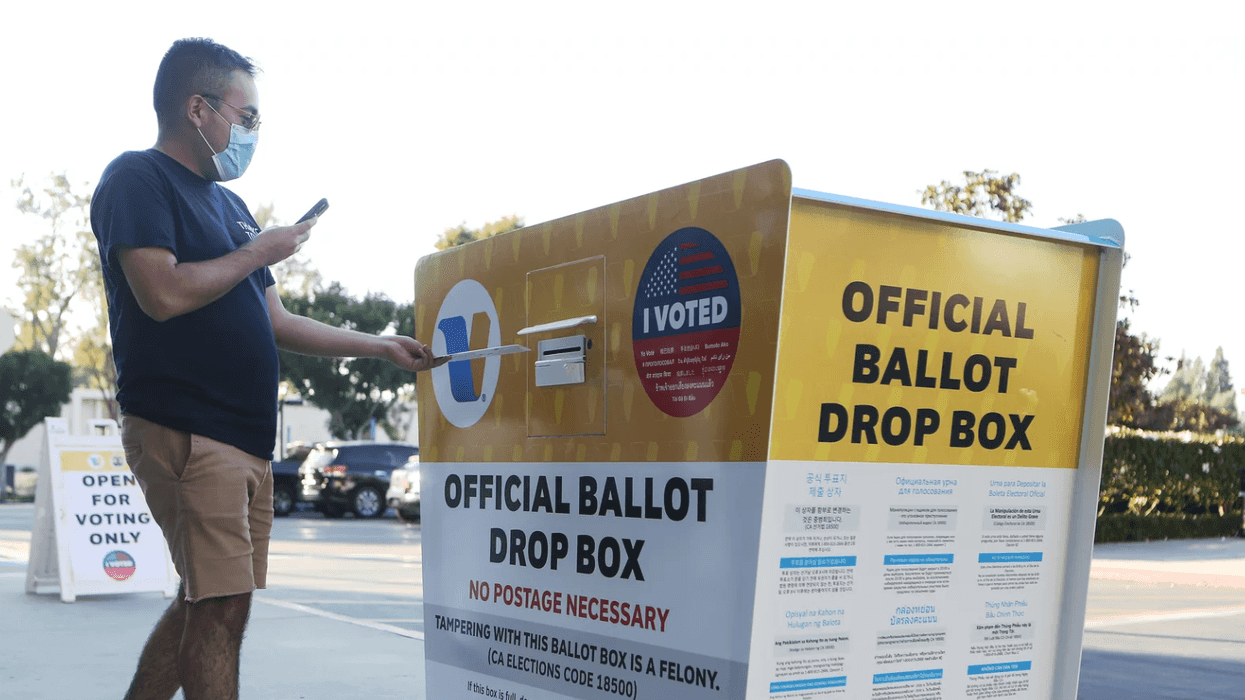
Among the most high-profile recent efforts has been surveillance of drop boxes in Arizona, a state where 80 percent or more of the voters cast mailed-out ballots. This effort includes taking photos and videos of individuals dropping off ballots and their car’s license plates. That tactic is among several to make the claim that legions of unregistered voters are casting ballots.

This tactic, apart from possibly intimidating voters, is an example of what the Brennan Center called an “error-ridden” practice. The address tied to a license plate may not be the same as a voter’s most recent registration information, especially if that voter recently moved.

Nonetheless, since the 2020 election, ex-Trump campaign workers and self-appointed data analysts have parsed voter rolls in swing counties in swing states to falsely claim that the rolls were rife with inaccuracies that could be exploited by Democrats to fabricate votes.

Initially, Trump activists started knocking on doors to verify if a voter’s address on their registration record was accurate, to ask if they voted in 2020 and gather personal information. That activity lead to accusations of voter intimidation by civil rights groups. Earlier this year, the focus shifted to filing mass challenges of voters’ credentials, such as in metro Atlanta in Georgia, where more than 60,000 challenges were almost entirely rejected by county election officials this past summer, who, nonetheless, had spent months investigating the complaints.

“Activists are being encouraged by those who claim the 2020 election was ‘stolen’ to perform their own amateur data matching. They are using National Change of Address lists, tax assessor data, a portal operated by government contractor Schneider Geospatial, public map services, and public voter data from multiple states to make inferences about current voter eligibility and past election legitimacy,” the Brennan Center report said. “In doing so, they are cobbling together incomplete datasets that can later become ‘evidence’ for candidates to baselessly challenge the legitimacy of the election if they lose.”

Those behind these efforts have waged recruitment drives to gather evidence for post-Election Day challenges or to generate fodder that almost certainly will be used for propaganda – filling media channels as some battleground states take more time to count their votes than others. (Pennsylvania and Wisconsin, for example, cannot start counting absentee ballots until Election Day. Florida, Arizona, and Nevada can start several weeks before.)

Whether led by ex-Trump White House officials or campaign lawyers based at Conservative Partnership Institute in Washington, or a looser collective of election deniers and self-appointed experts convened and funded by MyPillow CEO Mike Lindell, the ringleaders have instructed activists to use apps like Basecamp to coordinate their activities, and apps like VotifyNow to report incidents that they deem suspicious.

“In the upper left-hand corner is the menu tab that will bring up your voter integrity tools,” a VotifyNow tutorial said. “When you click on these buttons, such as mail-in ballot issues, you’ll see the app allows you to type in a brief description of any suspicious activity you notice, as well as upload a photo or video... That incident is then sent to our database to be analyzed and compared with other issues in your area.”

Needless to say, just because a citizen observer thinks that they are seeing something wrong does not mean that factually is the case, said Tammy Patrick, a senior advisor at the Democracy Fund, at a November 2 press briefing where threats to election officials were discussed.

“I’ve had some election officials tell me that these observers act like they’re going to find the body; that they are coming onto a criminal site or crime scene,” she said. “When you approach the information that way, when you don’t know what you are looking at, you’re going to find what [conspiratorial evidence] you are looking for.”

Nor are specious observations likely to be accepted as evidence in any post-Election Day administrative review or legal process. But what fails to meet a legal standard of evidence can succeed as disinformation.

“It is important to remember that all reliable evidence shows that our elections — including the 2020 election — are safe, secure, accurate, fair, and free of widespread voter fraud,” the Brennan Center said. “We cannot let these dangerous and defective schemes compromise our democracy.”

Steven Rosenfeld is the editor and chief correspondent of Voting Booth, a project of the Independent Media Institute. He has reported for National Public Radio, Marketplace, and Christian Science Monitor Radio, as well as a wide range of progressive publications including Salon, AlterNet, The American Prospect, and many others.

This article was produced by Voting Booth, a project of the Independent Media Institute.

While Advocates Seek Election Reform, Republicans Busily Restrict Voting

While Advocates Seek Election Reform, Republicans Busily Restrict Voting

The failure of major federal voting rights legislation in the Senate has left civil rights advocates saying they are determined to keep fighting—including by suing in battleground states. But the little bipartisan consensus that exists on election reform would, at best, lead to much narrower legislation that is unlikely to address state-level GOP efforts now targeting Democratic blocs.

“This is the loss of a battle, but it is not necessarily the loss of a war, and this war will go on,” Eric Holder, the former U.S. attorney general and Democrat, told MSNBC, saying that he and the Democratic Party will be suing in states where state constitutions protect voting rights. “This fight for voting rights and voter protection and for our democracy will continue.”

“The stakes are too important to give up now,” said Damon Hewitt, president and executive director of the Lawyers’ Committee for Civil Rights Under Law, which for years has operated an Election Day hotline to help people vote. “Our country cannot claim to be free while allowing states to legislate away that freedom at will.”

In recent weeks, as it became clear that the Senate was not going to change its rules to allow the Freedom to Vote Act and the John Lewis Voting Rights Advancement Act to pass with a simple majority, there have been efforts by some lawmakers, election policy experts, and civil rights advocates to identify what election reforms could pass the Senate.

“There are several areas… where I think there could be bipartisan consensus,” said David Becker, executive director of the Center for Election Innovation and Research, in a briefing on January 20. “These areas are all around those guardrails of democracy. They are all about ensuring that however the voters speak that their voice is heard… and cannot be subverted by anyone in the post-election process.”

Becker cited updating the 1887 Electoral Count Act, which addressed the process where state-based slates of presidential electors are accepted by Congress. (In recent weeks, new evidence has surfaced showing that Donald Trump’s supporters tried to present Congress with forged certificates as part of an effort to disrupt ratifying the results on January 6, 2021.) Updating that law could also include clarifying which state officials have final authority in elections and setting out clear timetables for challenging election results in federal court after Election Day.

Five centrist Washington-based think tanks issued a report on January 20, Prioritizing Achievable Federal Election Reform, which suggested federal legislation could codify practices now used by nearly three-quarters of the states. Those include requiring voters to present ID, offering at least a week of early voting, allowing all voters to request a mailed-out ballot, and allowing states to start processing returned absentee ballots a week before Election Day.

But the report, which heavily drew on a task force of 29 state and local election officials from 20 states convened by Washington’s Bipartisan Policy Center, was notable in what it did not include, such as restoring the major enforcement section of the Voting Rights Act of 1965, which was removed by the U.S. Supreme Court in 2013. It did not mention the Electoral Count Act nor growing threats to election officials from Trump supporters.

“This won’t satisfy all supporters of the Freedom to Vote Act, but this is a plausible & serious package of reforms to make elections more accessible and secure that could attract bipartisan support,” tweeted Charles Stewart III, a political scientist and director of the MIT Election Data and Science Lab. “A good starting point.”

The reason the centrist recommendations won’t satisfy civil rights advocates is that many of the most troubling developments since the 2020 election would likely remain.

Targeting Battleground States

Seasoned advocates in battleground states say that Republicans have been pursuing a bottom-up strategy of targeting key decision points in the voting process that, collectively, could end up suppressing more votes than the winning margins in recent highest-stakes contests.

They point to new laws and policies in Georgia, Florida, Wisconsin, and Texas, where the GOP has foreclosed early voting options, imposed new rationales to disqualify voters or cancel their ballots, and, in Georgia, has purged longtime Democratic county election officials. They also are concerned about new legislation that may be introduced in early 2022.

Georgia, whose 2020 elections were key to Donald Trump’s defeat and the return of the U.S. Senate’s Democratic majority, offers many examples. (The state received a 100 percent grade in the Prioritizing Achievable Federal Election Reform report, meaning it already complies with the suggested remedies.)

Beyond launching a state investigation of metro Atlanta’s Fulton County, which is seen as a precursor to a GOP-led takeover of its operations, pro-Trump Republicans’ partisan actions in Georgia also include a handful of smaller counties that have seen Democratic officials purged, polling place closures, and Sunday voting suspended, and more ballots disqualified during 2021’s municipal elections than in 2020’s presidential election.

“There’s a clear a pattern going on where they [pro-Trump Republicans] are burrowing into these counties,” said Ray McClendon, Atlanta NAACP political action chairman. “These [county] election boards are going to be hardened targets that you won’t be able to make heads or tails of how much they have rigged the system pro-Republican and anti-Democrat.”

“They’re going to tell you, ‘We’re just following the rules. There’s no requirement that we have Sunday voting. There’s no requirement that we have more than one polling place,’” said McClendon. “This is not a top-down strategy.”

News reports from local, regional, and national media confirm the overall pattern.

In rural Lincoln County, Georgia, county commissioners announced they would only stand up one polling place for 2022’s elections instead of seven. “We are not trying to suppress any votes; we’re trying to make it better,” Walker Norman, Lincoln County Commission chairman, told the local NBC TV affiliate. “If I thought it was suppressing anybody’s vote, I’ll be the first one with opposition to it.”

In Spalding County, south of Atlanta, several election commissioners in mid-2020—Black women and Democrats—were ousted under new authority given to local judges and county officials under SB 202, the GOP-led legislature’s response to the 2020 election. The new election board, led by Republicans, did not offer Sunday voting during 2021’s elections.

A Reuters investigative report found that Spalding’s Board of Elections (BOE) was among six county BOEs that had seen purges of Black Democrats under SB 202, which the federal Department of Justice has sought to overturn in a voting rights lawsuit filed in June 2021.

The six counties cited by Reuters—Lincoln, Troup, Morgan, Stephens, Pickens, and Spalding—supported Trump by large margins in 2020. But, collectively, the counties had more than 33,000 Biden votes, which was about three times Biden’s statewide victory margin over Trump. In contrast, in Fulton County, Biden beat Trump by more than 240,000 votes.

Similarly restrictive moves can be seen in Texas, said Andrea Miller, who heads the Center for Common Ground, which seeks to assist minority voters in Southern states.

“We’re currently dealing with the aftermath of the [2021] legislative changes in Texas,” she said, citing new rules over applying for a mailed-out ballot that have led to abnormally high rejection rates for the upcoming March 2022 primary elections.

“About 40 percent of the ballots are being rejected (which is a lot for Texas) and it is also taking nearly 30 days to get a ballot,” Miller said via email. “Seems Texas changed the length of your driver’s license number so if you have an old one, it doesn’t have nearly enough numbers and they ‘can’t find you in the system.’ The new law also requires that if you drop the ballot off, you must do so in person and you can only drop off your own ballot.”

Texas has also run out of voter registration forms, which the Texas secretary of state’s office has blamed on supply chain issues. (In his media briefing, Becker said that rejected absentee ballot applications were a failure by the state to educate the public, and the registration form shortage represented a failure to plan for implementing a new law.)

2022 State Legislation

Meanwhile, as 2022 begins, more legislation is looming. In Georgia, GOP legislators have introduced several bills to continue to foreclose voting options. One bill, sponsored by a state senator running for lieutenant governor, would prohibit the use of drop boxes to return mailed-out absentee ballots, which were a convenience during 2020’s COVID-19 outbreaks and alleviated polling place congestion on Election Day. In another battleground state, Wisconsin, a county judge ruled in mid-January that the ballot drop boxes were not properly authorized under state law in a lawsuit filed by a right-wing foundation. The state agency that approved their use in 2020 has been attacked by GOP lawmakers and is targeted in new legislation, Becker said.

Seen from the ground up, the purpose of the post-2020 legislation and related litigation is to allow newly empowered local Republicans to chip away at Democratic turnout, and, subsequently, to try to disqualify as many mailed-in ballots as possible, the NAACP’s McClendon said.

“They have become smart enough to know that they can’t justify just blocking people of color from voting,” McClendon said. “If they can just peel off a half a point from no Sunday voting, a quarter of a point from provisional ballots getting thrown out, another quarter of a point from people not properly filling out their ballot return envelope, they will get their numbers.”

This article was produced by Voting Booth, a project of the Independent Media Institute.

Steven Rosenfeld is the editor and chief correspondent of Voting Booth, a project of the Independent Media Institute. He has reported for National Public Radio, Marketplace, and Christian Science Monitor Radio, as well as a wide range of progressive publications including Salon, AlterNet, The American Prospect, and many others.
Shop our Store

Headlines

Editor's Blog

Corona Virus

Trending

World