Tag: public education
In Her New Book, Teachers Union Leader Explores 'Why Fascists Fear Teachers'

In Her New Book, Teachers Union Leader Explores 'Why Fascists Fear Teachers'

With nearly every day presenting more evidence of America’s eroding democracy, it’s understandable to wonder whether a countervailing force will come forward to ensure—to paraphrase Lincoln—that the government of, by, and for the people will endure.

Mass protests with catchy themes like “Hands Off” and “No Kings” seem to offer more symbolism than substance. Court cases often fail to uphold key democratic provisions such as voting rights and press freedoms. The political party representing opposition to the current “anti-democratic” presidential regime is more unpopular than ever. Prominent political experts caution that campaigning to protect and uphold democracy isn’t a winning strategy. And leading historians warn that the country is sliding toward fascism.

But a new book suggests that a powerful force for democracy and against fascism is indeed at work every day, despite all that’s being done to undermine it. And it’s not in the halls of Congress. It’s in public school classrooms.

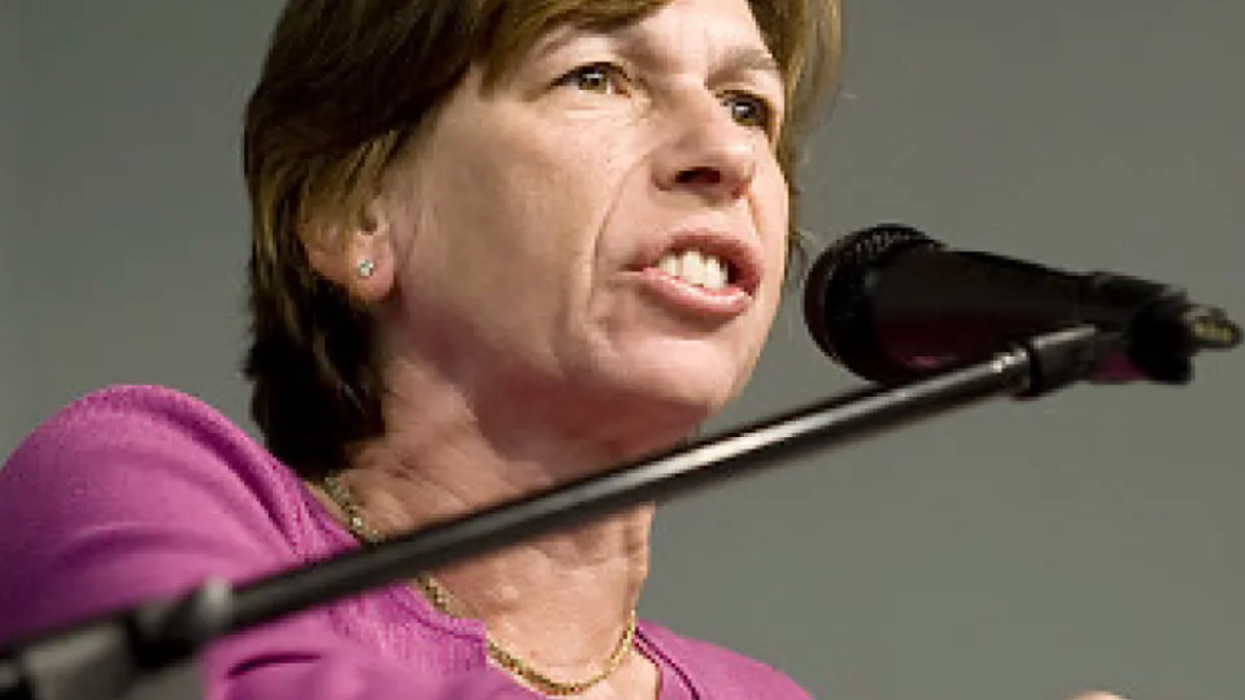
In her new book, Why Fascists Fear Teachers: Public Education and the Future of Democracy, American Federation of Teachers President Randi Weingarten, makes the case that democracy doesn’t only happen when political candidates vie for office, citizens post their opinions on editorial pages and social media, and voters show up at the ballot box. Democracy is also at work, she explains, when public school teachers engage in the seemingly mundane tasks of educating students.

Engaging in this work, Weingarten contends, has always made teachers a target for dictators—would-be and otherwise—who seek to undermine democracy and impose autocratic rule. Drawing from history, from stories of frontline teachers, and from her experiences as a former teacher—a champion for educators and a lightning rod for criticism from politicians in both political parties—Weingarten argues that public schools and teachers are “inextricably linked” with protecting democracy and ensuring its enduring presence in the nation’s politics and governance.

Weingarten’s case comes across most vividly in her examples of teachers who resisted fascist dictators in 20th-century Germany. In 1940, when Adolf Hitler’s Nazi army invaded Norway, teachers were among the frontline resistors to the takeover, she recounts. They refused to join a Nazi imposed teacher corps, even when German soldiers came into their schools and beat them. And when the Nazis eventually closed schools, teachers kept teaching students in secrecy.

In Poland, when Nazi forces shut down an orphanage for Jewish children run by Henryk Goldszmit, a Polish Jew who became a teacher and prominent author of children’s books under the pen name of Janusz Korczak, Goldszmit continued to teach his students, staying with them even when they boarded trains to the concentration camp, after which he and his students were never heard from again.

Another educator in the Nazi resistance was Lucie Aubrac, a French teacher who helped publish an underground newspaper and delivered communications and packages for the French Resistance.

Weingarten also tells of dedicated teachers in the U.S. during the Jim Crow era of racial segregation who protested, with their students, the appalling conditions in schools Black children attended. Their advocacy on behalf of their students helped bring about the legal actions that would eventually lead to the Supreme Court’s Brown v. Board of Education ruling that made racially segregated schools illegal.

Weingarten also recounts how former President Lyndon Johnson drew inspiration and insights from his experiences as a schoolteacher in a rural, impoverished community in Texas to press for his vision of a “Great Society” during his presidency. His political leadership eventually led to the enactment of numerous landmark progressive legislations, including the Civil Rights Act of 1964.

In the present day, Weingarten writes about Clare Berke, an English teacher in Washington, D.C., who runs a journalism class where students report about real-world events and people. The students’ reports often become national stories. She tells of Jeff Adkins-Dutro, a teacher and local AFT union leader in Peoria, Illinois, who brought together leaders from local businesses and the community to create an integrated system of career and technical courses to ensure students have career opportunities once they graduate high school.

And she recounts how Lillian Keys, a teacher in rural McDowell County, West Virginia, left her community to attend a university and earn her degree, but then returned to her hometown to teach in a community school that provides the county—which struggles with poverty, homelessness, and drug addiction—with education programs and nutritional support, healthcare, career education, and other student and family services.

What makes teaching an inherently democratic act, according to Weingarten, is that it involves creating a shared, public space that invites all children—regardless of race, income, religion, and ability—to engage in learning together, unencumbered by the prejudices and social hierarchies that fascism imposes.

Teachers impart essential knowledge and skills to their students, such as the ability to communicate effectively, solve problems, and think critically about news and information—abilities that run counter to top-down, autocratic government control.

Teachers also create opportunities for their students by encouraging them to pursue their interests and dreams and by providing programs and courses of study that prepare them for a future they, not government officials and big businesses, imagine for themselves.

And teachers create agency, not only for themselves, but also for others, by organizing labor unions and other cooperatives and supporting democratically governed efforts to press for societal advantages, such as fair wages, positive working conditions, and government funding for public services—things that a fascist system beholden to billionaires abhors.

“Fascists and autocrats fear what teachers do because they know their brand of greed, hierarchy, and extremism cannot survive in a democracy of diverse, educated citizens,” Weingarten writes, so the “authoritarian playbook” always includes efforts to destroy the credibility of teachers and dismantle public schools.

It would be good for other factions claiming to form the resistance to fascism to recognize the power teachers wield and to build strong alliances with them. But this is not always the case, as Weingarten alludes to when she mentions “neoliberal Democrats who have intentionally or unwittingly aided the right in their agenda to destroy public schools.”

In addressing that faction, Weingarten briefly mentions prominent Democrats who have promoted a market-based approach to education policies, such as Arne Duncan, the former CEO of Chicago schools and former secretary of education under President Barack Obama. She calls Duncan a “prime example” of someone who “bought into the idea that public schools would miraculously work better if they were run like corporations.”

And while she roundly criticizes the rollout of school vouchers and hails their defeat in states such as Nebraska and Kentucky, her take on charter schools, a darling of the neoliberal agenda, is more nuanced. She recalls her previous support for the idea of charters but also expresses her disappointment that charters often lack accountability, “pick and choose” their students, and operate “like businesses” more focused on market competition and profit rather than the needs of children and their education.

Because of her nuanced take on charter schools, ardent supporters of public education might come away dissatisfied that Weingarten doesn’t name more names in the neoliberal faction and highlight more of the actions they’ve taken to prepare the ground for right-wing factions to privatize education.

But clearly, the aim of the book is to build solidarity among opponents of fascism rather than promote intra-party factionalism at a time when that solidarity seems more important than ever. Her call for this solidarity makes the book a good read for those who may not closely follow education policy and politics but who welcome some hope and encouragement that they are not alone in their resistance to autocracy and are allied with a deep and broad coalition that includes millions of practicing educators and public school employees.

Why Fascists Fear Teachers is also a much-needed reminder of why the United States, since its founding, has made public schools fundamental to the well-being of its people and the success of the nation. During a time when prominent Republicans are calling for public education’s demise, Democrats often respond with vague, uninspiring arguments about why public schools are needed to overcome inequality or economic competitiveness instead of rousing voters to a cause that goes back to the origins of the country. For this reason, those who follow political rhetoric will want to see how Democrats, who are ramping up their campaigns for the 2026 midterm elections, take lessons from Weingarten’s book to heart.

This article was produced by Our Schools.

Department Of Education Wasted $1 Billion On Failed Charter Schools

Department Of Education Wasted $1 Billion On Failed Charter Schools

new report issued by the Network for Public Education provides a detailed accounting of how charter schools have scammed the U.S. Department of Education’s Charter Schools Program (CSP) for up to $1 billion in wasted grant money that went to charters that never opened or opened for only brief periods of time before being shut down for mismanagement, poor performance, lack of enrollment, or fraud. The report also found many of the charters receiving grant awards that managed to stay open fall far short of the grant program’s avowed mission to create “high-quality” schools for disadvantaged students.

President Trump’s 2020 budget blueprint proposes increasing funding for the charter grant program by 13.6 percent, from $440 to $500 million, and education secretary Betsy DeVos praised this increase as a step forward for “education freedom.” But the report finds that increasing federal funds for this program would mostly continue to perpetuate academic fraud.

Of the schools awarded grants directly from the department between 2009 and 2016, nearly one in four either never opened or shut their doors. The federal program’s own analysis from 2006 to 2014 of its direct and state pass-through funded programs found that nearly one out of three awardees were not currently in operation by the end of 2015.

Since then, the federal program has continued to award charters with grant money, increasing the total amount awarded to over $4 billion. Should the department’s own 2015 study finding hold, that one in three of the schools awarded grants had closed, never opened, or were not yet opened, the likely amount of money scammed by bogus charter operators tops $1 billion. In California alone, the state with the most charter schools, the failure rate for federal grant-awarded charters was 39 percent. Of the 306 schools that received CSP money but are not open, 75 are “ghost” schools—that is, they received money but never began operating.

As a coauthor of the report, along with Carol Burris, the executive director of NPE, I found an astonishing array of charter operators who ripped off American taxpayers with impunity, and generally suffered no adverse consequences for their acts. In fact, many are still actively involved in the scam. The scams varied from the brazenly open—such as the Michigan charter that isn’t a charter at all, it’s a Baptist church—to the artfully deceptive—like the Hawaii charter that received a grant in 2016 and still hasn’t opened, doesn’t have a location, and its charter hasn’t even been approved.

But perhaps my favorite scam artist to take advantage of the federal charter grant program was a Delaware company.

In 2013, Innovative Schools Development Corporation applied for and received a three-year start-up grant eventually totaling $525,000 to open Delaware Met Charter School in Wilmington, DE. The school’s grant application promised to create an “Expeditionary Learning (EL) charter” to “maximize learning” for “elementary-aged Hispanic Latino English Language Learners in a high poverty community.” The school claimed to “be able to cater to each students’ [sic] career goals by personalizing their education,” a local reporter gushed. “The model is called ‘Big Picture Learning,’ and for lack of a better analogy, it’s kind of like Build-A-Bear for a high school education.”

The school didn’t open until August of 2015, but the company was already at work getting more grants from CSP.

In 2015, Innovative Schools applied for and received a three-year grant totaling $600,000 to support the Early College High School charter schools at Delaware State University in Dover, Delaware. The school would focus on “the development of college-ready students through an inquiry and project-based learning environment that engages students with a dynamic, rigorous STEM curriculum … to serve a diverse student population, focusing recruitment on first-generation college-bound students from low-income families.”

Then in 2016, Innovative Schools applied for and received a three-year federal grant totaling $609,000 to open the Delaware STEM Academy charter school. The school promised in its application to enroll 250 students for 9th and 10th grade in September 2016 and to add 150 students each year for 9th grade thereafter from the high-needs student populations in the Wilmington and New Castle County area of Delaware.

In the meantime, while the company was applying for and receiving grant money from the federal government, no one seemed to notice that its schools were quickly failing.

Delaware Met was closed just five months into its first school year, in January 2016. The state committee that recommended closing found the school struggled to maintain a safe campus, used lesson plans that didn’t fit the state’s academic standards, and was out of compliance on all 59 of its Individualized Education Plans for its students with disabilities.

In June 2016, Delaware’s Charter School Accountability Committee and the State Secretary of Education both recommended revoking Delaware STEM Academy’s charter two months ahead of its planned opening, due to low enrollment of just 30 students and uncertain funding due to an overreliance on external grants. Local news reports on the demise of the school noticed that New Castle County already had a heavy concentration of charter schools—20 of 27 charter schools statewide. Yet in its review of the application, the U.S. Department of Education’s reviewers complimented the application for its “detailed management plan including objectives, measures, targets” and including a full year for implementation.

The Early College High School has managed to stay open, but although the application said it would have a student enrollment that is 24.7 percent “economically disadvantaged,” the school is located in a district with a student population that is 70 percent economically disadvantaged. In other words, what was supposed to be a lifeline out of poverty for students more closely resembles a white flight academy.

In the meantime, Innovative Schools Development Corporation did fine, as it was budgeted to receive, just from the STEM Academy deal, $247,500 of the federal grant funds for management fees, with $147,500 coming in the first year alone.

At this writing, the Innovative Schools Development Corporation website has been taken down and it is unclear whether the company still exists.

Much of the fraud and malfeasance is due to the fact that in many ways the charter scam is an inside operation.

The Department of Education uses a slipshod process to conduct reviews of charter school grant applications that allows applicants to get away with making false and misleading claims about their academic programs. The review process does not allow the verification of applicants’ claims, and reviewers are instructed to accept what applicants have written as fact. And reviewers are not publicly identified by the department and are likely to be biased because of the department’s requirement that they have “a solid understanding of the ‘charter school movement.’”

Many of the worst abuses take place in the grant program that sends money to states. When state education agencies pass the federal funding on to charter schools, there is generally little to no accountability for how the money is used. The sub-grantee schools often never open or close quickly, and the schools often blatantly discriminate, engage in outright fraud, and engage in related-party transactions that result in private individuals and companies pocketing huge sums of money at taxpayer expense. But once the monies are given to the state, the Department of Education maintains a “hands-off” policy.

One of these sub-grantee charter schools recently made national headlines when the New York Times reported about East Austin College Prep in Texas, where raccoons and rats invade offices and classrooms. When it rains, the roof of the main building leaks. Yet for all this, the secondary school pays almost $900,000 in annual rent to its landlord who is also its founder, Southwest Key Programs, the nation’s largest provider of shelters for migrant children. The federal charter grant program gave the school a grant to start the school through its Texas state grant.

There is only one way to deal with this blatant grift program for the charter school industry.

First, Congress must reject President Trump’s budget proposal for increasing funding for the charter school grant program. Then Congress must end funding for new charter grants coming from this program and demand thorough audits of previous grant awards and steps to ensure grant awards still under term are being responsibly carried out and that misspent money is returned.

And Congress also needs to consider the unintended consequences to districts caused by the unchecked expansion of charters. Resources are depleted for the students left behind, and public schools become more segregated and serve needier populations.

This article was produced by Our Schools, a project of the Independent Media Institute.

IMAGE: Secretary of Education Betsy DeVos is a determined advocate of charter schools. Illustration from Flickr/DonkeyHotey.

The 5 Cruelest Actual GOP Policies

The 5 Cruelest Actual GOP Policies

You didn’t see Saturday Night Live‘s “Establishment Shuffle” sketch on national television because it didn’t make the actual show. But it’s probably the best summary of the 2016 GOP primary that you’ll find.

In it, the dignified Paul Ryan — who almost had America intentionally default on its debt because President Obama wouldn’t agree to enough cuts to Social Security and Medicare — explains that Trump’s proud racism and erratic demagoguery don’t represent the establishment Republican Party, which prides itself on subtle, coded racism in service of a constant and unwavering effort to undo everything that built the middle class.

The extremism of the GOP establishment becomes more obvious every day as it rushes to support Ted Cruz’s efforts to swipe the nomination from Trump — and deliver it to a Senator who would be the most extreme national candidate since at least Barry Goldwater, and possibly since shoelaces were invented.

The GOP has never stopped catering to the catered and victimizing victims, but it’s worse than ever now. Trump’s cruelty-as-qualification runs on these very instincts, but turns off the voters Republicans need to win a general election. At this point, the billion-dollar baby’s brutality is all theoretical. But Republican cruelty is actual policy, and it has decimated states like Louisiana and Kansas, where the empty promises behind tax cuts for the rich are repaid with the blood, sweat, and fears of low-wage workers.

Saturday’s Boston Globe supplement imagines the damage a President Trump could do. But let’s not forget the damage being done by the Republican right at this very moment:

  1. Denying millions of the hardest working, most desperate Americans Medicaid expansion, for no good reason.
    Look at Texas to see the lengths the GOP will go to deny poor people basic health care. The state with the highest uninsured rate in the nation is turning down billions of dollars, forcing residents to pay higher insurance rates and letting thousands die rather than accept Medicaid expansion paid for almost entirely by the federal government. In addition, the state’s war on Planned Parenthood has driven between 100,000 and 240,000 women in the state to attempt to end a pregnancy themselves. Florida and 17 other states are doing their best to duplicate Texas’ efforts to punish the poorest working people in the state with third world health care.
  2. Trying to delegitimize the Veterans Administration after overloading it with suffering servicemen.
    Like any other Republican-driven “crisis,” there’s much more to the VA than what’s being reported. Exploiting an overloaded system, right-wing billionaires are attempting to destroy what has been the nation’s most effective means of delivering health care for veterans. “Working through the [Concerned Veterans of America], and in partnership with key Republicans and corporate medical interests, the Koch brothers’ web of affiliates has succeeded in manufacturing or vastly exaggerating ‘scandals’ at the VA as part of a larger campaign to delegitimize publicly provided health care,” Alicia Mundy writes in an explosive expose for the Washington Monthly. “All this has been happening, ironically, even as most vets who use the system and all the major veterans’ service organizations (VSOs) applaud the quality of VA health care.” There are problems in the system, no doubt. But they are problems consistent with an American health care system both underfunded and egregiously costly, thanks to the right’s aversion to government expansion.
  3. Unmooring struggling communities with the destruction of public education. 
    “School choice” is a perfectly poll-tested term for the conspiracy to undermine community schools that also — how convenient — just happens to target the last effective bulwark against Republican revanchism, teachers’ unions. School choice as a phrase is promising, but again and again, introducing “competition” to one of our most treasured institutions, public education, has uprooted the fabric of communities that have little holding them together. In Michigan a new study finds that “choice” students “fare no better on state standardized tests than similar students who stay in their home districts.” And what do students get in return for empty promises and classroom disruption? Mitchell Robinson, an associate professor and chair of music education at Michigan State University, called school choice “a scam designed to defund poor urban school districts and destabilize public education.”
  4. Purposely keeping wages as low as possible.
    Next year will mark a full decade since the lowest paid Americans got a federal minimum wage increase — so long ago that many states and localities have given up waiting for Republicans in Congress to act. In response to the Fight for Fifteen movement’s activism, city councils are addressing minimum wage increases at the local level, despite state legislatures’ interventions. Meanwhile, many of the same states enforce anti-union measures that purposely lower wages for all workers. Elected Republicans are doing their best to act on Donald Trump’s call that wages are too damn high.
  5. Doing whatever they can to make global warming worse.
    New research suggests that “the disaster scenario” of the West Antarctic ice sheet breaking off, melting, and raising ocean levels by as much as 12 feet could happen much sooner than expected. And Republicans are furious that President Obama is trying to do something about it. Why? Because the effects of climate change will, generally, fall hardest upon the world’s poor: those unable to cope with the devastating effects of drought, flood, and famine. That, or they really believe what Trump said: that global warming is a conspiracy invented by the Chinese.

Photo: Republican U.S. presidential candidate Texas Senator Ted Cruz waves as he arrives to speak at the 2016 Conservative Political Action Conference (CPAC) at National Harbor, Maryland March 4, 2016. REUTERS/Joshua Roberts 

California Lawsuit Pits Teacher-Protection Laws Against Right To Good Education

California Lawsuit Pits Teacher-Protection Laws Against Right To Good Education

By Brenda Iasevoli, The Hechinger Report

LOS ANGELES — On February 11 in California Superior Court in Los Angeles, Beatriz Vergara, 15, testified to enduring a string of bad public school teachers.

A sixth-grade math teacher allegedly slept in class. A seventh-grade history teacher allegedly told Latino students they would “clean houses for a living.” And a seventh-grade science teacher called female students “stick figure” and “whore,” Beatriz told the court.

Beatriz, her 16-year-old sister, Elizabeth, and seven other students say bad teachers denied their right to equal access to a quality education under the California Constitution. Their case, Vergara v. California, is attempting to overturn teacher-protection laws in the state that the students’ lawyers say make it nearly impossible to fire “grossly ineffective” teachers.

The nonprofit group Students Matter, which promotes access to quality education, filed the lawsuit on behalf of the plaintiffs. The group was founded by Silicon Valley entrepreneur David Welch.

Both sides predict that the case will be the first in a long line of lawsuits to hit states over teacher-protection rights, opening a new front in the attack on laws that govern tenure, seniority and dismissal.

Should Vergara prove victorious, states such as California — whose constitution contains language that establishes a right to quality education — will be particularly vulnerable to lawsuits. Even states without such language in their constitutions won’t be off limits to litigation.

“Sometimes litigation is the only route,” said Eric Lerum, the vice president of national policy for StudentsFirst, an education-reform group led by former District of Columbia schools chief Michelle Rhee. “In states where it looks as though changes are not going to happen through the legislature, you may have to force action.”

Minnesota is one state to watch. Lerum said the state passed a litmus test that made it a possible target for court cases. StudentsFirst gives Minnesota a D for its education policies. The state, according to the organization’s “policy report card,” relies too much on seniority, as opposed to classroom performance, when making decisions about teachers. Seniority factors into pay, dismissals and placement of teachers.

Lerum isn’t the only one analyzing the lawsuit landscape. According to Sandi Jacobs, the vice president of the National Council on Teacher Quality, a Washington-based research group that tracks teacher policies, it’s likely there are groups across the country that are working behind the scenes to build cases challenging teacher tenure laws.

Jacobs, who testified for the plaintiffs in Vergara, expects to see litigation over the seniority practice of LIFO, or “last in, first out” — the last teacher hired is the first fired in bad economic times or when student enrollment declines. Jacobs said many states had work to do in ensuring that it was the best teachers, not just the most senior, who remained in classrooms.

Only 18 states require districts to include performance as a factor in layoff decisions, according to a recent report by the National Council on Teacher Quality. Ripe for litigation are 10 states in which seniority must be factored into layoff decisions: Hawaii, Kentucky, Minnesota, New Jersey, New York, Oregon, Pennsylvania, West Virginia, Wisconsin and California, which has become the test case.

Defendants in the case, the two California teachers unions, charge that it’s an attempt to knock down the teacher protections that rich entrepreneurs see as obstacles to their goal to run schools more like businesses.

“Millionaires see this as a war on teachers,” said Joshua Pechthalt, the president of the California Federation of Teachers. “They want to use the idea of market forces to make teachers compete with each other. They think competition and the incentive of merit pay will make teachers better. But that’s not how it works.”

Photo: Greg953 via Wikimedia Commons

Shop our Store

Headlines

Editor's Blog

Corona Virus

Trending

World