Tag: us military
Incompetent Authoritarians: Military Misery Will Continue Until Morale Improves

Incompetent Authoritarians: Military Misery Will Continue Until Morale Improves

Is this America? I mean, think about the American way of war. We are not a warrior nation, which is fine. We are a lot of other things.

We were a nation that was supreme in the arts of peace. We were a nation of know-how. America won its wars by doing the arts of peace right, by.building better and more stuff than other countries. By getting our act together in ways that didn’t necessarily involve fighting.

Of course, you always need courageous warriors. You always need people able and willing to risk death in the service of their nation. But what America was supreme at was logistics. If you ask how did America and its allies pull off D-Day, well, a lot of it was being able to deliver supplies to the beaches of Normandy in a way that the Germans never thought was possible.

America was always the place, the country that was really good at logistics. For us to be not feeding our sailors, not able to keep ships that are not, after all, under fire all the time, to keep the plumbing working, that is incredible.

The idea that the president is imposing his personal aesthetic preferences to undo design decisions that were made by military professionals is also basically incredible.

Okay, what is this all about? And what happened? Some of it is specifically military, but mostly it’s not. I think these military failings should be put in the same context as the frantic and disastrous destruction and redesign of Washington, D.C. The demolition of the East Wing. The disastrous attempt to refurbish the reflecting pool to reflect Trump’s aesthetics. Even the gold leaf and gold lettering that is polluting the White House. All of this is really part of the same picture.So what is going on here?

Obviously we have a seriously mentally ill, mentally deficient guy with his finger on the button. The president of the United States is clearly dissociating, I’ve been calling it sundowning because I personally saw sundowning during my father’s awful last year.

Trump is not in full possession of his faculties, and he is obsessing about things that are really just kind of remnant ego trips. I haven’t read the Haberman book yet, but reportedly he spends a large fraction of his time and probably a larger fraction of his mental energy on his redecoration projects, which aside from all being carried out disastrously are also in incredibly bad taste. But this is where he is. He’s actually more interested in his giant, tacky, gilded ballroom than he is in the fate of the nation.

But how does somebody like this end up able to impose his will on these disastrous things? How does he end up able to eviscerate the military?

Well, part of it is that this is a wannabe authoritarian regime. We’re in a peculiar state now where the United States is not yet a police state. It is not yet a place where the secret police will cart you away for expressing the wrong opinion, unless you are not a white U.S. citizen. Maybe the time is coming when that will happen. But in any case, we are not yet East Germany under the Stasi. We are not yet Putin’s Russia.

But the Republican Party, senior politicians, who should be feeling that they have at least some dignity, ability to take a stand, behave as if they were living in an authoritarian state. They’re obviously terrified. They’re afraid to express any dissent. They go along with Bush’s — see, I’m dissociating, living in the past myself. They’re going along with Trump’s wishes.

On top of that, I think it really helps to think of the ruling party in America right now as being a party that behaves as if we were a full-on authoritarian state. And one of the things we learn about in studying how authoritarian regimes behave is, first of all, that the leader actually can be possibly the worst informed person in the nation because nobody dares to tell him bad news. We’re hearing this a lot about Putin, that he doesn’t know how badly his war is going. Well, Trump in many ways probably still doesn’t understand how badly his war is going.

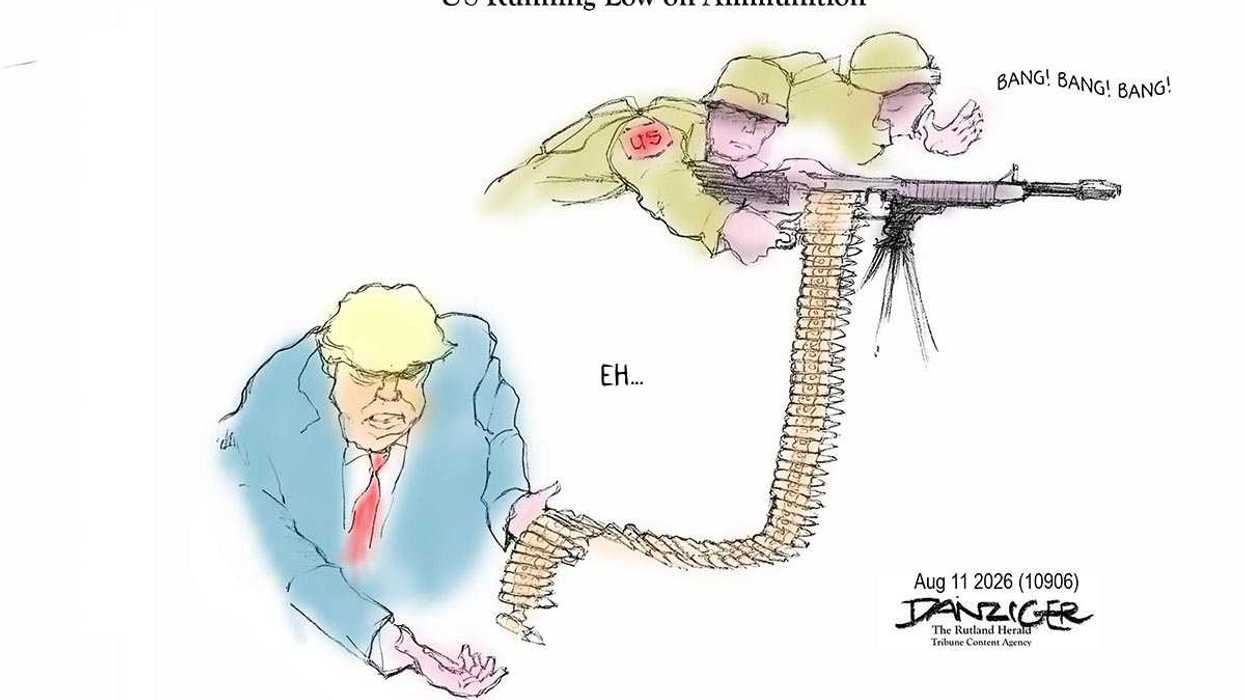
The really striking thing about the munitions shortage and now the horrible conditions on US ships is that to the extent that any action has been taken on either of those issues is it has been only after extensive reporting in the press. So now the Pentagon is talking about a crash program to have defense manufacturers produce more of the missiles that we’ve been running out of. But it’s not clear it’s even started yet, and that call didn’t happen until many months into the war, whereas the munition shortage was obvious to independent observers just a few weeks in — that we were expending munitions that we couldn’t replace. Nothing happened until there was widespread press reporting.

The USS Lincoln has finally been recalled for refit and shore leave. But that didn’t happen until after many press stories about it, all of which were denied, but it’s very obvious just looking at the behavior that the Pentagon and Hegseth and Trump finally reacted saying, oh, I guess something needs to be done. We can’t let this go on. But they didn’t do it until after the press reported.

Now, is this because they’re totally callous? Well, they are. They don’t care at all. The people who yell support the troops most loudly are the people who actually have no interest whatsoever in supporting the troops. But I think it’s probably also the case that they may not have known. That nobody told Trump that we were running out of missiles. He may have read some press stories to that effect, but he said that’s all fake news and nobody within the administration was willing to tell him.

They may not have been willing to tell Hegseth either, who by all accounts flies into a rage and punishes anybody who brings him bad news.So they just didn’t hear about this. They didn’t hear about the munitions. They didn’t hear about the conditions for US sailors until the drumbeat fromthe press became too loud for them to remain insulated, to remain in denial.

So this is what happens. This is the problem with authoritarian regimes. It goes with the related problem with authoritarian regimes, which is that they have a single point of failure. You elevate one person to a position of untouchable authority, and if that person loses it, that person is sundowning, there is no recourse.

One more thing to say about what’s going on is that authoritarian regimes systematically promote incompetence. This is Hannah Arendt on totalitarianism. That it’s not just that they value sycophancy and loyalty above competence. They actually actively dislike competence. Because someone who is competent, someone who knows what they’re doing, might stand on their dignity, might refuse to follow instructions from above. You need third-raters or worse.

This has long been true in areas that I know something about. It’s been true of right-wing economics forever. It’s long been the case that although there are plenty of conservative, competent economists, what the right-wing wanted, even pre-Trump, was creatures like Steve Moore or Larry Kudlow, people who had no idea actually how to do economic analysis, but were unimpeachably, unquestionably loyal because after all, they had no constituency to fall back on.

So we have this mix of leader principle, Führerprinzip -- yes, I think we’re allowed to use the original German here -- information blackout at the top because nobody wants to tell the leader bad news, and incompetence as a general principle throughout the government.

And if you want to understand how the Reflecting Pool happened, if you want to understand how we ended up with this hole in the ground, that was previously the east wing of the White House, all of this is fundamentally the same stuff and it’s true of lots of other areas of policy as well.

Still, I guess most of us thought — I thought, mea culpa — that the military would be among the last places to be hit by this. That, first of all, it should be obvious even to people likeTrump and Hegseth that you don’t muck too much with the military, that you don’t destroy the one instrument you really have, and also that the military itself had, so I thought, a strong enough culture, was highly enough respected among the populace that the military would be able to stand up and say no.

But it turns out that I was wrong. And so instead of being insulated from the craziness and incompetence, the military is actually possibly the most acute victim of everything that’s happening.

At this point they might manage to start feeding the sailors and fix the toilets, though I wouldn’t put 100 percent odds on that. But the broader problem of really destroying one of the last real sources of U.S. strength, that is not going to go away. Instead, it’s going to be the same thing. And the misery will continue until morale improves.

Paul Krugman is a Nobel Prize-winning economist and former professor at MIT and Princeton who now teaches at the City University of New York's Graduate Center. From 2000 to 2024, he wrote a column for The New York Times. Please consider subscribing to his Substack.

Reprinted with permission from Paul Krugman.
Danziger Draws

Danziger Draws

Jeff Danziger lives in New York City and Vermont. He is a long time cartoonist for The Rutland Herald and is represented by Counterpoint Syndicate. He is a recipient of the Herblock Prize and the Thomas Nast (Landau) Prize. He served in the US Army in Vietnam and was awarded the Bronze Star and the Air Medal. He has published eleven books of cartoons, a novel and a memoir. Visit him at jeffdanziger.com.

House Republicans Reject Effort To Track And Curb Neo-Nazis In Military

House Republicans Reject Effort To Track And Curb Neo-Nazis In Military

The House of Representatives voted on Wednesday to improve transparency about the ongoing problem of white supremacists and neo-Nazis in the military and federal law enforcement. But every single Republican present voted no.

The party-line vote was 218-208 in favor of an amendment sponsored by Rep. Brad Schneider (D-IL) to "direct the FBI, Department of Homeland Security, and the Secretary of Defense to publish a report that analyzes and sets out strategies to combat White supremacist and neo-Nazi activity in the uniformed services and Federal law enforcement agencies not later than 180 days after enactment and every six months thereafter."

The amendment's text requires that these reports include "the number of individuals discharged from the uniformed services due to incidents related to White supremacy and neo-Nazi activity," "the number of Federal law enforcement officers separated from federal agencies due to incidents related to White supremacy or neo-Nazi activity," a description of what happened in each incident, information about how the incidents were handled, and plans to address the problem.

In a floor speech explaining his proposal, Schneider cited a May report by the Defense Counterintelligence and Security Agency titled, "Insider Threat and Extremist Activity Within the DOD."

He said the agency "laid out in a very clear presentation, defining what is domestic violent extremism, laying out the stages of development, highlighted seven cases of extremism in active-duty and former-duty servicemembers, and went on to describe — for commanders — steps they can take in prevention and reporting."

Noting that the amendment would help agencies track and address the problem, Schneider explained, "These are exceptions. They are rare, but we must do everything we can to identify them and thwart them before risks become reality."

Rep. Andy Biggs (R-AZ) denounced the amendment as "Orwellian" and said it "attempts to create a problem where none exists." He also predicted that potential military recruits would be so offended by even the existence of such a report that they would not join up:

Every member of the military who showed an interest or actual participation in a white supremacist or white nationalist group has faced discipline. The relevant branch either demoted the individual, discharged them, or otherwise disciplined the sympathizer. Further, the armed services have taken steps to address these concerns going all the way back to the 1980s.

At a time when it is difficult to recruit military and law enforcement, Democrats should be not be maligning their integrity by implying they're overrun with white supremacists and neo-Nazis. In fact, we have lost recently tens of thousands, forced out of service — military service — due to the vaccine mandate. We are way below in our recruiting levels. This type of malignancy, this type of imputation of bad conduct, in a generic form, in a generalized form, because that's what this amendment does, actually will make it harder to recruit.

Extremism is a real problem in the military. But Republican lawmakers have opposed even talking about the issue, suggesting that doing so is an attack on servicemembers and veterans.

At an October 2021 hearing by the House Veterans' Affairs Committee on domestic violent extremist groups targeting active and former military members for recruitment, Rep. Jim Banks (R-IN) complained, "I hope every veteran in America is watching this hearing today and hearing from you and the majority in control of this committee that our veterans are so stupid and susceptible to becoming domestic terrorists that you and the Democrats have to save them from it," adding, "It's wildly offensive and dangerous."

After all 208 Republicans present voted against the amendment, Rep. Bill Pascrell (D-NJ) tweeted a photo of the vote breakdown, writing, "We just voted to combat neo[-N]azis in our military and every single [R]epublican voted no."

Despite the GOP's unanimous opposition, the Schneider amendment will now be part of the National Defense Authorization Act for Fiscal Year 2023, a must-pass bill to establish the budget and operating rules for the military for the upcoming year.

The House is expected to vote on final passage of the defense package by the end of this week.

Reprinted with permission from American Independent.

Are We At Risk Of Stumbling Into A Disastrous War With China?

Are We At Risk Of Stumbling Into A Disastrous War With China?

Reprinted with permission from TomDispatch

The leaders of China and the United States certainly don't seek a war with each another. Both the Biden administration and the regime of Chinese President Xi Jinping view economic renewal and growth as their principal objectives. Both are aware that any conflict arising between them, even if restricted to Asia and conducted with non-nuclear weapons — no sure bet — would produce catastrophic regional damage and potentially bring the global economy to its knees. So, neither group has any intention of deliberately starting a war. Each, however, is fully determined to prove its willingness to go to war if provoked and so is willing to play a game of military chicken in the waters (and air space) off China's coast. In the process, each is making the outbreak of war, however unintended, increasingly likely.

History tells us that conflicts don't always begin due to planning and intent. Some, of course, start that way, as was the case, for instance, with Hitler's June 1941 invasion of the Soviet Union and Japan's December 1941 attacks on the Dutch East Indies and Pearl Harbor. More commonly, though, countries have historically found themselves embroiled in wars they had hoped to avoid.

This was the case in June 1914, when the major European powers — Britain, France, Germany, Russia, and the Austro-Hungarian Empire — all stumbled into World War I. Following an extremist act of terror (the assassination of Archduke Franz Ferdinand of Austria and his wife Sophie by Serbian nationalists in Sarajevo), they mobilized their forces and issued ultimatums in the expectation that their rivals would back off. None did. Instead, a continent-wide conflict erupted with catastrophic consequences.

Sadly, we face the possibility of a very similar situation in the coming years. The three major military powers of the current era — China, the United States, and Russia — are all behaving eerily like their counterparts of that earlier era. All three are deploying forces on the borders of their adversaries, or the key allies of those adversaries, and engaging in muscle-flexing and "show-of-force" operations intended to intimidate their opponent(s), while demonstrating a will to engage in combat if their interests are put at risk. As in the pre-1914 period, such aggressive maneuvers involve a high degree of risk when it comes to causing an accidental or unintended clash that could result in full-scale combat or even, at worst, global warfare.

Provocative military maneuvers now occur nearly every day along Russia's border with the NATO powers in Europe and in the waters off China's eastern coastline. Much can be said about the dangers of escalation from such maneuvers in Europe, but let's instead fix our attention on the situation around China, where the risk of an accidental or unintended clash has been steadily growing. Bear in mind that, in contrast to Europe, where the borders between Russia and the NATO countries are reasonably well marked and all parties are careful to avoid trespassing, the boundaries between Chinese and U.S./allied territories in Asia are often highly contested.

China claims that its eastern boundary lies far out in the Pacific — far enough to encompass the independent island of Taiwan (which it considers a renegade province), the Spratly and Paracel Islands of the South China Sea (all claimed by China, but some also claimed by Malaysia, Vietnam, and the Philippines), and the Diaoyu Islands (claimed by both China and Japan, which calls them the Senkaku Islands). The United States has treaty obligations to Japan and the Philippines, as well as a legislative obligation to aid in Taiwan's defense (thanks to the Taiwan Relations Act passed by Congress in 1979) and consecutive administrations have asserted that China's extended boundary claims are illegitimate. There exists, then, a vast area of contested territory, encompassing the East and South China Seas — places where U.S. and Chinese warships and planes increasingly intermingle in challenging ways, while poised for combat.

Probing Limits (And Defying Them)

The leaders of the U.S. and China are determined that their countries will defend what it defines as its strategic interests in such contested areas. For Beijing, this means asserting its sovereignty over Taiwan, the Diaoyu Islands, and the islands of the South China Sea, as well as demonstrating an ability to take and defend such territories in the face of possible Japanese, Taiwanese, or U.S. counterattacks. For Washington, it means denying the legitimacy of China's claims and ensuring that its leadership can't realize them through military means. Both sides recognize that such contradictory impulses are only likely to be resolved through armed conflict. Short of war, however, each seems intent on seeing how far it can provoke the other, diplomatically and militarily, without triggering a chain reaction ending in disaster.

On the diplomatic front, representatives of the two sides have been engaging in increasingly harsh verbal attacks. These first began to escalate in the final years of the Trump administration when the president abandoned his supposed affection for Xi Jinping and began blocking access to U.S. technology by major Chinese telecommunications firms like Huawei to go with the punishing tariffs he had already imposed on most of that country's exports to the U.S. His major final offensive against China would be led by Secretary of State Mike Pompeo, who denounced that country's leadership in scathing terms, while challenging its strategic interests in contested areas.

In a July 2020 statement on the South China Sea, for instance, Pompeo slammed China for its aggressive behavior there, pointing to Beijing's repeated "bullying" of other claimants to islands in that sea. Pompeo, however, went beyond mere insult. He ratcheted up the threat of conflict significantly, asserting that "America stands with our Southeast Asian allies and partners in protecting their sovereign rights to offshore resources, consistent with their rights and obligations under international law" — language clearly meant to justify the future use of force by American ships and planes assisting friendly states being "bullied" by China.

Pompeo also sought to provoke China on the issue of Taiwan. In one of his last acts in office, on January 9, he officially lifted restrictions in place for more than 40 years on U.S. diplomatic engagement with the government of Taiwan. Back in 1979, when the Carter administration broke relations with Taipei and established ties with the mainland regime, it prohibited government officials from meeting with their counterparts in Taiwan, a practice maintained by every administration since then. This was understood to be part of Washington's commitment to a "One China" policy in which Taiwan was viewed as an inseparable part of China (though the nature of its future governance was to remain up for negotiation). Reauthorizing high-level contacts between Washington and Taipei more than four decades later, Pompeo effectively shattered that commitment. In this way, he put Beijing on notice that Washington was prepared to countenance an official Taiwanese move toward independence — an act that would undoubtedly provoke a Chinese invasion effort (which, in turn, increased the likelihood that Washington and Beijing would find themselves on a war footing).

The Trump administration also took concrete actions on the military front, especially by increasing naval maneuvers in the South China Sea and in waters around Taiwan. The Chinese replied with their own strong words and expanded military activities. In response, for instance, to a trip to Taipei last September by Under Secretary of State for Economic Affairs Keith Krach, the highest-ranking State Department official to visit the island in 40 years, China launched several days of aggressive air and sea maneuvers in the Taiwan Strait. According to Chinese Defense Ministry spokesman Ren Guoqiang, those maneuvers were "a reasonable, necessary action aimed at the current situation in the Taiwan Strait protecting national sovereignty and territorial integrity." Speaking of that island's increasing diplomatic contact with the U.S., he added, "Those who play with fire will get burned."

Today, with Trump and Pompeo out of office, the question arises: How will the Biden team approach such issues? To date, the answer is: much like the Trump administration.

In the first high-level encounter between U.S. and Chinese officials in the Biden years, a meeting in Anchorage, Alaska, on March 18th and 19th, newly installed Secretary of State Antony Blinken used his opening remarks to lambaste the Chinese, expressing"deep concerns" over China's behavior in its mistreatment of the Uighur minority in Xinjiang Province, in Hong Kong, and in its increasingly aggressive approach to Taiwan. Such actions, he said, "threaten the rules-based order that maintains global stability." Blinken has uttered similar complaints in other settings, as have senior Biden appointees to the CIA and Department of Defense. Tellingly, in its first months in office, the Biden administration has given the green light to the same tempo of provocative military maneuvers in contested Asian waters as did the Trump administration in its last months.

"Gunboat Diplomacy" Today

In the years leading up to World War I, it was common for major powers to deploy their naval forces in waters near their adversaries or near rebellious client states in that age of colonialism to suggest the likelihood of punishing military action if certain demands weren't met. The U.S. used just such "gunboat diplomacy," as it was then called, to control the Caribbean region, forcing Colombia, for example, to surrender the territory Washington sought to build a canal connecting the Atlantic and Pacific oceans. Today, gunboat diplomacy is once again alive and well in the Pacific, with both China and the U.S. engaging in such behavior.

China is now using its increasingly powerful navy and coast guard on a regular basis to intimidate other claimants to islands it insists are its own in the East and South China Seas — Japan in the case of the Senkakus; and Malaysia, Vietnam, and the Philippines in the case of the Spratlys and Paracels. In most instances, this means directing its naval and coast guard vessels to drive off the fishing boats of such countries from waters surrounding Chinese-claimed islands. In the case of Taiwan, China has used its ships and planes in a menacing fashion to suggest that any move toward declaring independence from the mainland will be met with a harsh military response.

For Washington in the Biden era, assertive military maneuvers in the East and South China Seas are a way of saying: no matter how far such waters may be from the U.S., Washington and the Pentagon are still not prepared to cede control of them to China. This has been especially evident in the South China Sea, where the U.S. Navy and Air Force regularly conduct provocative exercises and show-of-force operations intended to demonstrate America's continuing ability to dominate the region — as in February, when dual carrier task forces were dispatched to the region. For several days, the USS Nimitz and the USS Theodore Roosevelt, along with their accompanying flotillas of cruisers and destroyers, conducted mock combat operations in the vicinity of islands claimed by China. "Through operations like this, we ensure that we are tactically proficient to meet the challenge of maintaining peace and we are able to continue to show our partners and allies in the region that we are committed to promoting a free and open Indo-Pacific," was the way Rear Admiral Doug Verissimo, commander of the Roosevelt Carrier Strike Group, explained those distinctly belligerent actions.

The Navy has also stepped up its patrols of destroyers in the Taiwan Strait as a way of suggesting that any future Chinese move to invade Taiwan would be met with a powerful military response. Already, since President Biden's inauguration, the Navy has conducted three such patrols: by the USS John S. McCain on February 4, the USS Curtis Wilbur on February 24, and the USS John Finn on March 10. On each occasion, the Navy insisted that such missions were meant to demonstrate how the U.S. military would "continue to fly, sail, and operate anywhere international law allows."

Typically, when the U.S. Navy conducts provocative maneuvers of this sort, the Chinese military — the People's Liberation Army, or PLA — responds by sending out its own ships and planes to challenge the American vessels. This occurs regularly in the South China Sea, whenever the Navy conducts what it calls "freedom of navigation operations," or FONOPs, in waters near Chinese-claimed (and sometimes Chinese-built) islands, some of which have been converted into small military installations by the PLA. In response, the Chinese often dispatch a ship or ships of its own to escort — to put the matter as politely as possible — the American vessel out of the area. These encounters have sometimes proven exceedingly dangerous, especially when the ships got close enough to pose a risk of collision.

In September 2018, for example, a Chinese destroyer came within 135 feet of the guided-missile destroyer USS Decatur on just such a FONOP mission near Gavin Reef in the Spratly Islands, obliging the Decatur to alter course abruptly. Had it not done so, a collision might have occurred, lives could have been lost, and an incident provoked with unforeseeable consequences. "You are on [a] dangerous course," the Chinese ship reportedly radioed to the American vessel shortly before the encounter. "If you don't change course, [you] will suffer consequences."

What would have transpired had the captain of the Decatur not altered course? On that occasion, the world was lucky: the captain acted swiftly and avoided danger. But what about the next time, with tensions in the South China Sea and around Taiwan at a far higher pitch than in 2018? Such luck might not hold and a collision, or the use of weaponry to avoid it, could trigger immediate military action on either side, followed by a potentially unpredictable escalating cycle of countermoves leading who knows where.

Under such circumstances, a war nobody wanted between the U.S. and China could suddenly erupt essentially by happenstance — a war this planet simply can't afford. Sadly, the combination of inflammatory rhetoric at a diplomatic level and a propensity for backing up such words with aggressive military actions in highly contested areas still seems to be at the top of the Sino-American agenda.

Chinese and American leaders are now playing a game of chicken that couldn't be more dangerous for both countries and the planet. Isn't it time for the new Biden administration and its Chinese opposite to grasp more clearly and deeply that their hostile behaviors and decisions could have unforeseeable and catastrophic consequences? Strident language and provocative military maneuvers — even if only intended as political messaging — could precipitate a calamitous outcome, much in the way equivalent behavior in 1914 triggered the colossal tragedy of World War I.

Copyright 2021 Michael T. Klare

Michael T. Klare, a TomDispatch regular, is the five-college professor emeritus of peace and world security studies at Hampshire College and a senior visiting fellow at the Arms Control Association. He is the author of 15 books, the latest of which is All Hell Breaking Loose: The Pentagon's Perspective on Climate Change. He is a founder of the Committee for a Sane U.S.-China Policy.

Shop our Store

Headlines

Editor's Blog

Trending

World