Tag: budget
trump administration

Not Too Soon To Ask How We Can Repair Trump's Wreckage

One of the more interesting, and more hopeful, questions I like to think about is: how long will it take to repair the damage done by the Trump administration? As a member of the Biden admin, I have personal experience fixing some of what got broken in Trump 1. (EG, they did a good job supporting the creation of the COVID vax but blew the distribution; also, international relations).

The trade war is an obvious candidate, but we now need to think about their newly passed budget bill in this context.

The more one learns about the bill, the more it resembles a computer virus embedded in our economy and society, infecting policy in dozens of areas, and such viruses are hard to extract. The big ticket items—the upwardly skewed tax cuts and downwardly skewed spending cuts—have gotten ample attention. The cuts to renewable energy production, a bit less so; same with reductions in debt relief for college loans. And then there are a slew of “earmarks”—tax breaks for special interests—that have gotten very little attention. Politico does an excellent job collecting e.g.’s, some of which I relegate to an appendix.

Extracting such a virus will require the same type of focus and drive that Trump and the Republicans brought to the task. In a recent post, I argued that Ds need to both emulate this focused energy while reverse engineering the tariffs and budget on behalf of actually helping people who need it, versus pretending to do so while screwing them.

What will that look like?

Unwinding the sweeping (versus narrowly targeted) tariffs, given that they’re non-legislative, should be a slam-dunk, though it will require Ds not to fold when some interest group, be they industry or union, objects.

We’re also going to have to be willing to both unwind some tax cuts and seek new revenues. We already did some of the analytic work re the latter task in the Biden administration: our proposed budgets—which never got anywhere in the divided gov’t we mostly faced—proposed significant, highly progressive revenue-raising tax hikes, but only on a narrow slice at the top of the income scale. That’s not enough to get back on a more sustainable fiscal path, which is where we need to be if we’re going to not only reverse the new cuts in the safety net but also address affordability shortfalls in housing, child care, health care, and higher ed. But it’s the right place to start, as shown in this chart from Brendan Duke (see third bar).

That shouldn’t be a heavy lift for Ds, at least not for those who aren’t in the same donors’ pockets as the Rs who passed this beast. In fact, our proposed tax hikes above $400K had a lot of support from Ds, many of whom pushed us to go further.

They were right, and this means that Democrats are going need some spine to reverse tax cuts in the bill that have some constituent support but are terribly designed. The no-tax-on-tips leaves out a big group of tipped workers with no federal tax liability from which to deduct the tax break (they’d get actual, and much needed, help from an increase in the federal minimum wage, still stuck at $7.25!). And while the tip deduction may help some of the waitress, it does nothing for the cooks. The $6,000 seniors’ deduction, along with the lifting of the SALT cap, mostly give more money to people who are doing fine without the extra help.

Next, we’ll need to restore the cuts to the safety net. Again, this should not be a heavy lift for Ds, especially given the vast unpopularity of these cuts. The questions at that point will be more about expansion. Health coverage and groceries are at the heart of the affordability crisis, points that should lead attacks on the bill (the cuts mostly kick in after the midterms, so this argument must be made in bomb-defusing terms I discuss below). Thus, expanding coverage further up the income scale is worthy of consideration, as is lowering the age for Medicare eligibility. Again, this takes revenue, which circles back to reversing tax cuts and adding new revenue increases.

Then we’ll need to get back to the industrial policy that was generating important, significant investment in renewable energy production. This too shouldn’t be a heavy lift as the production tax credits that the bill ends had very broad support, which is one reason for the deep unpopularity of the Trump budget. Even traditional Rs like the Chamber of Commerce and energy companies that recognize renewable energy production is part of their and our futures don’t understand the motivation for these cuts which seem to be driven wholly by Trump’s nostalgia for coal and distaste for wind turbines blocking his view.

Reversing the harsh deportation measures, along with funding for the wall and ICE, must also be part of this effort, but this one is complex and deserves its own later post. Any Democratic action in this area must be forthright about the need to maintain secure borders. But fair-minded people should all take solace from the fact that the Trump admin’s cruelty in this place is recognized by majorities of Americans, who are both unhappy and shocked by the ongoing extremism of masked, unidentified people grabbing people off the streets and throwing them into vans and airplanes, not to mention the local realities of losing a significant chunk of their workforces.

The only way we’ll be able to do any of this is through the same budget reconciliation process that the Rs used to pass this bill (it avoids a Senate filibuster). Which is another way of saying that the ability to right the wrongs being perpetrated is conditional on Trumps’ opponents gaining power. This, in turn, requires us to deal with the timing of the bill wherein many—not all—of the goodies (tax cuts) come first and the pain (health coverage and SNAP cuts) come later. But campaigning on defusing a time bomb seems like a perfectly reasonable strategy to me, especially if we keep the pressure on by constantly pointing out the falsehoods used to sell the package.

For example, the admin claims deficit reduction from the bill starting this year, followed by quite large reductions next year. That’s unlikely, and requires tracking. Ending credits for the production of renewable energy occurs this year and next, and this too should be scrutinized for job losses and energy-cost impacts.

I hate to say it but this is only day 167 of this administration. There will be a lot more damage to reveal and elevate along with damage-reversal planning to do as the months roll on. But, especially in the days around July 4th, I like to think about this as a labor of love for this country, which needs a whole lot of that right about now.

Appendix: Earmarked tax breaks in the new bill that you might have missed.

From Politico:

Senate Republicans not only kept a House-approved provision exempting gun silencers from a long-standing $200 tax on firearms — they dumped the tax on all guns it applied to, except machine guns and what the legislation terms “a destructive device.” That cost: $1.7 billion.

There’s a new supersized deduction for business meals — though only for employees at certain Alaskan fishing boats and processing plants, with the measure stipulating the facilities must be “located in the United States north of 50 degrees north latitude” though not in a “metropolitan statistical area.”

There’s a $2 billion break important to the rum industry and, tangentially, Louisiana, said Sen. Bill Cassidy (R-La.), a tax writer…“We have the highest per capita intake of alcohol in the nation,” he said.

…an expansion of a little-known break that Silicon Valley investors have used to nix tax bills on tens and even hundreds of millions of dollars in earnings from Internet startups. Another spends $26 billion to create a new $1,700 credit for people who give to groups providing scholarships for children to attend private school.

Sen. Mitch McConnell (R-KY) secured a $7 billion tax cut for farmers that allows them to postpone paying some of the capital gains taxes they owe when selling off farmland.

…a $1 billion provision allowing “spaceports” — which the legislation defines as “any facility located at or in close proximity to a launch site or reentry site” — to sell tax-exempt bonds…Sen. Ron Wyden, the chamber’s top Democratic tax writer, said in an X post that “Trump’s wedding gift to [Jeff] Bezos and birthday gift to [Elon] Musk were tucked in the new budget bill.

Reprinted with permission from Substack.
Senate Parliamentarian Enrages GOP With Crushing Blow To Trump's Budget Bill

Senate Parliamentarian Enrages GOP With Crushing Blow To Trump's Budget Bill

The Senate parliamentarian delivered a significant setback to congressional Republicans and President Donald Trump’s extensive domestic agenda on Thursday, otherwise known as the “One Big Beautiful Bill.”

The highly unpopular legislation that’s so central to Trump’s policy goals was already on shaky ground because of its core premise: cutting entitlement programs like Medicaid to fund tax cuts for corporations and the wealthy. Now, about a week before the Trump administration’s self-imposed July 4 signing deadline, it’s also falling apart on procedural grounds.

Senate Parliamentarian Elizabeth MacDonough, a nonpartisan adviser who helps senators navigate procedures and rules, determined that several key provisions of the legislation violate the Senate’s budget rules and cannot be included under the fast-track reconciliation process Republicans are using to bypass a Democratic filibuster. Among the casualties are limits on student loan repayment options and a controversial crackdown on states’ use of the “provider tax loophole” to secure more federal Medicaid dollars.

That last one presents a big problem. Nearly every state utilizes the loophole in some form, and senators from states that depend heavily on it—especially those with rural hospitals—have warned they won’t support the bill unless it’s amended.

MacDonough’s ruling forces GOP leaders back to the drawing board. If they cannot salvage the struck-down provisions, they will lose more than $500 billion in planned spending cuts, according to Bobby Kogan, a former Democratic Senate Budget Committee staffer now with the Center for American Progress. And unless they find a work-around, Republicans would need 60 votes to keep those provisions—an unlikely prospect given the GOP’s narrow Senate margin.

Meanwhile, the tax cuts at the core of the bill remain under review.

This isn’t the first time MacDonough has blocked parts of the GOP’s wishlist. She’s previously rejected attempts to cut SNAP benefits and limit federal judges’ authority to block Trump’s policies.

Her decision has sparked immediate outrage among conservatives, with some Republicans now openly calling for her removal.

“The Senate Parliamentarian is not elected. She is not accountable to the American people. Yet she holds veto power over legislation supported by millions of voters,” Rep. Greg Steube of Florida posted on social media.

Sen. Tommy Tuberville went further, attacking the “WOKE parliamentarian” for rejecting cuts to states that fund health care for undocumented immigrants.

“This is a perfect example of why Americans hate THE SWAMP,” the Alabama senator wrote. “Unelected bureaucrats think they know better than U.S. Congressmen who are elected BY THE PEOPLE. Her job is not to push a woke agenda. THE SENATE PARLIAMENTARIAN SHOULD BE FIRED ASAP.”

Unsurprisingly, Democrats welcomed the ruling.

“Republicans are scrambling to rewrite parts of this bill to continue advancing their families lose, and billionaires win agenda,” said Sen. Jeff Merkley of Oregon. “But Democrats stand ready to fully scrutinize any changes and ensure the Byrd Rule is enforced.”

MacDonough, for her part, has blocked many Democratic priorities, including raising the federal minimum wage to $15 and parts of the party’s immigration reform efforts. She is a neutral rules referee, not a political player. If Republicans dislike the process, they can always eliminate the filibuster, a tactic which effectively requires a 60-vote supermajority to pass legislation. So far, they have not.

Nevertheless, the parliamentarian’s ruling could prove decisive. Senate Republicans had hoped to vote this weekend or sooner to give the House time to finalize changes and get the bill to Trump’s desk before his holiday deadline. That timeline now appears uncertain.

Senate Majority Leader John Thune attempted to downplay the chaos.

“These are speed bumps along the way; we anticipated those and so we have contingency plans,” Thune said. He also added that Republicans wouldn’t try to overrule MacDonough’s guidance.

Sen. Rand Paul of Kentucky was less optimistic, suggesting the GOP would “probably” still hold a vote this weekend.

Behind the scenes, Republicans are trying to modify the provisions MacDonough struck down, though it remains unclear whether they can be tweaked or must be entirely removed. One GOP source told Axios that the party still hopes to “find a solution to achieve the desired results.”

If not, they’re stuck. And for Trump, it’s another prominent legislative obstacle—this time from an unelected rules referee standing between him and a desperately wanted victory.

Reprinted with permission from Daily Kos.

Desperate Republicans Trying To Bully 'Vulnerable' Democrats Over Trump Budget

Desperate Republicans Trying To Bully 'Vulnerable' Democrats Over Trump Budget

The GOP congressional campaign arm is set to launch an advertising campaign attacking Democrats who opposed President Donald Trump’s “One Big, Beautiful Bill Act” that dismantles much of the safety net—yet another reminder that the bill and its provisions are overwhelmingly disliked by the public.

If the bill passes, millions of Americans will lose health care that they currently receive via Medicaid, which was established in 1965 by Democratic President Lyndon Johnson under his “Great Society” plan.

On Monday, Fox News published the details of the upcoming campaign after being given a “first on Fox” preview by the National Republican Congressional Committee. Fox describes the campaign as “aggressive messaging” by the party.

“Out of touch House Democrats lit the fire of inflation and tried to slap Americans with the biggest tax hike in decades, all to fund their radical agenda. Voters won’t forget this betrayal—not now, not next November,” NRCC spokesman Mike Marinella told Fox.

But the Democratic Congressional Campaign Committee, the Democratic counterpart to the NRCC, sounded less than impressed.

"It's no wonder the so-called moderate House Republicans continue to lie about their Tax Scam: the Big, Ugly Bill is wildly unpopular with the American public and they know their vote for it will lose them their majority next year,” DCCC spokesperson Justin Chermol told the outlet.

And the data backs up Chermol’s assertion.

In a KFF Health poll released June 17, 64 percent of adults had an unfavorable view of the bill. Even more dire for the GOP, while a majority of Republicans—particularly those identifying themselves as MAGA voters—back the bill, support has fallen. For instance, when MAGA voters were told that the bill would cut funding for local hospitals, support dropped 20 percentage points.

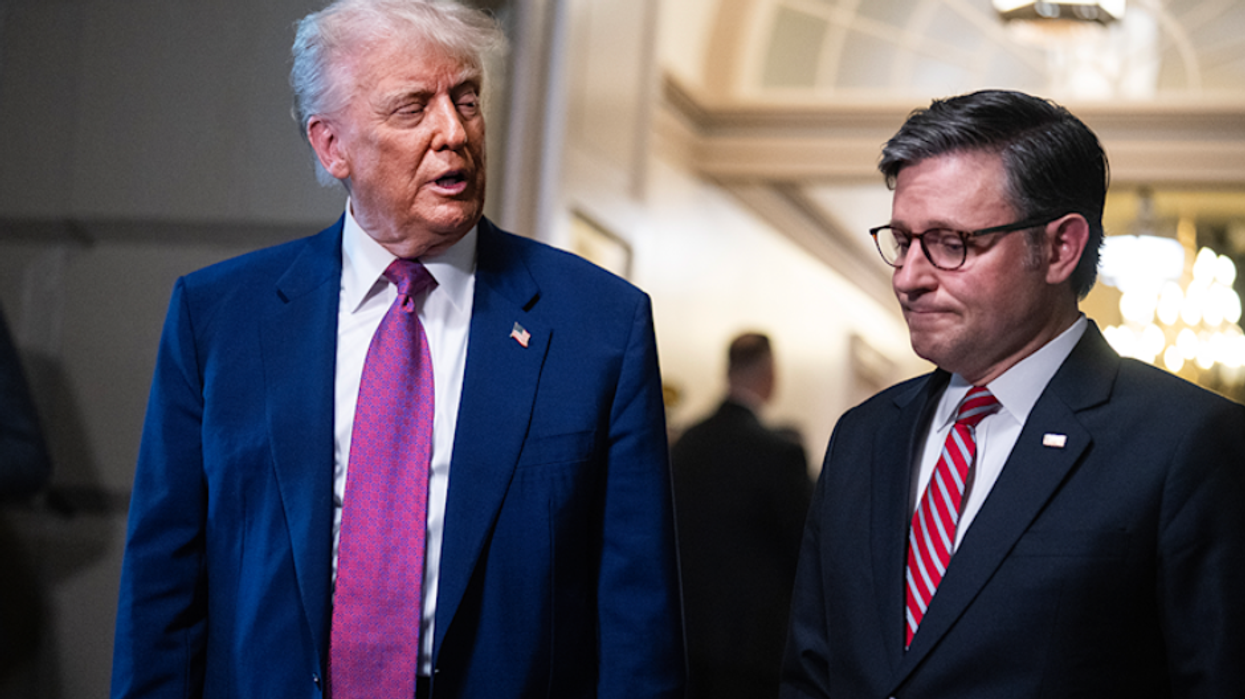
Perhaps not surprisingly, even with the support of Trump and House Speaker Mike Johnson, the bill barely made it through the GOP-led House, passing 215-214 on May 22 in the wee hours of the morning. No Democrats voted for the bill, and two Republicans voted against it while another voted “present.”

Soon after, as the bill made its way toward the Senate, Republicans who voted for it began expressing regrets about some of the contents. Rep. Marjorie Taylor Greene of Georgia, a prominent conspiracy-peddling MAGA voice, said she opposed a provision of the bill that banned regulation of artificial intelligence.

Republicans have mostly avoided direct contact with voters at town halls, hoping to avoid the backlash from the public on unpopular initiatives like cuts made by the so-called Department of Government Efficiency, but two Republicans did host events after voting for the Trump bill. That was a mistake.

Rep. Ashley Hinson of Iowa was drowned out by boos in her mostly Republican district after she said she was “proud” to vote for the legislation, and one constituent even called her a “fraud.” Rep. Mike Flood of Nebraska had a similarly hostile crowd at an event after the bill passed.

The NRCC’s decision to run to Fox for a puff piece about their shiny new ad campaign makes more sense in this context. Before it’s even become law, the public is opposed to the bill and passage in the Senate is not guaranteed.

Fox is simply one of the few media outlets that wouldn’t roll over laughing at the NRCC’s proposition that Democrats would face voter ire for siding with the public and opposing Trump’s “big, beautiful” mess.

Reprinted with permission from Daily Kos.

Margie Whines That Her Life In Congress Is 'Miserable' -- And Costs Too Much

Mad Margie Is Sorry She Voted For Trump's Budget Bill

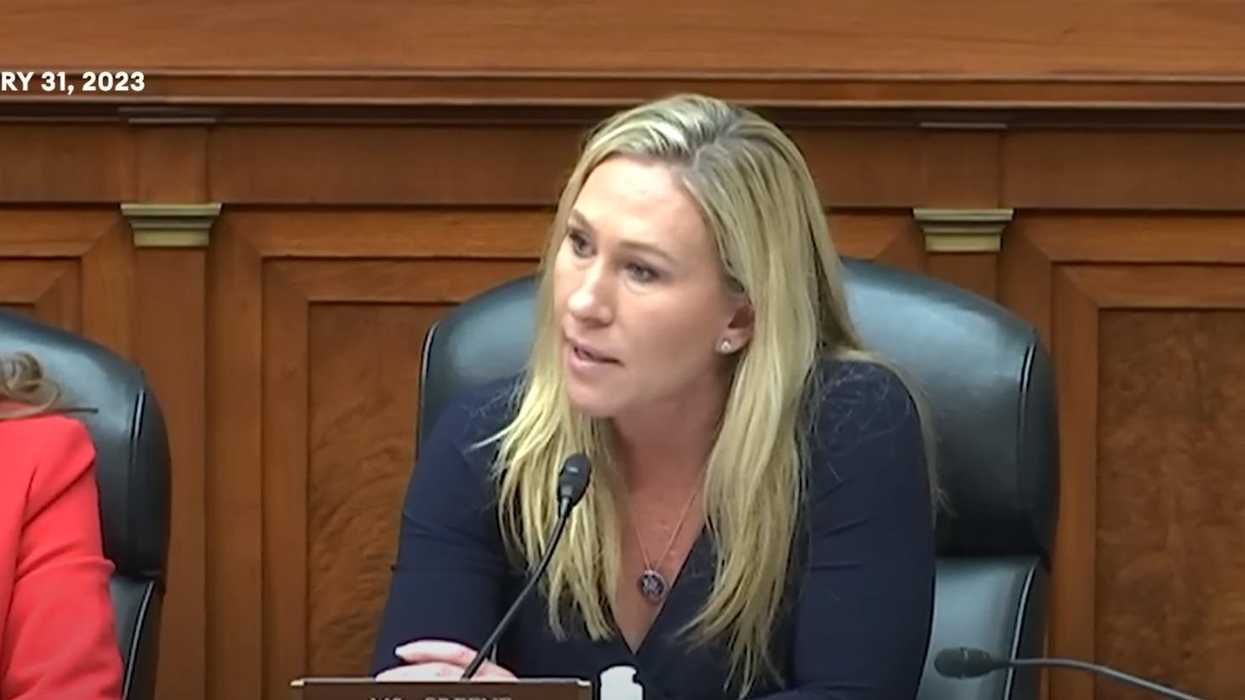
Rep. Marjorie Taylor Greene, Republican of Georgia, previously celebrated the House's passage of President Donald Trump's "One Big, Beautiful Bill.” But now she claims that she would have voted against it—had she actually read it.

In a post on X, Greene explained that she didn’t know that the bill includes a provision blocking states from regulating artificial intelligence, and had she known, she would have voted against the Medicaid-slashing legislation that passed by a one-vote margin.

"Full transparency, I did not know about this section on pages 278-279 of the OBBB that strips states of the right to make laws or regulate AI for 10 years. I am adamantly OPPOSED to this and it is a violation of state rights and I would have voted NO if I had known this was in there,” she wrote.

Greene had been championing the dogshit legislation that slashes health care and food stamps while exploding the deficit with tax cuts for the rich. And after it passed the House ahead of Memorial Day, she cheered.

"We passed President Trump’s One Big Beautiful Bill out of the House this morning and now it’s on its way to the Senate!!" Greene wrote on X, celebrating the fact that the legislation would block Medicaid payments to Planned Parenthood.

But now she claims that she didn't read the full bill, the text of which was released late at night and just a few hours before the House voted on it.

But Greene isn't the only Republican to admit to having no idea what she voted for.

Rep. Mike Flood of Nebraska said he didn't know that the bill includes a provision that would make it more difficult for federal judges to enforce contempt rulings—a last-minute addition from sycophantic lawmakers who want to protect Dear Leader from being held accountable for ignoring court orders.

“This provision was unknown to me when I voted for the bill,” Flood said during a town hall, where he was mercilessly booed by his constituents who were angry that he voted in favor of the bill.

As backlash mounts against the bill, it’s possible that we’ll see other GOP lawmakers express remorse for voting in support of legislation that will kick millions of people off of their health insurance and food assistance while potentially taking down the U.S. economy.

It seems that even Republicans understand how much of a political loser the bill is, as GOP lawmakers are straight up lying about its Medicaid cuts to try to avoid voter backlash, which has exploded at town halls across the country.

The White House even released a fact sheet assuring Americans that people won’t “literally die” because of the bill.

If you have to explain to people that you don’t think they’ll die from your signature legislation’s health care cuts, it’s safe to say that you’re not in a great place politically.

Reprinted with permission from Daily Kos.

Shop our Store

Headlines

Editor's Blog

Corona Virus

Trending

World