Tag: crime
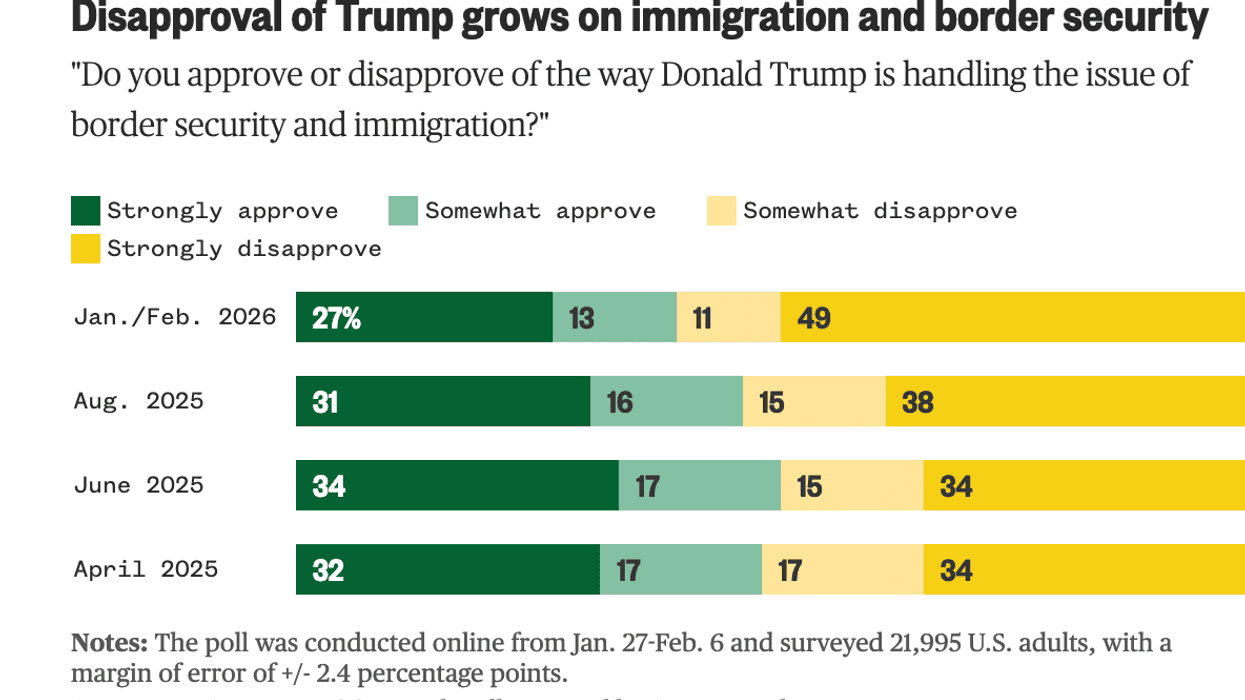
NBC News poll on immigration

The Democrats' Opportunity, If Only They Can Seize It

President Donald Trump's approval rating is sinking and gasping for air. His average net approval stands at -13.7, which is lower than Joe Biden's was at this point in his term. This matters beyond cosmic justice: The president's approval rating is the best predictor of midterm election outcomes. When it falls below 50 percent, his party tends to lose seats, as in the 1982, 1994, 2006, 2010, 2014 and 2018 elections.

So the Democratic Party, written off as dead by some a few months ago, stands poised for victory in November. That's good, but not good enough.

The stakes are so high that a win isn't sufficient to meet the moment. We need a crushing repudiation of this fascistic horror show.

The easiest issue, perhaps surprisingly, is immigration. Since 2024, Democrats have been snakebit on the subject, afraid that their instinctive pro-immigrant positions were unpopular enough to lead voters to select a snarling villain vowing mass deportations. They can exhale. What the polls over the past year suggest is that most Americans are not white-supremacist goons like Stephen Miller, ready to trash the Constitution in the name of purifying die Volk.

Instead, voters actually believed that Trump would only deport "the worst of the worst." As they watched the inhuman treatment of gardeners, veterans, children, and American-citizen protesters, they soured fast. Following the shooting of Alex Pretti, fully 60 percent of respondents told NBC they disapproved of Trump's immigration policies, 49 percent strongly so.

If Democrats present themselves as opposing the brutal tactics of ICE and CPB and favoring firm border controls, they should find themselves in the sweet spot. Messages like Billie Eilish's "No one is illegal on stolen land" are unhelpful. By all means, get angry about the savagery; stress that law and order means that first and foremost the state cannot be the lawbreaker. But also add that borders are not notional and chaos cannot be permitted to prevail along the Rio Grande.

The other big issue on voters' minds is inflation, or "affordability." The reality is that politicians cannot actually bring prices down, as Trump promised to do in 2024, except by crashing the economy. Still, some voters presumably believed him, and they are disillusioned now. Some Democrats may be tempted to run on taxing the rich. This is a comfortable old shoe for Democrats, but as a political strategy it hasn't been terribly successful. Middle-class voters often fear that they will be labeled as rich.

On the other hand, voters have already concluded that tariffs are making life more expensive. The issue is a layup — if Democrats can get out of their own way. Nearly 60 percent of Americans blame Trump for rising prices, and 65 percent disapprove of his tariffs. Fifty-nine percent of independent voters say the tariffs have hurt the economy and their personal finances. Voters are rarely able to connect policy to outcomes, but they have done so in the case of tariffs. Back in 2024, Americans were about equally divided on the question of trade, with some favoring higher tariffs and roughly similar numbers opting for lower tariffs. Experience has changed their views.

The progressive wing of the party has long favored tariffs as a way to protect American workers from competition from low-wage nations. This muddies the waters.

Cutting tariffs is one of the only levers governments can pull that will actually reduce prices, and since price sensitivity is very much on voters' minds, does it make sense to temper that message at all? All House Democrats voted in favor of a resolution that would end the national emergency excuse for tariffs, and three Republicans joined them. This is the moment. Tariffs are bad — full stop.

Finally, a vulnerability that Democrats must overcome is seeming soft on crime. Here again the Trump administration has handed them a golden opportunity. MAGA is so fixated on ethnic cleansing that it is pulling Justice Department officials off crime-fighting to pursue immigration cases. A memo from Acting Deputy Attorney General Emil Bove directed officers who had been working on transnational organized crime, money laundering, and major drug trafficking networks to focus instead on assisting ICE. Ditto for the FBI Joint Terrorism Task Forces.

Ditto for the FBI Joint Terrorism Task Forces. In fact, roughly 25 percent of FBI agents (and 40 percent in larger field offices) have been diverted from fighting financial crimes, public corruption, cybercrime and complex corporate investigations and pulled into immigration enforcement. Most maddening are the thousands of FBI and Homeland Security agents who've been pulled from investigations of child sex abuse to assist with deportations — as if the administration needed more ways of signaling that it's OK with child sex trafficking.

In fact, roughly 25 percent of FBI agents (and 40 percent in larger field offices) have been diverted from fighting financial crimes, public corruption, cybercrime and complex corporate investigations and pulled into immigration enforcement. Most maddening are the thousands of FBI and Homeland Security agents who've been pulled from investigations of child sex abuse to assist with deportations — as if the administration needed more ways of signaling that it's OK with child sex trafficking.

Cutting tariffs is one of the only levers governments can pull that will actually reduce prices, and since price sensitivity is very much on voters' minds, does it make sense to temper that message at all? All House Democrats voted in favor of a resolution that would end the national emergency excuse for tariffs, and three Republicans joined them. This is the moment. Tariffs are bad — full stop.

Democrats should stress that the funds appropriated for ICE would be far better deployed to local police departments. Bill Clinton's promise to hire 100,000 police officers was very popular in the '90s and cut against the Democrats' soft-on-crime image. The slogans write themselves: More Cops, Less ICE.

The voters are the last redoubt in the fight to reclaim American democracy and decency, and the Democratic Party, the world's oldest political party since the advent of universal suffrage, is the only entity that can carry the burden. If they can win a resounding victory in the House and Senate in nine months, there is hope for us.

Mona Charen is policy editor of The Bulwark and host of the "Beg to Differ" podcast. Her new book, Hard Right: The GOP's Drift Toward Extremism, is available now.

Reprinted with permission from Creators

2017 inaugural address

Now We Know What Trump's 'American Carnage' Rant Was About

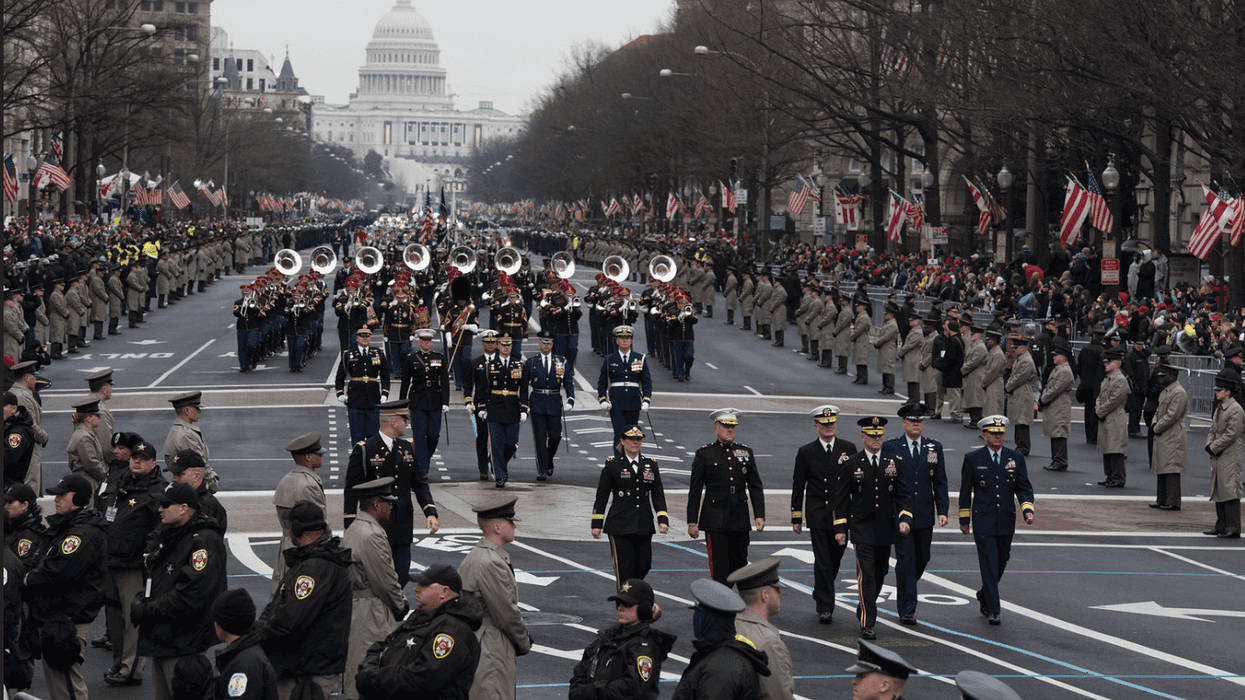
Does anyone remember “American carnage”? In his 2017 inaugural address Donald Trump portrayed a collapsing society, emphasizing in particular the “crime and gangs and drugs” destroying America’s cities.

It was a peculiar and disturbing speech, in part because it bore no relationship to reality. Then as now, America had many problems. But runaway urban crime wasn’t one of them. In fact, Trump chose to proclaim urban carnage after a remarkable generation-long run of plunging crime in our major cities. New York, for example, had only 335 murders in 2016, down from 2,262 in 1990.

So what was that about?

At the time, I thought it was mostly about sadism. Trump clearly loves punishing people, so he was eager to portray a nation full of people who needed punishing. And it remains true, as Adam Serwer pointed out back in 2018, that for Trump and many of his supporters cruelty is a goal in itself, that they rejoice in the suffering of those they hate and fear.

But the events unfolding in Los Angeles as you read this and, I fear, the events likely to unfold across much of America soon, quite possibly this weekend, suggest that the motivations of Trump and his cronies go deeper than mere (mere!) sadism. They want to use false claims of chaos to justify a power grab that, if successful, would mark the end of the American experiment.

As I assume everyone knows by now, on Friday heavily armed — and masked — ICE agents began raiding workplaces in and around Los Angeles, seeking to arrest people they claimed were illegal immigrants. Crowds quickly gathered to protest. After all, ICE wasn’t rounding up members of violent gangs. It was scooping up ordinary people doing ordinary jobs, many of whom had friends and relatives in the neighborhood.

The protests were relatively peaceful, although there were some scuffles, objects thrown and vandalism. Los Angeles has experienced real riots in the past. This didn’t even come close. But ICE and some other law enforcement personnel responded with heavy application of force — not lethal weapons, at least not yet, but lots of tear gas, rubber bullets, and so on.

Until ICE moved in Los Angeles was, in fact, remarkably peaceful. Like other major American cities, LA experienced a significant but not huge crime wave in the aftermath of Covid but has since seen that wave more than completely recede:

Los Angeles right now is probably as safe as it has ever been.

But if you read Trump, which you should to get past the sanewashing, the City of Angels sounds like a scene from Fallout:

And Noem has called LA a “city of criminals.”

As a New Yorker, I’m accustomed to seeing my quite livable city portrayed as a hellscape. Still, there are 13 million people living in Greater Los Angeles who can testify that it has not, in fact, been invaded and occupied, let alone taken over by insurrectionist mobs.

Oh, and let’s not forget that an actual insurrectionist mob tried to overturn the 2020 election — and Trump has pardoned its members.

But no matter. Trump wanted an excuse to mobilize the National Guard, even though the governor of California not only didn’t request it, but has sued Trump to demand that he rescind the order.

When did a president last federalize the Guard against a governor’s wishes? Sixty years ago, when Lyndon Johnson mobilized the Alabama National Guard against the wishes of George Wallace, so that the Guard could protect civil rights marchers.

I’m still seeing some news analyses portraying what’s happening as a confrontation over immigration. And there are definitely people in the administration, led by Stephen Miller, who simply hate immigrants — legal or not, it doesn’t much matter. White South Africans seem to be the only exception.

But this looks bigger even than a play by an administration that has been finding, to its horror, that mass deportation is a lot harder than it sounds — especially if you make any effort at all to follow due process.

What it looks like is an attempt to create confrontations that can be used to impose something that, for practical purposes, amounts to martial law.

And if that’s what it’s really about, what’s happening in Los Angeles is just the beginning.

Most immediately, what is going to happen this Saturday? The government is going to hold a costly military parade in Washington, even though we aren’t celebrating any recent victories I’m aware of. This is the kind of thing one expects to see in Red Square, not the capital of a democracy. And guess what: the parade will also fall on Donald Trump’s birthday.

Many pro-democracy groups have teamed up to organize protests against the parade. There will be “No Kings Day” demonstrations all across the country. I don’t know whether there will be any violent incidents. But I’m quite sure that Trump and his allies will claim that violent incidents are happening and seek excuses to use force against the protestors.

So it’s important to understand what is happening here. Trump isn’t reacting to any real threat of disorder in California. And while anti-immigrant bigotry is certainly an important factor, it’s not the whole story.

No, this is all about finding excuses to use force against Trump’s critics and opponents and justify an anti-democratic power grab.

Paul Krugman is a Nobel Prize-winning economist and former professor at MIT and Princeton who now teaches at the City University of New York's Graduate Center. From 2000 to 2024, he wrote a column for The New York Times. Please consider subscribing to his daily Substack.

Reprinted with permission from Substack.

Crypto Is A Criminal Enterprise That Now Controls Our Government

Crypto Is A Criminal Enterprise That Now Controls Our Government

I spent my very early years in Utica, New York. I was too young to know anything about the city’s reputation — I left when I was 8 — but I would later learn that it was known at the time as “Crime City,” because it was reportedly controlled by the Mob.

Stories of towns infiltrated by organized crime or ruled by blatantly corrupt politicians used to be fairly common. These days you hear tales of blatant personal corruption at the local level less often.

But who could have imagined raw corruption determining policy for the United States as a whole?

Unless there’s a sudden outbreak of conscience and rationality on Capitol Hill, Congress is about to pass, with (alas) wide bipartisan support, the GENIUS Act, which will legitimize and normalize “stablecoins” — cryptocurrency tokens that, unlike the original tokens such as Bitcoin and its imitators, are supposed to be protected against wild fluctuations in their purchasing power, because they’re backed by conventional assets like Treasury bills.

I’ll talk in a minute about why encouraging stablecoins is such a bad idea. But first let’s talk about crypto in general.

Crypto’s early enthusiasts may well have been idealists, imagining that they could create something that was better and safer than traditional money. But as the years have gone by — Bitcoin was introduced in 2009! — crypto keeps failing to find legitimate uses. There is, to a first approximation, nothing you can legally buy with crypto assets except other crypto assets.

The journalist Zeke Faux, who wrote “Number Go Up,” a portrait of the crypto industry, went around the world both studying cryptocurrencies and trying, when he could, to use them. In the end, he wrote, “Traveling around the world investigating crypto had given me a new appreciation for my Visa card.”

So why do ordinary people keep buying crypto? Part of the answer is intense marketing; as I mentioned in a recent post, my Venmo app (which is actually useful) is constantly trying to sell me crypto. But the most compelling explanation why people buy crypto is that there is a clear affinity between the psychology of buying crypto and the psychology of gambling. Retail crypto looks, in particular, a lot like the “numbers racket,” which siphoned millions of dollars from generations of working-class Americans until it was largely supplanted by state lotteries.

The numbers racket was illegal, but flourished anyway because the criminal organizations paid off police and politicians.

But they were pikers by today’s standards. According to Public Citizen, crypto companies accounted for almost half of all corporate spending during the 2024 election. Donald Trump and his family have made billions off the $Trump and $Melania “meme coins,” but I wouldn’t be surprised to learn that other politicians have also been the beneficiaries of crypto largesse.

And what the crypto industry wants out of today’s politicians, above all, is legislation that gives a veneer of legitimacy to stablecoins like Tether.

What is a stablecoin? It’s a digital token like Bitcoin — that is, an asset that “belongs” to whoever has the secret numerical key that unlocks it. But unlike Bitcoin, whose value in dollars fluctuates wildly day to day, a stablecoin is supposed to retain a fixed value in dollars. The stablecoin issuer maintains that stability by standing ready to buy its tokens back, holding reserves of conventional assets like Treasury bills for that purpose.

One way to think about this is that stablecoin issuers are like banks back in the days before the Civil War, when gold and silver coins were the only official forms of money. Many banks issued paper currency, which they promised to redeem for gold and silver coins on demand. Similarly, stablecoin firms issue tokens that they promise to redeem for dollars.

Antebellum banks that issued their own notes served a useful function, because the federal government wasn’t yet issuing its own paper currency. So bank notes played an important role in ordinary, legitimate commerce. For example, the $10 “Dixie” notes issued by the Citizens Bank of Louisiana (they were printed in French on one side) circulated widely across the lower Mississippi. Yet some of these early, unregulated banks were “wildcat banks”: banks that were specifically set up to defraud anyone foolish enough to accept their bank notes as payment.

So like antebellum bank notes, which were privately issued currencies supported by the claim that they were backed by gold and silver, stablecoins are privately issued tokens supported by the claim that they are backed by dollars. Unlike antebellum bank notes, however, stablecoins don’t serve any clearly useful function. They can’t be used to make ordinary purchases, and there’s nothing you can do with them that can’t be done more cheaply and more easily with debit cards, Venmo, Zelle, wire transfers etc. That is, why not just use dollars instead of tokens that are supposedly backed by dollars?

The answer to that question is that the ownership and disposition of stablecoins, unlike the ownership and distribution of bank deposits, is anonymous. This is a highly valuable feature for those who want to engage in money laundering, extortion, purchase of illegal drugs, and so on. In other words, the only economic reason for stablecoins is to facilitate criminal activity.

Do the politicians backing the GENIUS Act not understand this? Some of them probably do. As for the rest, well, it’s difficult to get someone to understand something when their campaign contributions and, in some cases, their personal wealth depends on their not understanding it.

But wait, there’s more. As I’ve already explained, stablecoin issuers are teched-up versions of antebellum banks, which were for the most part unregulated and, when they failed, provided no safety net for people who placed their money in their care (or accepted their notes.) As a result of this lack of regulation, the antebellum banking system repeatedly experienced “panics” — mass runs on banks perceived as risky.

Today, however, the federal government is deeply involved in banking, for very good reasons. After the devastating bank runs of the 1930s, in particular, officials realized that they needed to guarantee the value of deposits via the FDIC, while at the same time requiring banks to limit the kinds of risks they take. The goal was to limit the risk of financial crisis. While we did have a nasty crisis in 2008, that mostly involved “shadow banks” that evaded precautionary regulation. And stablecoins are, among other things, a new kind of shadow bank.

Recognizing that they could suffer the equivalent of self-fulfilling bank runs, the biggest stablecoin issuers are trying to reassure holders of their solvency by accumulating large reserves of U.S. government debt. But the flip side of this is that a run on stablecoins could turn into a run on U.S. government debt! That is, if the owners of stablecoins were to rush to convert their holdings into dollars, this would force stablecoin issuers into a fire sale of U.S. Treasury bills, driving up interest rates.

The fundamental point is that the growth and legitimation of stablecoins poses new risks to overall financial stability — all in the name of making it easier for criminals to do their business.

It's an amazing, depressing story, one that many readers may find hard to accept. But the truth is that when it comes to crypto (and other issues, but I’ll talk about them another day), Washington has become Utica on the Potomac: A town that, if not entirely controlled by the digital Mob, has at least been largely bought and paid for.

Paul Krugman is a Nobel Prize-winning economist and former professor at MIT and Princeton who now teaches at the City University of New York's Graduate Center. From 2000 to 2024, he wrote a column for The New York Times. Please consider subscribing to his Substack, where he now posts almost every day.

Reprinted with permission from Substack.

Texas Megachurch Pastor Who Advised Trump Indicted For Child Sex Crimes

Texas Megachurch Pastor Who Advised Trump Indicted For Child Sex Crimes

By Robert Downen

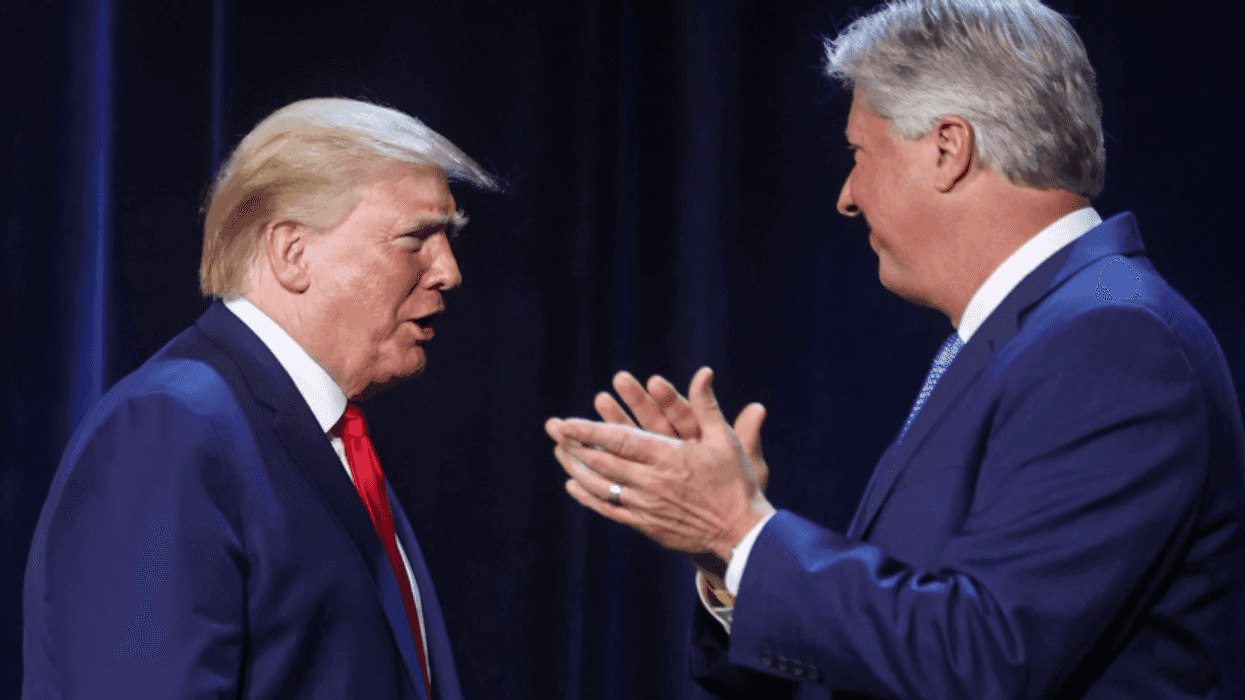
Robert Morris, the Dallas-area megachurch pastor who resigned last year amid sexual abuse allegations, has been indicted in Oklahoma for child sex crimes that date back to the 1980s.

Morris is a former spiritual adviser to President Donald Trump, and Gateway — one of the nation’s largest megachurches — has been particularly active in politics. In 2020, Trump held a “Roundtable on Transition to Greatness” there that was attended by then-U.S. Attorney General William Barr and other prominent Republicans.

Morris faces five counts of lewd or indecent acts with a child, the Oklahoma Attorney General’s Office said in a Wednesday evening press release.

The indictment comes less than a year after Morris resigned from Gateway Church in Southlake after an adult woman, Cindy Clemishire, said Morris repeatedly sexually assaulted her while she was a child in Oklahoma in the 1980s. Morris was at the time working as a traveling preacher.

In a Wednesday text message, Clemshire said through an attorney that she was grateful for the indictments.

“After almost 43 years, the law has finally caught up with Robert Morris for the horrific crimes he committed against me as a child,” she said. “Now, it is time for the legal system to hold him accountable. My family and I are deeply grateful to the authorities who have worked tirelessly to make this day possible and remain hopeful that justice will ultimately prevail.”

Clemshire’s disclosures last summer set off a political maelstrom in Texas and nationally, and prompted prominent Republicans to call for Morris to resign. Among those who said he should step down was Rep. Nate Schatzline, a Fort Worth Republican.

Schatzline is a pastor at Mercy Culture Church, a Tarrant County congregation that was founded with financial support from Gateway. Since then, Mercy Culture has become an epicenter of fundamentalist Christian movements and a staple of that Tarrant County GOP, often hosting political events and figures.

Gateway has been similarly active in local politics: Ahead of contentious local school board elections in 2021, the church was accused of violating federal rules on political activity by churches after it displayed the names of candidates, including some church members, who were running for office.

Morris denied the allegations at the time, saying that the church was not endorsing candidates but thought the church’s roughly 71,000 members would “want to know if someone in the family and this family of churches is running.”


This article originally appeared in The Texas Tribune, a member-supported, nonpartisan newsroom informing and engaging Texans on state politics and policy. Learn more at texastribune.org.

Reprinted with permission from Alternet.

Shop our Store

Headlines

Editor's Blog

Corona Virus

Trending

World