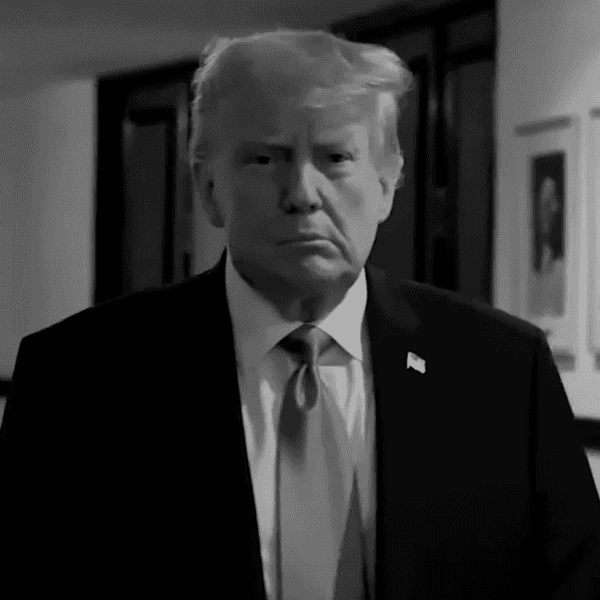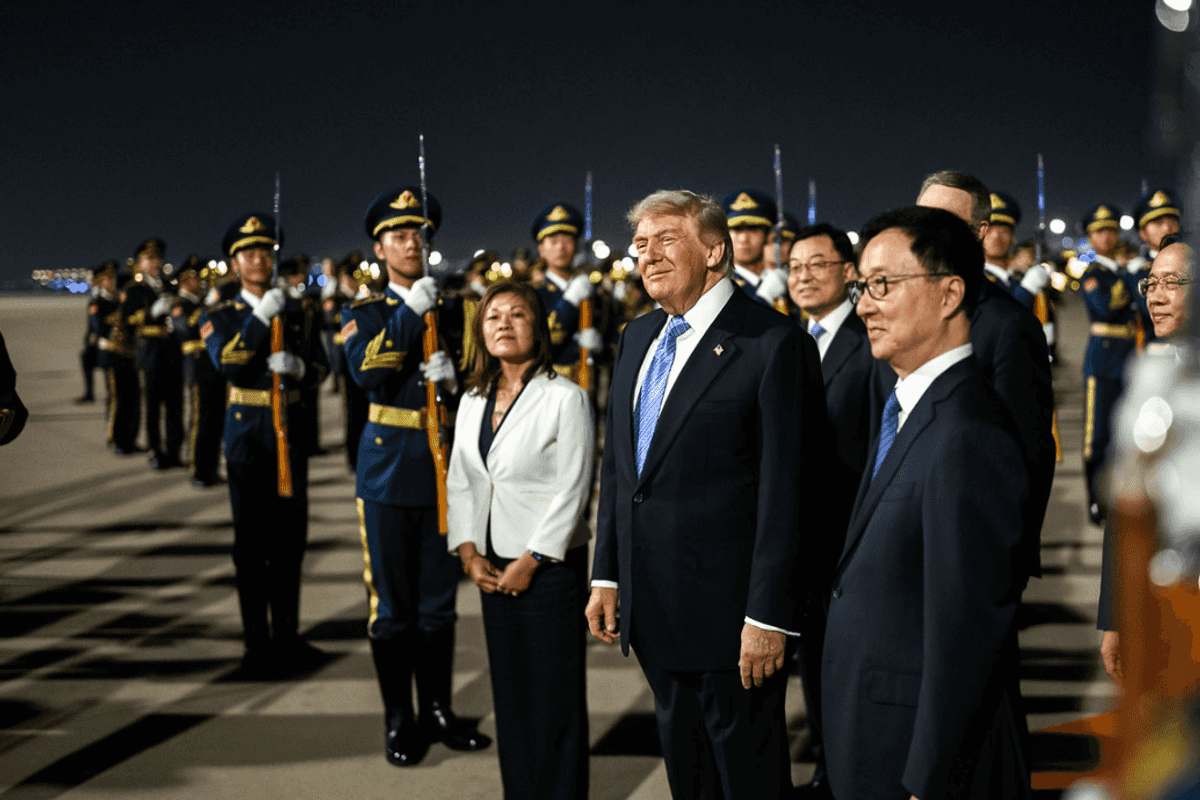
President Donald J. Trump arrives at Beijing International Airport on May 13, 2026
More often than not, the geopolitical impact of high-level summitry takes times to reveal itself, so perhaps history will record this differently than I do here. But virtually all the reporting from the Trump-Xi summit in Beijing last week suggests the US came out looking like the weaker partner.
Anyone whose been paying attention could see this coming. Donald Trump has two modes in foreign policy: bully those who he believes he has sway over, and be the supplicant to those who have something he admires. Strategic assessment and pursuit of goals that would help the US and its citizens are beyond his reach.
Moreover, Trump went into the summit with a sharp disadvantage: it’s no secret to anyone, most notably his Chinese counterparties, that he has dragged the US into a costly war with no clear rationale. Even worse, we’re stuck in the conflict as a tiny opposition army continues to hold us to a stalemate. Such weakness is toxic in this context, emboldening Beijing in its designs on Taiwan, a situation made significantly worse by Trump’s suggesting that “a potential multibillion-dollar weapons sale to Taiwan" is a “negotiating chip” with China, "raising new doubts about the pace and scale of American military support for the island democracy.”
The problem is that Trump’s approach to foreign policy is extremely simplistic, and is all about, to cite his favorite phrase, “who holds the cards?” Like all insecure narcissists1, he’s a bully who aspires to intimidate other leaders over whom we have an advantage, as in we buy more from them than they do from us. But Xi recognized early on that even while we have a large goods trade deficit with China, we require access to their rare earths, of which they refine 90 percent of global capacity. In those cases, Trump’s foreign policy reduces to making sure the opposing leader is his “friend,” a word he used frequently, if unrequitedly, to describe Xi in this visit.
End of the day, it looks like the two main results of this summit are 1) China might buy more soybeans and Boeing aircraft from us, though this remains unconfirmed, and if past is precedent, the likelihood that such an “agreement” will hold is low, and 2) Xi has further confirmation that the US is weakened by a feckless yet unchecked president who has alienated his international allies, is more focused on his ballroom than expanding American influence, and is bogged down in what is surely the most unpopular war in recent history.
None of this is at all surprising or even that interesting. The more compelling question is what, if anything, does all the above mean for the average American, or for that matter, to the average Chinese citizen, who, for the record, is one of 1.4 billion? This essay by Yi-Ling Liu tries to get at that:
Moving between the two countries, I’ve been struck by how they have come to mirror and resemble each other. There is a shared sense of precarity that lies beneath the envy and distrust: The technological future is taking shape at vertiginous speed, yet its promise is not shared by all.
I’m sure that’s true, and while it’s worse now given the AI-driven angst and uncertainty, along with the exacerbated wealth concentration—in both countries—that I see as another symptom of this technology’s proliferation, such precarity is nothing new.
In fact, it’s inherent to economies both capitalistic and communistic. What matters then is what guardrails the political system puts in place to protect innocent bystanders from everything from job displacements to higher utility costs driven by data centers. It’s what pathways to opportunity we clear for those whose economic starting point blocks their access. It’s the affordability policies we put in place to help people meet their basic needs for healthcare, housing, childcare, and food.
Our federal government is making life more precarious, and, while I’m no expert, I don’t think China’s doing much better. To be clear, I’m not saying international diplomacy is a sideshow. But I am saying that most Americans can be forgiven for being a lot less interested in whether Xi is Trump’s “friend” than what’s left in their paycheck after they filled their gas tank.
Jared Bernstein is a former chair of the White House Council of Economic Advisers under President Joe Biden. He is a senior fellow at the Council on Budget and Policy Priorities. Please consider subscribing to his Substack, from which this is reprinted with permission.
- Why Trump Is Driving Our Allies Closer And Closer To China ›
- Why America Is On Its Own: Slavery, Tariffs And Trump's Dire Strait ›
- No Contest: Under Trump, China's Growth Hugely Outpaced The United States ›
- Trump Posts 'Absurd Spin' On Meeting Where Xi Told Him America Is In Decline ›
- Trump Foreign Policy Follies: South Korea Goes To The Shakedown Shack - National Memo ›
- Trump returns to Washington after leaving Beijing summit with few clear wins ›
- Pomp, pageantry but precious little to show for Trump’s Beijing excursion | Donald Trump | The Guardian ›
- Beijing summit yields Chinese goal — equal footing with U.S. - The Washington Post ›
- What was actually achieved at Trump and Xi’s ‘stalemate summit’ in Beijing? ›
- Trump-Xi summit: The 3 big takeaways from historic meeting in Beijing ›