Tag: personal finance
stock exchange

Dumping American Stock: Why Doing Good May Also Be Doing Well

Before I go further here, let me qualify everything I’m saying here with a warning: I have no crystal ball from which to give people investment advice. However, I do know logic and arithmetic, apparently unlike Donald Trump, so I can draw out some hypothetical situations, which is what I do below.

There has been much discussion, both here and around the world, of the possibility of a flight from the dollar. This has always been a serious risk since Donald Trump took office, but the risk increased enormously from his deranged rant at the World Economic Forum in Davos last week.

Virtually everyone who was not on Trump’s payroll acknowledged that the speech was both scary and incoherent. He made threats to our allies, boasted about imposing tariffs based on personal whims, and displayed an extraordinary ignorance of major world events. With Trump commanding extraordinary powers as president as a result of a docile Republican Congress and servile Supreme Court the United States does not look like a good place to park your money.

There have already been some prominent instances of pension funds pulling their holdings out of Treasury bonds and other U.S. assets, but this is the less important part of the story. Most of the money at risk of leaving the United States is not held by public pension funds which may announce their decision to make a political point.

Rather, most of the money at risk of fleeing is held by private corporations and banks, and wealthy individuals, who would pull their money out of the United States because they think that Donald Trump’s America is a bad investment. There are literally trillions of dollars that could be leaving.

To correct one of the silly things often said by people who should know better, no individual, bank, or corporation is asking where to park one, two, or three trillion dollars. This scenario is supposed to leave them paralyzed in any effort to leave dollar assets, because there is no good alternative country where they can park $4 trillion.

But that is not how the financial system works. The big investors are asking where they can park $10 billion, $50 billion, or $200 billion, and the answer is there are plenty of places where this sort of money can be placed with reasonable safety, including the European Union, Brazil, China, India, the United Kingdom, and Canada. A flight from the dollar running into the trillions would be the result of tens of thousands of decisions to pull millions or billions of dollars out of dollar denominated assets.

I don’t know if we are seeing the beginning of this sort of flight, but if we are, we can say with some degree of confidence that the dollar, along with the U.S. stock, and bond market are headed lower. If that is the case, there is an obvious strategy for people in the United States: join the flight.

If the price of U.S. assets is headed lower, those interested in protecting the value of their retirement money, their kids’ college funds, or other savings should get out before the plunge. Fleeing dollar assets is not difficult to do these days.

Most brokerage houses offer foreign stock and bonds funds that will protect people from both a fall in domestic markets and a fall in the value of the dollar. (The collapse of the AI bubble could cause a plunge even apart from Trump’s craziness.) Obviously, some options will be better than others, but people should apply the same rule in looking at foreign funds as they would with domestic ones. Look to diversify your holdings. You probably don’t want to put all your savings in a German or Italian fund. Both countries’ markets may do great, but there also could be reasons they end up as poor investments. It’s best to hold funds that have stocks and bonds in a number of different countries.

And pay attention to fees. Some funds, like those managed by Vanguard, typically have low fees, while others can charge as much as 1.5-2.0 percent annually to invest your money. Remember, these fees are money that you’re just handing to the financial industry. If you have a fund that charges a 1.5 percent fee on a $100,000 account, that means you’re giving $1,500 a year to the company. Most people can probably find something better they can do with $1,500.

The other part of the story about joining the flight is that you will be speeding the decline in the dollar and the U.S. markets. In ordinary times, that would not be a good thing, but we know that Donald Trump cares about what happens in financial markets. He is totally fine with ignoring Congress (e.g. the Epstein files), the courts, and international law, but he does respond when financial markets take a dip.

Trump is surrounded by ridiculously rich people who couldn’t care less about democracy or what happens to the country, as long as they are making money. However, if they start to lose money because of Trump’s vicious loon tune policies, they will get upset. That could get Trump to start respecting the law and the Constitution. It could be our best hope for saving democracy.

And remember, if the stock market and the dollar are going down anyhow (the dollar has already fallen almost 10 percent under Trump and the stock market has lagged nearly every other major market), you will be protecting your savings by getting out ahead of the rush. This is definitely a case where millions of people can do well by doing good.

Dean Baker is a senior economist at the Center for Economic and Policy Research and the author of the 2016 book Rigged: How Globalization and the Rules of the Modern Economy Were Structured to Make the Rich Richer. Please consider subscribing to his Substack.

Reprinted with permission from Dean Baker.
Helping Young Adults Means More Than Writing a Check

Helping Young Adults Means More Than Writing a Check

Dear Carrie, Several years ago, I loaned my then 24-year-old son money to buy a car on the condition that he pay it back in monthly installments. Because of some job problems, he wasn’t able to keep up with the payments. Now he’s back on his feet and wants to start paying me again. While I’m happy he’s being responsible, I’m hesitant to take his money. I’m more financially secure than he is, and I know there are lots of things he needs to save for. On the other hand, I don’t want to lessen his sense of responsibility or independence. Any ideas on how to handle this?

—A Reader

Dear Reader, This is a great question because so many parents of young adults are faced with a similar dilemma. As you watch your kids struggle financially, of course you want to help. To me, that’s what families are for. And once your kids are grounded and feel confident that they can take care of themselves, it’s a pleasure to help them — and can make a big difference in their lives and the lives of their own families. However, how you give the help is important.

I applaud you for offering to loan your son the money for his car, not just making it a gift. Paying for a car over time provides important financial lessons, involving saving, budgeting and working towards a specific goal. Now that your son is in a better financial position and wants to pay you back, he obviously appreciates those lessons. And, as you imply, it’s important not to do anything to take away his drive.

On the other hand, as a mother, I completely understand your desire to continue to help him. So first, let’s talk about how you might handle the payments. Then we’ll explore other positive ways to give financial help.

Be creative about a repayment plan

Since you’re uncomfortable accepting payments because your son needs the money more than you do, there are a couple ways to handle this that could work for both of you.

One idea is to set a monthly payment your son could easily afford. Accept the payments, but put half aside to help him again when he needs it. You don’t even have to tell him you’re doing this. He’ll feel the pride and confidence that comes with making good on a debt. And you’ll know that you’re actually using that money for his future benefit.

Another possibility is to strike a deal where your son divides his payment into two parts: half to you and half into his savings account or IRA. That way, he’ll be encouraged to pay his debts as well as save for his future.

By accepting some sort of payment, you’re acknowledging your son’s financial responsibility and encouraging his good habits. Refusing to accept payment might actually undermine both.

Look for other ways to help that foster growth and independence

Even if you’re in a position to help grown kids financially, I think it’s important to be selective and not just write a check. Ideally, you want to offer help that reflects your values and can have a positive impact both today and down the road. Here are three areas to consider:

—Insurance and health care costs: If a young adult doesn’t have health insurance, consider paying initial premiums on a high deductible policy. You’ll not only be helping with the monthly bills, you’ll be emphasizing the importance of having adequate coverage. Even with a high deductible policy, there still may be periodic medical expenses that need to be covered. You could offer to pick these up for a specified time period. If you make a direct payment to a healthcare provider or hospital on behalf of another person, there’s no gift tax.

—Education, both for kids and grandkids: Whether it’s an advanced degree or the need for new job skills, education is expensive. Would you be willing to cover these costs? What about paying for daycare or pre-school for the grandkids?

—Keeping a roof over their heads: Coming up with move-in costs such as first and last month’s rent plus deposit is a struggle for many young adults just getting started. Covering these costs can be an excellent opportunity to help get a young person get off the ground. When it comes to buying a first house, helping with a down payment is a positive way to offer support, whether as a gift or a loan.

Make a gift as part of estate planning

If reducing your taxable estate during your lifetime makes sense, you can gift up to $14,000 a year to an individual without incurring gift taxes ($28,000 for a married couple splitting gifts.) You might also consider gifting larger amounts to a 529 College Savings Plan—an excellent opportunity for grandparents to make a significant, targeted contribution.

There are many reasons why grown kids might need financial help — after all we live in a very expensive world — so if you can help, by all means, do it. To me, it’s an investment in the next generation. Just make sure you’re comfortable with what you’re giving and that your kids know what’s expected in return.

Carrie Schwab-Pomerantz, CERTIFIED FINANCIAL PLANNER(tm), is president of Charles Schwab Foundation and author of The Charles Schwab Guide to Finances After Fifty, available in bookstores nationwide. Read more at http://schwab.com/book. You can e-mail Carrie at askcarrie@schwab.com. This column is no substitute for an individualized recommendation, tax, legal or personalized investment advice. Where specific advice is necessary or appropriate, consult with a qualified tax advisor, CPA, financial planner or investment manager.

Photo via Images Money, Flickr  

Thinking Of Taking An Early 401(k) Withdrawal? Consider the Ultimate Cost

Thinking Of Taking An Early 401(k) Withdrawal? Consider the Ultimate Cost

Dear Carrie: If you’re younger than 59, and a half, is it possible to withdraw money from your 401(k) without having to pay it back? — A Reader

Dear Reader: The balance in your 401(k) can be a tempting source of cash when times are tough and you have no other options. Yes, it’s possible to withdraw early without having to pay it back, depending on your personal situation and your specific plan.

But being possible doesn’t necessarily mean it’s practical for your financial future — and the IRS doesn’t make it easy. There are a lot of rules and regulations. So before taking any money from your 401(k), I’d take a step back and carefully review the basics as well as the short- and long-term costs.

Basic Taxes and Penalties

First, no matter your age, all 401(k) distributions are taxed as income according to your tax bracket the year that you withdraw the money, unless you have a Roth IRA. What’s more, unless you meet specific criteria, early distributions are subject to an additional 10 percent penalty. Together, this could take a huge bite out of your distribution — not to mention your future potential retirement savings.

Criteria You Have to Meet

If your plan allows it, you may qualify for a hardship distribution as long as you prove immediate heavy financial need. The amount of a hardship distribution is limited to your own contributions to the 401(k), and possibly your employer’s contributions, but doesn’t include your income earnings or savings. The terms of proof once again depend on your plan, but in general, the IRS defines immediate and heavy financial need as:

–Medical expenses for you, your spouse or dependents.

–Costs directly related to the purchase of your principal residence — excluding mortgage payments.

–Postsecondary tuition and related educational fees, including room and board for you, your spouse or dependents.

–Payments necessary to prevent you from being foreclosed on or evicted from your principal residence.

–Funeral expenses.

–Expenses to the repair of damage to your principal residence.

What You Stand to Lose

Regardless of why you need the money, you’ll have to pay both income taxes (unless it’s a Roth IRA) and an additional 10 percent penalty. Let’s put that into real numbers. Say you want to take $20,000 from your 401(k) and you’re in the 25 percent tax bracket. Income taxes on your distribution could be $5,000. Now add the 10 percent penalty of $2,000. You could end up having to deduct about $7,000, or 35 percent, from your $20,000 distribution — a hefty price cut.

Next, figure out how much you’d lose in potential earnings over time. For example, if you had a total of $20,000 in the account, and let that money grow at a hypothetical annual interest rate of 5 percent for another 15 years, you’d have over $41,500 — more than double your money!

Finally, even if you continue to make contributions after an early distribution, annual 401(k) limits will make it hard to recoup your losses. On top of that, in certain circumstances, you’re not allowed to make additional contributions for six months after the withdrawal. That’s six months of lost savings.

This example is hypothetical in nature and not intended to represent, predict or project the performance of any specific investment. Charges, expenses and taxes that would be associated with an actual investment are not reflected.

Penalty-Free Options

There are some exceptions to these rules. For instance, if you leave or lose your job at age 55 or later, you can take a lump sum 401(k) distribution. You can also set up a payment schedule of substantially equal payments over your lifetime, which has to be a minimum of 5 years or until you reach age 59 and a half — whichever is longer. This is known as separation of service, and while both situations are penalty-free, you’d still pay income taxes.

The penalty is also waived if you become disabled: You’d pay for medical expenses exceeding 7.5 percent of your adjusted gross income. If you die, a payment is made to your beneficiary or estate. Otherwise, it would be waved if you were mandated to give your distributions to a former spouse under a qualified domestic relations order.

Another Less Costly Option — a 401k Loan

A 401(k) loan is potentially a less costly way to take some cash if your retirement plan allows it. There are no penalties or taxes, but you do have to pay interest. On the plus side, that interest will go back into your account, so in a sense you’re paying it to yourself. However, repayment schedules are strict and failure to repay may trigger penalties and taxes. Also, if you lose your job or change jobs, you’ll almost certainly have to pay back the entire loan within 60 days. If you don’t, once again you’ll likely be hit with penalties and taxes.

The Ultimate Cost

To me, taking an early distribution should be a last resort. I’d advise you to think carefully and talk to your tax advisor. Make sure you understand what a distribution would mean in terms of upfront dollars and lost opportunity for growth. While it may seem like the answer to a current financial need, you could be sacrificing your future financial security by depleting your retirement savings now. That’s the ultimate cost.

Carrie Schwab-Pomerantz, CERTIFIED FINANCIAL PLANNER(tm), is president of Charles Schwab Foundation and author of The Charles Schwab Guide to Finances After Fifty, available in bookstores nationwide. Read more at http://schwab.com/book. You can e-mail Carrie at askcarrie@schwab.com. This column is no substitute for an individualized recommendation, tax, legal or personalized investment advice. Where specific advice is necessary or appropriate, consult with a qualified tax advisor, CPA, financial planner or investment manager. To find out more about Carrie Schwab-Pomerantz and read features by other Creators Syndicate writers and cartoonists, visit the Creators Syndicate website at www.creators.com.

COPYRIGHT 2016 CHARLES SCHWAB & CO., INC. MEMBER SIPC.

DIST BY CREATORS SYNDICATE, INC. (0316-0926)

Photo: Flickr user _e.t.

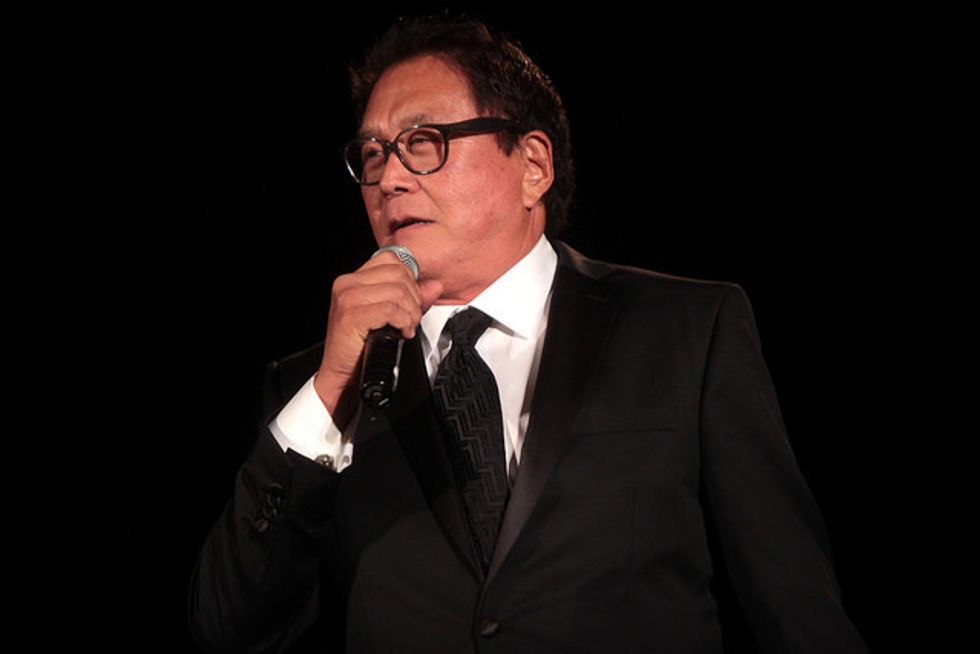
Robert Kiyosaki’s 5 Best Money Tips Of All Time

Robert Kiyosaki’s 5 Best Money Tips Of All Time

By Cameron Huddleston, GOBankingRates.com (TNS)

Robert Kiyosaki is one of the best-known names in personal finance largely due to the success of his book Rich Dad Poor Dad, in which he wrote that workers won’t get rich toiling away at conventional 9-to-5 jobs.

His advice continues to resonate, so GOBankingRates has once again selected him as a finalist in its 2015 Best Money Expert competition. As part of this year’s competition, Kiyosaki was asked to share his best money tip for 2016.

“Don’t wait for the government, a financial advisor or your boss to take care of you,” he said. “You must take control of your finances. You must get financially educated. Take responsibility for your life and your future.”

Here are five of Kiyosaki’s best money tips of all time, selected to help you take control of your finances as you head into the new year.

FINANCIAL EDUCATION: THE KEY TO WEALTH

Kiyosaki has said that his true passion is teaching. He created a board game and financial education company to teach people about money management. The board game is designed to simulate real-life financial strategies and scenarios.

“Financial education and getting smarter with your money is always a great way to prepare for the future, whatever it holds, good and bad, and hedge against all the unexpected speed bumps on the road to financial freedom,” Kiyosaki told GOBankingRates.

TAKE CONTROL OF YOUR FINANCES

No one cares as much about your financial security as you do. So Kiyosaki’s advice is to “take responsibility for your finances or take orders all your life.”

He added: “You’re either a master of money or a slave to it.”

PAY YOURSELF FIRST

Budgeting isn’t only about paying the bills. It’s also about paying yourself first by socking away money routinely.

“When Kim and I were first married, we committed to making our investing an expense in our budget,” Kiyosaki wrote on his blog. “Each month, we paid ourselves through our expense column the money we needed to save up for and purchase assets that would provide us cash flow. This was an example of an expense that made us rich.”

HAVE A CONTINGENCY PLAN

In the event of a job loss, decrease in income, medical emergency or other unexpected situation, it’s important to have a contingency plan and cash reserves to cover expenses, he said.

“Setbacks often leave us reeling since they’re often unexpected and can involve high emotion. And when emotion goes up, intelligence goes down,” Kiyosaki said. “I try to step back, calm my emotions and ask myself: What’s the lesson here? What can I learn from this? How can I be better prepared in the future?”

SPEND ON ASSETS, NOT LIABILITIES

To get ahead financially, Kiyosaki recommended that you spend money on assets that generate wealth such as real estate. You can’t grow your wealth if you’re spending it on cars, clothes and vacations.

Yet, Kiyosaki said that people should not consider their house an asset, even when it’s paid off. “The home that I live in still costs me money every month for utilities, taxes, insurance (and) maintenance,” he said in a published interview.

Cameron Huddleston writes for GOBankingRates.com (), a leading portal for personal finance news and features, offering visitors the latest information on everything from interest rates to strategies on saving money, managing a budget and getting out of debt.

© 2015 GOBankingRates.com, a ConsumerTrack web property. Distributed by Tribune Content Agency, LLC.

Photo: Gage Skidmore via Flickr


Shop our Store

Headlines

Editor's Blog

Corona Virus

Trending

World