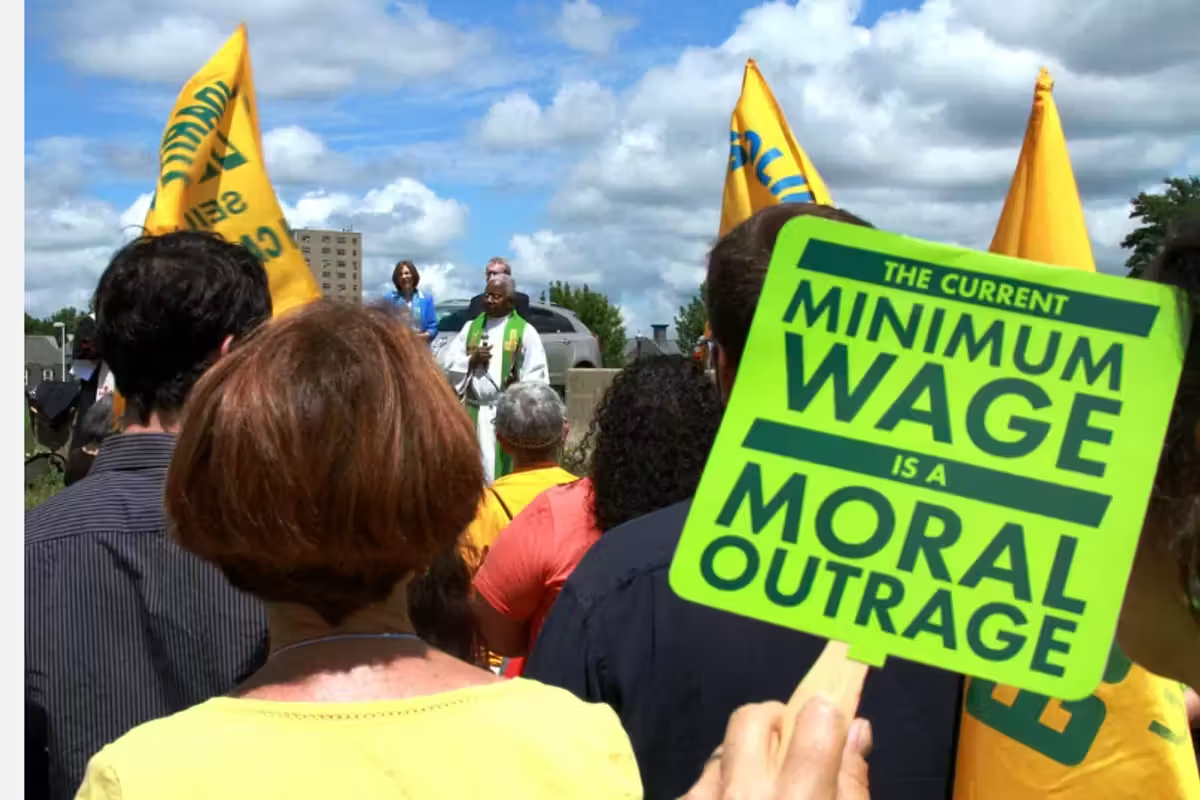
Workers rally to raise the minimum wage in Providence, Rhode Island
The time has come to talk about raising the minimum wage. In fact, the conversation is way overdue.
Though most states—30, to be precise—have raised their wage floors relative to that of the federal floor, which has been stuck at $7.25 since 2009—the longest stretch on record without an increase in the federal level—the rest have not done so. (Some of those laggards have higher within-state minimums; this dynamic map from EPI captures all the geo-variation.)
A bit of throat clearing before I get to the specifics. In a recent post, I ticked off my simple, four-part strategy for raising both pay and labor’s share of national income and giving working people a better chance to earn a fair slice of the pie their labors are helping to bake:
—get to and stay at full employment
—move to sectoral union bargaining
—for low-wage workers in low-productivity sectors, fill out incomes with refundable tax credits (EITC, CTC)
—raise the minimum wage
[Read Arin Dube’s book The Wage Standard for background re all of the above (and more). His research on minimum wages has been highly influential both here and abroad.]
Going back to seminal 1990s work on minimum-wage impacts by economists Card and Krueger, all that state and sub-state variation has enabled economists to get a pretty solid grip on the benefits and costs of the higher wage floor. Arguments by opponents that any such increase will lead to massive layoffs of affected workers have been disproved time and again. Dube’s chapter on this work offers a balanced assessment, and the conclusion is that moderate increases have their intended effect of raising the pay of targeted workers with little by way of job losses.
That’s “little,” not zero. It is not uncommon for some studies to find some negative impacts on jobs and hours of affected workers—those whose wages are lifted by the legislated increase. But, of course, any rational cost/benefit analysis must compare the relative shares of winners and losers, and the literature is clearly in sync with the conclusion noted above.
Dube’s favored metric for this is the own-wage-elasticity (OWE): the ratio of the percentage change in employment to the percentage change in wages due to the minimum wage hike. In an exhaustive literature review from 2024, he and Ben Zipperer find that “the median OWE estimate of 72 studies published in academic journals is -0.13, which suggests that only around 13 percent of the potential earnings gains from minimum wage increases are offset due to associated job losses. Estimates published since 2010 tend to be closer to zero.”
Okay, enough defense. First the politics. Then the plan (or at least, a plan; there are many ways to come at this).
The politics is very simple. In fact, the policy itself is very simple. While most federal legislation takes at least hundreds of pages to explain, minimum wage bills can be a page or two. “Raise the wage floor to $X.” Boom—that’s it.
Complications can arise around a lower minimum for tipped workers, and I’ve got my own complication I’m going to suggest below, but they’re still simple relative to any tax bill you’ve ever had the misfortune to try to parse through.
I’m neither a pollster nor a political strategist, but I know some of the best and have talked to them about this. The gist of their and my thinking is that Ds can get pretty far on the old “we’re not Trump!” play, which taps solidly into Trump’s awful economic record and the anti-incumbency cycle that dominates electoral politics amidst the affordability crisis. But the dispositive group of “persuadables”—neither never- or always-Trumpers—isn’t bullish on Ds either. They need to see candidates fighting to make their lives better, going up against the forces of inequality, unaffordability, and AI-induced wealth concentration.
A higher minimum wage fits nicely into that box. To be clear, any credible proposal will reach a minority of the workforce, but that’s okay. It’s a popular policy with a clear track record of reaching folks who need the help (in Dube/Zip terms, reasonable proposals have an OWE that’s in the 0 to -0.2 or -0.3 range, meaning at least 70-80 cents on the dollar accrues to intended beneficiaries).
The next political question is what and when. Which specific proposal should Ds coalesce around and when should they launch it? The “when” is truly above my paygrade. I’d say after the midterms but well before the presidential, but that’s not informed.
For the what, read this by Ben Zipperer, a highly knowledgeable, rigorously empirical economist who is, as noted, often Dube’s partner on minimum wage research.
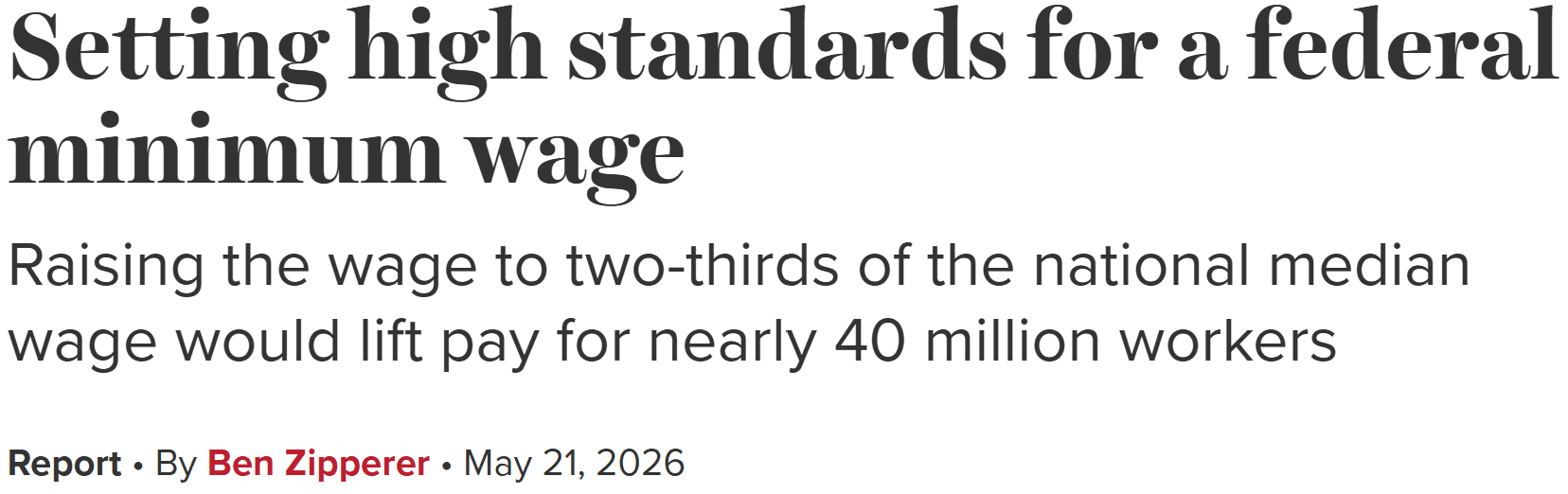
The proposal, as you see, is to set a relative minimum wage (versus an absolute level, like $15), at two-thirds of the median wage, phasing it in over time and then indexing to the actual change in the median:
Raising the federal minimum wage to two-thirds of the national median wage would lift pay for nearly 40 million workers, about a quarter of the workforce. Two-thirds of the median—equivalent to roughly $17.70 today, a projected $20 in 2030, and a projected $25 in 2038—matches the benchmarks used in other high-income countries and tracks the direction of recent minimum wage research. Indexing to median wage growth thereafter would keep the floor from losing ground to inflation or falling behind the broader economy.
That’s an historically large increase, so we must worry about unintended impacts, higher-than-usual job loss and a lower (more negative)-than-acceptable OWE. In my own work on this question, which preceded the higher-powered analysis from today’s crop of sharpshooters, I came to feel comfortable with increases that picked up 10-20 percent of the workforce in the “sweep,” i.e., directly between the old and new minimum (“directly” is important; it means before you factor in “spillovers”—wage increases to workers above the new minimum). And once you started creeping up on 20%, I got nervous.
So, when I saw Ben’s “about a quarter of the workforce,” that spidey-sense got triggered. I asked Ben about it and he calmed me down, explaining that his 25 percent includes spillovers, and that the direct impact was around 17 percent. It’s also worth reading his “How High is Too High?” section, wherein he cites careful studies that show comparable increases doing much more good than harm. EG:
The most direct evidence that the floor can go meaningfully higher comes from California’s $20 fast-food minimum wage. In April 2024, the state raised the wage for fast-food chain workers from $16 to $20, pushing the ratio of that minimum to the state’s median wage to about 74%, well above most U.S. precedents. One might worry that customers would substitute toward lower-priced independent restaurants exempt from the policy, generating job losses at the chains. The actual evidence shows otherwise. Despite the large wage increase, research finds little to no employment effect of the policy (Bivens and Zipperer 2026), and the median employment effect in Dube (2026a) is essentially zero. Evaluations of the UK minimum wage through 2019, when it reached nearly 60% of the median wage, also find small, statistically insignificant effects on the employment of low-wage workers (Giupponi et al. 2024).
When it comes to minimum-wage impacts, if we’ve learned anything, it’s this: you’ve got to rigorously and unceasingly test the waters. You just can’t know how these things play out in the real world. In fact, the one thing you can know is that the econ 101 textbook model, which predicts huge job losses if the gov’t imposes a wage floor above the “equilibrium” market wage, is wrong. The truth lies somewhere in-between, which is why you want input from the Dubes, Zipperers, Cards and Kruegers, etc.
As to why the textbook model is wrong, again read Dube’s book for pages of entertaining work on monopsony theory—firms that employ min wg workers can play more of a role in setting wages than the 101 model suggests—and my work, cited by Ben Z on the three-Ps on how higher prices, lower profits, and higher productivity help to absorb the increase (Dube makes similar points). Obviously, the price point is notable in today’s climate, so note that passthrough is well below 1, but it’s not zero.
But—and here’s my one complication—going to two-thirds the national median constitutes a huge jump in the wage floor for the laggard states. We don’t want to reward their irresponsibility to their low-wage workforces, but neither do we want to shock them. The sweeps in these cases will be much larger than the shares Ben cites, and the price effects could also be worrisome.
There are, thus, two options: shift from benchmarking to the national median to state-specific medians or lengthen the phase-in for the states that start with lower floors. I much favor the latter. Benching to state medians seems highly complex, involving 50 different national minimum wages, and it locks in state-level wage structures that militate against getting closer to living wages. Having longer phase-ins for low-base states gets us to the desired destination, but at different cadences for different states.
At any rate, such details can be analyzed and debated along the way. For now, we are—or we can be if we want to—standing once more at my favorite intersection, where good policy meets good politics.
Raise the wage, help the workers, and show the electorate who’s fighting for whom!
Jared Bernstein is a former chair of the White House Council of Economic Advisers under President Joe Biden. He is a senior fellow at the Council on Budget and Policy Priorities. Please consider subscribing to his Substack, from which this is reprinted with permission.
- Trump: Waitress Who Makes $2.13 An Hour Is ‘Overpaid’ ›
- Minimum Truth: The Hollow Argument Against Higher Wages ›
- On Minimum Wage, Martin Luther King’s Dream Is Far From Achieved ›
- Super-Rich GOP Senate Candidate Says Keep Minimum Wage At $7.25 ›
- The Failure To Raise The Federal Minimum Wage Is A Moral Outrage ›
- Newsmax’s Ruddy: Raise Minimum Wage, Vote For Common Sense ›
- How Many Big Macs Can You Afford On Minimum Wage? ›
- Report: Minimum Wage Increases Are Not Killing Jobs - The National Memo - Smart. Sharp. Funny. Fearless. ›
- Happy Labor Day To The Steadfast Economists Who Fight For Working Families - National Memo ›
- AOC-backed proposal to raise federal minimum wage to $25 an hour from $7.25 | Fox News ›
- History of Changes to the Minimum Wage Law | U.S. Department of Labor ›
- Lawmakers introduce bill to raise federal minimum wage to $25 an hour ›
- Democratic lawmakers introduce bill to raise federal minimum wage to $25 an hour ›