Tag: abigail spanberger
Virginia's First Female Governor Inaugurates Her 'Affordability Agenda'

Virginia's First Female Governor Inaugurates Her 'Affordability Agenda'

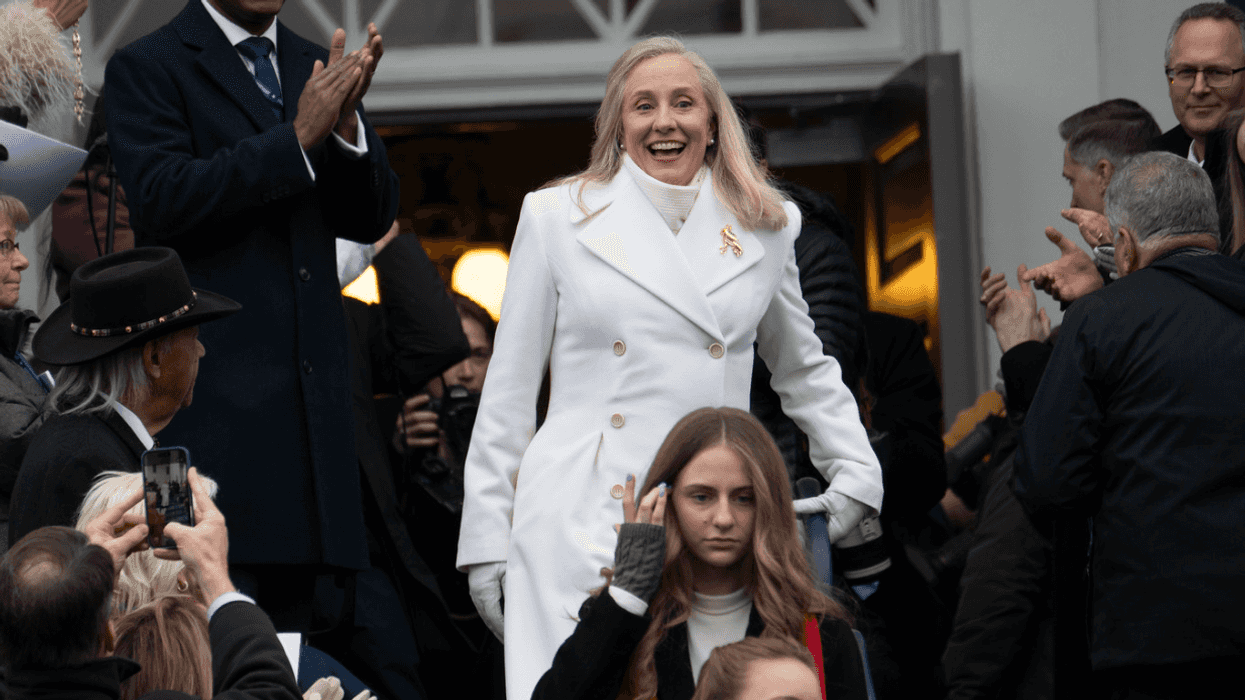
Abigail Spanberger, inaugurated on January 17 as the 75th governor of Virginia, began to implement her agenda centered around her campaign pledges to make the state more affordable, improve education, and address gun violence almost immediately after taking office.

Minutes after taking her oath of office, Spanberger signed 10 executive orders. The first order, called the Statewide Affordability Directive, ordered all Cabinet secretaries and executive branch heads to report to her within the next 90 days “identifying immediate, actionable budgetary, regulatory, or policy changes that would reduce costs for Virginians” addressing cost savings in housing, health care, energy, education, child care, and living expenses.

Other orders created an Interagency Health Financing Task Force to strengthen Virginia’s health care system, ordered a multi-agency Housing Development Regulation Review to increase the supply of housing, directed the Department of Education to strengthen literacy, math, school accountability, and assessment in the commonwealth’s public education systems.

“Today, we are responding to the moment. We are setting the tone for what Virginians can expect over the next four years: pragmatic leadership focused on lowering costs and delivering results,” Spanberger said in a press release. “My administration is getting to work on Day One to address the top-of-mind challenges facing families by lowering costs for Virginians in every community, building a stronger economy for every worker, and making sure that every student in the Commonwealth receives a high-quality education that sets them up for success. These executive orders represent the first steps in our work to create a stronger, safer, and — critically — more affordable future for our Commonwealth.”

On the campaign trail, she promised to address rising housing, health care, and energy costs and touted an eight-page plan detailing how she would do so.

Spanberger laid out her policy agenda in an address to the General Assembly on January 19, which is centered around the Affordable Virginia Agenda she and Democratic leaders in the House of Delegates and Senate are proposing in order to lower those costs.

Among her proposals was legislation to limit the profits of pharmacy benefit managers, provide targeted assistance to Virginians at risk of losing health insurance coverage due to the expiration of federal subsidies, boost energy storage, help Virginians make their homes more energy efficient, help renters avoid eviction, and build more affordable housing.

“These are not hyperpartisan proposals; they are commonsense solutions,” Spanberger told lawmakers. “And I believe they deserve support from every member of this body, Democrats and Republicans.”

Spanberger urged legislators to create a statewide paid family and medical leave program, increase subsidized child care, raise the hourly minimum wage to $15, and increase pay for teachers. She promised to sign bills, vetoed last year by then-Republican Gov. Glenn Youngkin, aimed at curbing gun violence, such as a ban on ghost guns, a law blocking convicted domestic abusers from accessing firearms, and an expansion of Virginia’s red-flag law temporarily disarming those judged to be an imminent danger to themselves or others.

Finally, Spanberger expressed her support for three constitutional amendments to be voted on by Virginians in November that would guarantee reproductive rights, automatically restore the right to vote for individuals convicted of a felony after they have completed their sentences, and codify the rights of two adults to marry.

She defended a fourth proposed constitutional amendment to temporarily change the way Virginia draws its congressional maps, likely to be considered by voters in April, saying: “Virginia’s proposed redistricting amendment is a response to what we’re seeing in other states that have taken extreme measures to undermine democratic norms. This approach is short-term, highly targeted, and completely dependent on what other states decide to do themselves.”

Giving the Republican response, Republican state Sen. Glenn Sturtevant criticized Democrats for advancing the redistricting amendment, saying it would not lower costs, according to a Cardinal News transcript. “We also need to be honest about what Democrats are proposing, because it will make life more expensive,” Sturtevant said, “Their tax-and-spend agenda would cost Virginia families billions each year, adding thousands of dollars in new burdens for the typical household.”

Reprinted with permission from the Virginia Independent

Democrats Are So Back! And Other Takeaways From Blue Blowout 2025

Democrats Are So Back! And Other Takeaways From Blue Blowout 2025

As Tuesday night’s blue wave crashed down on Donald Trump, he remained silent for hours, until he could restrain himself no longer.

“TRUMP WASN’T ON THE BALLOT, AND SHUTDOWN, WERE THE TWO REASONS THAT REPUBLICANS LOST ELECTIONS TONIGHT, according to Pollsters,” the president blurted defensively on his Truth Social -- just as actually existing pollsters began to explain how very present he was on ballots across the nation even though his name did not appear.

Both Trump and his party suffered a resounding repudiation in every election on November 4, from the marquee contests in New York City, New Jersey and Virginia to statewide contests for judicial and utility commission posts in Pennsylvania and New Jersey to the massive landslide support for Democrats to redraw Congressional districts in California.

In Virginia, both Democratic Governor-elect Abigail Spanberger and her running mate Ghazala Hashmi – the first Muslim woman elected statewide anywhere -- won by landslide margins, but so did the party’s candidate for attorney general, Jay Jones, who ran under the burden of a texting scandal and beat an incumbent. Democrats in the Virginia legislature expanded their majority by more than a dozen seats, ensuring that the state’s Congressional maps will be redrawn.

We shall see in coming cycles whether this promising election, whose results were historic in many respects, was indeed a turning point in America’s struggle to preserve democracy and defeat an authoritarian threat. But while anticipating the future, we can point to significant developments right now.

  • 1. The Democratic Party is back –- and more to the point, was never as weak as suggested by its poor approval ratings in recent surveys. What became clear soon after Trump’s inauguration, contradicting those “Democrats in disarray” clichés, was that voters dissatisfied with the party would nevertheless vote for its candidates in election after election. We saw that in elections throughout 2025, notably in Wisconsin where a liberal judicial candidate crushed a radical rightist whose campaign got $20 million from Elon Musk. And we saw it last night across the country, where enthusiastic turnout and swinging “independent” votes drove astonishing margins across the board.
  • 2. The touted "Trump effect" on Black and Hispanic voters wasn’t a trend and probably nothing more than a blip. Tuesday’s exit polls showed 68 percent of Latino voters supporting Democratic gubernatorial nominee Mikie Sherrill in New Jersey and 67 percent voting for her counterpart (and former Congressional roommate!) Abigail Spanberger in Virginia. In California, 69 percent of Latino voters approved Proposition 50, Democratic Gov. Gavin Newsom’s plan to redraw the state’s Congressional districts to answer Republican gerrymandering in Texas and elsewhere, while 90 percent of Black voters supported it.
  • 3. More surprisingly, male voters, and in particular younger male voters, moved sharply back toward the Democratic side in nearly every election. In Virginia, 88 percent of Black men and 55 percent of Latino men voted for Spanberger, while in New Jersey 92 percent of Black men and 61 percent of Latino men voted for Sherrill. She won male voters between 18 and 44 by double-digit margins. Younger voters in both states strongly supported the Democrats, as did younger voters (by overwhelming margins) in New York City.
  • 4. The political analysts who predicted close elections in New Jersey and elsewhere, based on polling averages that include dishonest Republican-skewed polls, were proved embarrassingly wrong. Don’t hold your breath waiting for those windbags --who constantly predict Democratic doom, even when Democrats are winning -- to confess error or correct course. The rest of us, however, can stop shrieking like Chicken Little every time some such clown sounds off. Please.
  • 5. Focusing on economic issues that unite Americans is the path that leads to Democratic victories, whether in ultra-blue New York or purplish New Jersey and Virginia. But Democrats will also come out in enormous numbers to defend democracy and aren’t afraid to fight back, as they proved in California. As Gov. Newsom noted in his victory remarks, Trump’s chief ICE goon Greg Bovino showed up to intimidate voters in his state – and only motivated a record-breaking turnout.

Finally, encouraging as this 2025 blowout is, next year will be very challenging for Democrats, who must reject complacency. Younger white males must still be won over. As Ilyse Hogue of Speaking With American Men (SAM) observed, Trump’s absence from the ballot may indeed have helped Democrats a bit by discouraging the most hostile young males from voting at all.

“The online machine that backed him in 2024 was disillusioned and fragmented,” Hogue told me, as key influencers turned against Trump for various reasons and showed little interest in the off-year elections. “While this is obviously great news that [young men] are gettable – and misogyny is not an overwhelming driver in their decision making -- I don’t want Democrats to get too comfortable.”

Joe Conason is founder and editor-in-chief of The National Memo. He is also editor-at-large of Type Investigations, a nonprofit investigative reporting organization formerly known as The Investigative Fund. His latest book is The Longest Con: How Grifters, Swindlers and Frauds Hijacked American Conservatism (St. Martin's Press, 2024).

CNN Polling Analyst: Upcoming Elections May Foretell Midterm Doom For GOP

CNN Polling Analyst: Upcoming Elections May Foretell Midterm Doom For GOP

The upcoming gubernatorial elections in New Jersey and Virginia, along with next week's mayoral election in New York City, could be viewed as a reliable bellwether for how next year's midterm elections will go, according to CNN data analyst Harry Enten.

In a Friday segment on CNN's OutFront, Enten told guest host Erica Hill that "Donald Trump can't be too happy" with the latest polling in those three races. Even though New Jersey's gubernatorial race is the closest of the three, Trump-endorsed Republican Jack Ciattarelli is still anywhere from six to eight points behind Democratic candidate Mikie Sherrill.

Republicans have an even smaller chance of keeping control of the governor's mansion in Virginia, as Republican Lieutenant Governor Winsome Earle-Sears is trailing Democrat Abigail Spanberger by 14 points according to a recent YouGov poll. And Democrat Zohran Mamdani is poised for a clear victory over former New York Gov. Andrew Cuomo (who is running as an independent) and Republican Curtis Sliwa. An Emerson College poll shows Mamdani ahead of Cuomo — his closest challenger — by roughly 25 percentage points.

"At this point in time, to me, it seems like the Democrats are most likely going to sweep all three of those races," Enten said. "And that's in part because of Donald Trump."

Enten went on to observe that there have only been five instances in the past 90 years where Democrats have swept all three off-year elections, with the latest instance happening in 2017. The other four times were in 1989, 1961, 1957 and 1953. However, he added that Democrats have reason to be hopeful if they repeat the feat next week.

"The five times that I mentioned that the Democrats swept all three of those races, each and every single time, the following year, they won a majority in the U.S. House of Representatives," he said. "So if Democrats sweep on Tuesday, in my opinion, it's a very good sign looking forward to 2026 in taking back that majority from the Republicans."

Reprinted with permission from Alternet


Democrats Shatter Midterm Forecasts With Victories Across Country

Democrats Shatter Midterm Forecasts With Victories Across Country

Control of the House and Senate have not yet been determined but many political experts are now saying that supposed “red wave” Republicans have been projecting does not look like it will happen.

The New York Times’ chief political analyst Nate Cohn at 9:51 PM ET election night, tweeted: “So far, Democrats are running about a point ahead of our expectations outside of Florida, with the GOP lead in the House starting to come down a bit.”

“Not many signs of a red wave at this point,” Cohn said.

Historically the President’s party almost always loses seats in the House. In the last midterm elections, 2018, Donald Trump lost 40 House seats.

“Bill Clinton lost 54 House seats in 1994, Barack Obama lost 63 in 2010, and both went on to win re-election,” Jen Psaki, former Biden White House Press Secretary tweeted earlier Tuesday.

Just before 11 PM on MSNBC Psaki observed, “This was supposed to be an election where it would be embarrassing for Joe Biden to wake up in the morning. And it’s not going to be.”

Indeed, it does not currently appear Democrats will lose anywhere close to the number of seats that Trump, Clinton, or Obama lost in their first (or only) terms. The New York Times predicted that Republicans are likely to take the House, but control of the Senate is still a tossup.

At 10:45 PM ET on Tuesday night, MSNBC analyst Steve Kornacki said it was still “conceivable” Democrats could keep control of the House, although he stressed he was not making a prediction.

NBC News Senior Capitol Hill correspondent Garrett Haake pointed to a Democratic House seat that should have been won by the GOP had there been a “red wave,” but was held, as Rep. Jennifer Wexton (D-VA) kept her seat. Her Virginia Democratic colleague Rep. Abigail Spanberger also won her bellwether race.

Gen Z now has its first U.S. Congressman. And out of Florida, a state that appeared to be turning rapidly red on election night 2022 as GOP Gov. Ron DeSantis romped to an overwhelming victory in his re-election race.

Florida Democrat Maxwell Alejandro Frost, 25-years-old, has beaten the GOP candidate to take the House seat being vacated by Rep. Val Demings, PBS reports. Demings lost her bid to unseat Republican Senator Marco Rubio.

PBS calls Frost “a 25-year-old gun reform and social justice activist,” and reports he is “a former March For Our Lives organizer seeking stricter gun control laws and has stressed opposition to restrictions on abortion rights. Generation Z generally refers to those born between the late 1990s to early 2010s. To become a member of Congress, candidates must be at least 25 years old.”

In Vermont, Rep. Peter Welch will become U.S. Senator Peter Welch, replacing the retiring Democratic Senator Pat Leahy, the Associated Press reported. Also in Vermont, that state elected Democrat Becca Balint to the House of Representatives, NPR reported. She will become the state’s first out lesbian member of Congress.

“Good news for Democrats in flipping two governor races in Maryland and Massachusetts,” Bloomberg News tweets. “Republican moderates had held those seats, though neither was running for re-election. Democrats, taking on new challengers, won easily.”

Massachusetts has elected Democrat Maura Healey governor, NBC News reports. Healy, the current Attorney General, becomes the first out lesbian governor ever elected in the U.S., Massachusetts’ first woman governor, and move the state from Republican to Democratic control.

.In Maryland, Democrat Wes Moore becomes the state’s first Black governor and only the third Black governor in U.S. history. Like Healy in Massachusetts, Moore takes the state out of Republican hands after that states' GOP governor retired. he beat a far-right MAGA Republican endorsed by Donald Trump, NPR reports.

And in another bellwether race, incumbent Democratic Senator Maggie Hassan was reportedly re-elected. Last night MSNBC and NBC News projected Hassan will keep her seat.

Reprinted with permission from Alternet


Shop our Store

Headlines

Editor's Blog

Corona Virus

Trending

World