Debunking Trump's Fantasies About Foreign Investment (And Falling Drug Costs)
Today I thought I would discuss two of my favorite Trumpian lies about the economy: he lowered drug prices 1500 percent, and we’re bringing in $18 trillion in foreign investment. These are among my favorite Trumpian lies because they involve important issues and Trump repeats them all the time.
They are both also absurd on their face. All of us who learned arithmetic in fourth grade know that the price of an item can’t fall more than 100%. Once the price drops 100%, it is free. If it falls more than that, the drug companies would be paying us money to buy their drugs. Maybe in Donald Trump’s head drug companies pay people to use their drugs, but not in reality land.
The investment story is almost as absurd. Trump’s $18 trillion would be 60 percent of current GDP. It would be more than four times the annual level of investment. The economy could not handle an inflow of investment like this without massive disruptions and inflation. For better or worse, we don’t have to. The number is also something that only exists in Trump’s head.
Drugs and Factories are Important
Spending on prescription drugs and other pharmaceutical products are a very big deal. We spent over $700 billion on these items last year, which comes to almost $5,400 per household. And this is not just a question of getting the newest iPhone or the deluxe suite on your vacation. People buy drugs to protect their health or even their life, so it really does matter how much people have to pay.
Similarly, the story on factories is important in part for Trump’s imagination, but also for some very real-world reasons. On the imagination side, Trump constantly spins the tale of the Golden Age, when white men had good-paying factory jobs and could support their families with their white wives staying at home raising the kids. This was destroyed by the globalists and their trade deals.
There is some truth to this story. Factory jobs used to be much better paying than other jobs in the economy for workers without college degrees, but that was largely because they were union jobs. And we know that Trump very much does not like unions. Trade did change this picture, not just because it cost us millions of jobs, but also because it disproportionately hit union jobs.
As it stands now, the manufacturing wage premium has been largely eliminated. This means that even if we got back jobs in manufacturing, they would likely not be better on average than the jobs they replaced.
The real-world story is that manufacturing does matter. I’m not going to get carried away in Cold War competitions with China, but we should have some capacity in key areas, like computer chips, cars (preferably EVs), solar panels, batteries, and the like. The Biden administration was trying to remedy this situation with his infrastructure bill, CHIPS Act, and the Inflation Reduction Act.
Anyhow, since we got new data in both areas, it is worth checking in.
The Prescription Drug Price Story
Starting with drugs and pharmaceuticals, year-over-year spending as of November was up 7.5%.
This is not necessarily any worse in terms of rising drug prices than we were doing under Biden, but it’s also not any better. And as a practical matter, rapidly rising drug costs matter much more when they are a larger share of our budgets. If the price of potatoes goes up by 7.5 percent, all of us potato eaters will be unhappy, but it is unlikely to have a big effect on our standard of living. But when we’re spending $5,400 on drugs, a 7.5 percent increase is a very big deal which could affect our standard of living.
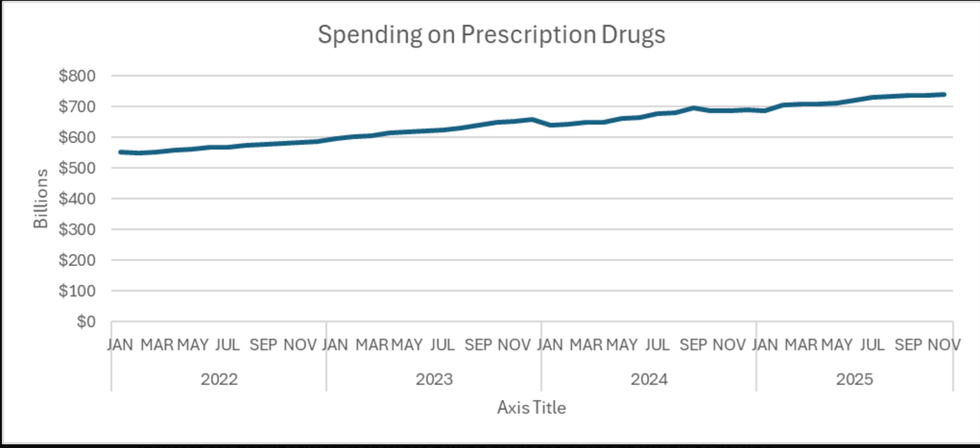
Source: NIPA Table 2.5.U, Line 122.
To be clear, the impact of this increase on family budgets is a bit more complicated. Close to half of drug spending is paid by insurers or government programs like Medicare and Medicaid, so most people are not paying that $5,400 out-of-pocket. But insurers are not charities, if they are paying more for drugs, they will be raising premiums to employers or the person buying the insurance. And higher drug prices are big costs for federal, state, and local governments.
There is one other point worth making on drug prices. The measure of drug price inflation shown in the Consumer Price Index (CPI) shows a much lower figure. That is because the CPI is tracking price changes for the same drugs. My guess is the CPI measure matters little to most people. If their doctor switches them from a less expensive to a more expensive drug, people care about how much they pay for their drugs, not how much the price of a specific drug has risen or fallen.
The Biden Boom in Factory Construction Is Fading
The October data, the most recent data available, show factory construction fell 0.9 percent for the month and is down 9.7 percent year-over-year. Factory construction had surged under Biden, peaking at more than double its 2019 level, after adjusting for inflation. It has been on a downward path since the fall of 2024 as factories have been completed or cancelled due to Trump’s efforts to undermine Biden era programs.
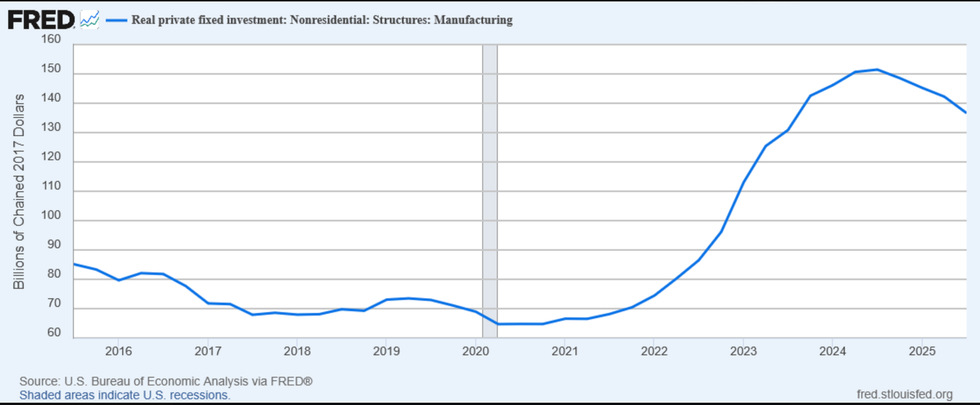
The slowing of factory construction goes along with a loss of manufacturing jobs. We were down by 70,000 jobs under Trump in the January data, but the jobs number will be revised downward by around 100,000 when BLS incorporates benchmark revisions with the release of January data.
In any case, from a Trumpian perspective, it’s clear we’re going the wrong way, with fewer factories being built and fewer jobs in manufacturing. Does this make Trump’s $18 trillion in foreign investment a bigger lie than the 1500% drop in drug prices? That’s the great question MAGA fans will have to decide for themselves.
Dean Baker is a senior economist at the Center for Economic and Policy Research and the author of the 2016 book Rigged: How Globalization and the Rules of the Modern Economy Were Structured to Make the Rich Richer. Please consider subscribing to his Substack.
Reprinted with permission from Dean Baker.