Tag: fast food
Troubling Signal: 'Fast-Food Index' Of Consumer Sentiment Is Falling Fast

Troubling Signal: 'Fast-Food Index' Of Consumer Sentiment Is Falling Fast

For the last several years, I’ve been using real spending at fast food restaurants as a gauge for assessing how the non-rich are feeling about their personal finances. The logic is that it is a type of discretionary spending where people can easily make cutbacks if they are feeling squeezed.

Also, it should not be affected much by the spending of the rich. It’s not likely that Elon Musk eats more Big Macs when his wealth increases or he cuts back when SpaceX’s stock plunges.

And to be clear, I’m not saying the rich don’t eat fast food. I’m sure they do. The claim is just that their consumption of fast food is not affected much by changes in their short-term financial situation.

Anyhow, the story the index has been telling us in the last year is not a good one.
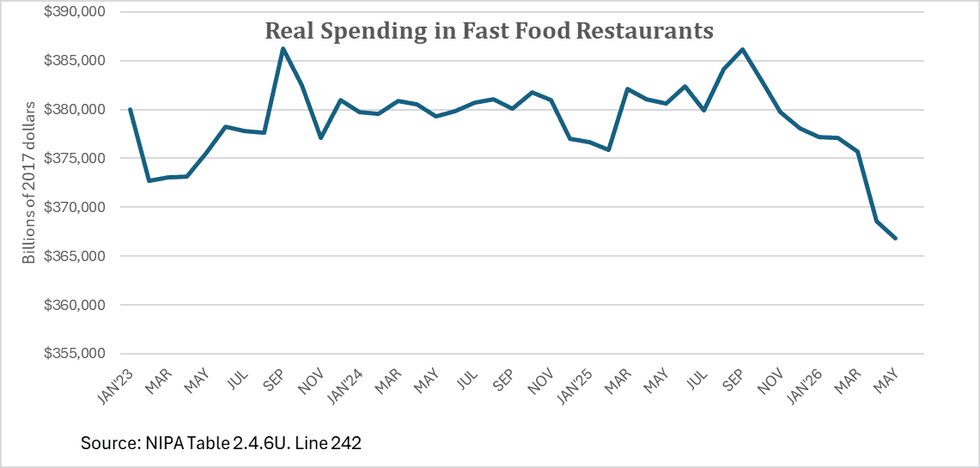

After rising at a healthy pace through 2023 (the January number was an upward blip), spending had been largely flat through 2024 and the first half of 2025. It then rose in the summer and peaked at an annual rate of $386.2 billion in September. Since then, it has fallen sharply, hitting $366.8 billion in May, a decline of just over 4.0 percent from its peak.

That would seem to indicate that people are feeling pretty bad about their economic situation. This is consistent with the bad numbers being reported in the consumer confidence indexes.

I’ve had people suggest to me that this decline could be driven by the increased use of Ozempic or related drugs. This would be a positive spin, since it would probably be good for people’s health if they consumed less fast food.

Unfortunately, that does not seem likely to explain this sort of decline. By 2024, 12 percent of the adult population was already taking a GLP-1 drug. The increase in usage did not prevent fast-food consumption from rising rapidly in 2023 and at least staying flat in 2024.

The number of people using these drugs has undoubtedly continued to rise, but probably not by enough to explain the sharp drop in consumption over the last 8 months. The drop in spending is likely giving us bad news about the state of the economy, not good news on public health.

People’s negative assessments of the economy continue to be somewhat of a mystery. The recent run-up in gas prices and inflation more generally is unambiguously bad news, but is this the worst economy ever, as some of the consumer confidence measures have been showing? Real income for those at the middle and bottom has generally been rising by standard measures, so it seems that we’re missing something, and I’m not sure any of us have figured out what.

The fast-food index is telling us what people do and not just what they say. And what they do is telling us that they don’t feel very good about the economy.

Dean Baker is a senior economist at the Center for Economic and Policy Research and the author of the 2016 book Rigged: How Globalization and the Rules of the Modern Economy Were Structured to Make the Rich Richer. Please consider subscribing to his Substack.

Ominous Economic Indicators In The 'Fast-Food Consumption Index'

Ominous Economic Indicators In The 'Fast-Food Consumption Index'

For the last several years I have relied on real (inflation-adjusted) spending at fast food restaurants as a useful gage of consumer sentiment. I began this during the pandemic recovery when the media were constantly telling us that people were struggling to make ends meet.

While this is always true in a country with a weak social safety net and extreme income inequality, the question any serious person asks is whether it’s getting worse or better. I kept pointing to the data showing that, at least for those at the bottom, it seemed to be getting better.

Wages in the lowest paying sector, hotels and restaurants, were substantially outpacing inflation. Also, analysis of wage data in the Current Population Survey showed that workers in the bottom decile of the wage distribution had the fastest real wage growth in half a century, with their wages outpacing inflation by 15 percent between 2019 and 2024.

To be clear, no one in their right mind would say that workers at the bottom of the wage distribution had it good. An inflation-adjusted $17.25 an hour in 2024 might be a lot better than $15.00 in 2019, but that is not the sort of pay on which someone could support themselves very well, and certainly not raise kids. Nonetheless, real wages were at least moving in the right direction, which they had not for much of the past five decades.

Anyhow, the pundits insisted that they didn’t care what the data showed, people didn’t feel they were doing well. It is hard to get into people’s heads. I know reporters are apparently experts at telling us what people really think, but most of us are not capable of mind reading.

We can look to what people say, but in a country of 330 million people, we could always find someone saying almost anything. It’s true that we saw lots of people quoted in news accounts telling us things were awful, but that was the decision of people writing the news to find people saying things were awful.

There is polling data, but that also ends up being ambiguous. People tended to answer questions about the economy in general very negatively, but they usually described their own situation as being relatively positive. Most people don’t have any direct knowledge of the economy as a whole. They get tidbits from the media, on social media, or their friends and co-workers. For this reason, their personal assessments of the economy have to be taken with a grain of salt.

There is an old saying that economists look at what people do, not what they say. There is some wisdom in this approach. People may say they think the economy is good or bad because they have been told this is the case, but their spending presumably reflects their own perception of their financial situation. For this reason, if we can measure what people are spending, we can get an idea of how they view their finances.

However, this does raise the problem of distribution. A grossly disproportionate share of spending is done by the top quintile of the income distribution. If aggregate consumption rises it could be because these people are seeing big stock gains, not because typical workers are doing better. In fact, recent research shows the richest 10 percent of households account for nearly half of all consumption.

This is my reason for turning to the fast-food consumption index. While rich people also go to McDonalds and KFC, it is unlikely they increase their visits much when the stock market rises. In fact, having more money may lead them to eat at more expensive sit-down restaurants instead of fast-food restaurants.

This means that changes in fast-food consumption are likely to primarily reflect changes in spending by lower and middle-income people, not the rich. With the revised consumption data released last week, we can see an interesting and not very good pattern in fast-food spending.

In 2021, 2022, and 2023, real fast-food spending was growing at an average annual rate of 5.4 percent, considerably faster than the 2.9 percent growth rate in the decade prior to the pandemic. But spending largely stagnated in 2024. Real spending in December of 2024 was actually 1.0 percent less than it had been in December of 2023. That stagnation has continued into 2025. Spending in August was less than 0.1 percent higher than it had been in December of 2023. This suggests that most workers do not feel they are doing well these days.

That fits the story with real wages in the hotel and restaurant industry. Real hourly wages for non-supervisory workers are less than 0.8 percent above their level in December of 2023. On the positive side, at least real wages are not falling, as was often the case in prior decades, but a gain of 0.8 percent in almost two years is not much to boast about.

With the revised data, there is more of a case that the labor market was weakening in 2024. It looks like it is continuing to weaken in 2025. Perhaps something on the horizon will turn that story around, but there look to be many more potential negatives than positives for the near future.

Dean Baker is a senior economist at the Center for Economic and Policy Research and the author of the 2016 book Rigged: How Globalization and the Rules of the Modern Economy Were Structured to Make the Rich Richer. Please consider subscribing to his Substack.
Reprinted with permission from Dean Baker.

How Tacky Can The Golden Arches Get?

How Tacky Can The Golden Arches Get?

McDonald’s is scrambling, and I’m not talking about eggs. You know your business has what image consultants call “quality perception issues” when you have to launch a PR initiative that publicly addresses such questions as: “Does McDonald’s beef contain worms?”

Thornier yet for the world’s largest burger machine is its boneheaded response to the remarkable, ongoing rebellion by fast-food workers, who’re demanding a $15-an-hour wage and the freedom to unionize without corporate retaliation. The overpaid and clueless executives at McDonald’s responded by — guess what? — retaliating against hundreds of the employees who joined the protests. Big Mac managers illegally reduced the hours (and therefore the pay) of those who joined the “Fight For 15” campaign, spied on them, interrogated and threatened them, and imposed restrictions on their freedom to even talk about unions or working conditions.

The corporation now faces federal charges on hundreds of labor law violations — as well as rising customer anger over its ham-handed tactics. Naturally, McDonald’s responded by apologizing and raising workers’ wages.

Ha! Just kidding. Instead, it’s running a new series of TV ads that, astonishingly, tries to tap into people’s emotions about such tragic events as 9/11 and the Boston Marathon bombing, as well as linking its logo to people’s positive feelings about veterans, birthdays, and even “love.” McD’s corporate marketing director explains that the ads are all about the Golden Arches shining bright in every community, being with us through the good and the bad. As she puts it, “Who better to stand up for lovin’ than McDonald’s?”

What a joke. For over a decade the burger behemoth has pushed its product with an advertising slogan that exuberantly proclaims, “I’m Lovin’ It.”

But it turns out that putting words of praise in customers’ mouths doesn’t sell more burgers — in fact, customers have been putting fewer Big Macs, Chicken McNuggets, and other McEdibles in their mouths, causing sales to sag. This decline in affection has to do with the corporation’s boring burger, unappetizing news reports that some of its suppliers have been repackaging expired meat, its corporate-wide policy of paying poverty wages, its ruthless anti-union tactics and its cynical strategy of having taxpayers subsidize its labor costs by directing employees to go on food stamps and Medicaid.

Not to worry, though, for new CEO Don Thompson (the second replacement in the top slot in only two years) is all over these boo-boos. Is he offering real improvements in quality, wages and benefits, and corporate attitude?

Come on — get serious! This is McDonald’s, and its investors and bankers don’t fritter away profit taking on real solutions. Instead, Don is doubling down on that McLovin’ feeling. The new ad campaign is specifically designed to link the corporate brand to the healing power of love. The ads show Batman and the Joker breaking bread together over a Happy Meal, a mailman and a dog finding peace under the Golden Arches, and — how’s this for seriously clever? — a blue donkey and a red elephant sharing common ground at a McDonald’s formica table. Each ad closes with the lovely thought that you, I and everyone everywhere should “Choose Lovin’.”

Get it? Choose McDonald’s, for it’s the source of love, and you’ll truly be “Lovin’ It.” Not for nothing is CEO Thompson, who is paid $9.5 million a year, plus full health coverage, a platinum pension and private use of the corporate jet. Where else but America can you be so enriched for preaching Lovin’, while directing your corporate lobbyists to kill any increase in the poverty wages of your employees?

Just ask protesting workers about the “love” they’re getting from McDonald’s. Oh, to be fair, the bosses did make one change for workers — new uniforms, supposedly to buff up the corporation’s public image. That’s not just boneheaded, it’s pathetic! I forgot to mention that most of these low-wage employees were forced to buy the uniforms themselves. How’s that for McLove?

To find out more about Jim Hightower, and read features by other Creators Syndicate writers and cartoonists, visit the Creators Web page at www.creators.com.

Photo: JKCarl via Wikimedia Commons

Shop our Store

Headlines

Editor's Blog

Corona Virus

Trending

World