Tag: fdr
Bernie Sanders

Socialist? Capitalist? Americans Live In A Mixed Economy, Without Labels

Democratic Senate nominee Abdul El-Sayed of Michigan keeps calling himself a capitalist. And the Democratic Socialists of America keep backing him to the eyeballs.

Why? Because the DSA understands that El-Sayed has to say that to win over even Democrats in a moderate state like Michigan. They firmly expect that once elected, he would do as they say, which happily conforms with what he truly believes.

Confusing? Yes, on purpose. But let's move beyond this war of labels. Let's stop using socialist and capitalist as either compliments or denunciations.

The United States has a mixed economy, as do most modern countries. It has an economic system in which both the government and the private sector control resources. The American government runs public education, Medicare, and the U.S. Postal Service, to name a few programs. They are all taxpayer supported.

Why does a stamp on a letter going from a remote farmhouse in North Dakota to Chicago cost the same as a stamp on a letter sent from one Chicago apartment to another three blocks away? In a purely capitalist system, the stamp's price would have reflected the difference in cost of delivery. The North Dakotan would have had to pay for this service, a lot more. But U.S. law mandates "universal service," which keeps the cost of a stamp fixed. Thus, dense cities subsidize mail delivery in rural areas.

Private companies, such as UPS and FedEx, charge vastly higher prices for delivery to remote places. Note that President Donald Trump has supported selling off the USPS to a private company.

Franklin D. Roosevelt pushed through the Social Security Act of 1935 as part of his New Deal program. America was in the jaws of Great Depression, and FDR used the power of the federal government to create jobs, stabilize the financial system and keep the destitute elderly alive.

New York's Democratic Socialist mayor, Zohran Mamdani, says he's another FDR. But FDR said, "No one in the United States believes more firmly than I in the system of private business, private property and private profit."

Roosevelt's new government programs were intended to save the capitalist-market system from collapsing, not, to use Mamdani's words, "replace the frigidity of rugged individualism with the warmth of collectivism." Where are the heroic peasants of the Soviet agitprop films waving banners?

Socialist Bernie Sanders heralds Sweden as the socialist model, citing its free health care, free college, and so forth. He also says, "I don't think billionaires should exist."

Sanders may not be up to date on Sweden's economy. It is highly capitalist with more billionaires per capita than the United States. The social programs he admires are supported by taxes.

Sweden, meanwhile, has been tightening the rules for receiving government benefits. For example, it's been cutting benefits to those not working. It has also adopted a hyper-restrictive immigration policy. In addition to the shock of a massive influx of people from very different cultures, Swedes rebelled at the impoverished newcomers' claims on its social programs.

The number of migrants entering Sweden was down to 12,000 last year from 117,000 in 2016. And the country is trying to get people already there with residency permits to leave.

What do the "abolish-ICE" Democratic Socialists think of that?

As conservative economist Milton Friedman famously put it, "It's just obvious you can't have free immigration and a welfare state."

Here's how it works: Our capitalist-market system generates a huge amount of wealth that can be taxed to pay for social and other programs. A balance must be found between encouraging wealth creation and crafting a tax code able to raise money for desired public needs. That's a lot harder than throwing around dated labels.

Froma Harrop is an award winning journalist who covers politics, economics and culture. She has worked on the Reuters business desk, edited economics reports for The New York Times News Service and served on the Providence Journal editorial board.

Reprinted with permission from Creators.
Red Scare: Almost None Of Us Are 'Socialists,' But Most Are Social Democrats

Red Scare: Almost None Of Us Are 'Socialists,' But Most Are Social Democrats

Fox News has a poll supposedly showing “socialism gaining ground with young voters.” But I don’t believe it. Young people may be more receptive to the word socialism, but that’s only because right-wingers constantly use that word to smear policies that have nothing to do with real socialism — i.e., government ownership of the means of production.

The fact is that very few Americans — even among politicians who call themselves “democratic socialists” — are really socialists. What many, I’d say a majority, of Americans support is what Europeans call social democracy — an ideology that is OK with living in a mostly market-driven economic system in which some people make much more money than others, but one that advocates policies to tame markets and inequality with progressive taxation, safety net programs, and regulations.

America already has an extensive range of social-democratic policies, although they are weaker than those in most other rich countries. And sustaining social democracy — indeed, making U.S. social democracy stronger — has very broad support, even among Republicans. Actual socialism, by contrast, has little public appeal.

Why, then, does it look as if socialism is on the rise? Mainly because right-wing propagandists continually smear social democratic policies as socialist, trying to make popular, mainstream policy ideas sound extreme. And some Americans who are basically social democrats in effect respond by saying, “Well, if that’s socialism, I guess I’m OK with socialism.”

Right-wingers often try to portray social democratic policies as somehow un-American. But social democracy is as American as sliced bread, invented in 1928. The Social Security Act, which created a safety net for the disabled and the unemployed as well as retirees, was passed just a few years later, in 1935. A national minimum wage was established in 1938. The big healthcare programs, Medicare and Medicaid, weren’t established until 1965 — but even that was 60 years ago.

So very few Americans even remember a nation that didn’t have a large, expensive social safety net — albeit one with some big holes in it. (In Texas, 19 percent of the population under 65 and 14 percent of children lack health insurance.)

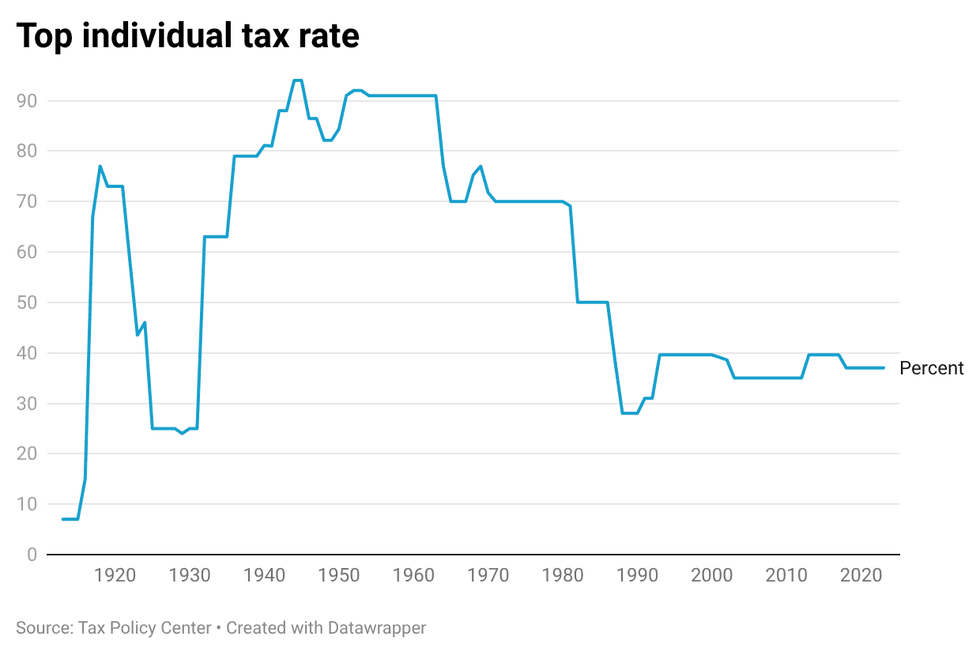
Progressive taxation has also been around for a very long time. In fact, taxes on high incomes were much higher in the 1950s than they are today:

At each stage of the expansion of U.S. social democracy, the right has screamed “socialism.” There was hysterical opposition to the creation of unemployment insurance in the 1930s; that opposition is the context for FDR’s famous 1936 Madison Square Garden speech, in which he declared of the forces of “organized money”,

They are unanimous in their hate for me—and I welcome their hatred.

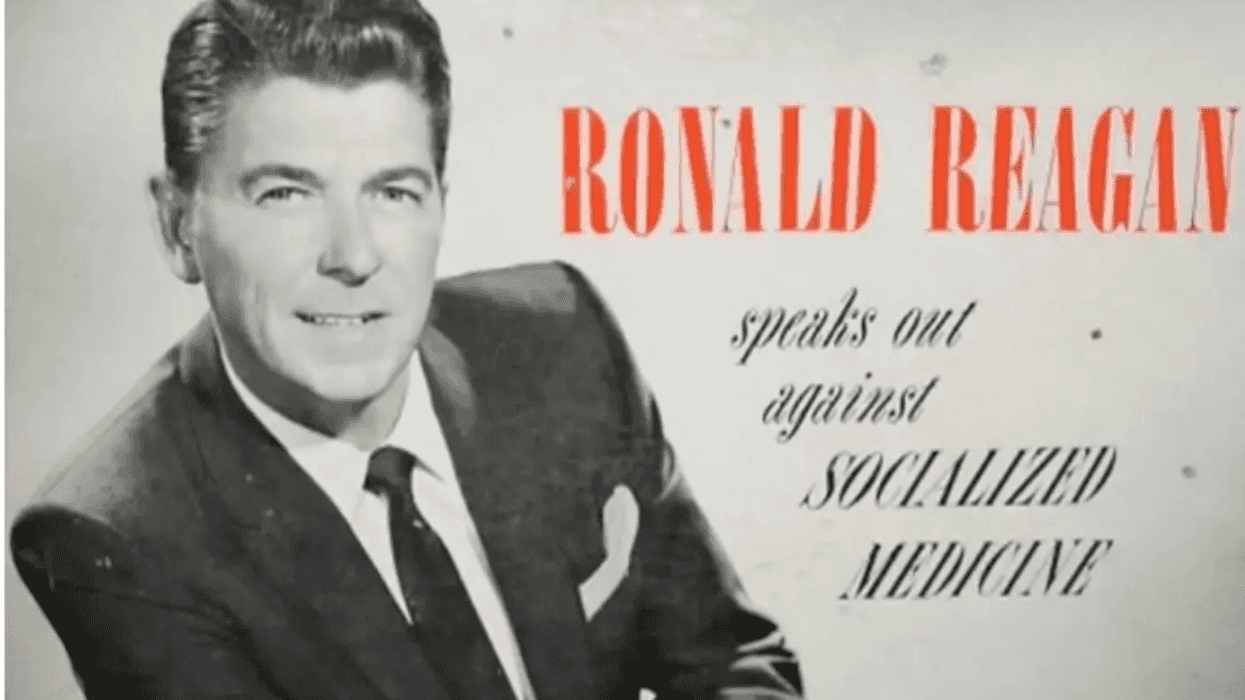
The picture at the top of this post comes from Operation Coffee Cup, a 1961 effort to head off what would soon become Medicare by getting doctors’ wives to invite their friends over to drink coffee and listen to a recording of Ronald Reagan explaining that government health insurance would destroy American freedom.

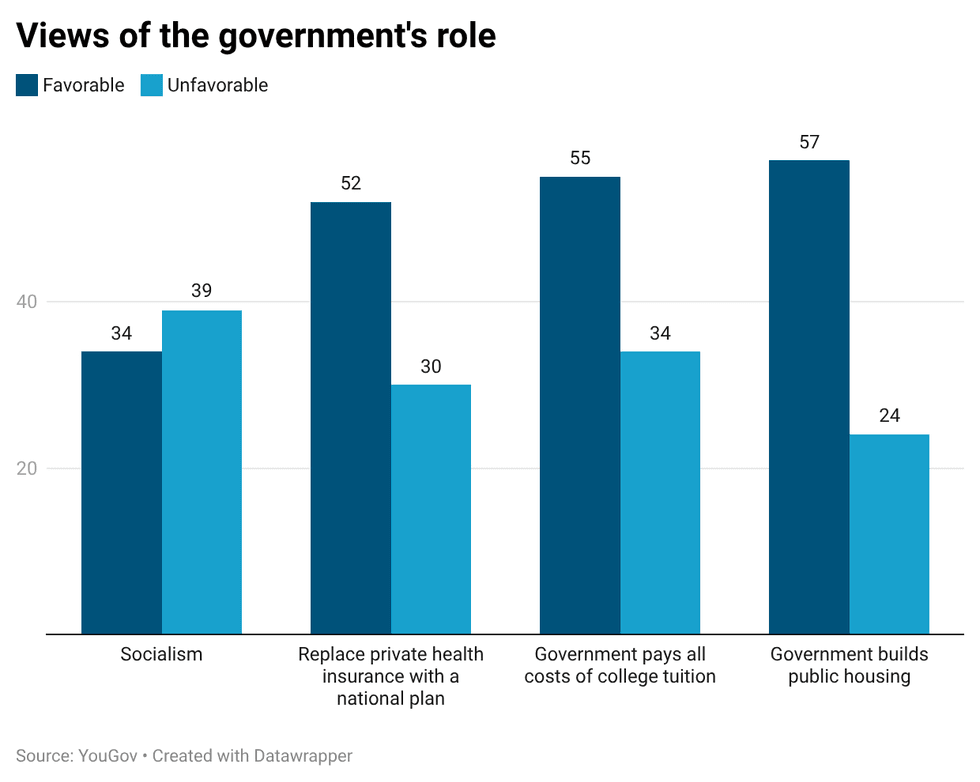
Yet Social Security and Medicare exist and are immensely popular. Indeed, while Americans continue to have a generally unfavorable view of socialism, they are strongly supportive not just of existing social democratic programs but of proposed expansions of the government’s role. From the latest YouGov poll:

Which brings me back to polls showing a rise in acceptance of “socialism.” What do they mean?

It’s safe to say that they don’t represent a groundswell of public support for actual socialism. Even politicians who call themselves socialists really aren’t.

It’s misleading even to call this a lurch to the left. As analysts like G. Elliott Morris have shown at length, most voters don’t think about politics in terms of left versus right. For the most part they think about kitchen-table issues, without strong ideological frameworks.

There is, however, a real groundswell of dismay over an economy that increasingly favors a tiny group of billionaires, and a political system that all too often works on these oligarchs’ behalf. When people say that they favor socialism, surely what they are often really saying is that they are angry about the rise of oligarchy. They are not demanding a dictatorship of the proletariat.

And while there are, of course, left-wing radicals in America, they have no realistic prospect of getting their way. So it’s important to understand what the current uproar over socialism is really about. For the most part, it’s an attempt to distract from the danger posed by the important radical movement in America — that of right-wing radicals who want to dismantle both social democracy and democracy itself.

Paul Krugman is a Nobel Prize-winning economist and former professor at MIT and Princeton who now teaches at the City University of New York's Graduate Center. From 2000 to 2024, he wrote a column for The New York Times. Please consider subscribing to his Substack.

Reprinted with permission from Paul Krugman.


Biden’s Ambitious Agenda Is More Truman Than FDR

Biden’s Ambitious Agenda Is More Truman Than FDR

Joe Biden's multitrillion-dollar plans to revive the economy, fix America's infrastructure and ease poverty have spawned comparisons between him and Franklin D. Roosevelt. At the 100-day mark of the Biden presidency, David Gergen, who has advised presidents of both parties, wrote, "Biden is off to an excellent start — arguably, one of the best since Roosevelt."

And Biden hasn't discouraged such talk. He now has a giant portrait of FDR in the Oval Office, right across from the Resolute Desk.

But while there may be likenesses between those two presidents' agendas, the less glamorous Harry Truman also deserves inspirational face time. Truman and Biden both came from modest small-town origins. Unlike the aristocratic Roosevelt, they knew firsthand about middle-class striving.

It's not surprising, then, that the Biden agenda seeks to recreate the Golden Age for the American middle class — the postwar years of 1947 through 1973, when productivity doubled but so did the median compensation of full-time workers. Truman was instrumental in launching it.

Truman understood that the well-being of workers depended on factors beyond the magic of the market. Widespread prosperity needed a third player in addition to business and labor. That player was a government willing to impose social norms through tax policy, the minimum wage, and protection for organized labor.

As World War II was ending, impatient workers launched destabilizing strikes. And so, in November 1945, Truman held a conference to create a new labor policy through which postwar abundance would be broadly shared. The participants came from business, the labor movement and — at Truman's insistence — government.

The business community came eagerly on board. As Eric Johnston, the president of the U.S. Chamber of Commerce, told the conference: "Labor unions are woven into our economic pattern of American life, and collective bargaining is a part of the democratic process. I say recognize this fact not only with our lips but with our hearts."

Truman proposed a national health care plan, which didn't happen, and higher taxes on the top incomes, which did. Biden's agenda both strengthens the Affordable Care Act and seeks to raise taxes on the top incomes.

Unlike Roosevelt's New Deal, Truman's Fair Deal took a strong stance on civil rights. New Deal programs broadly discriminated against Blacks. The National Recovery Administration, for example, gave preferences to white job seekers and allowed lower pay scales for Blacks.

Roosevelt appointed a few Blacks to token jobs. Truman put nonwhites in positions of real power, notably William Henry Hastie, the first African American federal appellate judge.

Biden just announced a racially diverse slate of judicial nominees. It includes sending Judge Ketanji Brown Jackson to the U.S. Court of Appeals for the District of Columbia Circuit, considered a springboard for the Supreme Court.

Biden is pursuing racial equity in some controversial ways. The COVID-19 relief bill includes a $5 billion fund for minority farmers only. And the infrastructure package says that 40 percent of the benefits of clean energy must go to "disadvantaged communities." How that would work is unclear.

The offshoring of American jobs and technological change of course accelerated workers' loss of economic security — and helped end the Golden Age. But the ditching of norms that only government could enforce also played a part.

Ronald Reagan cut taxes on the rich. Then George W. Bush did, and then Donald Trump. The federal minimum wage remains stuck at $7.25 an hour. In 1973, it was equivalent to $9.81 in today's dollars.

Biden seems to be summoning his inner Harry Truman and bringing back the third player. In assuring a stable and happy middle class, the market has a job to do, but so does government.

Follow Froma Harrop on Twitter @FromaHarrop. She can be reached at fharrop@gmail.com. To find out more about Froma Harrop and read features by other Creators writers and cartoonists, visit the Creators webpage at www.creators.com.

Shop our Store

Headlines

Editor's Blog

Trending

World