Tag: health insurance
'The Ideas Are There': Shutdown End Signals Renewed GOP Assault On Health Care

'The Ideas Are There': Shutdown End Signals Renewed GOP Assault On Health Care

First they came for the federal employees. Then they slashed food stamps. And now that the Democrats have surrendered in their fight to preserve expanded Affordable Care Act subsidies and Medicaid funding, expect to see a full-blown attempt by the GOP to gut the individual market in December.

Fresh off their overwhelming victories in last week’s off-year elections, a handful of Democratic centrists decided the possibility of delayed Thanksgiving travel plans was the bridge too far when it comes to protecting millions of people from losing their health insurance.

I put the odds of the Democrats winning concessions in the promised December negotiations — if they actually take place — at about five percent. Why would the Trump-owned GOP agree to even a one-year extension of expanded subsidies when they are planning to offer their own plans for “lowering premiums” during next year’s mid-term election campaigns?

This morning’s Modern Healthcare reports GOP leaders are planning to reintroduce many of the same policies they floated but failed to pass in their many efforts to repeal Obamacare during Trump’s first term in office. They include rejiggering the original ACA subsidies so that people buying plans on the exchanges pay lower premiums but have higher co-pays and deductibles.

Also under consideration is expanding the amount of money people can put into health savings accounts to defray their out-of-pocket expenses. This is meaningless for most lower-wage workers — the ones hurt most when thrown into high-deductible plans. They can’t afford to take money out of their paychecks to put into a health care rainy day fund. Such policies are a gift to the well-insured upper middle class, not people in the bottom half of the wage distribution.

GOP efforts to pose as defenders of health care will also include a push to eliminate restrictions on short-term plans, which the Biden administration had limited to three-months duration. Such plans, which have none of the guaranteed coverage or cost controls included in ACA plans, were originally conceived as a bridge for people between jobs.

The Trump administration announced in August it wouldn’t enforce the Biden rule. At the time, it said it plans to promulgate new rules giving such plans a one-year duration and allow people to stay on them for three consecutive years. Passing a law would get that job done more quickly.

They also want to bring back association plans, where industry, religious, or other groups can set up cooperative insurance schemes that meet none of the consumer protections in the ACA. Those include guaranteed issue (where you can’t be denied coverage if you have an existing medical condition); caps on out-of-pocket expenses; and requirements that plans offer benefits deemed essential like mental health and substance abuse treatment; pregnancy, maternity and newborn care; and preventive and wellness services.

A suite of changes like that will give young, healthy workers without employer-based coverage numerous low-cost options that enable them to bypass the exchanges when seeking coverage. Brokers will gladly push such plans since they make huge and repeated commissions through their sale. This will drain the insurance pool of healthy workers, leave behind a sicker insurance pool, and thus raise premiums for everyone who needs more comprehensive insurance.

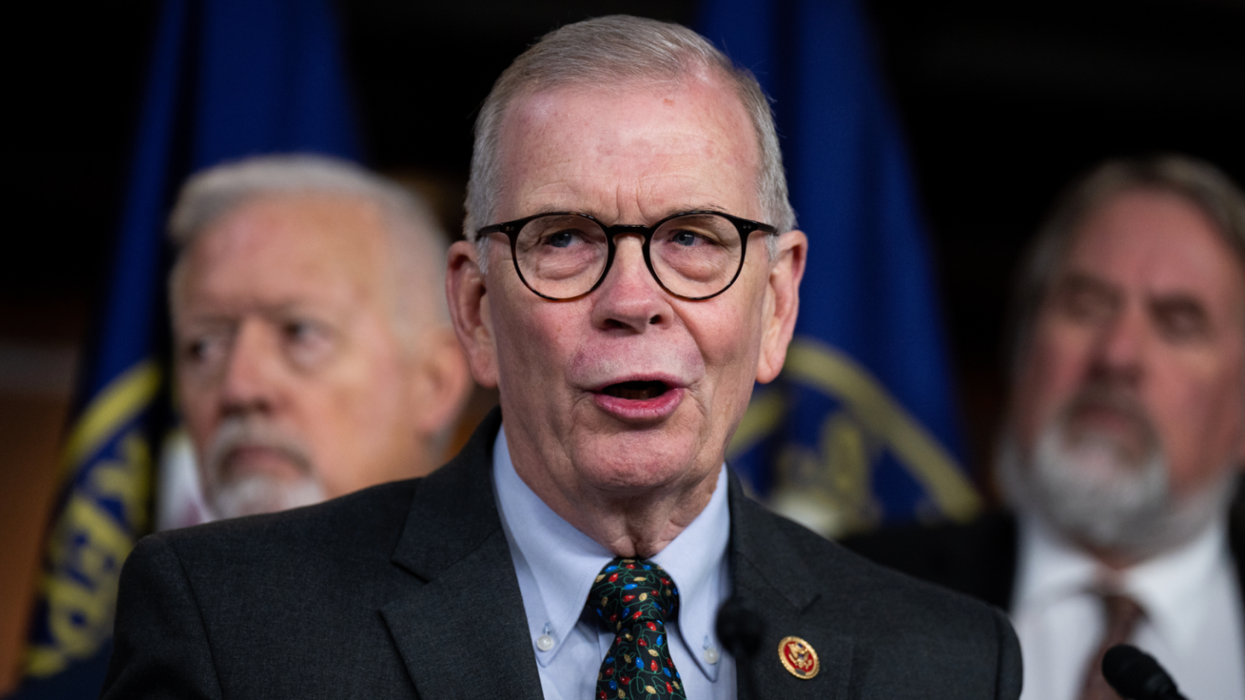
“We have discussions ongoing right now, and I think for any side to say the Republicans don’t have ideas for healthcare reform is to forget what we went through and almost got done,” House Education and Workforce Committee Chair Tim Walberg (R-MI) told Modern Healthcare in an interview. “The ideas are there.” (Editor's note: Another Walberg idea was launching nuclear strikes in Gaza to "get it over quick.")

And they’re moving to enact them. The Senate Homeland Security and Government Affairs Committee held a hearing last week to discuss a new insurance pool that would provide catastrophic health coverage for skimpy individual plans sold outside the exchanges. Numerous states tried this prior to passage of the ACA. In every case the plans were deemed inadequate and often foundered because of their high premiums, exclusions for pre-existing conditions, and annual and lifetime limits. Some states were forced to cap enrollment to limit costs.

Why the capitulation?

Some pundits are reporting that the Democratic capitulation “was all about the filibuster.” Others suggest the cutoff of food stamps was a larger issue. “Trump was purposefully making the shutdown hurt as many people as possible,” wrote Bill Scher of Washington Monthly. Yet “little in this deal is going to prevent him from inflicting further harm.”

The morning headlines in the Kaiser Health News daily feed said it all. “The Trump administration is telling states not to pay full November food stamp benefits, revising its previous guidance after winning a temporary victory at the Supreme Court on Friday,” Politico reported.

Iowa Public Radio reports the federal government ordered states to start enforcing a part of the One Big (Ugly) Bill that cuts off food assistance for refugees and many other types of immigrants with legal status. The Conversation reports the National 211 Hotline has seen calls for food assistance quadruple in recent days, to levels typically seen during natural disasters.

“Shockingly, President Trump and his allies were willing to cut off food assistance to children and fire federal public servants rather than to simply extend an existing tax credit to prevent a premium price spike of hundreds or thousands of dollars for millions of Americans,” Anthony Wright, executive director of Families USA, said in a statement this morning.

“While we are relieved to finally see an end to the longest government shutdown in history — getting federal workers back on the job and ensuring that essential safety net programs like the Supplemental Nutrition Assistance Program (SNAP) can continue — we must continue the fight to contain health costs,” he said. “Americans need a permanent extension of help for health care premiums, and a broader effort to address health care affordability overall.”

There is definitely a health care affordability crisis. It is being made worse by the Trump regime. I spent some time this morning looking at how out-of-pocket health care expenses are affecting different classes of Americans. Here’s what I found:

...
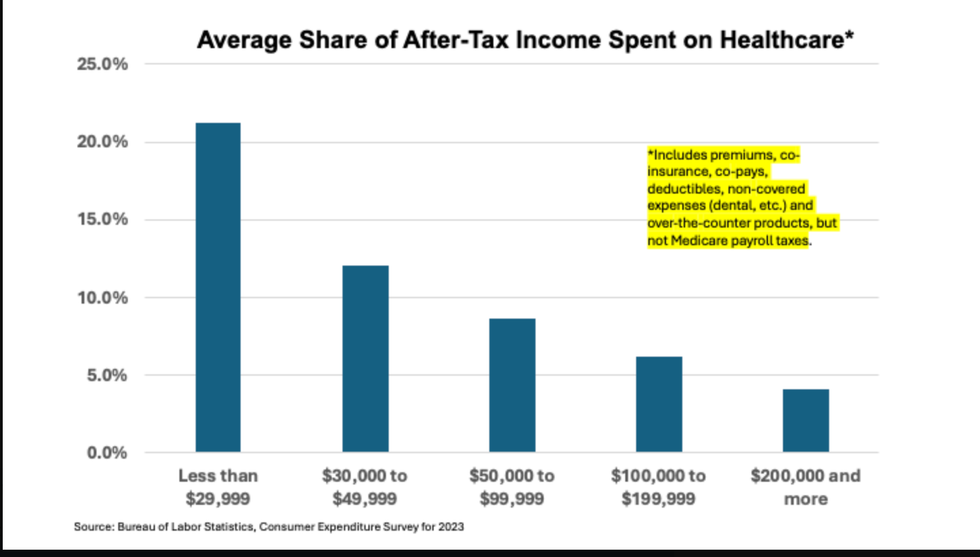
It’s time for the politicians to start coming up with real solutions to the affordability crisis that is hitting not just people on ACA plans or on Medicaid, but on the broader population. The Trump regime is only making things worse.

Merrill Goozner, the former editor of Modern Healthcare, writes about health care and politics at GoozNews.substack.com, where this column first appeared. Please consider subscribing to support his work.

Reprinted with permission from Gooz News
Trump Van Winkle, Obamacare And The 'Money-Sucking' Health Insurance Industry

Trump Van Winkle, Obamacare And The 'Money-Sucking' Health Insurance Industry

There is an old child’s tale about Rip Van Winkle. He fell asleep for 20 years and wakes up after the American Revolution and finds the world has changed in big ways. Donald Trump seems to be doing his own Rip Van Winkle routine. Yesterday, Trump suggested as an alternative to Obamacare, which he said feeds the “money sucking” insurance industry, that we just give money directly to people and let them buy their own healthcare.

This is a Rip Van Winkle story because Trump seems to think he has come up with a new idea. He apparently has missed the debate around healthcare reform that led up to Obamacare. He also apparently missed the debate on developing an alternative during his first term.While we don’t know exactly what Trump has in mind -- the plan will be ready in two weeks :), I hear -- there are fundamental problems with this sort of "just give people cash" idea. These problems push serious people, who have been awake, towards something like Obamacare or universal Medicare.

The basic problem of providing healthcare coverage is that some people have health conditions that are very expensive to treat, but most people are relatively healthy. If we just left things to the market, insurers will only cover healthy people. These people are very profitable for the industry, since they are basically just sending their insurer a check every month.

The problem is with the tens of millions of people who have health issues like diabetes, heart disease, cancer, or other conditions. These people are big money losers for the industry. They will avoid insuring them if they can or alternatively charge them tens of thousands a year for coverage. They may also contest making payments by claiming people had failed to disclose their health condition when they applied for insurance. I briefly went through the problems of the pre-ACA insurance market a few weeks back.

If Trump just gives people cash, it will do nothing to get around these problems. First, it is not clear which people he wants to give cash, and which cash. If he just means the enhanced subsides, he has around $35 billion a year to play with. Currently, around 22 million people get the enhanced subsidies, so that would imply checks of around $1.600 a year.

But there are another 28 million people currently without insurance, and another 2 million getting insurance in the exchanges without subsidies. Surely these people should be eligible for the Trump checks also. That would come to 52 million people sharing $35 billion, giving them each a check of less than $700.

Making the story even more complicated, people gain and lose coverage all the time, as they or a family member gets hired or leave a job with insurance. They may also gain or lose coverage for a government program like Medicaid. This means Trump has to figure out whether he will be sending out his checks once a year, giving many people a huge bonus and screwing those who lose their job after the cutoff date. Alternatively, this would have to be some sort of recurring payment, monthly or quarterly.

Perhaps Trump intends to take all the money going to Obamacare, not just the enhanced subsidies, which the Center on Policy Priorities puts at $125 billion, and roll it into his Trump checks. That would make them around $1,900 a year.

The next question is what Trump expects people to do with their money. A young healthy person may be able to cover their healthcare costs with $1,900 a year, but even these people would likely want insurance against the risk they may incur a serious illness or be in some sort of accident. Good luck finding insurance for $170 a month.

And the problem is far worse for older people and people with major health issues. In an unregulated insurance market, these people would be paying thousands of dollars a month for their insurance. Their Trump check will not go very far towards covering a premium of several thousand dollars a month.

Perhaps Trump plans to keep the Obamacare restrictions that require insurers to cover everyone, regardless of health condition, and prohibits discriminating based on health condition. That would limit the payments for people with health problems but still mean premiums that dwarf the size of the Trump checks, especially for those in the oldest pre-Medicare age bracket 55-64.

That would also put us basically where we are now except the checks would be smaller and untargeted, since all people without insurance, not just those enrolling in the exchanges, would be getting checks. Also, the current payments are adjusted by income. We don’t know whether Trump plans his checks to be income-based.

And in this story, the money would still be going to money sucking insurance companies, except presumably with less regulation so that the money sucking insurance companies could suck up more money. Under Obamacare, insurers have to pay out at least 80 percent of what they collect in premiums to providers, otherwise their customers get a rebate. Since Trump wants to get the government out of the picture, the insurers could presumably pocket even more money.

If Trump really wants to go after the money sucking insurance companies, getting them out of Medicare would be a great start. They mostly add cost to the program. He can improve the traditional program, adding dental, eyecare, and hearing coverage, and also imposing an out-of-pocket cap, and stop paying money sucking insurers in the Medicare Advantage program. Due to their higher administrative costs and profits, Medicare Advantage costs the government at least $100 billion a year compared to the traditional Medicare program.

If we’re really serious about cracking down on the money sucking insurance companies, why not go all the way and just provide universal Medicare. This would not only save the money directly paid to insurers, it would also eliminate much of the cost that hospitals, doctors’ offices and other providers have to incur dealing with complex forms from multiple insurers. This could save as much as $1 trillion a year ($8,000 per household) compared to what we pay now for administrative costs and insurance industry profits.

A universal Medicare system would also mean that everyone has access to healthcare regardless of where they work, what government program they qualify for, or if they remembered to pay their insurance premium last month. Not many would have expected Donald Trump to be the person to get us to Medicare for All, but if he really wants to crack down on money sucking insurance companies, that would be the way to go. Welcome aboard, comrade!


RNC Taking Unprecedented

It's Not Over: Now Is The Time To Pressure Vulnerable House Republicans

It was just under eight years ago that the nation nearly did what it is about to do and has never done before: Eliminate health insurance for millions of Americans.

I vividly recall how the last effort to repeal the Affordable Care Act ended. The entire newsroom of Modern Healthcare (the magazine I edited at the time) had gathered in front of a television monitor to watch the final Senate vote. President Donald Trump had strode into office promising repeal of the ACA. The House, with a large Republican majority, had voted in favor, but only narrowly. Twenty Republicans voted against scuttling a law that had succeeded in cutting the nation’s uninsured rate in half.

In the Senate, the decision came down to one man. Everyone stared as John McCain of Arizona, who was dying of brain cancer, strode across the Senate floor to cast the deciding vote. Republicans senators Lisa Murkowski of Alaska and Susan Collins of Maine had already voted no. As he approached the well where votes are cast, he stretched out his right arm. He had just held a brief phone conversation with the president. When his name was called, he held out his fist. With a quick flourish, he turned his thumb down. The gasp was audible.


The road to an inadequate system

Unlike every other country in the industrialized world, health insurance in the U.S. is not universal. Nor is it a right (despite the United Nations, the World Health Organization and a half dozen Democratic presidents declaring it so over the past 80 years). It is not even a guaranteed benefit for working under our employer-based health insurance system. There is no legal requirement that thousands of small businesses with tens of millions of workers offer coverage to their employees or that business, large or small, make it affordable when they do.

That’s why over the past century Congress has created an inadequate patchwork quilt of health insurance systems that to this day leaves 27 million people or 8.2% of the population uninsured. We have a government-run health care system for veterans (officially organized in 1921); a government-subsidized private insurance system paid for by employers (1940s); a government-run Medicare system for the old and disabled (1965); a joint federal-state Medicaid system for the poor (1965), subsequently expanded to include millions who work at low-wage jobs (20100; a government-run program for children who fall through the cracks (1997); and government-subsidized private health insurance for individuals who otherwise don’t have coverage (2010).

As Congress stitched each program onto the quilt, the share of the population without coverage fell. During recessions, the uninsured rate would sometimes rise temporarily, but the overall trajectory of the past century has been to move slowly, seemingly inexorably toward universal coverage.

We’re now on the verge of reversing progress for the first time. Donald Trump’s idea of making America great is to take us backwards to the time a little over a decade ago when fully 17% of the population was uninsured.

Let’s not forget that passage of the ACA took place against a backdrop of private insurance rates skyrocketing to pay for the uncompensated care given to the desperately ill people who showed up on hospitals’ doorsteps. It was also a time when tens of millions of people lacked access to routine health care, especially among the poor and poorly paid working class. That led to the gross disparities in life expectancy, infant and maternal mortality, and chronic disease incidence and deaths, which still bedevils this country.

Meanwhile, Robert F. Kennedy Jr., the Trump-appointed head of the Health and Human Services Department, is presiding over the dismantling of our world-class medical research system. He’s organizing sharp reductions in childhood vaccination programs and has little to say about the budgetary evisceration of our public health infrastructure. He makes loud pronouncements about the low quality of our food supply, yet says nothing about legislation that will literally rip food out of the mouths of children. Make America healthy again? Make America unhealthy again is more like it.

There’s still hope

Despite Trump’s threat to deploy the MAGA hordes to destroy the careers of Republican Congresspersons who go against his wishes, there’s still hope that the One Big Ugly Bill can be stopped. It only takes five Republicans in the House to vote no with the 212 Democrats who will be solidly against the legislation. The Senate version that passed Tuesday sharply reduces federal support for hospitals in nearly every jurisdiction in the country in addition to maintaining massive cuts in the core Medicaid program. Its aid for rural hospitals doesn’t begin to cover the losses most will absorb.

That’s the main reason the bill barely squeaked by in the upper chamber. GOP Sens. Thom Tillis of North Carolina and Susan Collins of Maine, who couldn’t stomach the Medicaid cuts, were joined by Sen. Rand Paul of Kentucky, who didn’t think its cuts went far enough. Alaska’s Sen. Lisa Murkowski, whose largely rural state would be harmed by the bill, could have been the deciding vote by said ‘yay’ despite what she said were grave misgivings. “We do not have a perfect bill by any stretch of the imagination,” she told reporters. “My hope is that House is going to look at this and recognize that we’re not there yet.”

The reality is that had she voted no, the bill as presently constructed would have died. That would have opened the Senate up for another round of deliberations where she would have wielded enormous influence.

“This fight’s not over”

The next battleground is the House, where Speaker Mike Johnson (R-LA), who represents another district heavily dependent on Medicaid, faces a difficult choice. He could call for a conference with the Senate, which could become a long and messy negotiation between budget hawks like Paul and those pleading for special bailouts like Murkowski and Collins.

Or, he could take the politically risky path of calling for a vote on the Senate bill, which would test Trump’s power. That opens the door for citizen activists, advocates for the poor, and the hospital and physician lobbies to put maximum pressure on Republican legislators, particularly those from swing districts that will suffer greatly from reduced support for Medicaid.

That work is already underway. Hundreds of people recently showed up on a rainy night in Omaha to pressure Rep. Don Bacon (R-NE), a former Air Force general. The Nebraska Hospital Association has warned his district faces at least six hospital closings should the bill pass. Last year, he narrowly won a district that supported Kamala Harris in the presidential race. After voting for the House version of the One Big Beautiful Bill, he announced his retirement.

“Nebraskans want no cuts to Medicaid,” Kelsey Arends, a staff attorney for Nebraska Appleseed, said at a press briefing organized by Families USA, which is just one of many groups organizing protests across the country. “340,000 people here rely on it.” Voters passed a referendum in 2018 expanding Medicaid under the ACA. In 2020, there were widespread protests that succeeded in stopping the Republican governor from instituting work requirements. “Rep. Bacon vowed to protect (Medicaid), but these bills are taking it away,” she said.

Similar local organizing campaigns are taking place in all the districts where Republican won House seats by thin margins, often riding into office on Trump’s coattails. Now they’re telling their constituents that they want to protect Medicaid and keep rural hospitals open.

“This fight’s not over,” Families USA executive director Anthony Wright said. “If these members mean anything that they said, they should not vote for this bill.”

Merrill Goozner is a former editor of Modern Healthcare, where he wrote a weekly column. He is also a former reporter for The Chicago Tribune and professor of business journalism at New York University.

Reprinted with permission from Gooz News.

Trump, CDC, public health threat

Fox News Ignores Trump Bill's Threat To End Health Care For Millions

Fox News has almost entirely ignored the projection that millions of people will lose health insurance if Republicans’ spending bill passes, mentioning the estimated effects of the health insurance cuts just once since a recent Congressional Budget Office report described the consequences. The report estimated that 10.9 million people would be left uninsured due to cuts to Medicaid and changes to the Affordable Care Act.

The majority of insurance losses — 7.8 million — can be attributed to “strict work requirements and more frequent eligibility checks.” The bill is currently being deliberated in the Senate.

Fox News’ overall coverage of the bill has praised these strict work requirements, pushed misinformation on the bill’s price tag, and suggested that only the undeserving will lose health insurance. Fox News host Laura Ingraham glossed over the possibility that millions of people might lose health insurance, suggesting that those who could be kicked off Medicaid are “stay-at-home sons.” Other Fox News personalities claimed Medicaid is not meant for “able-bodied men.” Host Sean Hannity falsely claimed that the CBO projected the legislation would reduce the deficit by $2.5 trillion — while in reality the CBO estimated the bill would increase the deficit by $2.4 trillion.

Since the CBO released its report on the projected uninsured on June 4, Fox News mentioned the potential insurance crisis only 1 time, devoting less than 30 seconds of coverage to the news. The Five’s Democratic co-host Jessica Tarlov offered the only mention of the CBO’s projection about the bill’s effect on millions of Americans’ health insurance.

Methodology

Media Matters searched transcripts in the SnapStream video database for all original programming on Fox News Channel for either of the terms “Congressional Budget Office” or “CBO” or any of the terms “Trump,” “Big Beautiful Bill,” “budget,” “reconciliation,” or “tax bill” within close proximity of any of the terms “health,” “insurance,” “Affordable Care Act,” “ACA,” “Obamacare,” or “Obama care” or any variation of the term “medica” from June 4, 2025, when the Congressional Budget Office (CBO) released its estimated budgetary effects of the One, Big, Beautiful Bill Act, through noon ET June 5, 2025.

We timed segments, which we defined as instances when the CBO's estimate of the budgetary effects of the “One Big Beautiful Bill Act” with regard to health care enrollment was the stated topic of discussion or when we found significant discussion of the CBO's estimate of the bill’s effects on health care enrollment. We defined significant discussion as instances when two or more speakers in a multitopic segment discussed the CBO's estimate of the bill’s effects on health care enrollment with one another.

We also timed mentions, which we defined as instances when a speaker mentioned the CBO's estimate of the bill’s effects on health care enrollment without another speaker in the segment engaging with the comment, and teasers, which we defined as instances when the anchor or host promoted a segment about the CBO's estimate of the bill’s effects on health care enrollment scheduled to air later in the broadcast.

We rounded all times to the nearest minute.

Reprinted with permission from Media Matters.

Shop our Store

Headlines

Editor's Blog

Corona Virus

Trending

World