Tag: john lewis
ICE Tactics Disgrace Us -- And Resemble Abuses Closer To Home Than 'The Gestapo'

ICE Tactics Disgrace Us -- And Resemble Abuses Closer To Home Than 'The Gestapo'

When Joe Rogan compares your tactics to that of the Gestapo, your rock-solid coalition might be in trouble. In January, the popular podcaster, who famously interviewed Donald Trump in the lead-up to the 2024 presidential election and endorsed him, expressed his disgust at the tactics of Immigration and Customs Enforcement on American streets.

“Are we really going to be the Gestapo? ‘Where’s your papers?’ Is that what we’ve come to?”

And Rogan is not alone.

Democratic Rep. Seth Moulton denounced “Gestapo-type stuff happening in the streets of America” after the killing of protester Alex Pretti in Minneapolis, joining other politicians, such as Minnesota Gov. Tim Walz, who have made that connection.

But the critics who flinch at the scenes out of Minneapolis need not have traveled so far back or far away for a combustible example of a clash between the power of the state and the public.

In a time before cellphones but with photographers documenting the scenes, American law enforcement acted as an occupying force rather than protectors. The citizens they came after were simply asserting their rights — to live where they wanted, to access shops and hotels and jobs they were overqualified for, to vote.

Those citizens were joined by allies who may not have been the targets of a government intent on control and subjugation but who still recognized that attacks on some were attacks on the very idea of America itself.

Ironically, during the civil rights movement, it was the federal government that provided a relief, of sorts, by sending in federalized National Guard troops to enforce laws that rebellious states resisted.

Today, it’s federal agents who storm in to grab power, smash things and people, and claim, in the false words of Vice President JD Vance, “absolute immunity.”

This isn’t an oppression Olympics, or an attempt to diminish the atrocities Hitler’s Germany unleashed or the experiences of the millions who suffered and died because of the actual Gestapo.

It’s about judging the Third Reich as singular, about seeing it for what it was, and seeing America for exactly what it is and has been. It’s an acknowledgment that fighting the powerful has always been a long and bloody struggle — abroad yes, and definitely at home.

You can be shocked at the scenes all the world now views through a haze of tear gas in previously calm Minneapolis neighborhoods, while recognizing their familiarity.

When we are used to digesting American history in TV-movie fashion, with clear heroes and villains and a clean resolution of justice by the closing credits, it fosters frustration when real life isn’t so cooperative and the people who resist don’t always win.

In fact, sometimes they die. And when that happens, it seems a senseless invitation to despair.

That’s why I’m not mad at those who observe unarmed citizens being tear-gassed, shoved and beaten, approached by masked men pointing weapons, and immediately reach to another country’s worst abuses.

We want to believe that it can’t happen here, at least not for long.

It makes it so much easier to judge what has happened and is happening in American cities from Chicago to Portland (Oregon and Maine) as aberrations in a country that mostly gets it right.

There is a reason the Trump administration is absolving and elevating U.S. soldiers who massacred Native Americans. There is strategy in attempts to obliterate any uncomfortable history about enslaved Americans who fought back, such as Ona (Oney) Judge, who fled George Washington’s President’s House, choosing a difficult and at times impoverished freedom, and never regretted it. (You will no longer find stories like hers in the Washington exhibit in Philadelphia, courtesy of America’s new rulers.)

But that erasure is a lot harder when veteran civil rights activists are alive and well, with memories of armed enforcers, police officers, sheriffs and judges who truly had absolute immunity from consequences. The children set upon by dogs and knocked down by the force of fire hoses can and do tell their stories.

Maybe I clearly see the connection because, though I was too young to know the meaning of what was going on, I remember the worry of parents who sent their three oldest out to protest, with nothing but a poster as protection.

As a journalist, I’ve interviewed folks like Democratic Rep. Jim Clyburn of South Carolina and the late John Lewis of Georgia, who often gave witness before his death.

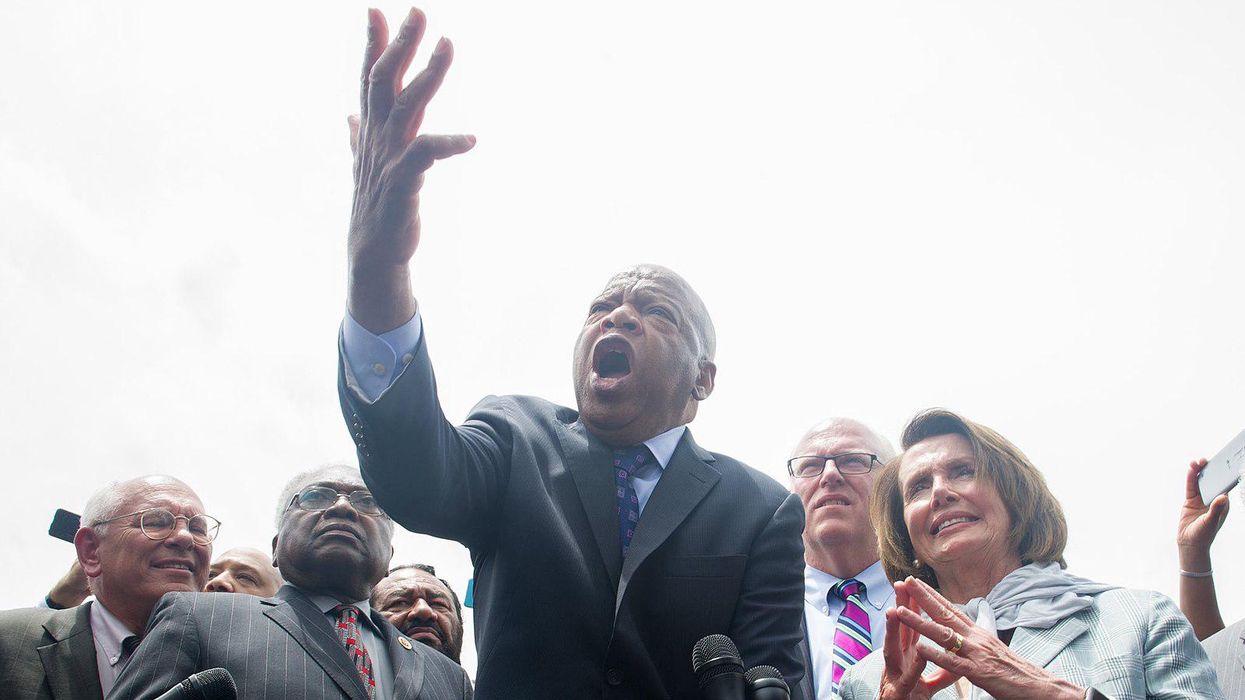
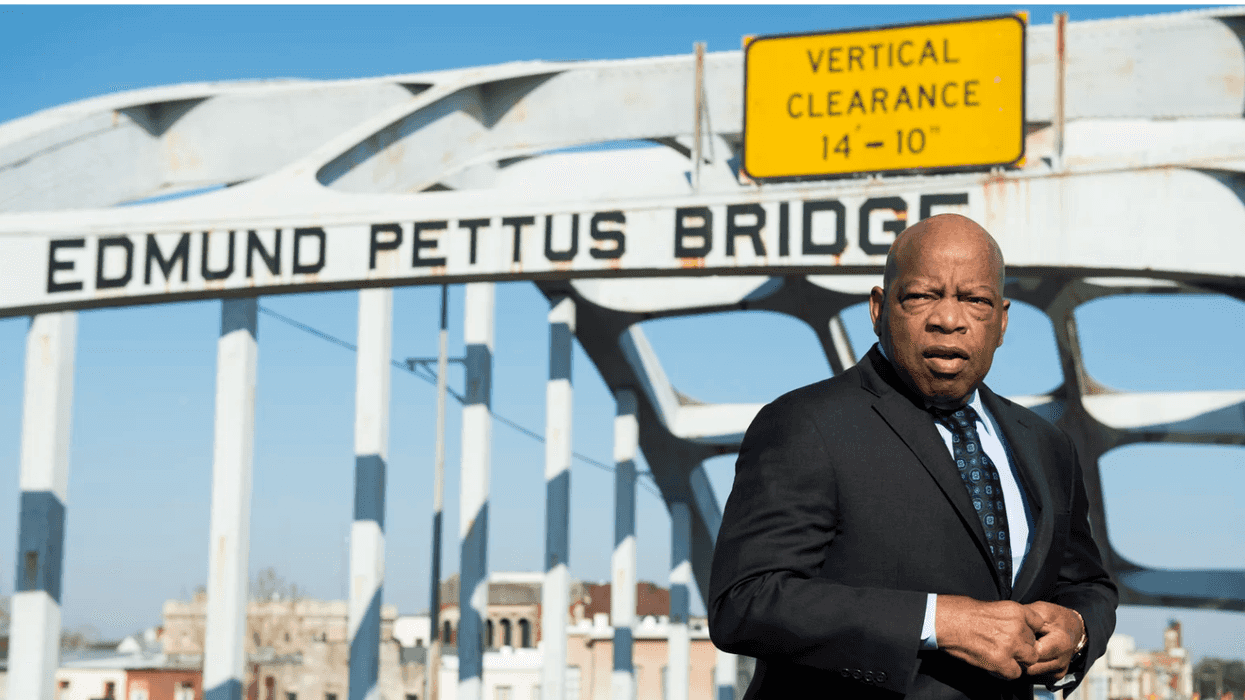
Lewis said that when he started his trek across the Edmund Pettus Bridge in 1965, a young man in a trench coat and toting a back pack, he didn’t know if he would make it to the other side alive. And though he did, photos of Lewis aiding women felled by policemen’s batons proved his fears were righteous.

Then and now, images made America notice, especially when the faces beamed around the world included white college students, clergy and housewives, protesters who saw Black Americans as neighbors rather than “the other” and joined the fight.

Then and now, there was shock when law enforcement treated them with the same disregard as Black men, women and children on the front line.

Anyone is free to make those parallels to authoritarian countries run by lawless secret police with orders from the top.

But never forget that what we’re going through now is all-American.

It’s especially important in the year of our country’s 250th birthday, one that, let’s face it, marks a “founding” that doesn’t consider those who lived here before the British, the colonists, and the United States of America.

In the lead-up to America’s anniversary celebration, it’s necessary to highlight how we achieved the progress that deserves celebration, and to remember that there has never been progress without pushback, often from those who should be on the side of justice.

Mary C. Curtis has worked at The New York Times, The Baltimore Sun, The Charlotte Observer, as national correspondent for Politics Daily, and is a senior facilitator with The OpEd Project. She is host of the CQ Roll Call “Equal Time with Mary C. Curtis” podcast. Follow her on X @mcurtisnc3.

Reprinted with permission from Roll Call
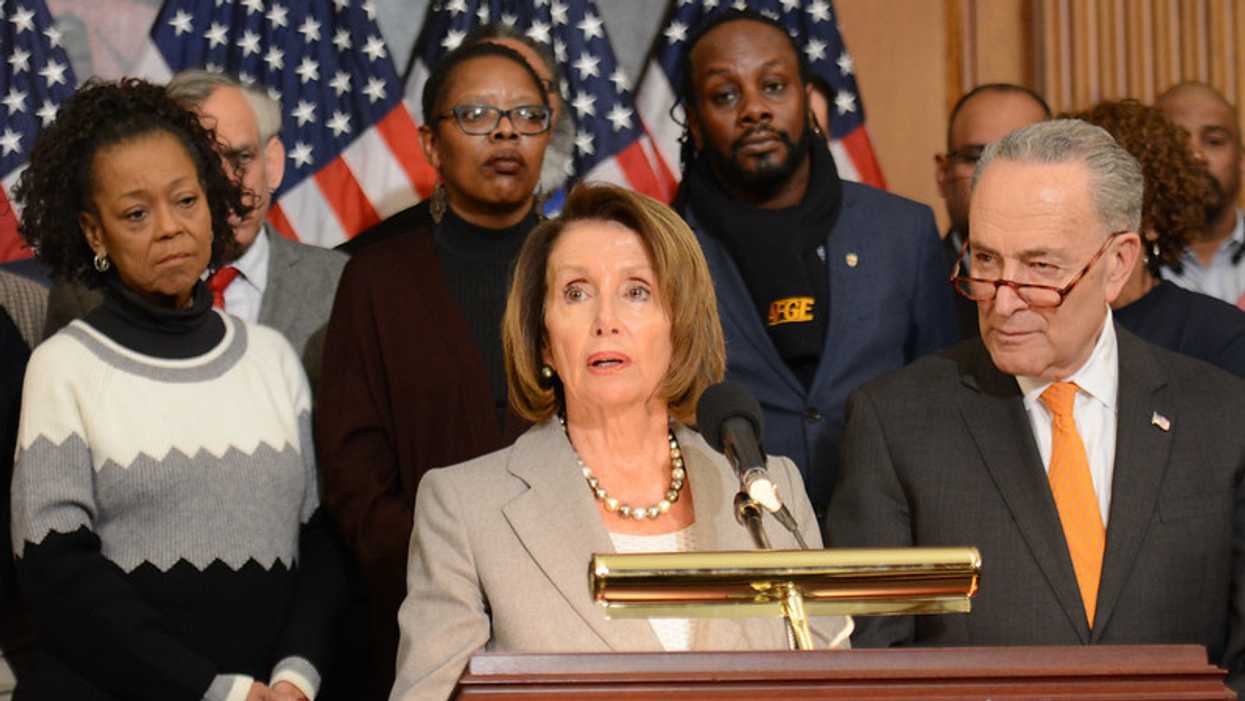
Schumer, Pelosi

Do Democrats Have An Ace Up Their Sleeve To Beat Filibuster On Voting Rights?

The Senate resumes Tuesday at noon, foregoing what would have been a week of recess for Martin Luther King Jr. Day, in order to debate the Freedom to Vote: John R. Lewis Act, the combined voting rights and election reform bills passed by the House last week. That debate can’t be avoided, thanks to the process Majority Leader Chuck Schumer and Speaker Nancy Pelosi engineered to bypass the first Republican filibuster, on the motion to proceed. The House folded the combined voting rights bill into an unrelated bill that was in reconciliation between the two chambers. Because the Senate had already passed the underlying bill, the whole thing can go directly to the floor for debate.

There, Democratic senators who aren’t Joe Manchin and Kyrsten Sinema will talk about its importance and—other than Mitch McConnell and a few grandstanders declaring that it’s a Democratic power grab trying to seize power from the states—Republicans will mostly not show up. That argument, by the way, is exactly the same framing that Southern segregationists in the 1950s and ‘60s used while filibustering civil and voting rights legislation.

Republicans—with the help of Manchin and Sinema—will use the filibuster in the most Jim Crow tradition to defeat the bill. Schumer and fellow Democrats—minus Manchin and Sinema—will move to alter the filibuster in order to pass the bills. Because of the two saboteurs will refuse to help save democracy, the bill will fail to pass. That is, unless a miracle of decency and enlightenment occurs between now and then for the two -- or Democrats agree to use another procedural gambit to outlast Republicans and pass it with a simple majority without ending the filibuster.

Democrats are pushing forward because, in the words of Virginia Sen. Tim Kaine, “We all have to be recorded at this moment in time about where are we in protecting the right to vote.”

In comments at a National Action Network event on Martin Luther King Jr. Day, Schumer called out Manchin and Sinema. He said he would do “everything in my power to advance legislation that would strengthen our democracy” despite the “two Democrats who don’t want to make that happen,” adding that the “fight is not over.”

“Far from it,” Schumer said. “I’m going down to Washington, and we are going to debate voting rights. We are going to debate it, and, in the Senate, you know we need 60 votes to break a Republican filibuster … but since we only have 50 Democrats in our razor-thin majority, the only path forward on this important issue is to change the rules to bypass the filibuster.”

“We must never give up,” Schumer said Monday. “We are going to continue till we get full voting rights for all Americans. We will never give up until we stop these horrible, horrible laws from passing, until we expand the right to vote, not contract it.”

How that’s going to happen, or when exactly, is not clear. As of Tuesday morning, the health status of all Democrats wasn’t apparent—Sen. Brian Schatz of Hawaii had tested positive for COVID last week, and Sen. Dianne Feinstein of California was absent for an undisclosed reason. It’s possible there won’t be 50 Democrats available right now to move forward.

That could argue for that other procedural trick at Schumer’s disposal—it would buy time. That’s to use yet another Senate rule to force Republicans to hold the floor with speeches and procedural motions and tire either them or the two traitor Democrats out enough to just break the filibuster.

This is something Democrats are looking at. “There are a couple of paths here. Do we go down the path and do a long debate until it’s done and then have a simple debate?” Kaine said last week. “We wouldn’t need a rules change to pass the bill by simple majority if the debate is over. Theoretically, you do not need a rules change to pass a bill that’s on the floor, you just have to allow debate to occur,” he added.

James Wallner, a former Senate Republican aide and expert on Senate procedure, explained how it would work. “The easiest way to get to final passage on this bill is to put it on the floor and have Vice President Kamala Harris or Majority Leader Schumer or any other senator start to make points of order against any senator who tries to speak more than twice.” That’s Senate Rule XIX, which says a senator can’t speak more than twice on the same question on a legislative day. That would mean Schumer would have to keep the Senate in session indefinitely—staying on the same legislative day for days, possibly weeks. That means simply recessing at night instead of adjourning. That would force Republicans to debate until all 50 of them had spoken twice.

That would put some pressure on the 16 sitting Republicans, including McConnell, who are on the record in support of the federal government protecting voting rights. Those sixteen have all voted to reauthorize the federal Voting Rights Act.

But it would also require a much more coordinated Democratic caucus than we’re used to seeing, and a presiding officer who was rock solid on the rules. “This requires a more aggressive presiding officer,” a senior aide to Senate Democrats told The Hill. “The parliamentarian is not going to advise the presiding officer, ‘Nobody seems to be seeking debate so bring the question.’ It will have to be affirmatively sought by the presiding officer.” The aide added: “The two-speech rule is hard to make work because you can always offer another amendment or bring up a new debate proposition and then get two more speeches out of that. And once again, the parliamentarian doesn’t look to enforce it again, so it would have to be presiding officer causing the parliamentarian to do something they don’t traditionally do.”

It would also mean that all 50 Democrats and Vice President Kamala Harris would have to be available all the time to squash Republican procedural motions. It requires both energy and discipline. If Schumer could muster that among his conference for a week, maybe two, it actually might wear Sinema and Manchin down to the point where they would give in on a filibuster carve-out for voting rights. Or not. The tactic would also force Manchin to stand by his claims that he thinks the talking filibuster should be restored. Because this would be essentially that, a talking filibuster.

There’s really nothing else pending in the immediate term to keep Democrats from trying this, though we’re just one month away from the next must-pass government funding bill. The continuing resolution that government is currently operating on runs out on February 18. A potential government shutdown could serve as an additional pressure point on Manchin and Sinema, who were more than happy to support a filibuster carve out in a similar situation last month, with the debt ceiling.

“They can table at any point anything before the Senate, so the Democrats are literally in simple-majority territory right now,” Wallner told The Hill. "They’ve got the majority, even though in a 50-50 Senate that’s kind of a technicality. They have it and they need to use it."

Reprinted with permission from Daily Kos

Late Rep. John Lewis with House Speaker Nancy Pelosi

Students Don’t Need The Disney Version Of Our History

Reprinted with permission from Roll Call
The White House issued a proclamation last week, of the sort that most presidents have issued about historical events that deserve commemorating, but that were missing, for the most part, during the Trump reign.

This one marked the 60th anniversary of the first Freedom Rides, on May 4, 1961, when traveling on a bus meant risking your life, if you were with an integrated group, sitting in a spot of your choice. Those southbound heroes were willing to face beatings and the unknown at the hands of fellow citizens intent on stopping progress by any means necessary. Angry and afraid, the violent white supremacist mobs refused to acknowledge the humanity of African Americans or the validity of any law that looked forward not back.

It's the reality — and not the myth of uncomplicated greatness the country has told the world and itself for far too long.

And it's not always pretty.

For that reason, many Republicans want to "cancel" it, to use a word today's conservatives have been misusing with reckless abandon. They'd like to erase the history and the essential lessons that reveal so much about how and why America is so divided and its systems — of health care, housing, education, and more — so inequitable in 2021.

Why? Because for all the chest-thumping toughness so many Americans brag about, apparently white students are too fragile to hear the truth, or see the pictures on prized postcards that treated lynchings as entertainment for the whole family, an indictment of more than a few rogue racists.

Black students, of course, subject to disproportionate school suspensions, stereotypical assumptions from teachers, and keen scrutiny by law enforcement on their way to and from, and sometimes in, the classroom, know all too well that the problems they face stretch back 400 years and more. But the laws being passed and pushed in states across the country — no surprise — don't have them in mind.

Alternate Reality

For those making and debating these rules, in states such as Idaho, Tennessee, Oklahoma, Texas, and Arkansas, creating an alternate reality, a version that resembles a Disneyfied diorama, is fine even if it is false, as long as it accommodates white feelings and gives in to white fears.

How will these laws be enforced? Government monitors? Would a fine be imposed if a teacher steps over some vague line? Well, yes, in Arizona, the penalty could be $5,000. If a curious student asks a question, will the teacher no longer be allowed to answer?

The late Rep. John Lewis, brave and persistent, who endured brutal beatings as a consequence of his civil rights activism —including his part in the Freedom Rides — would seem to be someone America's students could look up to. But I'm doubtful his march across the Edmund Pettus Bridge in 1965 would make it past the curriculum censors since his attackers were agents of the state, enforcing unjust laws that prevented African Americans from voting, from living a free life.

Can you imagine? Students might make a connection between those troopers and Derek Chauvin, a murderer in a uniform, and want to learn about the racist history of policing in America. Plus, calling that day "Bloody Sunday" just wouldn't do.

It's no coincidence that the defenders of a white-washed version of history are in many cases the same legislators rushing through laws that criminalize the protesters who are the spiritual sons and daughters of Lewis.

Do these arbiters of education think that if students don't learn about Jim Crow, they won't see anything shameful about "Jim Crow 2.0" laws that restrict voting rights and harken back to post-Reconstruction rules enacted to crush the progress of those who, once unshackled, achieved elective office and thrived?

It's clear from the twisted views of America's past held by many of the staunchest defenders of the anti-history movement that a more inclusive curriculum is overdue, and they should sign up for a makeup class.

Get the dunce cap ready for Martha Huckabay, president of the Women's Republican Club of New Orleans, who defended Louisiana GOP state Rep. Ray Garofalo's words on teaching about the "good" parts of enslaving men, women, and children and offered choice thoughts of her own. Huckabay opined that slavery resulted in "hard working ethics" and that "many of the slaves loved their masters, and their masters loved them, and took very good care of them, and their families." Was she talking about the torture, the rape, or the selling of children away from moms and dads?

Tennessee Republican state Rep. Justin Lafferty somehow interpreted the three-fifths compromise in the original Constitution, which counted the enslaved as three-fifths of a human being, as a step toward ending slavery.

Colorado GOP state Rep. Ron Hanks said the three-fifths compromise "was not impugning anybody's humanity" — after he made a lynching joke. His Republican colleague, state Rep. Richard Holtorf, called another colleague the racist stereotype "Buckwheat," and insisted it had nothing — nothing — to do with race.

CNN contributor Rick Santorum has tried and failed miserably to explain his comments that "we birthed a nation from nothing. I mean, there was nothing here. I mean, yes we have Native Americans, but candidly there isn't much Native American culture in American culture." Why, when he was a senator from Pennsylvania, could Santorum not be bothered to stroll to the National Museum of the American Indian? Was he too lazy or just incurious, either way not an example for school kids of any age?

Senate Minority Leader Mitch McConnell has weighed in on the debate. He seems fine with teaching the words of America's founding documents — the Declaration of Independence, the Constitution. Does he want to stop there, leaving out how, when and why the country failed to live up to the lofty principles in those documents until forced to by true patriots? He has said the year 1619, when the first enslaved Africans arrived in colonial Virginia, means little to him. Considering his slave-owning ancestors benefited from trading and "owning" human beings and, presumably, passed the wealth on to family members, you'd think McConnell would be a little more "woke."

History Repeats

"The past is never dead. It's not even past," wrote William Faulkner. The depressing proof can be seen in the tiki-torch-carrying white supremacists in Charlottesville, Virginia., chanting, "Jews will not replace us!" You have to wonder if avowed neo-Nazi James Fields Jr., serving life in prison for the killing of Heather Heyer, would even be charged under new laws that give a pass and winking approval to drivers who mow down protesters blocking a roadway?

Just months ago, on January 6, violent, hate-filled mobs — cousins in crime to those who greeted the Freedom Riders — stormed the U.S. Capitol, attacking police with the same weapons of batons and bats, hoisting Confederate flags, erecting gallows, hunting for lawmakers and endangering democracy itself.

South Carolina, where Lewis was viciously attacked and left in a pool of blood at the Rock Hill stop of the original Freedom Rides, on Monday officially observed Confederate Memorial Day, honoring traitors who fought to split a nation over the issue of slavery.

This Monday.

How will the next generations do better if they are forbidden from learning the history they must not repeat?

Mary C. Curtis has worked at The New York Times, The Baltimore Sun, The Charlotte Observer, as national correspondent for Politics Daily, and is a senior facilitator with The OpEd Project. Follow her on Twitter @mcurtisnc3.

Shop our Store

Headlines

Editor's Blog

Corona Virus

Trending

World