Tag: medicare fraud
Who Are The Biggest Fraudsters In Minnesota (And America)? They're Not Somali

Who Are The Biggest Fraudsters In Minnesota (And America)? They're Not Somali

It’s been seven weeks since the Department of Justice stepped up its investigation of fraud at Minnesota social service organizations run by citizens of Somali descent. The Department of Homeland Security simultaneously stepped up the Immigration and Customers Enforcement (ICE) presence in the Twin Cities.

The results thus far? One dead, one wounded, and the entire Somali community living in fear after being demonized by President Trump with statements like “we don’t want them in our country” and “they should go back to where they come from.”

A horrified public has rightfully focused on the murderous tactics and egregious civil rights violations perpetrated by out-of-control ICE agents. Nightly newscasts are filled with scenes of masked, camouflaged, machine gun-toting men patrolling the streets of Minneapolis; making warrant-less stops of anyone with brown skin; arresting those not carrying proof of citizenship; and throwing tear gas canisters at peaceful demonstrators. They’ve even entered a hospital and shackled a severely injured patient to his bed. The 2,000-plus ICE agents now in the city is nearly four times the size of the local police force.

Why are they there? The Trump administration was given cover to step up its attacks on the Somali immigrant community by national media coverage of longstanding fraud investigations in the state. The Minnesota Attorney General has issued three indictments over the past two years, while the U.S. Attorney in Minnesota brought one, all begun during the Biden years.

In the wake of its latest incursion, the administration announced it would block all federal social service funding to five blue states including Minnesota, a move that was temporarily blocked in a New York federal court earlier this month.

Media attention drove events

The national media got the ball rolling in late November when a story in the New York Times reported on three fraud schemes at programs that feed the hungry and provide day care, allegedly costing taxpayers over $1 billion. The three cases mentioned totaled a third of that amount. A key paragraph near the top claimed “Minnesota’s fraud scandal stood out even in the context of rampant theft during the pandemic, when Americans stole tens of billions through unemployment benefits, business loans and other forms of aid, according to federal auditors.

The link (which was included in the original Times story) leads to a Government Accountability Office report that estimated there was at least $100 billion in pandemic-era unemployment insurance fraud. The GAO blamed all 50 states for failing to police the program. That level of fraud would be 400 times greater than the largest fraud scheme so far confirmed in a Minnesota court room.

Meanwhile, the Trump administration is paring back fraud enforcement in red states. Last October, it put on hold a Biden-era order that Mississippi repay $101 million for welfare embezzlement. Agency officials — not patients, not providers — had involved former professional football quarterback Brett Favre in a scheme to channel temporary assistance families money into a fund for building a volleyball stadium on the University of Southern Mississippi campus.

The Times followed up two weeks later with coverage of a press conference held by acting U.S. Attorney Joseph H. Thompson, who was appointed by Trump last June. He announced a new probe of 14 Medicaid-funded programs for suspicious billing practices. Half of the $18 billion spent by those programs since 2018 was stolen, he said, although no specific allegations were included. “What we see in Minnesota is not a handful of bad actors committing crimes,” he said. “It is staggering industrial-scale fraud.”

Then, the day after Christmas, a conservative YouTube influencer named Nick Shirley posted a widely-seen video highlighting shuttered day care centers and Somali daycare workers refusing him entry. A few days later, Homeland Security secretary Kristi Noem, whose department has no jurisdiction over the allegedly defrauded programs, called for a “massive investigation of daycare and other rampant fraud” and unleashed ICE agents to begin investigating sites based on tips from the YouTube video, not FBI investigators, according to CBS News.

There is no doubt greedy operators ripped off Minnesota safety net programs. Several of the nearly 100 people under investigation have already pleaded guilty. Democratic Gov. Tim Walz, who dropped out of his re-election campaign in the wake of the scandals, clearly was slow to heed warnings from local and federal investigators about the large fraud schemes in the state’s programs.

Who’s the biggest alleged fraudster in Minnesota?

But if federal officials in Minnesota really want to go after industrial-scale fraud, they ought to step up their slow-motion investigation of UnitedHealth Group, the nation’s largest health insurer, whose headquarters just happens to be in Minneapolis.

They could start by taking a look at the UnitedHealth Group Abuse Tracker run by the American Economic Liberties Project, a anti-monopoly watchdog organization founded by Fordham Law School professor Zephyr Teachout. UHG, according to the tracker, has been accused of myriad wrongdoings in recent years, including:

  • Twelve reports and five lawsuits for upcoding and overbilling the federal government;
  • Three reports and one lawsuit for violating patient privacy;
  • Fifteen reports and five lawsuits for denying patient care based on cost instead of medical necessity;
  • Fourteen reports and seven lawsuits for steering patients and providers toward UHG owned subsidiaries in order to increase company profits; and
  • Eight reports of corrupt practices.

UHG, in its responses to news organizations and in court filings, denied every finding and claim, including those in last week’s report from Sen. Chuck Grassley’s office. After reviewing 50,000 internal documents subpoenaed by the Judiciary Committee, the report found UnitedHealthcare, UHG’s insurance arm, maintained a huge workforce dedicated to inflating risk-adjustment codes on its 8 million Medicare Advantage customers. This upcoding allegedly bilks the government of billions of dollars annually.

Outside analysts and the Medicare Payments Advisory Commission have repeatedly accused private insurers of overcharging the Centers for Medicare and Medicaid Services (CMS)’ MA program, which now covers over half of all seniors. The most recent estimates suggest over-billing based on upcoding needlessly costs taxpayers $84 billion a year.

Yet federal prosecutors bungled the one whistleblower case that finally came to trial after a decade of legal maneuvering. A special master ruled last February that the Department of Justice had failed to prove the insurance giant deliberately exaggerated how sick its Medicare Advantage patients were to increase federal reimbursements.

But there are still numerous cases pending against UHG and other MA providers. Multiple investigations have been announced by the DOJ. Just last week, Kaiser Permanente, a leading Medicare Advantage insurer in California, agreed to pay $556 million to settle claims it bilked Medicare of $1 billion through upcoding between 2009 and 2018. The case took years to make its way through the courts.

Fraud is widespread

If one needs more evidence that the fraud uncovered in Minnesota is not out of line with typical health care and social service fraud schemes across the country, one need only look at the settlements in cases compiled by Bass, Berry & Sims, a law firm with an extensive practice defending corporate clients against False Claims Act suits. (The False Claims Act is a Civil War-era statute that allows whistleblowers and their lawyers to keep as much as a third of money recovered from firms convicted of defrauding the federal government.)

In just the first half of last year:

  • Walgreens agreed to pay at least $300 million to resolve allegations its stores illegally filled invalid prescriptions for opioids and other controlled substances that were reimbursed by federal health care programs.
  • Gilead Sciences agreed to pay $202 million to resolve allegations that it funneled kickbacks in the form of speaker fees, costly meals, and travel expenses to physicians to induce them to prescribe its HIV medications.
  • California-based Seoul Medical Group and an affiliated radiology practice agreed to pay $62 million to settle claims it fraudulently increased Medicare Advantage reimbursements by falsely claiming patients had a severe spinal condition.
  • A Pfizer subsidiary agreed to pay nearly $60 million to resolve allegations that it provided remuneration to physicians in the form of speaker honoraria and lavish meals in order to induce prescriptions of its migraine medication.
  • Fresno-based Community Health System agreed to pay $31.5 million to settle allegations that it paid bonuses to physicians and subsidies for electronic health record systems in exchange for referrals and subsidies. The alleged illegal inducements included providing referring physicians with expensive meals, alcohol, and cigars provided in a lounge on premises at the health system.
  • New York’s St. Vincent Catholic Medical Centers agreed to pay $29 million to resolve allegations that it kept the money despite learning that it had overcharged the Department of Defense for health care provided retired military members and their families.
  • C.R. Bard Inc. and its affiliates agreed to pay $17 million to resolve allegations that they provided free samples and discounts to urology practitioners in a kickback scheme aimed at inducing use of the company’s catheters.
  • And, last June, in Minneapolis, NUWAY Alliance, a substance use disorder treatment provider, agreed to pay $18.5 million to resolve allegations that it double-billed for treatment services and paid Medicaid patients to seek outpatient care.

The last case, the only one settled in Minnesota in the first half of last year, involved a non-profit organization whose last federal tax filing showed $28 million in annual expenses. Its CEO, David Vennes, earned $619,000 in 2024. None of the 12 high-paid executives and 8 board members listed on the non-profit’s 990 form have Somali last names.

During last year’s second half, the U.S. Attorney’s office in Minnesota indicted eight Somali residents for stealing millions of dollars from the state’s housing stabilization fund. How much was siphoned from the $300 million in grants made to their organizations from that fund since 2000 was not specified in the press release, but it would probably fall within the lower range of thefts that make various organizations’ tracker lists.

It’s not the immigrants; it’s not the poor

So is Minnesota a hotbed of fraud compared to other states? Does it call into question, as other media accounts have suggested, the very idea that a more generous safety net like the one in that state invites fraud?

No, sadly, the problem of fraud is the same there as it is everywhere, even in redder-than-red places like Mississippi. It is as American as apple pie (it’s the government’s money, so it’s nobody’s money). It is inadequately policed by federal and state officials, Democrats and Republicans alike.

The nation’s tattered social safety net, under assault by the Trump administration and shrinking daily, remains prone to abuse by unscrupulous operators. Medicare and Medicaid are especially juicy targets. Most of the perpetrators are lodged within large corporations run by white executives with excellent and expensive legal representation.

A real crackdown on fraud would go after those big fish first.

Merrill Goozner, the former editor of Modern Healthcare, writes about health care and politics at GoozNews.substack.com, where this column first appeared. Please consider subscribing to support his work.

Reprinted with permission from Gooz News
Trump's Illegal Firing Of Inspectors General Undermines Fight Against Fraud

Trump's Illegal Firing Of Inspectors General Undermines Fight Against Fraud

It’s enough to give one a migraine.

Last Friday, just hours before President Trump illegally fired Christi Grimm as Inspector General of the Health & Human Services Department (along with 16 other inspectors general), her office and the Department of Justice successfully forced Pfizer Inc. to pay $60 million to settle charges it improperly marketed an anti-migraine drug.

A 2022 law strengthening the independence of in-house watchdogs at federal agencies requires the president to give Congress at least 30 days advanced notice before firing an IG. POTUS must also provide Congress with a detailed legal justification for any dismisssal.

The president’s contempt for the law parallels Pfizer’s alleged illegal activity. According to the settlement reached Friday, the company’s drug salespersons paid physicians “in some cases more than a hundred thousand dollars” to speak on behalf of Nurtec ODT, an anti-migraine drug. The speeches took place at dinner meetings attended by the speakers' family members, friends and colleagues from their own practice.

“Providers received no educational benefit from attending these meetings,” the settlement said. The subsidiary “intended the purchase of meals and drinks to induce these providers to prescribe Nurtec ODT.”

Why must Pfizer give financial inducements to doctors to convince them to prescribe a drug that helps people with a debilitating condition like migraines? One doesn’t have to look far for the answer to that question. Nurtec ODT’s topline celebrity promoter — Lady Gaga — offers only a half-hearted endorsement on the company’s website. “If you're, like me, one of the millions suffering from pain caused by migraine, Nurtec ODT may help,” she says.

“May” is the operative word. According to the Food and Drug Administration label on Nurtec, popping the pill ended migraine pains within two hours for just 21 percent of patients. That compared to 11 percent among those taking a placebo. It reduced major symptoms like nausea and light sensitivity in 35 percent of patients taking the drug compared to 27 percent among those taking a placebo.

In other words, Nurtec ODT was barely better than nothing. Two-thirds of patients received no benefit at all.

Cracking down on illegal marketing is only one of the crucial functions played by the Office of the Inspector General at HHS. Since 2007, the OIG and the Department of Justice have been operating a special joint task force to root out waste, fraud and abuse in a dozen major metropolitan areas.

“The Health Care Fraud Unit has charged more than 5,400 defendants with fraudulently billing Medicare, Medicaid, and private health insurers more than $27 billion,” a recent DOJ blog post noted. “In recent years, the average loss associated with the schemes prosecuted by the Health Care Fraud Unit has steadily risen, underscoring our focus on the most egregious offenders.”


Pill mills a target

One of the more significant recent cases took place in Alabama, where in 2023 an opioid pill-mill operator and his wife were sentenced to 20 years in prison for illegally distributing controlled substances and committing health care fraud. This was one of the first cases that Grimm, who has been with the agency since 1999, brought to a successful conclusion after becoming IG the previous year.

“At trial, evidence showed that the physician and his wife operated pain clinics in which patients often received pre-signed prescriptions that were issued to patients who went months or years without being seen by the doctor,” the joint task force’s most recent annual report said. “The doctor was responsible for writing prescriptions for over 10 million opioid pills and he and his wife also participated in fraud and kickback schemes that billed public and private insurance programs for over $270 million in fraudulent claims.”

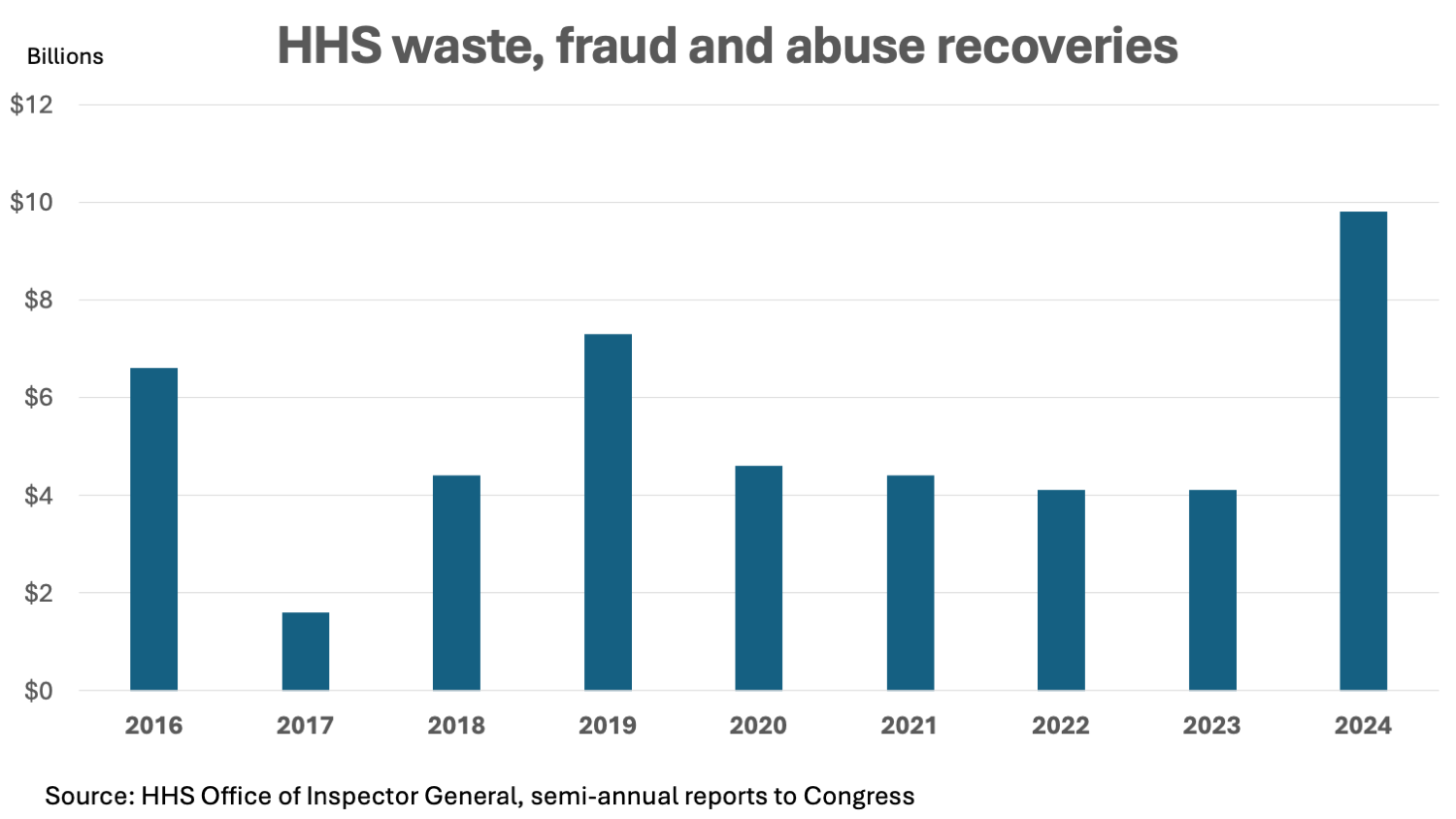
You would think someone who wants to make American healthy again, and help some of his most loyal constituents avoid being victimized by illegal pill-mill operators, would want someone like Grimm to run HHS’s watchdog agency. The OIG’s semiannual reports to Congress estimated the agency recovered close to $10 billion for Medicare and Medicaid in 2024, nearly 20 times the 1,500-person agency’s annual budget.

Much of the HHS-DOJ task force’s efforts in recent years has focused on cracking down on opioid abuse. It set up special offices in New England and Applachia. It also stepped up efforts in traditional hotbeds of Medicare fraud: Texas and Florida, both of which have two major task force offices dedicated to combating illegal billing.

Here’s hoping a federal judge capable of reading the plain letter of the law will force Trump to rescind these illegal firings and submit the necessary paperwork. He offered nothing last Friday to justify removing these career professionals, almost all of whom came up through the ranks and dedicated their professional lives to protecting taxpayers, program integrity and current and future beneficiaries of important government programs.

Since I’ve began covering health care more than two decades ago, the HHS OIG has always been headed by a career professional. Dan Levinson, who retired in 2019, had been there for 15 years. When he left, Alex Azar, HHS secretary during Trump’s first term, said “Under Dan’s leadership, the HHS Office of Inspector General (OIG) has done tireless, invaluable work to protect program beneficiaries and taxpayer funds, improve the management and integrity of HHS programs, and respond to emerging challenges such as the ongoing opioid crisis.”

This time around, there’s widespread fear that the mission of the OIG will be undermined if Trump gets away with turning the job into a political appointment. “President Trump is dismantling checks on his power and paving the way for widespread corruption,” Sen. Elizabeth Warren (D-MA), said on Friday after the president’s announcement.

Merrill Goozner, the former editor of Modern Healthcare, writes about health care and politics at GoozNews.substack.com, where this column first appeared. Please consider subscribing to support his work.

Rick Scott

The Sordid History Behind Rick Scott's Medicare Mess

In Washington, acrimonious public disagreements among congressional leaders of the same party are unusual, which was why reporters took note not long ago when Sen. Mitch McConnell publicly spanked Sen. Rick Scott for what he considered an act of monumental stupidity.

What infuriated the Senate minority leader, who yearns above all to become the majority leader again, was Scott's unveiling of a 60-page "plan" describing what the Republicans will do if and when their party regains the majority. As chair of the National Republican Senatorial Committee, Scott's job is to ensure victory in the November midterm by doling out tens of millions to candidates.

But McConnell saw Scott's plan as the equivalent of a loud emission of noxious gas: unpleasant, unhelpful, and very much to be avoided. McConnell has steadfastly refused to state what Republicans would do if they win the Senate; now, the lunkhead Rick Scott has let the cat out of the bag.

Especially irksome to McConnell were two aspects of Scott's blueprint. "Let me tell you what would not be part of our agenda," snapped McConnell. "We will not have, as part of our agenda, a bill that raises taxes on half the American people and sunsets Social Security and Medicare within five years. That will not be part of the Republican Senate majority agenda."

Of course, McConnell just doesn't want to tell voters what his party will do, because their ideas are deeply unpopular and always get them in trouble, like when Newt Gingrich proposed privatizing Medicare and former President George W. Bush proposed privatizing Social Security.

Scott's scheme to raise income taxes on most households struck McConnell as politically insane, and so did the plan's endorsement of allowing "all federal legislation," including Social Security, Medicare and Medicaid, to simply expire within five years.

Scott, for his part, has portrayed himself as a "bold" visionary victimized by conventional thinkers. Polling, however, indicates that the Scott scheme is profoundly unpopular among all voters, including Republicans, with majorities north of 65% rejecting it. No more than 15% like it.

So, the Florida senator has simply lied since then.

"No one that I know of wants to sunset Medicare or Social Security," he insists, although that's exactly what his plan urges.Perhaps McConnell was too polite to mention the other utterly politically crazy aspect of the Scott proposal: namely, the likelihood that attacking Medicare and Medicaid will remind America about the massive health care fraud underlying Rick Scott's enormous personal fortune, estimated at $300 million.

Beginning in 1987, Scott founded and built Columbia/HCA, a hospital chain that included hundreds of health care providers across multiple states and engorged itself on billions in Medicare and Medicaid fees. Unfortunately, this lucrative business involved truly gigantic levels of fraud, which by early 1997 drew the attention of federal investigators. Columbia/HCA illegally scammed billions of dollars intended for patient care, perpetrating what remains the biggest fraud on government ever by any health care institution.

The company's board forced Scott to resign within months after the federal investigation became public. He pleaded ignorance, barely escaped indictment and walked away with vast wealth. He claims to have accepted "responsibility," although he consistently blamed others, adding piously that the experience "made me a better leader."

Somehow, Florida's voters narrowly elected him governor in 2010 and then to the U.S. Senate in 2018. The words of his 2010 primary opponent Bill McCollum, a former Navy prosecutor and Florida attorney general, still ring true. During the campaign McCollum denounced Scott as "the disgraced former CEO of Columbia/HCA who is inseparably associated with one of the most massive Medicare fraud schemes in American history."

Scott's sordid narrative raises an obvious question. How did this come to pass? We know that Florida voters have a habit of electing some truly awful politicians, and that Scott spent $60 million to win his first election. We know that Republican leaders in Washington have no problem with fraud or corruption, so long as it accrues to their own power. Just ask "Moscow Mitch," who was in the tank for Oleg Deripaska, a sanctioned Russian oligarch with Kentucky investments. We know that the Republican concern for ensuring the fairness and stability of our health care system is nil, given their long war against Medicare and, more recently, the Affordable Care Act. Now, they won't even act to reduce the cost of lifesaving insulin.

Voters should be aware that this corporate malefactor is in charge of handing out the big campaign bucks from the Senate Republican campaign — and that he aims to destroy the nation's most successful and popular domestic programs. Somebody better tell them before November. Buyer beware.

To find out more about Joe Conason and read features by other Creators Syndicate writers and cartoonists, visit the Creators Syndicate website at www.creators.com.

First, Do No Harm — To Your Bank Account

First, Do No Harm — To Your Bank Account

After being sued by The Wall Street Journal, the government finally released its Medicare reimbursement data last week. It included the less-than-stunning revelation that 28 of the 100 doctors who received the largest payments in 2012 were from Florida.

No other state came close. And no physician in the country billed Medicare for bigger bucks than Dr. Salomon E. Melgen, a West Palm Beach ophthalmologist who operates several clinics and is tight with a powerful Democratic senator.

Melgen got almost $21 million from Medicare in 2012. (No, you don’t need your vision checked — $20,827,341 is the actual number, for one year.)

Records show Melgen filed claims for 894 patients and 92,000 procedures, meaning Medicare paid him approximately $11,700 for every eyeball that was eyeballed by him and his staff.

Even in Florida, the mecca for Medicare tricksters, Melgen’s billing habits drew notice. The government had already forced him to give back $8.9 million from 2007 and 2008, alleging he overbilled for injectable Lucentis, an expensive medication that combats macular degeneration.

The disorder is common in the elderly, and nationwide the treatment costs Medicare $1 billion a year. In 2012, Melgen reported administering more than 37,000 doses of Lucentis in South Florida.

Currently he’s under investigation for possible fraud, and twice FBI agents have swarmed his offices in search of evidence. His attorney says he’s done nothing wrong, and has taken action to recover the nearly $9 million that Melgen repaid the agency in charge of Medicare and Medicaid.

The doctor has an important ally in Senator Robert Menendez, the New Jersey Democrat, who has traveled on Melgen’s private jet and hung out at his posh spread in the Dominican Republican.

When Melgen first got in trouble, Menendez called the U.S. Department of Health and Human Services to defend his pal’s prolific billing. Another time the senator argued in favor of a company owned by Melgen in a dispute over a seaport contract in the Dominican Republic.

For his part, the doctor donated $700,000 to a Democratic political action committee that gave $582,000 to Menendez’s re-election efforts. So far, Melgen’s friendship with Menendez has failed to deflect the FBI’s interest.

Second on the national scoreboard of Medicare’s top billers is Dr. Asad Qamar, an Ocala cardiologist who was paid $18.2 million in 2012. He told the New York Times that his charges are fair, and that the sum is so large partly because he works in an outpatient facility for which the government pays added fees.

Like Melgen, Qamar is an enthusiastic donor to Democrats, including President Obama. He gave more than $100,000 to the Democratic National Committee, and distributed other contributions to congressional candidates in five states, including Florida.

After federal auditors began examining Qamar’s bills, the doctor hired lobbyists to contact more than a dozen U.S. lawmakers, seeking relief from the scrutiny. “The auditors put an astronomical burden on us, in terms of manpower,” he told the Times.

An astronomical burden caused by astronomical billing.

Any physician who rakes in $18 million from Medicare in 12 months deserves special attention, because such a massive volume of medical claims definitely isn’t business as usual.

In fact, according to a Times analysis, only about 2 percent of doctors collected almost 25 percent of the country’s Medicare payouts in 2012. Expanding that graph, just 25 percent of doctors accounted for 75 percent of Medicare’s total spending, which reached $77 billion that year.

It’s hardly a shocker that Florida leads the way. No place in the nation hosts more Medicare fraud prosecutions, a grim distinction.

The good news is that the conviction rate is high; the bad news is that we could quadruple the number of prosecutors, and they’d still be overworked.

Meanwhile, soaring Medicare costs cut deeper and deeper into federal tax revenues. The program is so huge that it practically defies effective auditing, but certainly a much better job of that could be done.

Publicizing the payment database is a start. Some medical practices are more complex than others, and the numbers only tell part of the story for each physician on the list.

However, it’s more than a statistical blip when two doctors collect a total of $39 million, more than hundreds of other practitioners in those same specialties added together.

California, which has twice the population of Florida, had only 10 doctors in the top 100 Medicare billers, compared to our stellar 28.

It’s not that Florida has more sick and elderly people than California, because we don’t. We just happen to attract more opportunists.

(Carl Hiaasen is a columnist for The Miami Herald. Readers may write to him at: 1 Herald Plaza, Miami, Fla., 33132.)

Photo: Michael McCullough via Flickr

Shop our Store

Headlines

Editor's Blog

Corona Virus

Trending

World