Courageous Carney, Demented Donald And The Shameful End Of Pax Americana
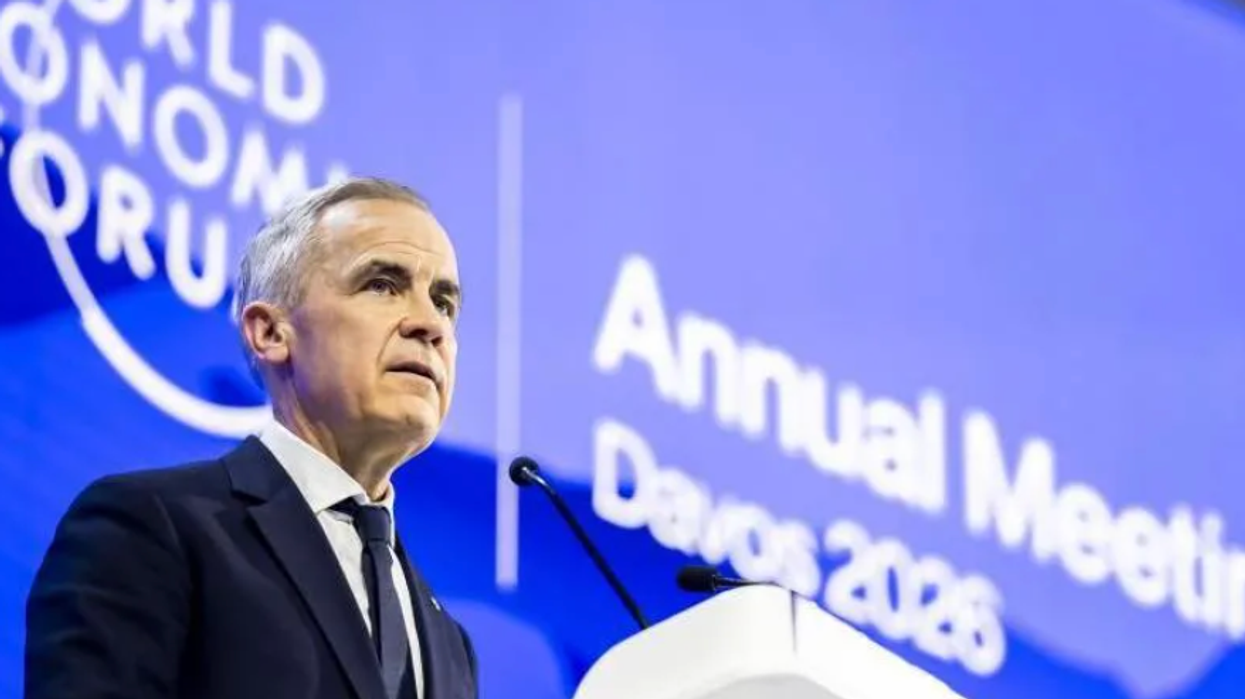
On Tuesday Mark Carney, Canada’s Prime Minister, gave a remarkable speech at the World Economic Forum in Davos. In effect he announced, calmly and lucidly, that Canada is filing for divorce from the Pax Americana:
Let me be direct. We are in the midst of a rupture, not a transition.
Over the past two decades, a series of crises in finance, health, energy and geopolitics have laid bare the risks of extreme global integration. But more recently, great powers have begun using economic integration as weapons, tariffs as leverage, financial infrastructure as coercion, supply chains as vulnerabilities to be exploited.
You cannot live within the lie of mutual benefit through integration, when integration becomes the source of your subordination.
And he urged other nations — implicitly, although he didn’t say it in so many words, the nations of Europe in particular — to join Canada in a new alliance of democracies no longer willing to take orders from an abusive hegemon:
[T]he middle powers must act together, because if we’re not at the table, we’re on the menu.
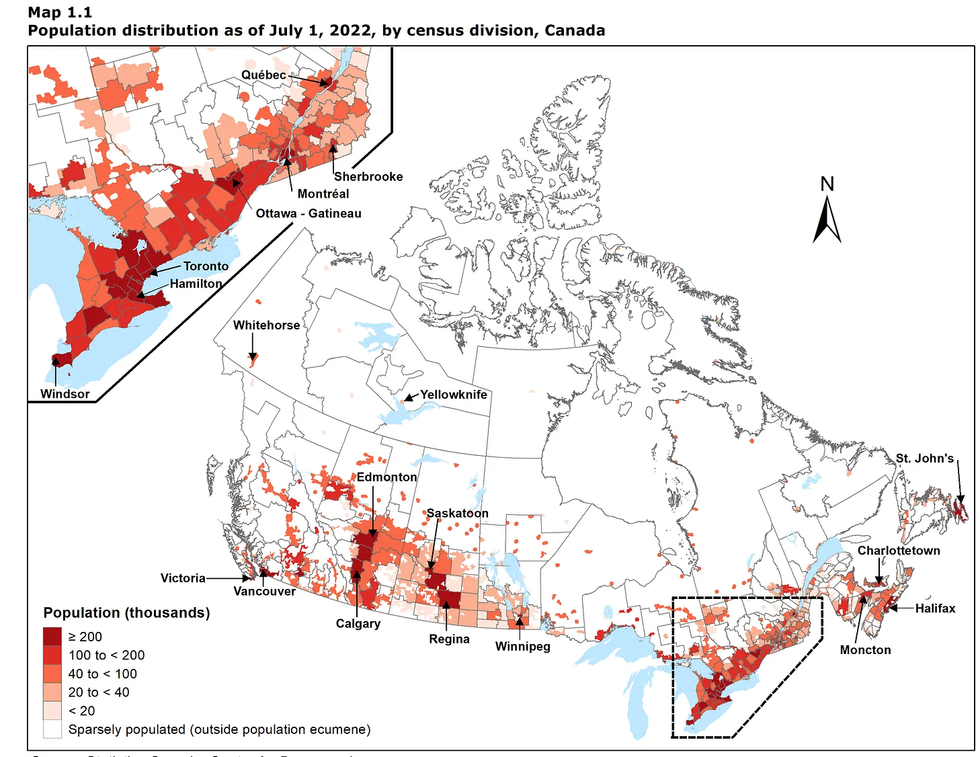
It was a brave stand to take. Canada sits right next to the United States, whose economy is a dozen times larger. Moreover, as the map below shows, Canada’s population lies almost entirely within a narrow band on top of the U.S. Back when I was writing a lot about economic geography, I used to joke that Canada was closer to the United States than it was to itself. Nature wants Canada and the United States to be closely intertwined. And for this reason Canada is arguably more exposed to the consequences of Trumpian wrath than any other nation.
 Courageous www.nationalmemo.com
But democracies can no longer maintain close ties with the U.S. The day after Carney spoke, Donald Trump showed why.
I listened to Trump’s Davos speech with fear: How much damage will this demented, vindictive individual do to America and the world? I also felt a deep sense of shame: What is wrong with my country, that we put someone like this in a position of unprecedented power?
As the whole world watched, the president of the United States (God help us) repeatedly referred to Greenland, which he is willing to blow up NATO to acquire, as Iceland. Don’t dismiss this as trivial: if any previous president had been that befuddled, the whole press corps would have been howling about senility and demanding that he step down.
And of course Trump’s press secretary insisted that he didn’t say what we all saw and heard him say.
Trump also repeatedly displayed his trademark willful ignorance, for example when talking about renewable energy. While berating Europe for using wind energy, he admitted that China also has big wind farms — someone must have showed him pictures — but declared that
They put up a couple of big wind farms, but they don’t use them. They just put them up to show people what they could look like. They don’t spin, they don’t do anything.
In reality, China accounts for almost 40 percent of total world generation of electricity from wind power, substantially more than Europe.
Beyond confusion and ignorance, Trump delivered menace:
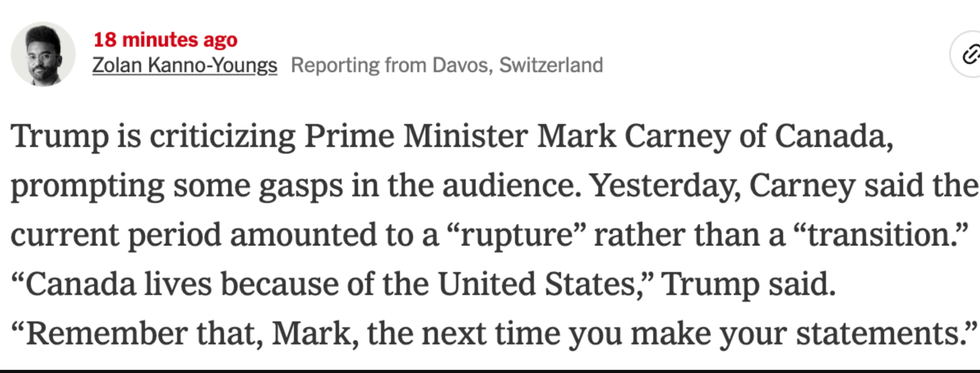
The horrifying details of Trump’s rant aside, what strikes me about the Trump administration’s performance at Davos — not just Trump himself but his minions — was the utter lack of purpose. The whole Trump team seems to have gone to Europe with no goal other than to belittle and insult their hosts.
On Tuesday evening Howard Lutnick, the Commerce secretary, spoke to a private dinner at Davos — at which he belittled European economies and their lack of competitiveness. He was reportedly booed, and Christine Lagarde, the president of the European Central Bank, walked out.
On Wednesday morning Scott Bessent, the Treasury secretary, dismissed reports that one major Danish pension fund has decided to divest itself of U.S. bonds by declaring that “Denmark’s investment in U.S. Treasury bonds, like Denmark itself, is irrelevant.”
And Trump devoted much of his speech to portraying Europe as a hellhole, its economy destroyed by renewable energy and its society destroyed by immigration.
Never mind whether any of this is true. (It isn’t.) What was the point of saying such things? Do Trump and his Mini-Mes imagine that they can convince European leaders that they, their economies, and their societies are all pathetic losers?
To say what should be obvious but apparently isn’t, we don’t need top government officials playing at being shock-jock podcasters, getting clicks by being outrageous. God knows, MAGA has plenty of those already. Official speeches aren’t supposed to be rants that provide red meat to your political base. They’re supposed to influence people who aren’t your supporters, in ways that serve the national interest.
This doesn’t mean that official speeches must be mealy-mouthed and boring. Mark Carney’s speech definitely wasn’t. But Carney had a clear purpose: To rally other nations into solidarity against U.S. economic blackmail.
Trump, on the other hand, just wanted to swagger, whine, and mostly hear himself talk. And all he accomplished was to turn suspicions that he’s gone off the deep end into certainty.
We’re already seeing some consequences of Trump’s ranting:
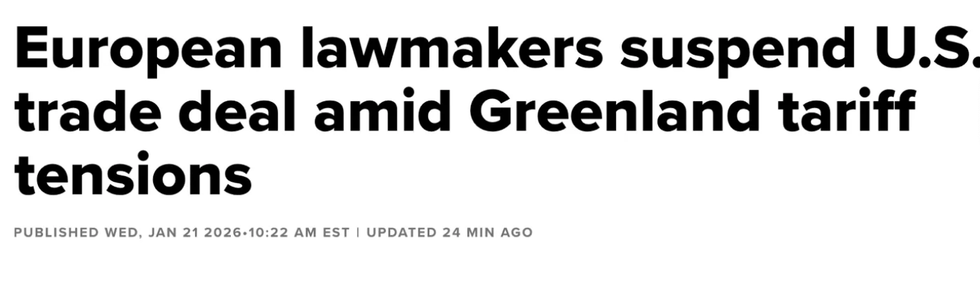
There will be much more of this. American power and influence have always rested, much more than many people realize, on the perception of American trustworthiness. We didn’t always do the right thing, but we honored our agreements and were the least greedy imperial power in history.
That’s all over. At Davos, Mark Carney called for giving up hope that the Pax Americana can be restored, and Donald Trump proved him right.
Paul Krugman is a Nobel Prize-winning economist and former professor at MIT and Princeton who now teaches at the City University of New York's Graduate Center. From 2000 to 2024, he wrote a column for The New York Times. Please consider subscribing to his Substack.
Reprinted with permission from Paul Krugman.