In Minnesota, Political Repression And Prosecutorial Abuse Under Color Of Law
It is by now a familiar Trump pattern. He blows through what had long been understood as an inviolable boundary of law or institutional norms and then, rather than pausing to let the system respond, accelerates—compounding the original violation with still further abuses.
That pattern is now unfolding in Minnesota.
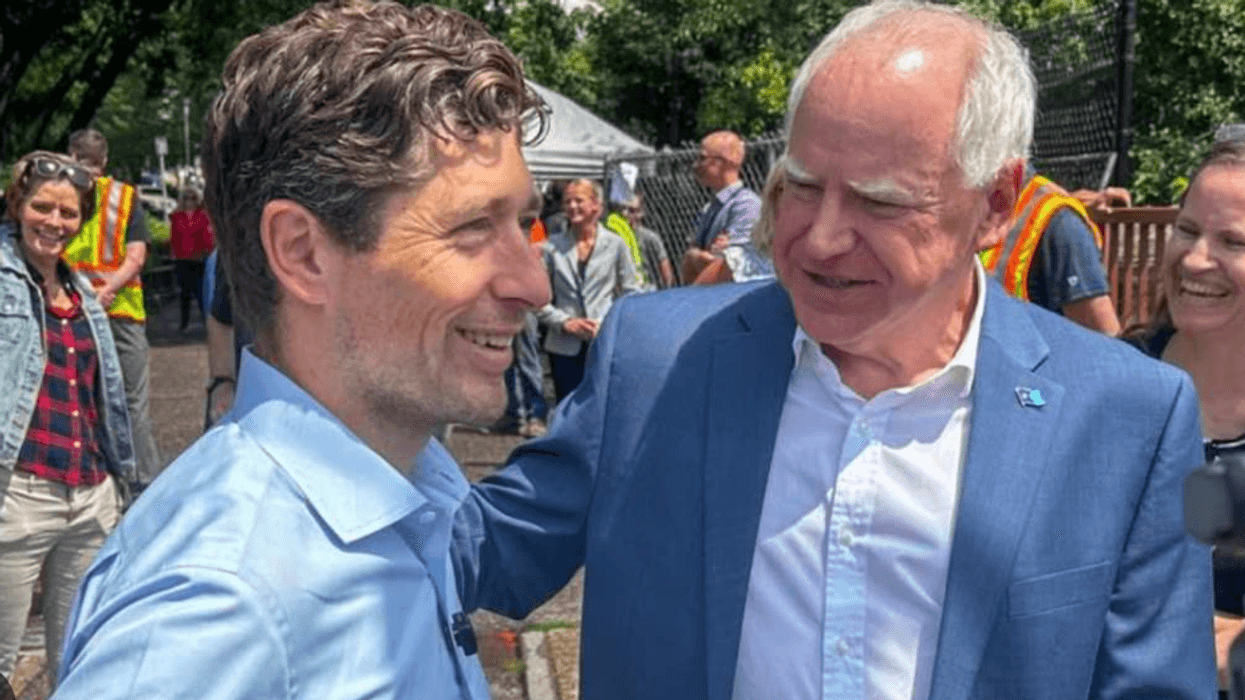
The federal government has announced that it has opened a criminal investigation into Minnesota Governor Tim Walz and Minneapolis Mayor Jacob Frey on a pretext so thin as to be transparent. The move belongs in the same category as the reprisal prosecutions that have marked the first year of Trump’s second term. But it goes further, aggravating an already grave constitutional injury with a series of additional, compounding corrupt acts.
News reports indicate that grand jury subpoenas have been issued, though at least one major outlet reports uncertainty about whether they have actually been served. Either way, the signal is unmistakable. The machinery of federal criminal investigation is being turned on two political adversaries of the president who are not remotely culpable.
What follows reflects not a single abuse, but five distinct and reinforcing forms of corruption.
1. No Cognizable Crime
A federal criminal investigation requires, at a minimum, a cognizable offense—something to write on the folder in the U.S. Attorney’s Office. Here, the administration has settled on 18 U.S.C. § 372, the Reconstruction-era ban on conspiracies to interfere with the exercise of federal rights.
All indications—from public statements by senior administration officials to comments by Trump himself—are that the supposed “interference” with federal law enforcement consists entirely of public statements by Walz and Frey. There is no indication the grand jury is considering any nonpublic evidence.
Thus Border Czar Tom Homan proclaimed that “rhetoric from the mayor and the governor emboldens that small percentage who go beyond protesting to criminal activity” (a curious moral lecture from an official still unable to explain the $50,000 he carried off from an FBI sting in a CAVA takeout bag). Homeland Security Secretary Kristi Noem similarly complained that Walz and Frey “have been very clear that they’re going to continue their rhetoric.”
But the “rhetoric” in question consists entirely of statements urging peaceful protest against what Walz and Frey have described as unconstitutional federal immigration tactics. Those statements—again, all part of the public record—encouraged Minnesotans to exercise their constitutional rights, criticized ICE practices, and emphasized calm and lawful conduct.
That makes the invocation of § 372 not merely strained, but ridiculous.
To sustain a charge under § 372, the government would have to prove beyond a reasonable doubt that Walz and Frey entered into an agreement to deploy force, intimidation, or threats to obstruct federal officers. Nothing remotely approaching such evidence has been suggested. One would have to imagine a governor or mayor openly directing citizens to physically attack or menace ICE agents. No honest federal prosecutor could plausibly believe the elements of § 372 are satisfied here.
To invoke the criminal process anyway is corrupt in precisely the same sense as the Comey and James reprisal prosecutions: it uses federal prosecutorial power to punish political enemies rather than to vindicate the law.
2. Criminalizing Protected Political Speech
The infirmity is not merely statutory. It is constitutional.
When the alleged crime consists of speech, additional constraints apply.The Constitution forbids criminalizing even heated political criticism except in the narrowest circumstances. Under long-settled First Amendment law, the canonical Brandenburg standard, rhetoric may be punished only if it is 1) directed to and 2) likely to produce 3) imminent unlawful action.
Indeed the court has made clear that the First Amendment protects even “advocacy of the use of force or of law violation “— exactly the line Walz and Frey have not crossed. That is necessary, the Court has emphasized, in order to “assure unfettered interchange of ideas for the bringing about of political and social changes desired by the people.”
Here, the Feds have not even suggested any covert maneuvering, back-channel coordination, or operational interference with federal agents. The alleged misconduct lies exclusively in Walz’s and Frey’s public comments. Those include objections to what they characterized as a federal “invasion” of Minnesota and assurances to citizens of their constitutional rights. The public record reflects restraint and legality, not exhortations to unlawful obstruction.
The contrast with Trump’s conduct on January 6 underscores the constitutional inversion at work. As Jack Smith testified, the Department was prepared—after a comprehensive investigation—to prove that Trump’s words were intended to incite unlawful action and satisfied the Brandenburg standard because they were directed to producing imminent lawlessness and were likely to do so. Even in that setting, prosecutors moved with painstaking caution, acutely aware of the dangers of criminalizing political speech. Here, the Justice Department jettisons that caution and treats speech urging lawful protest as suspect while recasting criticism of federal enforcement tactics as criminal intimidation.
3. Using Criminal Process to Gain Leverage in a Losing Political Battle
The Comey and James prosecutions, ugly as they were, at least fit a familiar pattern of personal vendetta. This episode is worse.
The subpoenas aimed at Walz and Frey are not merely about punishment. They are about pressure—about coercing Minnesota’s elected leadership in the midst of an ongoing political confrontation that the Trump administration is losing badly. Rather than defend its policies through political persuasion or litigation—Minnesota has now sued the federal government in a broad-gauged action alleging multiple constitutional violations—the administration has reached for the criminal law to change the balance of power.
Even if, as seems likely, no case ever eventuates—because prosecutors decline to proceed, a grand jury balks, or a court throws it out—the investigation itself exacts a toll. It imposes anxiety, drains time and resources, and inflicts reputational harm. Trump knows this well, having repeatedly weaponized the justice system only to retreat when his hand is called.
In that respect, the Minnesota episode closely resembles Trump’s recent bullying of Federal Reserve Chair Jerome Powell. Powell stated the point plainly: threats of criminal prosecution were not about misconduct at all, but about pressuring the Federal Reserve to abandon its independent judgment and follow the president’s policy preferences.
Threatening criminal prosecution to gain leverage in a political dispute is an additional level of corruption. It is all the more brazen when deployed in contests the administration is losing on the merits. Recent polling shows that a majority of Americans view ICE unfavorably and support the independence of institutions like the Federal Reserve. Here, the Justice Department is being pressed into service to achieve political objectives that cannot be secured democratically.
4. Flagrantly Improper Public Declarations of Guilt
Even as this purported investigation proceeds, senior administration officials have paired it with public statements that all but declare guilt. In the context of a pending criminal inquiry, that conduct is itself an abuse of power.
Administration figures have mocked Walz and Frey as “dumb” or “boobs,” demeaned them as “corrupt,” and gone so far as to label them “terrorists” or “insurrectionists.” This language does not clarify the government’s legal theory. It poisons the well, framing elected officials as criminals before any adjudication—and in some instances before any charge.
The most repugnant comments have come from the public official who should know better than anyone else not to prejudice a pending investigation: Deputy Attorney General Todd Blanche. Blanche declared that a “Minnesota insurrection is a direct result of a FAILED governor and a TERRIBLE mayor encouraging violence against law enforcement,” adding that he was “focused on stopping YOU from your terrorism by whatever means necessary.” These are extraordinary remarks from a senior Justice Department official speaking mid-investigation.
When the story of this Justice Department is written, there will be a special section devoted to Todd Blanche. A once-ordinary federal prosecutor has remade himself into a loyal political enforcer, repeatedly transgressing long-settled Department norms in service of the president’s political aims. His conduct here is not an aberration; it is a marker of institutional decay.
5. Corrupt Use of the Grand Jury Process Itself
Finally, the issuance—or even the threatened issuance—of grand jury subpoenas in such a threadbare case completes the abuse.
We have not seen the subpoenas. But it defies common sense to think they are limited to the public statements that form the entirety of the administration’s supposed theory of exposure; such subpoenas would serve no investigative purpose. One can be confident they demand internal communications, drafts, calendars, messages, and deliberative materials from the offices of a sitting governor and mayor.
Courts have long held that the grand jury may not be used when its dominant purpose is something other than pursuing a viable criminal prosecution. Federal prosecutors may not deploy compulsory process to rummage through officials’ records, harass or intimidate them, or gather political intelligence. Yet that is precisely what remains once it is clear—as it is here—that the floated charge is going nowhere and that the Department knows it.
Taken together, the picture is unmistakable: a criminal investigation launched without a crime, aimed at protected speech, used to gain leverage in a losing political battle, accompanied by public declarations of guilt, and enforced through abusive use of the grand jury.
The legitimacy of the Justice Department rests on the fundamental premise that its extraordinary powers may be exercised only to pursue provable crimes, not to coerce political outcomes. The investigation of Governor Walz and Mayor Frey inverts that premise. It deploys the most fearsome tools of the federal government in response to lawful political speech, while stretching a criminal statute past recognition to manufacture exposure. That is not law enforcement. It is political pressure by prosecutorial means.
Walz and Frey are doing precisely what the First Amendment contemplates and protects, and its value is all the greater because they are leaders of the community. The fundamental perversion of the Administration, as in so many other instances, is to redefine anyone who disagrees with Trump as criminal and an enemy of the state. It’s the classic move, and springboard for vicious repression, of totalitarian tyrants from Stalin to Putin.
The core value on the line here is not the government’s authority to rein in lawless conduct; it is just the opposite, the constitutional protection of dissent aimed at that very government abuse. That is not law enforcement. It is political repression carried out under the color of law.
Harry Litman is a former United States Attorney and the executive producer and host of the Talking Feds podcast. He has taught law at UCLA, Berkeley, and Georgetown and served as a deputy assistant attorney general in the Clinton Administration. Please consider subscribing to Talking Feds on Substack.
Reprinted with permission from Talking Feds.