Tag: republican voters
Poll: Trump Approval Plummets To New Low As Republicans Start Defecting

Poll: Trump Approval Plummets To New Low As Republicans Start Defecting

President Donald Trump’s approval rating is nearing doomsday levels for the GOP, with the pollster American Research Group on Monday releasing a survey showing just 30 percent of Americans approve of the job he’s doing in office.

It’s difficult to put into words just how bad things have to get in this polarized political climate for a president to reach 30 percent approval. To get that low it means you’re losing ground not just with the opposing party and independents but also with your own party.
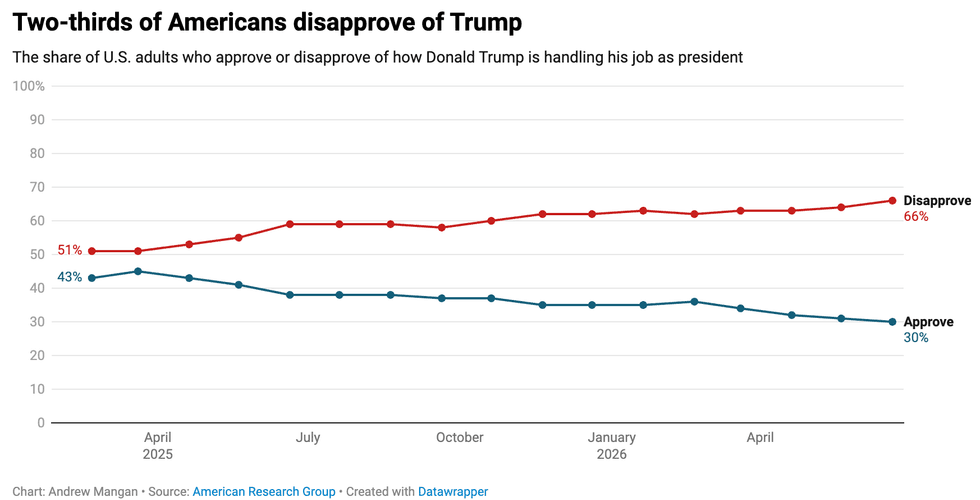
Chart by Andrew Mangan with data from American Research GroupCreated with Datawrapper

And that’s what’s happening for Trump, whose approval is sliding with Republicans, who typically blindly support whatever he does but are frustrated with the war in Iran and its negative impact on gas and other prices.

American Research Group’s poll found Trump’s approval among Republicans has fallen to 67 percent — a 12-percentage-point drop from the pollster’s June 2025 survey.

Once you start losing support from your base, it’s a massive problem for members of your party, especially in a midterm election year like 2026 when the only way to voice disapproval in Trump is to punish Republicans in office.

If the GOP voting base is not motivated to vote, this midterm election will turn from bad to catastrophic, with Republican elected officials and candidates alike falling even in areas Trump carried in 2024.

Indeed, nonpartisan political handicappers are starting to move races in otherwise safe Republican territory into the competitive column, as Trump’s approval is dragging down the GOP.

“Despite recent Republican wins on redistricting, Democrats remain in a strong position to regain control of the House, with the battlefield continuing to shift in their favor as the political environment further deteriorates for the GOP,” Erin Covey, a House editor at the Cook Political Report, wrote Friday in a post explaining why her outlet shifted seven race ratings toward Democrats.

There are also a number of tangible signs that Republicans are not motivated and could cost the GOP this fall.

A Washington Post analysis published Monday found Democrats are vastly outvoting Republicans in primaries across the country, even in areas where Democrats don’t have competitive races on their ballots.

According to the analysis, people have thus far cast 12.6 million ballots in Democratic House primaries, while only 8.6 million votes have been cast in Republican House primaries—a statistic experts say is a sign of Democratic enthusiasm.

Even worse for Republicans is that more Democrats turned out in a number of House primaries in seats the GOP corruptly gerrymandered to try to rig the midterms in their favor. For example, Democrats outvoted Republicans in the primaries in three of the five seats the GOP redrew in Texas at the behest of Trump himself, The Washington Post found.

“Something would really fundamentally have to change in a way that would favor the Republicans to change the dynamics that we’re seeing right now,” Michael McDonald, political science professor at the University of Florida and an expert on voter turnout, told the Post.

It’s difficult to see how things could fundamentally change to benefit Republicans given that Trump cannot get out of his own way.

Look at the news from just this week. It’s focused on the boondoggle of a “renovation” Trump attempted at the Lincoln Memorial Reflecting Pool, in Washington, D.C. Barely a week after the pool was refilled, it’s plagued with algae, and the new coat of “American flag blue” paint is peeling away. Rather than admit failure, Trump is having people arrested as he ridiculously blames “vandals” for his own personal failure.

November is quickly approaching, and it’s not going to be pretty for Trump and the GOP.

Reprinted with permission from Daily Kos

Poll: Most Republicans Want Trump To Run Again, But Most Americans Don't

Poll: Most Republicans Want Trump To Run Again, But Most Americans Don't

A new poll suggests a majority of Republicans want former President Donald Trump to try for the White House again in 2024 — but the vast majority of Americans do not.

A national survey of adults released Thursday by Marquette Law School found that by a 60 percent to 40 percent margin, those who identify as Republicans would like Trump to run in the next presidential election. But overall, just 28 percent of those surveyed want to see another Trump campaign, versus 71 percent who do not.

The poll results show 73 percent of independents and 94 percent of Democrats oppose Trump running again.

While 73 percent of Republicans say they have a favorable view of the one-term president, just 32 percent do overall — and 65 percent of Americans hold an unfavorable opinion of him.

This puts him well below President Joe Biden, whose rating in the poll is at 45 percent favorable, 49 perecent unfavorable, and six percent unable to give a rating. The survey puts Biden's overall job approval rating at 49 percent.

This survey comes as Trump is hinting he will mount another presidential campaign. On November 8, he told Fox News, "I am certainly thinking about it and we'll see. I think a lot of people will be very happy, frankly, with the decision, and probably will announce that after the midterms."

He boasted that "a lot of great people who are thinking about running are waiting for that decision, because they're not going to run if I run."

After winning in the Electoral College in 2016 despite getting three million fewer votes than Democratic nominee Hillary Clinton, Trump badly lost both the popular and the electoral votes in 2020.

Biden won 306 of the 538 electors, a margin Trump himself deemed a "landslide" four years earlier when it went in his favor, and received over seven million votes more than the incumbent.

Days after plotting to overturn the election results and egging on supporters who then rioted at the U.S. Capitol on January 6, Trump left office on January 20 with a historically low approval rating of 29 percent.

He has spent much of the time since then falsely claiming the election was stolen from him and threatening retribution against his political enemies — a strategy that does not appear to have improved his national popularity.

After Republican Virginia gubernatorial nominee Glenn Youngkin narrowly won earlier this month, Trump claimed credit for the result. "I would like to thank my BASE for coming out in force and voting for Glenn Youngkin," he wrote. "Without you, he would not have been close to winning. The MAGA movement is bigger and stronger than ever before." Trump had endorsed Youngkin, but the two had not campaigned together.

Trump faces a number of legal issues between now and the next election. His company is under criminal indictment on tax fraud charges in New York; a select House committee is investigating the Capitol insurrection and his administration's possible involvement; and Congress is still working through the federal courts to obtain his tax returns.

Published with permission of The American Independent Foundation.

Numbers Show Republican Pandemic Policies Killing Off Their Own Base

Numbers Show Republican Pandemic Policies Killing Off Their Own Base

Reprinted with permission from AlterNet

When COVID-19 was overwhelming New York City hospitals during the 2020 spring, a silly talking point in right-wing media was that residents of red states didn't need to worry about the pandemic because it only posed a threat to Democratic areas. But COVID-19, just as health experts predicted, found its way to red states in a brutal way. And the current COVID-19 surge is especially severe in red states that have lower vaccination rates. Journalist David Leonhardt, in an article published by the New York Times this week, examines a disturbing pattern: red states where residents are more likely to be anti-vaxxers and more likely to be infected with COVID-19 and die from it.

Leonhardt explains, "A Pew Research Center poll last month found that 86 percent of Democratic voters had received at least one shot, compared with 60 percent of Republican voters. The political divide over vaccinations is so large that almost every reliably blue state now has a higher vaccination rate than almost every reliably red state."

According to the Centers for Disease Control and Prevention, 75 percent of U.S.-based adults have been at least partially vaccinated for COVID-19. But vaccination rates can vary considerably from one state to another. The Mayo Clinic reports that rates for at least partial vaccination range from 77 percent in Vermont to 49 percent in Mississippi, 46 percent in Idaho and 52 percent in Alabama. Vermont is a deep blue state with a moderate Republican governor, while Mississippi, Idaho, and Alabama are deep red states that former President Donald Trump won by a landslide in 2020.

"It's worth remembering that COVID followed a different pattern for more than a year after its arrival in the U.S.," Leonhardt explains. "Despite widespread differences in mask wearing — and scientific research suggesting that masks reduce the virus' spread — the pandemic was, if anything, worse in blue regions. Masks evidently were not powerful enough to overcome other regional differences, like the amount of international travel that flows through major metro areas, which tend to be politically liberal. Vaccination has changed the situation."

Leonhardt continues, "The vaccines are powerful enough to overwhelm other differences between blue and red areas. Some left-leaning communities — like many suburbs of New York, San Francisco and Washington, as well as much of New England — have such high vaccination rates that even the unvaccinated are partly protected by the low number of cases. Conservative communities, on the other hand, have been walloped by the highly contagious Delta variant."

The Times reporter notes that in many other developed countries, the pandemic hasn't been politicized to the degree that it has in the United States.

"What distinguishes the U.S. is a conservative party — the Republican Party — that has grown hostile to science and empirical evidence in recent decades," Leonhardt observes. "A conservative media complex, including Fox News, Sinclair Broadcast Group and various online outlets, echoes and amplifies this hostility. Trump took the conspiratorial thinking to a new level, but he did not create it."

Epidemiologist Eric Feigl-Ding, in a Twitter thread posted over the weekend, argues that Republicans are "killing off" their own voters by promoting anti-vaxxer and anti-masker views:


Feigl-Ding points out that under far-right President Jair Bolsonaro, Brazil — not unlike red states in the U.S.— has suffered high COVID-19 infection rates:

Leonhardt notes that the Delta variant has been especially deadly in Republican areas.

"Since Delta began circulating widely in the U.S.," according to Leonhardt, "COVID has exacted a horrific death toll on red America: In counties where Donald Trump received at least 70 percent of the vote, the virus has killed about 47 out of every 100,000 people since the end of June, according to Charles Gaba, a health care analyst. In counties where Trump won less than 32 percent of the vote, the number is about 10 out of 100,000."

Trump And Melania Were Vaccinated At White House But Kept It Secret

Trump And Melania Were Vaccinated At White House But Kept It Secret

Reprinted with permission from Alternet

Before leaving the White House as president, Donald Trump and First Lady Melania Trump chose to be inoculated from the deadly coronavirus, but opted to keep it a secret. Republicans represent the largest group of Americans who say they will not or are unsure if they will get vaccinated.

As head of a very loyal group of supporters, Trump could have gone on national television, as President-elect Joe Biden did, to receive the vaccine, which would have helped convert many opposed to the life-saving shot.

On Monday, the New York Times' Maggie Haberman reported the news that Trump was vaccinated, citing an advisor to the former president.

Some may have noticed that during his Sunday speech at the Conservative Political Action Conference (CPAC), Trump in a rare move gave lip service to getting the vaccine, although couching it in an attack against President Biden. He told supporters to "go get your shot."

"Remember, we took care of a lot of people, including, I guess on December 21st, we took care of Joe Biden, because he got his shot," Trump told the CPAC crowd in Orlando at his speech that was widely panned. "He got his vaccine. He forgot. It shows you how unpainful that vaccine shot is. So everybody go get your shot. He forgot. So it wasn't very traumatic, obviously. But he got his shot. And it's good that he got his shot."

Axios reported last week that 41 percent of Republicans say they will not get the coronavirus vaccine. That number jumps to 56 percent when including Republicans who say they are unsure. Just one-third of Republicans (33 percent) say they will get vaccinated. Compare that with 70 percent of Democrats who say they will get vaccinated.

"White Americans are now less likely than Black and Latino Americans to say they plan to get the vaccine," Axios notes.

Shop our Store

Headlines

Editor's Blog

Trending

World