Tag: russell vought
Billions Squandered: New Report Details Absurd Waste Of Musk's DOGE

Billions Squandered: New Report Details Absurd Waste Of Musk's DOGE

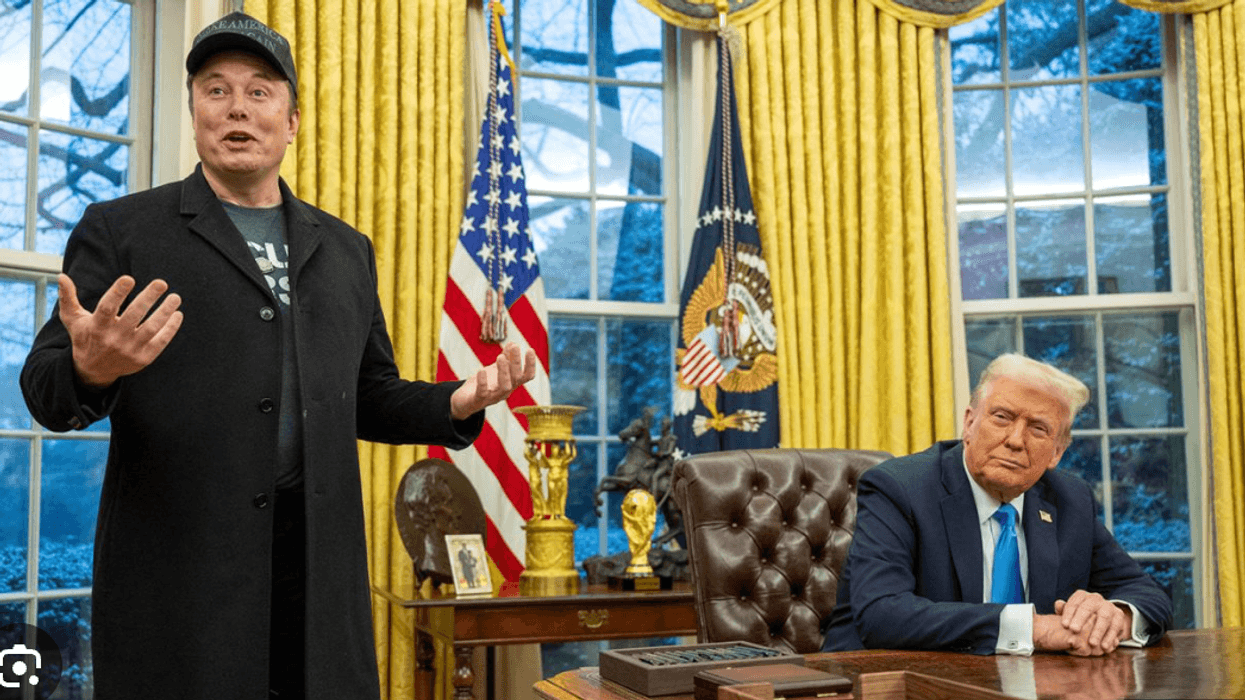
Since retaking the White House, President Donald Trump and his team have forced hundreds of thousands of federal workers out of their jobs. Ostensibly, they did that to save money. Realistically, it seems to have hurt the economy.

Due largely to the so-called Department of Government Efficiency, the federal workforce has shrunk by 352,000 jobs on net since January 2025, according to the U.S. Bureau of Labor Statistics. Surely, that saved us oodles? And soon the glorious efforts of Trump and former Shadow President Elon Musk, who ran DOGE, will trickle down and bless us all, right?
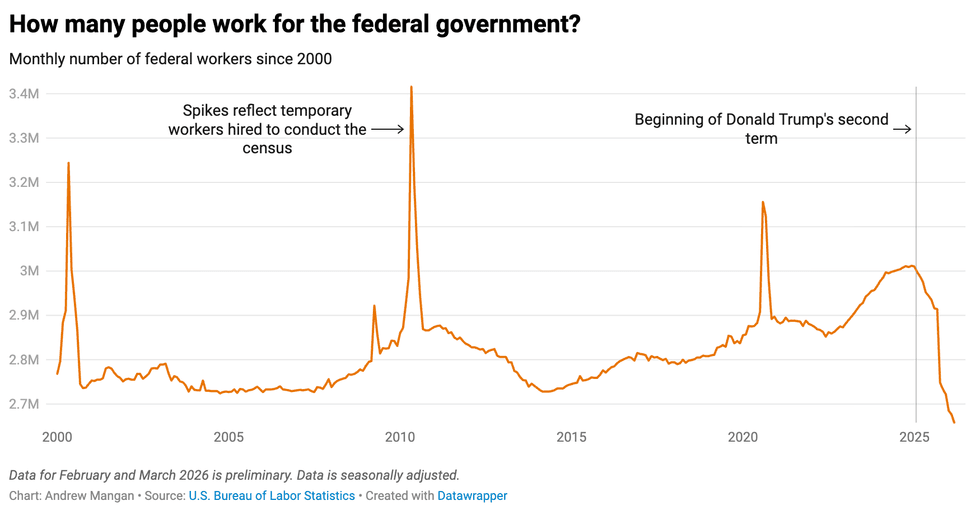
Not so much. The administration’s slipshod efforts to shove out as many workers as fast as possible, using a combination of mass firings, forced resignations, and shuttering agencies, is estimated to have cost the U.S. economy at least $165.6 billion. That comes from a new report by the Partnership for Public Service, a nonpartisan nonprofit focused on civil service.

DOGE claims to have saved $215 billion through job cuts and other measures, but those numbers are heavily inflated. For instance, as of this past August, DOGE had claimed to save roughly $54 billion in canceled contracts, but Politico could verify savings of only about $1.4 billion.

“Who is getting fired matters. How they’re getting fired, will there be lawsuits?” Dominik Lett, an analyst at the libertarian Cato Institute, told the Associated Press in March, adding that “we don’t know how much DOGE has saved.”

What DOGE has cost us, though, might be easier to measure.

In its report, the Partnership for Public Service drills down on the cost of the Trump administration’s antics.

First, there was the “deferred resignation program,” a truly grim idea. To speedily shrink the federal workforce, Musk sent out a ridiculous “Fork in the Road” email, just as he did when he took over Twitter, and over 150,000 federal workers took the offer.

Deferred resignations weren’t intended to be a cost-saving measure, which becomes clear when you learn that all of those employees were paid through at least Sept. 30, 2025. Instead, the real idea was to hobble the government by starving it of workers. But as a result, the Partnership for Public Service estimates that the administration shelled out over $4.5 billion to keep workers paid but not working. It’s hard to tell exactly where this money might be coming from. The “Fork in the Road” email came via the Office of Personnel Management, but it isn’t clear what authority OPM would have to pay for deferred retirements, since employee salaries are paid by their agencies.

Approximately 10,000 employees who left in the first 12 months of Trump 2.0 were entitled to roughly $763 million in severance pay. Thousands more, though, were placed on an “extended administrative leave,” where they were paid but not allowed to work or visit their offices. This happened at agencies Trump was trying to dismantle, like the Consumer Financial Protection Bureau, where leave-related costs are pegged to be about $152 million. Employees stuck in administrative limbo at the U.S. Agency for Global Media cost us all about $126 million, without any pesky government work in return. Over at the U.S. Agency for International Development, employees cooling their heels came with an estimated price tag of about $298 million.

You get the picture.

The rehiring of fired employees—arguably one of the dumbest things that happened since Trump took office—has run up about $12 million in costs. To date, the government has rehired over 25,000 workers.

But rehiring is costly. Workers need all sorts of things when they are onboarded, even at a place they have worked before. They need to get access to buildings and IT services. They need to sign fresh paperwork. They might need additional training.

The largest cost shown in the Partnership for Public Service’s estimate is for “disengaged workers”—people who remain employed but do the minimum. A Gallup report from several years ago found that disengagement costs an employer roughly 34% of every disengaged employee’s salary.

Federal workers became disengaged not because they are lazy sods who hate Trump but because they’ve been put in trauma, an explicit goal of OPM head Russell Vought. Employees watched their colleagues get fired en masse, their ability to serve the public was impeded or destroyed, and no one knew what arbitrary costs were coming next. That disengagement is estimated to cost $53 billion in lost engagement and productivity.

Funding DOGE itself cost an estimated $81 million.

DOGE was never about saving money. Eliminating over 300,000 federal jobs was never about saving money, either. All this is doing is compromising the work of government and costing us a fortune.

Reprinted with permission from Daily Kos
White House Chief Of Staff Rips Vance, Musk, Vought -- And Trump's 'Alcoholic Personality'

White House Chief Of Staff Rips Vance, Musk, Vought -- And Trump's 'Alcoholic Personality'

President Donald Trump's former campaign manager and current chief of staff, Susie Wiles left no one untouched speaking to a Vanity Fair reporter

In a new tell-all article, Wiles calls Vice President JD Vance "a conspiracy theorist for a decade."

There has been speculation about Vance's conversion from calling Trump "Hitler" to becoming a fierce defender of the president. Wiles reveals in the interview that Vance has been "sort of political" in his conversion.

Wiles also criticized Russell Vought, the director of the Office of Management and Budget (OMB). Vought was the "architect of the notorious Project 2025," the Heritage Foundation plot to radically change the U.S. government from the inside.

According to Wiles, Vought is nothing more than "a right-wing absolute zealot."

Vought was closely involved with the effort to eliminate thousands of federal workers, leading to a brain drain of some of the smartest experts in government, Reuters reported in September.

Vanity Fair asked Wiles about the effort under Elon Musk to cut $2 trillion from the federal budget. Toward the end of his time in the White House, Musk confessed he would only able to cut about $150 billion by the end of 2026.

In March, the billionaire argued, in a since-deleted posted, that leaders like Joseph Stalin and Adolf Hitler "didn't murder millions of people. Their public sector workers did."

Wiles said of the statement, “I think that’s when he’s microdosing.”

Wiles remark was in reference to reports of Musk's heavy drug use while working in the White House. In May, the New York Times reported Musk had a daily supply of 20 ketamine pills. He mixed the ketamine with ecstasy, psychedelic mushrooms and Adderall, according to the Times.

Wiles said she never had first-hand knowledge of Musk's drug use.

...

At one point during the interview, which involved a number of Trump staff members, Wiles said Trump has “an alcoholic’s personality."

She explained that he “operates [with] a view that there’s nothing he can’t do. Nothing, zero, nothing.”

Trump's brother, Fred Trump Jr., was an alcoholic, and Trump doesn't drink alcohol at all. However Mary Trump, the president's niece, has said that for the president, "nothing is ever enough."

"This is far beyond garden-variety narcissism," Trump's niece, who has a degree in clinical psychology, said of Trump. "Donald is not simply weak, his ego is a fragile thing that must be bolstered every moment because he knows deep down that he is nothing of what he claims to be."

Mary Trump wrote that her grandfather bullied his son, Fred Jr., into alcoholism.

Later in the Vanity Fair report, it explains that Wiles' father "was an absentee father and an alcoholic, and Wiles helped her mother stage interventions to get him into treatment." He finally got sober and stayed there for the 21 years before his 2013 death.

"Alcoholism does bad things to relationships, and so it was with my dad and me,” Wiles said.

“Some clinical psychologist that knows one million times more than I do will dispute what I’m going to say. But high-functioning alcoholics or alcoholics in general, their personalities are exaggerated when they drink. And so I’m a little bit of an expert in big personalities.” Wiles said.

Reprinted with permission from Alternet

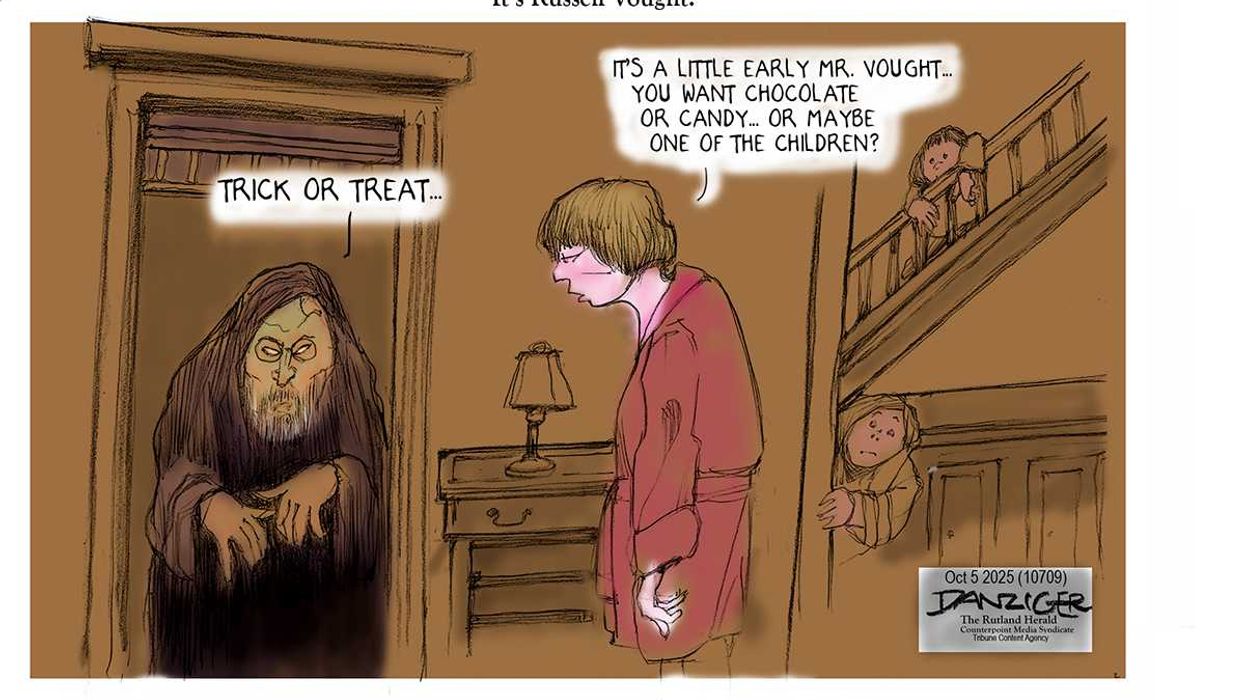
Danziger Draws

Danziger Draws

Jeff Danziger lives in New York City and Vermont. He is a long time cartoonist for The Rutland Herald and is represented by Counterpoint Syndicate. He is a recipient of the Herblock Prize and the Thomas Nast (Landau) Prize. He served in the US Army in Vietnam and was awarded the Bronze Star and the Air Medal. He has published eleven books of cartoons, a novel and a memoir. Visit him at jeffdanziger.com.

Russ Vought

'Dictator' Cancels Congressional Authority -- And Republicans Roll Over

Russell Vought is the ultimate Trumper. The head of the Office of Management and Budget just anointed by Secretary of State Marco Rubio to wind down the U.S. Agency for International Development ("wind down" being one of his favorite words) had a new stunt to try out this week to subvert constitutional separation of powers. You remember — Congress has the power of the purse. It must be on the citizenship exam. The answer should have an asterisk for President Donald Trump.

Trump's new trick this week is called the pocket rescission. The beauty of this one, unlike your usual rescission (of PBS funding, for instance) is that Congress doesn't have to do anything. The president just asks for the money to be rescinded — which freezes it automatically for the next 45 days, and if that should coincide with the end of the fiscal year, the money goes poof! And Congress' power of the purse is rendered a nullity.

So sayeth Mr. Vought:

"Last night, President Trump CANCELLED $4.9 billion in America Last foreign aid using a pocket rescission," the White House Office of Management and Budget posted on X.

Even some Republicans spoke up. "Congress has the responsibility for the power of the purse," Sen. Susan Collins (R-ME), the Senate Appropriations chair, said in a statement. "Any effort to rescind appropriated funds without congressional approval is a clear violation of the law."

The funds Trump canceled were largely intended for USAID, a global peacekeeping and anti-poverty agency that Trump has done everything he can to destroy; so it continues.

This was the script for the second term, and it is being carried out in every quarter. Accumulate power in the executive. Use it aggressively. Make of it a veritable show. Belittle and cast doubt on the courts and their authority. Undercut their esteem. Play chicken. And, of course, Congress. Play chicken and win.

Watching it, day-by-day, trick-by-trick, it is easy to miss the whole picture.

Is this what it looks like when a dictator moves in to take over?

Trump has been musing, aloud of course, about himself as dictator. "The line is that I'm a dictator, but I stop crime," Trump said during a Cabinet meeting, "So a lot of people say, 'You know, if that's the case, I'd rather have a dictator.'"

He later added: "Most people say ... if he stops crime, he can be whatever he wants."

Not that Trump wants to be a dictator. He made that clear, sort of, the night before, albeit still fascinated with the idea that people might prefer dictators.

"'He's a dictator. He's a dictator,'" Trump said of his critics. "A lot of people are saying, 'Maybe we'd like a dictator.' I don't like a dictator. I'm not a dictator."

Really? Asking permission to rescind is all that it takes?

Russell Vought, a self-described Christian nationalist, had this same job at the end of the first Trump administration. He was a key contributor to Project 2025, which as you recall was all about this, and some of us didn't want to believe it then, so here it is again. He said then that his final goal of Project 2025 was to "bend or break the bureaucracy to the presidential will" and use it to send power from Washington, D.C., back to America's families, churches, local governments and states. He has said that he wants to "traumatize" federal employees. He comes from the Heritage Foundation.

Just this week's stunt. Just $5 billion in aid. I wouldn't bet against him. And I can only imagine what's next.

Susan Estrich is a celebrated feminist legal scholar, the first female president of the Harvard Law Review, and the first woman to run a U.S. presidential campaign. She has written eight books.

Reprinted with permission from Creators.


Shop our Store

Headlines

Editor's Blog

Corona Virus

Trending

World