Tag: social security
Social Security Deficits Are Caused By Inequality, Not Demographics

Social Security Deficits Are Caused By Inequality, Not Demographics

The rich almost completely control debate in this country. There is no better proof of this fact than the current debate over the future of Social Security.

This has been conveniently framed as a problem of demographics. You know, too many people living long into retirement and not enough kids entering the workforce. That sounds compelling, as long as we don’t try to think about it too much.

First, we knew this basic story long ago. On the life expectancy side, we’re actually doing somewhat worse (better from the standpoint of the program’s finances) than was expected in 1982, the last time there was a major reform to the program. The projections from that year showed men living on average 16.6 years after they turned 65. We are beating that some in the current projections at 18.2 years. But the story for women looks considerably worse than was projected in 1982, 20.7 years now compared to a projection of 22.6 years in 1982. So, we can’t say the problem is people are living longer than expected.

The fertility rate has fallen behind projections. and that has made the financing of the program worse, but the big story is that wage growth has fallen far behind the pace projected in 1982. The projection in 1982 was that real wages (the gap between wage growth and prices) would grow 1.8% percent annually for the indefinite future. And this wage growth was assumed to be for the workforce as a whole; there was no anticipation that there would be substantial changes in the wage distribution.

Inequality Matters Big Time for the Finances of Social Security

If real wages had grown as projected, they would have increased by more 120 percent between 1982 and the present. Instead, median wages have risen by just over 30 percent.

A big part of this story is that productivity growth has been weaker than was projected. But an even larger part is that there has been a huge upward redistribution of income over this period. If wages had kept pace with productivity growth, they would be more than 60 percent higher than they are today.

This directly matters for Social Security’s finances for two reasons. The first is that a much larger share of wage income has gone over the payroll cap. The cap rises in step with average wages, not the typical worker’s wages. As a larger share of wage income went to those at the top, Wall Street types, CEOs and other top executives, and highly paid professionals, less was subject to the Social Security tax. In 1982. only 10 percent of wage income avoided taxation. Now it’s close to 18 percent of wage income.

And since the turn of the century, a larger share of income has been going to corporate profits. This money also escapes taxation for Social Security.

There is also the issue that if wages had been growing more rapidly over the last half-century, tax revenue would be higher relative to benefit payments. Benefit payments after retirement are indexed to prices. If wages outpace prices, tax revenue increases relative to benefits. The Trustees calculate that a 0.1 percentage point increase in the annual rate of real wage growth is equivalent to a 0.2 percentage point increase in the tax rate.

If real wages had grown by roughly 1.0 percentage point faster over the last half-century, and were projected to continue to grow at that pace, it would eliminate most of the projected shortfall in the trust fund.

The Indirect Effect of Growing Wage Inequality

This direct effect of growing inequality accounts for far more than half of the gap in Social Security’s finances, but there is also a very important indirect effect. In 1960, the Social Security tax rate was 6.0 percent, combining the employer and employee side contributions. By 1990, the tax rate had risen to 12.4 percent, an increase of 6.4 percentage points over 30 years. In the last 35 years, the tax rate has not increased at all.

In the context of weak real wage growth and a massive upward redistribution of income, it is understandable that there would be enormous resistance to any further tax increases to support Social Security. But suppose real wage growth had kept pace with productivity over the last half-century, and we had not seen the massive upward redistribution to Elon Musk, Mark Zuckerberg, and the rest.

I’m an economist, not a political consultant, but my guess is that if real wages were more than 60 percent higher, most workers would be okay with a 1-2 percentage point increase in the tax rate to secure Social Security for themselves and their children. This was the case for workers in the decades from 1960 to 1990, who put up with much larger tax increases.

The Government DID Upward Redistribution; It Didn’t Just Happen

The other part of this story that is essential for everyone to understand is that the upward redistribution was brought about by government policy; it did not just happen. The most obvious way this happened was through government-granted patent and copyright monopolies. These government-granted monopolies make folks like Larry Ellison and Bill Gates incredibly rich. They also make prescription drugs and medical equipment very expensive, when they would be cheap in a free market.

The government has protected the financial industry with bailouts, tax policy, and bankruptcy laws that allow private equity barons and Wall Street tycoons to become rich at the expense of the rest of us. If we drafted the laws to promote efficiency, we would have a much smaller financial sector and fewer and poorer billionaires.

We also have written and enforced labor laws to the detriment of unions and workers. Most obviously by banning contracts that require all workers who are represented by a union to pay for that representation. While these contracts are not enforceable in most states, contracts that prevent workers from working for a competitor are enforceable.

These and other policies that were designed to redistribute income upward have had their intended effect of taking money from the rest of us and giving it to the rich and very rich. And now that their upward redistribution has had the effect of undermining the financing of the country’s most important social program, they want to cut Social Security. It’s essential that people stand up to the lies; the problem is the rich taking too much of our money, not overly generous Social Security benefits.

Dean Baker is a senior economist at the Center for Economic and Policy Research and the author of the 2016 book Rigged: How Globalization and the Rules of the Modern Economy Were Structured to Make the Rich Richer. Please consider subscribing to his Substack.


Red Scare: Almost None Of Us Are 'Socialists,' But Most Are Social Democrats

Red Scare: Almost None Of Us Are 'Socialists,' But Most Are Social Democrats

Fox News has a poll supposedly showing “socialism gaining ground with young voters.” But I don’t believe it. Young people may be more receptive to the word socialism, but that’s only because right-wingers constantly use that word to smear policies that have nothing to do with real socialism — i.e., government ownership of the means of production.

The fact is that very few Americans — even among politicians who call themselves “democratic socialists” — are really socialists. What many, I’d say a majority, of Americans support is what Europeans call social democracy — an ideology that is OK with living in a mostly market-driven economic system in which some people make much more money than others, but one that advocates policies to tame markets and inequality with progressive taxation, safety net programs, and regulations.

America already has an extensive range of social-democratic policies, although they are weaker than those in most other rich countries. And sustaining social democracy — indeed, making U.S. social democracy stronger — has very broad support, even among Republicans. Actual socialism, by contrast, has little public appeal.

Why, then, does it look as if socialism is on the rise? Mainly because right-wing propagandists continually smear social democratic policies as socialist, trying to make popular, mainstream policy ideas sound extreme. And some Americans who are basically social democrats in effect respond by saying, “Well, if that’s socialism, I guess I’m OK with socialism.”

Right-wingers often try to portray social democratic policies as somehow un-American. But social democracy is as American as sliced bread, invented in 1928. The Social Security Act, which created a safety net for the disabled and the unemployed as well as retirees, was passed just a few years later, in 1935. A national minimum wage was established in 1938. The big healthcare programs, Medicare and Medicaid, weren’t established until 1965 — but even that was 60 years ago.

So very few Americans even remember a nation that didn’t have a large, expensive social safety net — albeit one with some big holes in it. (In Texas, 19 percent of the population under 65 and 14 percent of children lack health insurance.)

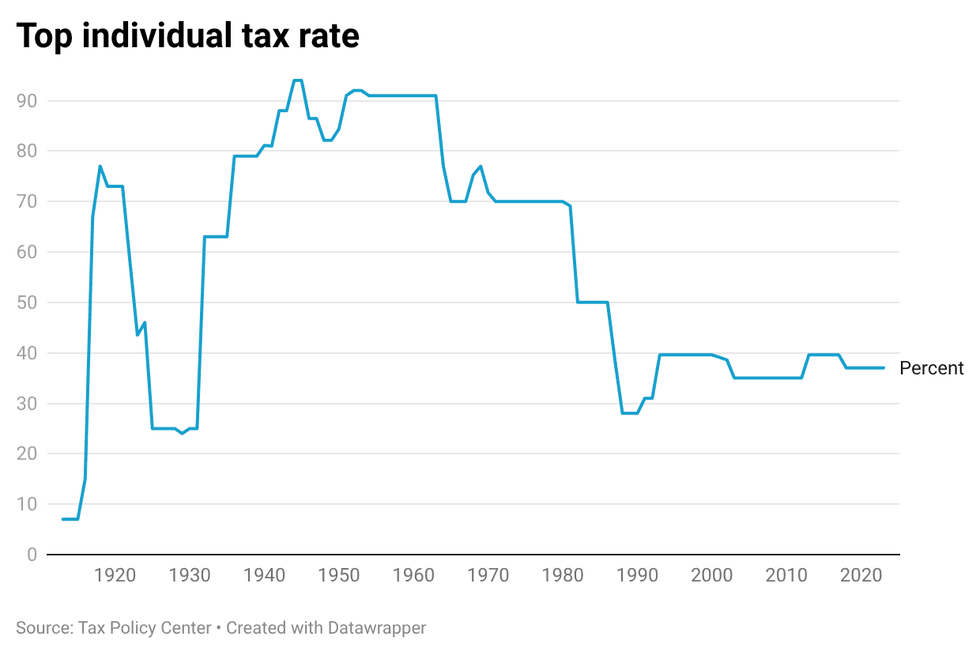
Progressive taxation has also been around for a very long time. In fact, taxes on high incomes were much higher in the 1950s than they are today:

At each stage of the expansion of U.S. social democracy, the right has screamed “socialism.” There was hysterical opposition to the creation of unemployment insurance in the 1930s; that opposition is the context for FDR’s famous 1936 Madison Square Garden speech, in which he declared of the forces of “organized money”,

They are unanimous in their hate for me—and I welcome their hatred.

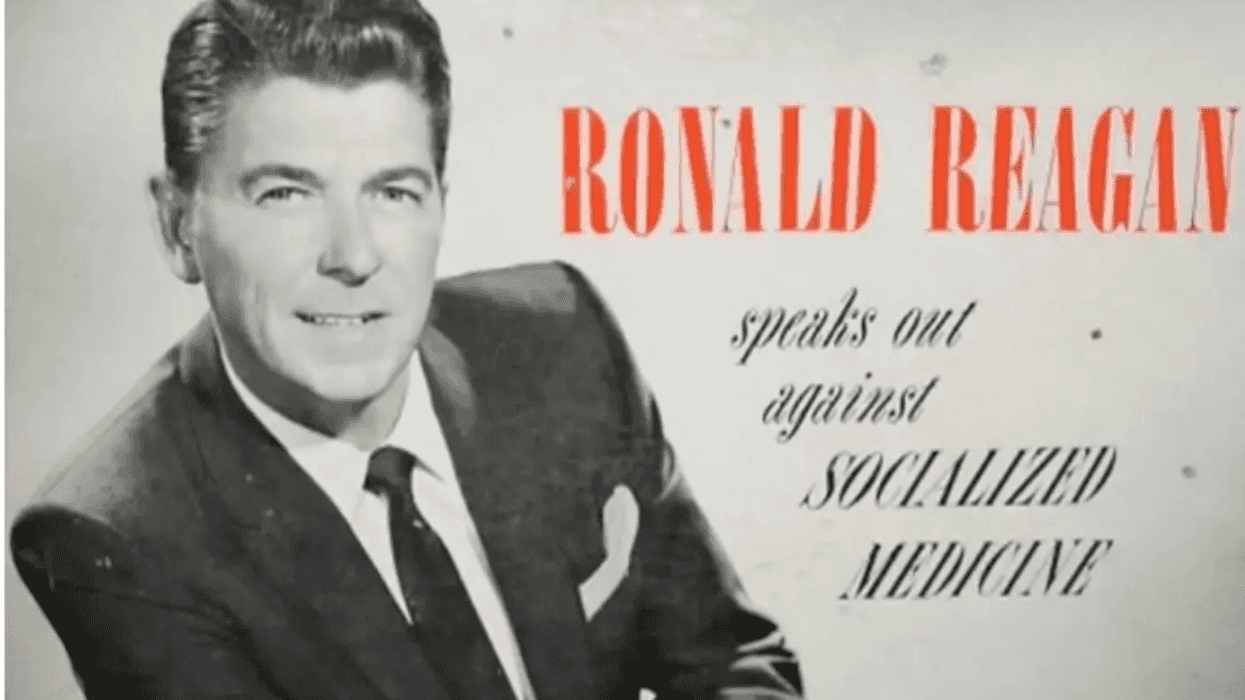
The picture at the top of this post comes from Operation Coffee Cup, a 1961 effort to head off what would soon become Medicare by getting doctors’ wives to invite their friends over to drink coffee and listen to a recording of Ronald Reagan explaining that government health insurance would destroy American freedom.

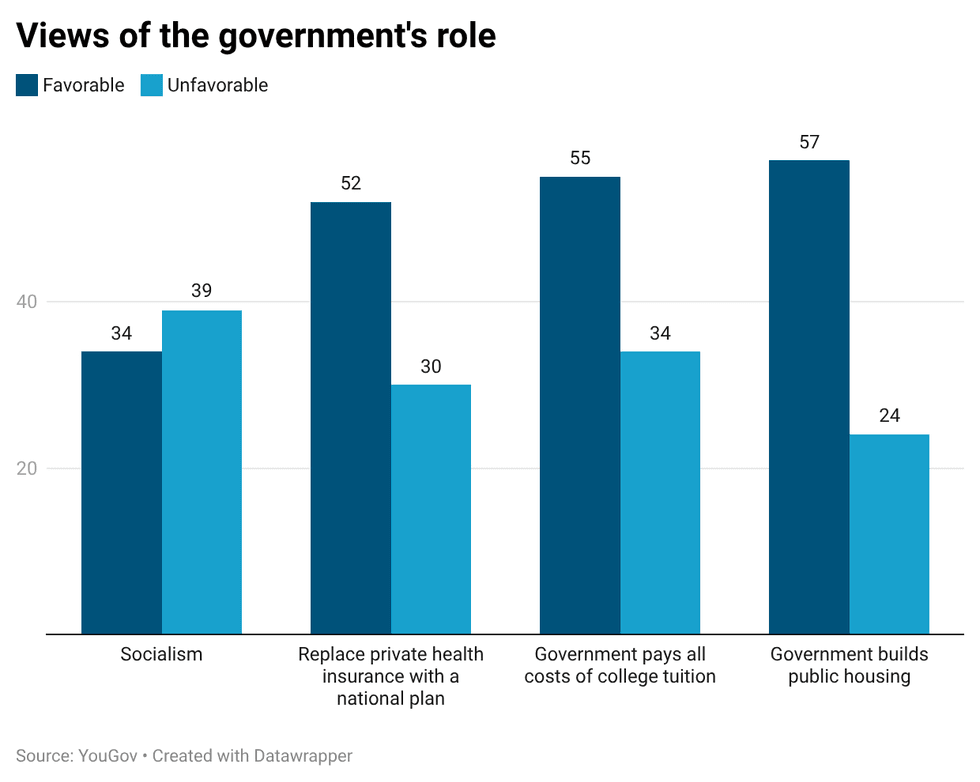
Yet Social Security and Medicare exist and are immensely popular. Indeed, while Americans continue to have a generally unfavorable view of socialism, they are strongly supportive not just of existing social democratic programs but of proposed expansions of the government’s role. From the latest YouGov poll:

Which brings me back to polls showing a rise in acceptance of “socialism.” What do they mean?

It’s safe to say that they don’t represent a groundswell of public support for actual socialism. Even politicians who call themselves socialists really aren’t.

It’s misleading even to call this a lurch to the left. As analysts like G. Elliott Morris have shown at length, most voters don’t think about politics in terms of left versus right. For the most part they think about kitchen-table issues, without strong ideological frameworks.

There is, however, a real groundswell of dismay over an economy that increasingly favors a tiny group of billionaires, and a political system that all too often works on these oligarchs’ behalf. When people say that they favor socialism, surely what they are often really saying is that they are angry about the rise of oligarchy. They are not demanding a dictatorship of the proletariat.

And while there are, of course, left-wing radicals in America, they have no realistic prospect of getting their way. So it’s important to understand what the current uproar over socialism is really about. For the most part, it’s an attempt to distract from the danger posed by the important radical movement in America — that of right-wing radicals who want to dismantle both social democracy and democracy itself.

Paul Krugman is a Nobel Prize-winning economist and former professor at MIT and Princeton who now teaches at the City University of New York's Graduate Center. From 2000 to 2024, he wrote a column for The New York Times. Please consider subscribing to his Substack.

Reprinted with permission from Paul Krugman.


Stupid Rich: Elon Musk Spews Idiocy On Universal Income And Social Security

Stupid Rich: Elon Musk Spews Idiocy On Universal Income And Social Security

I have no idea how smart or stupid Elon Musk actually is. Unlike Donald Trump, I don’t do IQ testing. But like everyone else in the world, I can evaluate the logic of the things he says. And there ain’t much there.

Apparently, Musk is now babbling something about how we need the government to provide a universal high income because AI will take all the jobs. The idea of universal high income is a contrast with the universal basic income plan that many have put forward, which would ostensibly provide enough money for people to afford basic necessities. Musk is saying that the income provided by a government payment should be enough to support a comfortable standard of living.

If it’s not obvious to everyone already, these views are 180 degrees at odds with each other. If we have enough money sitting around to pay people a universal high-income, then we surely have enough money to pay people the Social Security and Medicare benefits they are expecting and paid for. It’s probably also worth mentioning that if we really thought that we need to reduce the deficit, we could tax people like Musk more and/or reduce the size of the government contracts we are giving him.

Anyhow, we have Elon Musk simultaneously saying that we are richer than we can possibly imagine and that we are so poor we can’t pay the basic benefits that tens of millions depend upon to support them in retirement or due to disability. This isn’t the first time Musk has spewed utter nonsense.

Last year, when he was playing DOGE master, he insisted that 20 million dead people were getting Social Security benefits. While one dead person was uncovered, the other 19,999,999 are still free. The claim is utterly absurd on its face.

There surely are a small number of cases where a few checks get sent out after someone dies. These would barely make a dent in the cost of the program. Furthermore, much of the money is later recovered.

Musk also has repeated lunatic claims about millions of non-citizens voting. This claim, which Donald Trump also likes to make, defies common sense at both ends. The overwhelming majority of non-citizens in the country want, first and foremost, to be able to stay here to work and ultimately to gain legal citizenship.

How many of these people would risk everything to cast a vote in an election? In every election, there are tens of millions of citizens who have every right to vote, who decide it’s not worth their time. Elon believes that there are millions of non-citizens who would risk everything to cast an illegal vote?

On the other side, we have had Republicans yelling about non-citizens voting for more than a quarter-century. In all that time, maybe they have found a few dozen non-citizen voters. (There is a larger number, although still very small, who seem to have mistakenly registered. The overwhelming majority of these people never cast a vote.) We know that Trump and his crew are not very sharp, but if there were really millions of non-citizens voting in every election, even they would be competent enough to find ten or twenty thousand.

But getting back to the basic economics, what does Musk think he’s saying when he says the government will go bankrupt? The government prints the currency it spends. There is a story where we could be spending and printing so much money that we get runaway inflation, but we are obviously very far from that now, even with the burst of inflation from Trump’s tariffs and war. And even runaway inflation is not bankruptcy. Does our DOGE master really know that little about government finance?

Musk obviously runs off his mouth to advance whatever goal suits him at the time. Whatever he may think about the world, his comments often make no sense and are frequently contradictory. They do not deserve to be taken seriously.

The famous line, “if you’re so rich, how come you’re not smart,” could have been written for Elon Musk.

Dean Baker is a senior economist at the Center for Economic and Policy Research and the author of the 2016 book Rigged: How Globalization and the Rules of the Modern Economy Were Structured to Make the Rich Richer. Please consider subscribing to his Substack.



Trump Accounts Are A Sick Joke, Not A Replacement For Social Security

Trump Accounts Are A Sick Joke, Not A Replacement For Social Security

Many of the Trump crew seem to be delusional about Trump accounts. They claim to believe that they will replace Social Security. It shouldn’t be a surprise to us that many supporters of Trump are out of touch with reality, but that is not a reason for the rest of us to take their nonsense seriously.

Let’s keep our eyes on the ball. This is not three-dimensional chess; it is an account for newborn kids in which the government deposits $1,000. Parents or other relatives can add to it each year, like they can add to an education savings accounts in most states. The amount people contribute to the account is deducted from their taxable income. Also, the money accumulated in the account is not taxed until it is withdrawn.

Some people take advantage of these accounts; most don’t. The reason is that most people don’t have an extra $1,000 or $5,000 or whatever to contribute to a Trumo account. Furthermore, the tax benefit is not a very big deal to most moderate and even middle-income people.

The overwhelming majority of households are in the 12 percent bracket or below. More than a fifth are in the zero bracket, meaning they pay no income tax and would get no benefit from tax-advantaged accounts.

Furthermore, even if they wanted to put money in a tax-advantaged account, why would they choose a Trump account rather than an education savings account or an IRA? Money in existing tax-advantaged accounts can be withdrawn, albeit with a penalty. Money in a Trump account can only be accessed by the kid when they turn 18.

This brings us to the sick joke part of the Trump account story. Trump and Congressional Republicans have been gleefully cutting Food Stamps, housing assistance, Medicaid, and the subsidies in the Obamacare exchanges. As a result, tens of millions of people will be denied benefits that they previously depended upon.

Many of these people will end up hungry, homeless, and/or unable to obtain needed medical care. This means two or three years from now, there are likely to be tens, or even hundreds, of thousands of kids with $1,000 in their Trump accounts who are living on the streets, going hungry, or unable to get necessary medical care because Trump has cut the programs their families depend upon.

This will make for great photo ops. Maybe Trump can have some homeless kids over to the White House, or even Mar-a-Lago, and they can talk about living in the streets of Chicago in winter, or the needed surgery that they can’t afford, but they still have $1,000 in their Trump account. Then Trump and his entourage can all say how great that is!

The other part of the story is the nutty illusion about how rapidly these accounts will grow. The Trump gang likes to say they will grow 10% a year. Amazingly, many who are not on Team Trump are prepared to accept this nonsense.

The 10% rate of return is based on looking at the past, where stocks have yielded somewhere close to a 10% rate of return over the last eight decades. But this is a case of incredibly bad induction, sort of like the person who falls off an 80- story building and says as they pass the 60th floor, the 59th floor, and the 58th floor, “so far so good.”

The simple and obvious point that people who make this inference miss is that the stock market was valued far lower relative to corporate earnings in prior decades than is the case today. Through most of the decades of the 40s, 50s, 60s, and 70s, the price-to-earnings ratio (PE) was generally in the low teens and often considerably lower. When the PE is low, and the economy is growing relatively rapidly, it’s possible for the stock market to generate 10 percent nominal returns, or seven percent real (inflation-adjusted). That’s somewhat oversimplifying the inflation story, but it doesn’t affect the argument.

Today, the PE is over 30, and the economy is projected to grow roughly 2.0 percent a year going forward. In that world, the only way to generate the historic seven percent real rate of return is with an ever-rising price-to-earnings ratio.[1]

The Trumper’s story gives us a PE of almost 92 when today’s newborns turn 18 in 2044.[2] If we want to ask what happens if they hold their money until they hit the Social Security normal retirement age of 67, the PE will be over 2000. A Trump administration economist may be able to make this sort of projection with a straight face, but not many other people could.

Is there a way around this story? Well, the after-tax profit share of GDP could rise further, as it has been doing for the last quarter century. This would be a bleak story for the rest of us, since it would likely mean wages are shrinking. It would also have to almost triple in the next 18 years to keep the PE constant. This is close to unimaginable and a truly horrible story, even if it were. For what it’s worth, the Congressional Budget Office projects the profit share will fall in the next decade.

People could invest their Trump accounts overseas. China is having far more rapid growth than the United States, so perhaps people can get closer to 7.0 percent real returns there. Maybe this is what the Trump gang has in mind.

If we look at the actual returns that people can expect in their Trump account, it will be close to 3.0 percent a year in real terms, assuming that they are not ripped off badly on fees by one of Trump’s Wall Street friends. That will give today’s newborn $1,700, adjusted for inflation, when they turn 18.

Somehow, I don’t think this will lead people to discard Social Security. But I could be mistaken.

[1] I wrote about this issue in a paper with Brad DeLong and Paul Krugman 20 years ago in the context of the Bush Social Security privatization drive.

[2] The data for after-tax corporate profits Bureau of Economic Analysis, National Income and Product Accounts, Table 1.12, Line 15. The data for the valuation of the stock market comes from the Federal Reserve Board’s Financial Accounts of the United States Financial Accounts, Table L.2, Line 38, plus Table l.108, Line 20. The 2.0% GDP growth projection is from the Congressional Budget Office’s Long-term Budget Projections. The projection assumes that companies pay out 60 percent of their profits as either dividends or share buybacks, and the rest of the seven percent real return is made up through capital gains.


Dean Baker is a senior economist at the Center for Economic and Policy Research and the author of the 2016 book Rigged: How Globalization and the Rules of the Modern Economy Were Structured to Make the Rich Richer. Please consider subscribing to his Substack.

Shop our Store

Headlines

Editor's Blog

Trending

World