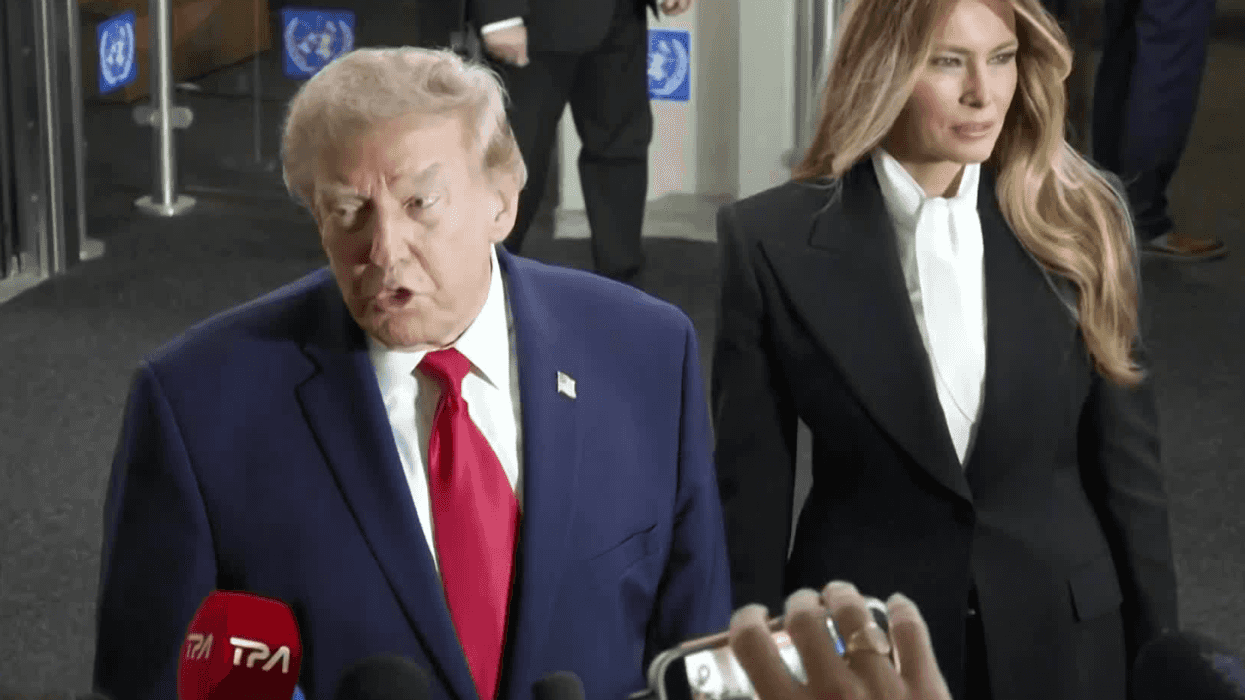
Good for CNN, MS NOW, and Politico for filing an immediate lawsuit Monday against Donald Trump’s order barring them from the White House grounds. Better still, the rest of the press pool refused to fill their slots, suspending a shared arrangement that has put an independent camera on every president since Eisenhower. Trump traveled to the United Nations on Monday with no network crew recording his official movements, the first such blackout in modern memory.
It was a collective flexing of muscle, and twenty months of Trump 2.0 have taught us that this—institutions acting together, refusing to be picked off one at a time—is exactly the right way to push back against a tyrant. And of course it hit Trump where it hurts him most, cutting off the oxygen of the public’s attention to his every move.
There will be a hearing before Judge Timothy Kelly tomorrow afternoon, Wednesday, September 23, on the networks’ motion for a temporary restraining order.
The networks’ solidarity was historic, if not quite unprecedented. A far smaller version happened in 2009, when the Obama White House tried to exclude Fox News from a round of pool interviews with pay czar Kenneth Feinberg. The other networks refused to take part unless Fox was included, and the administration backed down within days. Something similar will happen here.
And as the Fox News precedent demonstrates, the perniciousness of Trump’s move has nothing to do with politics, i.e., with the particular viewpoint that the government is trying to ostracize. The principle is about the structure of a free press, not the politics of any one network.
The collective action figures to hasten the collapse of Trump’s order even faster than the lawsuit will. And if the courts do not quickly reverse him, he will likely find a way to declare victory and undo it himself. We can take heart in that, and in the show of vigor by the press and the courts, which have been among the more stalwart institutions resisting Trump’s authoritarian moves throughout this presidency.
But before popping the champagne, we should take stock of the gravity of this latest move—one of three in the last couple of weeks—to transgress what is arguably, along with invidious racial discrimination, the most categorical constraint on government action in the Constitution.
Of course, all the constraints the Constitution places on government are important, and constitutional lawyers are not in the habit of ranking the charter’s commands, but the Constitution is an instrumental document, designed to promote, in five words or fewer, life, liberty, and the pursuit of happiness. Considered from that vantage point, few if any of its commands rank higher than the proscription against government discrimination on the basis of viewpoint, the very epicenter of the First Amendment. Given the coercive power of the state, it presents special harms to a self-governing society.
And the last two weeks alone have supplied three direct attacks on that principle. Each was executed not by a rogue actor but as the settled policy of the United States government.
Besides the latest outrage, Kash Patel cut off cooperation with Canada’s national police force to punish an editorially independent broadcaster over how it chose to describe the 9/11 attacks; and the FCC leaned on ABC hard enough that Jimmy Kimmel pulled a Senate candidate’s interview off the air rather than expose his local stations to the agency’s wrath. We took note of each as it occurred, then largely moved on. Such is the degraded state of government and daily life under Trump that these episodes just get filed away in the overflowing, ever-growing drawer of constitutional abuses.
The prohibition on viewpoint discrimination by government is as central to the American experiment as any provision of the Bill of Rights: the government may not punish or reward speech because of the speaker’s viewpoint. Eighty years ago, Justice Robert Jackson put it in words no one has improved on, warning in West Virginia Board of Education v. Barnette that “no official, high or petty,” may prescribe what shall be orthodox in politics or opinion. Among the justices, Jackson had a gift for the ringing phrase that has rarely been equalled. “High or petty” turns out to be the phrase for the moment.
It’s familiar ground in our constitutional tradition to justify freedom of speech according to the hoary principle of the open competition of ideas. Justice Oliver Wendell Holmes gave it its enduring image in Abrams v. United States—“the best test of truth is the power of the thought to get itself accepted in the competition of the market.” But the marketplace is only the start of the answer, because its signature remedy—that the cure for bad speech is more speech—has nothing to say when the government itself is the censor. The wrong is not that a bad idea is circulating but that the state has put its thumb on the scale.
There are several influential accounts of the particular evil of viewpoint discrimination by the government, and why it is nearly always unconstitutional.
When she was a law professor, Elena Kagan traced the danger to the government’s motive. She argued that free-speech law is best understood not as a device for maximizing the sheer quantity of speech, but as a tool for flushing out the government’s illegitimate reasons for acting: of which viewpoint discrimination is the surest sign. When officials burden speech because they dislike the idea behind it, they are almost always acting for a reason the Constitution forbids: hostility to a message, or the wish to shield themselves from criticism and tilt the debate in their own favor. That is an abuse of power whatever its practical effect. This is why the rule applies even when a particular restriction barely dents public debate; the wrong lies not in the damage done to the conversation but in the corruption of the government’s reason for acting.
A second fairly canonical understanding is the “checking value” of the First Amendment. As the scholar Vincent Blasi explained, free expression matters above all because it is how a free people exposes and restrains the abuse of official power. On this view, the special danger of viewpoint discrimination is that the speech a government most wants to punish is precisely the speech that holds it to account, so a state that can silence its critics has disabled the very instrument built to keep it honest.
Justice Hugo Black encapsulated that idea in the Pentagon Papers case: the press “was to serve the governed, not the governors,” protected so “that it could bare the secrets of government and inform the people.” The worry again is more fundamental than a distortion in the marketplace of ideas. When an administration punishes the outlets that scrutinize it, it is dismantling a safeguard.
The state is perfectly free to express its own preferences (though limits come in—as we’ve found honored in the breach—with false speech by government). But it can’t use the machinery of the state to punish the people who hold the view it dislikes. It’s the difference between persuasion, which is fine, and coercion, which is a fundamental abuse of government power, the classic tactic of authoritarian government.
In sum, viewpoint discrimination is forbidden because it betrays an illegitimate government motive and because it uses the coercive power of the state to suppress speech that a free society depends on to keep government honest.
Each of the three recent episodes is a signal lesson in the social harm and deep constitutional betrayal that viewpoint discrimination occasions. None offends only one of the rationales above, but each throws one of the harms into especially sharp relief.
Trump’s barring of CNN, MS NOW, and Politico is as pristine an instance of viewpoint discrimination as we have seen in Trump 2.0. Usually the administration has scrambled to manufacture a pretextual rationale—as when it dressed the Associated Press ban as a quarrel over the AP’s refusal to say “Gulf of America” rather than the plain retaliation it was. But here Trump brandished the smoking gun.
As I wrote on Bluesky, “Trump does CNN & MS big favor by putting it so bluntly. Government discrimination on the basis of viewpoint is virtually always unconstitutional.” With unintended irony, given his grotesque transformation of the White House into a monument to his own presidency, Trump complained that there is “something wrong with a country” that lets people “write purposely negative stories,” and so “I don’t have to let them into…the people’s house”.
The offense is best seen through Kagan’s lens: the illegitimate motive hangs over the whole episode like a pall. The wrong is complete on that motive alone; it does not turn on any measurable effect on coverage. Its gravamen is that Trump wielded public power to reward flattery and punish scrutiny—precisely the malign purpose the rule exists to prevent.
But the core offense is to the First Amendment’s checking value. Trump has launched a frontal attack on the outlets whose job in a democracy is to hold him to account. As of today, he is vowing to fight and, ironically, branding the coverage he dislikes “a threat to democracy.” That will be short-lived: unless Trump takes action to reverse his own edict, the suit filed Monday will succeed.
But the important lesson from the explanations of the special dangers of viewpoint discrimination is that a reversal weeks from now may arrest the constitutional evil. It will not undo the serious injury the press and society already have sustained.
The Kimmel episode illustrates why a winning legal case is not the same as a constitutional safeguard, not in an authoritarian society anyway. Brendan Carr, Trump’s ideological warrior atop the FCC, adopted a viewpoint preference and dressed it as a neutral scheduling rule. His “equal time” rationale was transparently meritless in light of the long-settled exemption for bona fide news interviews. Carr didn’t care. He used his mangled account to pressure ABC, its affiliates, and its local stations over the show’s booking of James Talarico, the Democratic candidate for Senate in Texas.
Kimmel named the wrong exactly—the FCC wanted “to make our editorial decisions for us, which of course we cannot accept”.
And yet they did accept it in a fashion. ABC concluded, rationally, that the fight would be too expensive and time-consuming, and the show pulled the interview from the air and posted it to YouTube.
The aftermath was fairly delightful. The banished interview drew more than twelve million views on YouTube, a far larger audience than the timeslot would ever have delivered. Kimmel and Talarico got the last laugh.
But that viewpoint overlooks the serious constitutional injury that Carr and the administration imposed and got away with. It’s precisely the kind of coercion that the government may never practice against disfavored viewpoints (much less to promote its own party’s candidates). The pressure was flatly unconstitutional, and a lawsuit would almost certainly have won. But vindication would have taken months and cost a fortune, and the blast radius reached past ABC to the affiliates and local stations caught in the crossfire. Weigh the near-certain victory against the fatigue, expense, and exposure of getting there, and the rational calculation becomes: let this one go.
That calculation is itself the authoritarian’s victory. He does not need to win in court; he needs only to make the defense of one’s rights so costly and so exhausting that a rights-holder with a sure case decides it isn’t worth the fight. And of course there is the collateral prospect of an overall chilling effect, so that the next time a network will make a similar calculation to avoid the time and expense—not to mention the many creative ways that this administration finds to make all aspects of life harder for its ideological opponents.
Patel’s browbeating of Canada over the words it used to describe 9/11 belongs on this list. As FBI director, he cut off a portion of the bureau’s law-enforcement cooperation with Canada’s national police—canceling meetings, telling his counterparts they would be out of touch—to punish the CBC, Canada’s public broadcaster, over an internal guidance memo on how to describe the September 11 attacks. The news organization’s long-standing policy was to describe the attacks as terrorism but only with accompanying expert attribution.
And he did it where argument was not only available but obvious. Patel was free to say, loudly, that the CBC’s policy requiring some expert attribution in order to use the word “terrorism” was ridiculous; Canada’s own culture minister called it “pedantic and foolish,” and that kind of government counter-speech is entirely legitimate. What he could not legitimately do was warn that any Canadian agency failing to “publicly reject this bastardization of history” would “no longer have a friend in this FBI.” The CBC folded within days. Patel still halted some cooperation between the two nations’ law enforcement agencies anyway.
This may not be a First Amendment violation, strictly speaking. The broadcaster is foreign; the squeeze ran through the Mounties. But it is of a piece with the administration’s petty, bullyboy instinct: when it encounters views it doesn’t like, it screams and threatens. And the harm here fell on Americans: live counterterrorism and cybersecurity work with a close ally, suspended to punish an editorial judgment that had already been surrendered.
In the daily functioning of a democracy, ideas fight for space in the hurly-burly, with the winner being the most worthwhile—or so is the large bet we placed as a country on the Constitution. Government suppression of ideas it disfavors, or that cut against its political interests, is a more pernicious matter altogether.
Barring reporters for unfavorable coverage, threatening a network’s licenses over a comedian’s monologue, punishing an ally over a style guide are the reflexes of an autocracy. The state insists on a single approved version of events and treats the truth as a loyalty test.
Hannah Arendt, who along with George Orwell is the prescient prophet of our current dark times, put the stakes plainly in a 1974 interview: “The moment we no longer have a free press, anything can happen. What makes it possible for a totalitarian or any other dictatorship to rule is that people are not informed.”
Thanks largely to the courts and the collective action of the media, we are not yet at the point where everything comes apart; and I believe we will not get there. That is a buoying headline of a sort. But a democracy can be eroded and pushed toward authoritarianism, with current and lasting consequences. The administration’s violations of the viewpoint discrimination principle harm us as a free society, even if they are forced to walk back every one. We are, here and now, poorer and less free, for having authoritarians in charge.
Harry Litman is a former United States Attorney and the executive producer and host of the Talking Feds podcast. He has taught law at UCLA, Berkeley, and Georgetown and served as a deputy assistant attorney general in the Clinton Administration. Please consider subscribing to Talking Feds on Substack.


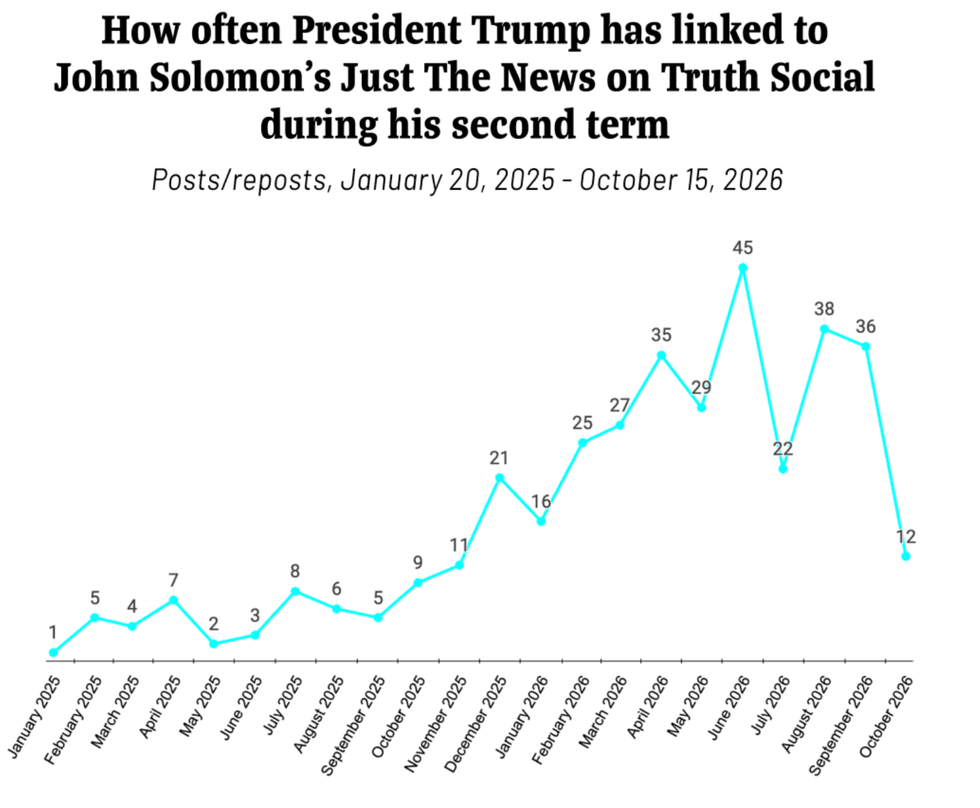
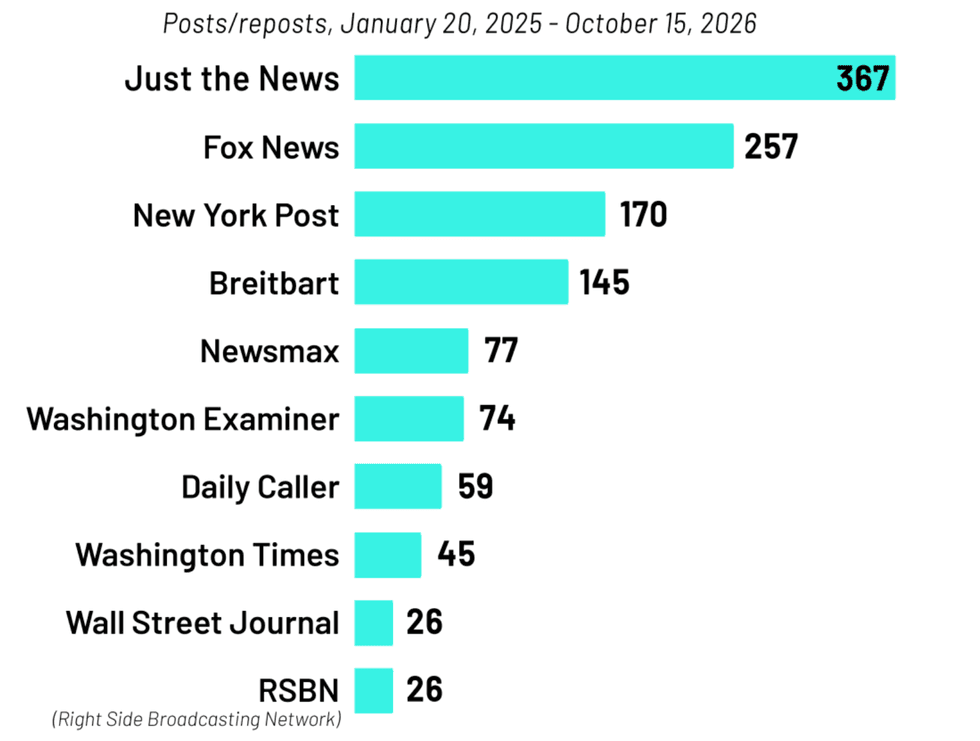 Top news sites linked by President Trump on Truth Social during his second term