Tag: viktor orban
It's The Corruption, Stupid -- With Both Viktor Orban And Donald Trump

It's The Corruption, Stupid -- With Both Viktor Orban And Donald Trump

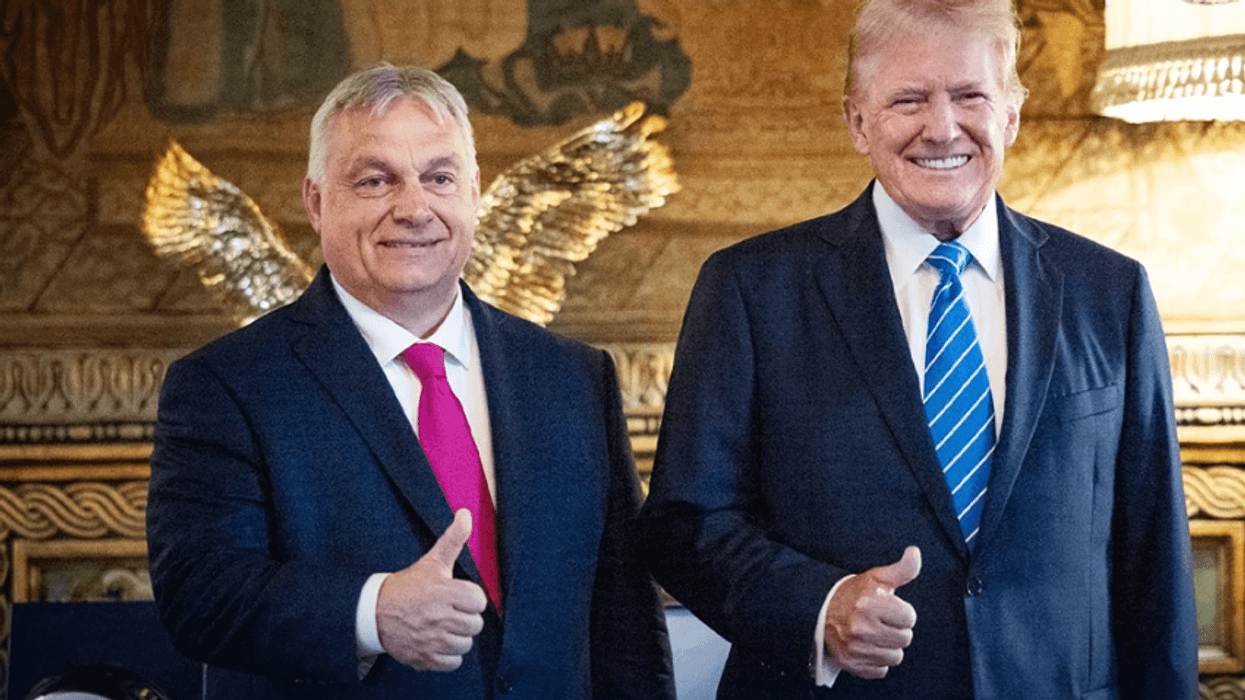
The humiliating demise of Viktor Orban’s authoritarian regime is bracing news for endangered democracies, including our own, but America isn’t Hungary. Of the parallels that can be drawn between their despot and ours, the most salient may have been commented on the least – the overwhelming and unprecedented mafia-style corruption that enriched the ruling family and entrenched their power.

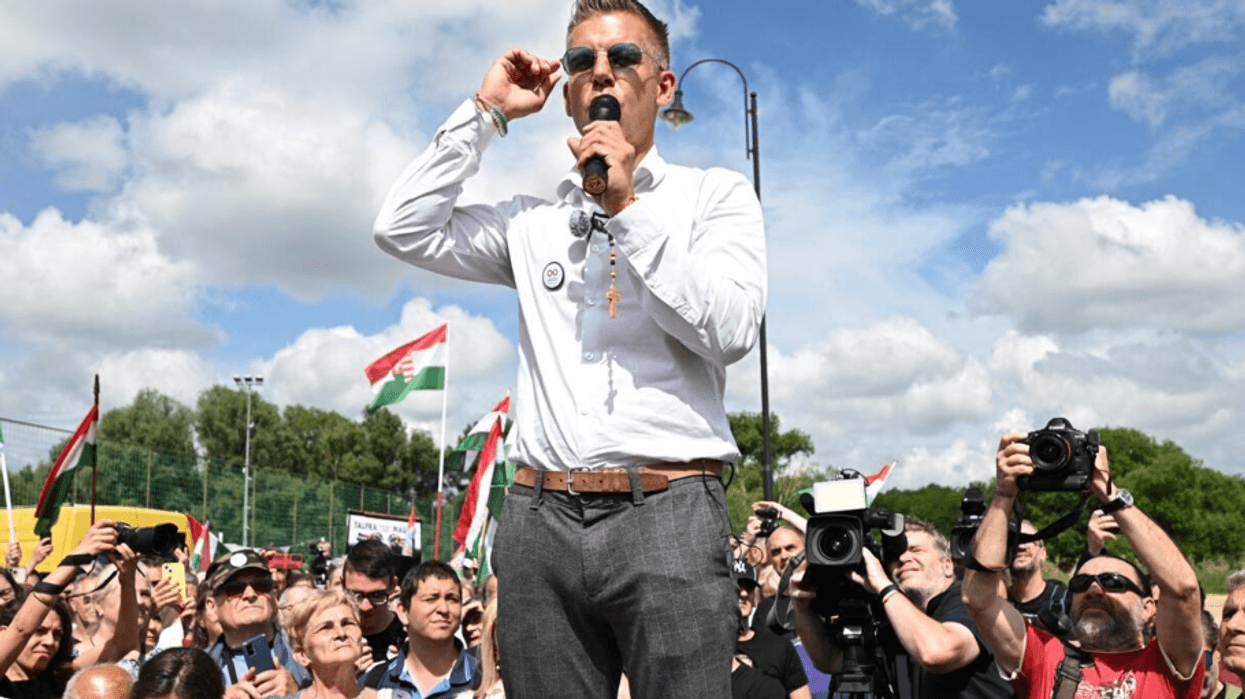
It was the corruption that motivated Peter Magyar, a lifelong loyal appartchik until two years ago, to break with Orban’s Fidesz party and inaugurate the campaign to overthrow the regime. It was the corruption that forced the European Union to act against Budapest by withholding billions in funding and isolating its government. And it was the corruption – so pervasive in Hungary’s media, judiciary, and business institutions – that finally drove otherwise conservative Hungarian voters to reject the crooked outfit that had ruled them for 16 years.

Liberals in Hungary celebrated Magyar’s election victory, not necessarily because they agree with the new prime minister on every issue – they don’t – but because he vowed to clean up Orban’s legacy of outrageous theft, to enforce accountability and to strengthen the nation’s frayed ties with Europe. Relying on his long experience inside the Fidesz machine, Magyar was able to expose its sleazy deals, including a pardon scandal that embroiled his then-wife, who had served as Orban’s justice minister.

Like so much of the criminality perpetrated by Orban and his cronies, that pardon affair echoed a train of remarkably similar offenses in the Trump White House. And as Magyar emphasized throughout his innovative grassroots campaign, the cost of Orban’s venality fell on ordinary Hungarians, whose national wealth was siphoned off to enrich the dictatorship’s cronies.

According to Akos Hadhazy, a leading voice against corruption as an independent member of Hungary’s parliament, the mafia-style graft perpetrated by the Orban regime has looted more than 2.8 billion euros (over $3.2 billion) annually from public funds. Much of that stolen money came from the European Union itself, which played a role in the regime’s demise by withholding further funds from suspect projects. Among the reasons to renew ties with Brussels, as Magyar often explained, was to facilitate prosecution of the ‘Orban mafia’ that stole those EU funds.

The details of the Fidesz government’s boodling might almost seem quaint in comparison with the high-tech crypto scams hatched in the Trump White House. Viktor Orban’s son-in-law, an entrepreneur named Istvan Tiborcz, became wealthy by forming Elios, a company that won multi-million-euro contracts to upgrade street lighting in cities and towns all over the country. Those contracts were financed by the European Union, but as auditors later discovered, the project details were designed to favor Tiborcz’s firm and eliminate any competition. In fact, the same officials who oversaw the lighting specifications also wrote the Elios bids.

EU investigators recommended that Hungary void those contracts, claw back the money, and commence legal action against the officials and business executives responsible for the scandal. The crooks in Budapest have been “investigating” that case for the past 11 years.

Meanwhile even more public millions flowed into the accounts of Orban’s father Gyozy, whose real estate development company swelled with government and EU contracts – and is suspected of serving as a front for Orban himself. This arrangement smacks of the millions in US government funding and related payments that have flowed over the years to the Trump Organization.

Various other Orban cronies – notably including the chief of his cabinet, Antal Rogan, and his closest friend since childhood, Lorinc Meszaros – have walked away with enormous fortunes. So brazen was Rogan that the U.S. Treasury sanctioned him in January 2025, during the final weeks of the Biden administration.

The Office of Foreign Assets Control found that Rogan had “orchestrated Hungary’s system for distributing public contracts and resources to cronies loyal to himself and the Fidesz political party, [including] schemes designed to control several strategic sectors of the Hungarian economy and to divert proceeds from those sectors to himself and to reward loyalists from his political party. “

The Trump administration lifted the U.S. sanctions on Rogan within three months of taking office, as part of its broader abandonment of anti-corruption agencies and measures throughout government.

As for Meszaros, he is the richest man in Hungary, sitting atop a fortune estimated at over $3 billion. Having started out as a gas-pipe fitter in 2006, with assets worth less than $42,000, his wealth grew exponentially through state energy and construction deals. When asked how this could have happened, Meszaros modestly attributed his wealth to “God, luck, and Viktor Orban.”

Americans have long seemed indifferent to the orgy of corruption that has characterized Trump’s career and especially his return to power. Citizens whose news consumption is limited to Fox News, Newsmax, and the MAGA media have heard little or nothing about the ways that Trump, his wife and offspring, and their circle of supporters have gorged themselves in one shady deal after another, often at risk to our national security.

Yet somehow, despite a state-controlled Hungarian media universe, Peter Magyar’s movement brought the truth about Orban’s corruption to the people, who responded with appropriate fury. In this country, democrats of every persuasion must convey to every American voter that same message about the decadent MAGA movement and its greedy overlord.
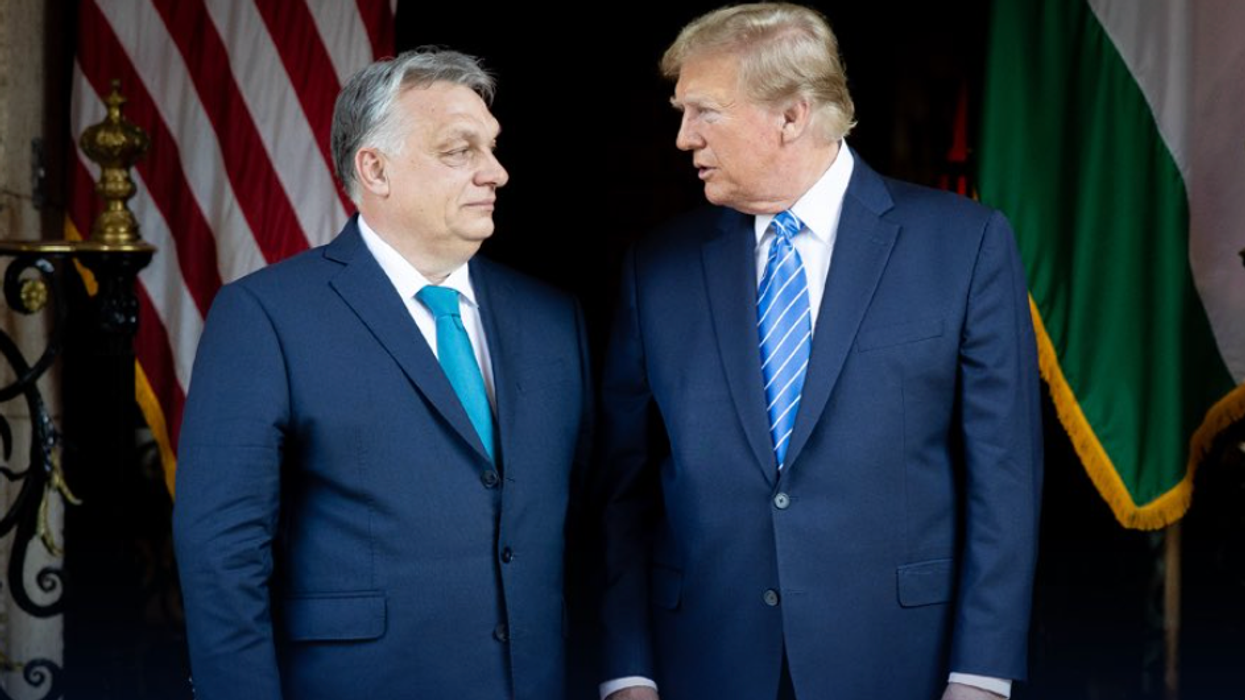
'Crashing Out': Why Trump Runs When Asked About Orban's Landslide Defeat

'Crashing Out': Why Trump Runs When Asked About Orban's Landslide Defeat

On Sunday, far-right Hungarian strongman Viktor Orban was voted out of office after 16 years of dictatorial rule. His defeat not only spelled significant change for the nation of Hungary, but was widely interpreted as a major blow against far-right movements around the world, including MAGA in the United States. As a result, President Donald Trump is “crashing out” in the face of a bad sign for his authoritarian political project.

Following Orban’s loss, Trump — usually not shy about sharing his thoughts on any subject — declined to answer questions from reporters about the election, making a quick escape to board Air Force One. Many who watched this exit online were struck by the typically wordy president’s lack of response.

"You can tell he’s so close to crashing out lmao,” wrote one commenter on a NewsNation broadcast of the moment. "He can't handle the truth," said another, with a third still declaring, "LOL. This has been a week of huge losses in the life of this big loser."

It may seem strange for an American president to hang so much importance on a Hungarian election, but not only has Orban been a longtime “illiberal” ally of Trump and Russian President Vladimir Putin, but he had become something of a superstar within the MAGA movement, garnering headline appearances at events like CPAC due to the popularity of his conservative, anti-immigrant, authoritarian policies within the Republican Party.

Orban’s election or lack thereof was viewed as so symbolically vital to MAGA that Vice President JD Vance was sent to Hungary during the final days of the race in an attempt to help build support. Vance’s appearance did not have the desired effect, as Orban’s party was defeated by a landslide.

For many within the MAGA-sphere, the rise of figures like Orban and Trump has been embraced as a signal of the growing power of the far-right movement and its righteous if not outright fated assumption of power around the globe. But Orban’s loss suggests that history is not as inevitable as they thought.

As Ivan Krastev, chair of the Center for Liberal Strategies in Sofia, Bulgaria, explained, Orban’s loss will have “an incredible psychological impact” on the far-right. Or as Orban biographer Pal Daniel Renyi put it, the election is proof to Orban, Trump, and their followers that “nothing lasts forever.”

Reprinted with permission from Alternet

Peter Magyar

Massive Rejection By Hungarian Voters Shows How To End MAGA-Style Politics

Hungary’s strongman Viktor Orban has lost reelection in stunning fashion, an absolute electoral wipeout that presages what his MAGA allies in the U.S. will be facing this November.

The brand-new opposition Tisza party won around 53 percent of the vote, to just 37 percent for Orban’s Fidesz. Tisza is projected to secure around 138 seats in the 199-seat parliament, comfortably above the 133 needed for a supermajority, giving it the power to rewrite Hungary’s constitution and begin dismantling the autocratic system Orban spent 16 years building. Fidesz currently holds 135 seats.

The victory came despite Orban rigging the playing field: gerrymandering the country so the opposition needed about a 5-point margin just to break even, and turning public media into government mouthpieces.

MAGA and Orban have long been tied at the hip. The right-wing CPAC conference has hosted an annual Hungary edition since 2022. There, he’s fed the MAGA faithful red meat like: “Progressive liberals, neo-Marxists intoxicated by the dream of wokeness, those in the pay of George Soros, they want to abolish the Western way of life that you and we love so much.”

He’s also leaned hard into culture war paranoia, telling the CPAC Hungary crowd in 2023: “Gender and woke also divide the nation into classes, and proclaim that class is more important than nation, taking precedence over belonging to the nation and taking precedence over national identity.”

So you can see why the MAGA crowd loves him so much. For many on the American right, Orban isn’t just an ally—he’s a blueprint, with influential voices openly arguing for “Orbanizing” U.S. institutions by using state power to reshape media, universities, and the civil service. Tucker Carlson helped cement that relationship, broadcasting a week of shows from Budapest in 2021.

For millions of MAGA viewers, Hungary wasn’t some distant country—it was a working model of what conservative power could look like in practice, a model Orban actively marketed. “Hungary is actually an incubator where experiments are done on the future of conservative policies,” he said in 2023. “Hungary is the place where we didn't just talk about defeating the progressives and liberals and causing a conservative Christian political turn, but we actually did it.”

Yeah, he and his party did it. And on Sunday, two-thirds of his country rebelled against it.

Adding to the schadenfreude, Vice President JD Vance actually traveled to Hungary and campaigned for Orban. “What the United States and Hungary represent under Viktor’s leadership and under President Trump’s leadership is the defense of Western civilization,” Vance declared at one rally. At another, he went full sermon: “Will you stand for Western civilization and for the God of our fathers?”

The god of our fathers? Vance is so weird.

His overt meddling drew backlash across Europe, including from Germany, which rejected Vance’s claims that the European Union was the real outside influence in Hungary’s election. But really, everyone should be happy at Vance’s visit, as his “kiss of death” record (literally with the last Pope) remains unvarnished:

President Donald Trump, meanwhile, tried his own version of election interference—dangling U.S. economic support if Hungarians kept Orban in power. It worked in Argentina, where Trump gave his pal Javier Milei a $20 billion taxpayer giveaway in the weeks before his reelection campaign.

“My Administration stands ready to use the full Economic Might of the United States to strengthen Hungary’s Economy, as we have done for our Great Allies in the past, if Prime Minister Viktor Orbán and the Hungarian People ever need it,” Trump posted on Truth Social. “We are excited to invest in the future Prosperity that will be generated by Orbán’s continued Leadership!”

Can’t wait to see how “excited” he is now.

Trump’s support was just the latest in a long line of backing for Orban, whom he praises in the same breath as Russian dictator Vladimir Putin. And the alignment isn’t just rhetorical. Orban has consistently acted as a spoiler inside the European Union, delaying or weakening sanctions on Russia and complicating efforts to support Ukraine. In practice, that’s made him Vladimir Putin’s most reliable ally inside the EU, a bridge between Moscow’s interests and the MAGA movement that has long admired him.

There is, however, one way Orban appears to be better than Trump or Putin: He has reportedly respected the outcome of this election, calling opposition leader and Prime Minister-elect Péter Magyar to concede and congratulate him.

It’s a low bar, but one Trump couldn’t manage to clear.

The geopolitical implications are immediate. Ukraine, in particular, stands to benefit. While Slovakia’s Robert Fico remains aligned with Putin and hostile to EU support for Ukraine, he will now be far more isolated. Without Orban to share the burden, it becomes much harder for a single leader to block aid to Kyiv without facing serious consequences for his poor nation from the rest of Europe.

And for Trump, it’s one less strongman ally. If MAGA wants to keep pointing to the Hungarian model, let them. Voters there just showed how that story ends.

Markos Moulitsas is founder and editor of the blogging website Daily Kos and author of three books.

Reprinted with permission from Daily Kos


Kimmel's Triumph: A Sign That The Tide Is Turning Against Autocracy?

Kimmel's Triumph: A Sign That The Tide Is Turning Against Autocracy?

It’s irrefutable now: Trump is nakedly following the playbook of autocrats like Vladimir Putin and Viktor Orban. As his poll numbers fall, he is rushing to lock in permanent power by punishing his opponents and intimidating everyone else into submission. Craven congressional Republicans and a complicit Supreme Court have abetted Trump’s destruction of our democratic safeguards and norms.

Yet Trump has a significant problem that neither Putin nor Orban faced. When Putin and Orban were consolidating their autocratics, they were genuinely popular. They were perceived by the public as effective and competent leaders. Just nine months into his presidency, Trump, by contrast, is deeply unpopular. He is increasingly seen as chaotic and inept. As David Frum says, this means that he is in a race against time. Can he consolidate power before he loses his aura of inevitability? Will those who run major institutions – particularly corporate CEOs – understand that we are at a crucial juncture, and that by accommodating Trump they have more to lose than by standing up to him?

To put it bluntly, is the Jimmy Kimmel affair the harbinger of a failed Trumpian putsch?

Before I address that question, I want to offer some historical comparisons that illustrate how poorly Trump is doing compared with his role models, Putin and Orban. I wrote about this a couple of weeks ago, but I think the point deserves further elaboration.

First, Russia. Putin appears to have been extremely popular in the early 2000s, as he was consolidating power. His net approval — approval minus disapproval — was consistently above 50 percent.

Why was Putin so popular? Kitchen table issues. The Russian economy performed very badly for years after the fall of Communism, culminating in a devastating financial crisis in 1998. But Putin got to preside over a rapid economic recovery: Real GDP per capita doubled between 1998 and 2008:


Viktor Orban has never been as popular as Putin at his peak. Nonetheless, for most of the 2010s, as he consolidated power, his net approval was strongly positive, often by 10 points or more. Again, the main explanation was probably his perceived economic success. Orban took power at a time when Hungary’s economy was deeply depressed by austerity policies, and was able to preside over a large decline in unemployment:

Trump’s net approval, by contrast, turned negative within weeks after taking office and has just continued to fall:

As G. Elliott Morris points out, his position looks even worse when you consider intensity. Almost half the public disapproves “strongly,” twice the share with strong approval.

Some of the public’s disdain for Trump reflects alarm over his assault on democracy, the spectacle of abductions by masked secret police, his attacks on education and public health, his destruction of key agencies like the FBI, and more. Yet, as always, economics plays a key role in Trump’s cratering popularity.

People have not forgotten that Trump made big promises during the campaign: He would end inflation on day one, reduce the price of groceries, and cut electricity prices in half. None of that is remotely happening. Moreover, more economic pain is coming as the full inflationary impact of tariffs and deportations will soon be felt. Not surprisingly, consumer sentiment has plunged. It’s almost as low as it was in the summer of 2022, when Covid-induced supply-chain inflation was at its peak:


It’s clear that if Trump were subject to normal political constraints, obliged to follow the rule of law and accept election results, he would already be a political lame duck. His future influence and those of his minions would be greatly reduced by his unpopularity. But at this juncture he is a quasi-autocrat. He is the leader of a party that accommodates his every whim, backed by a corrupt Supreme Court prepared to validate whatever he does, no matter how clearly it violates the law.

As a result, Trump has been able to use the vast power of the federal government to deliver punishments and rewards in a completely unprecedented way. He has arbitrarily cut off funding to universities, refused to spend Congressionally-mandated funds, threatened to take away broadcast licenses, fired officials who are supposed to have job security, pardoned J6 insurrectionists, defied the lower courts, retaliated against those who have tried to hold him accountable, and enriched his family. This has created a climate of intimidation, with many institutions preemptively capitulating to Trump’s demands as if he already had total power.

But the fact is that Trump has not yet locked in his autocracy. Timid institutions are failing to understand not only how unpopular Trump is, but also how severe a backlash they are likely to face for surrendering without a fight.

They should understand, because some major corporations have already seen the costs of surrendering to Trump. Notably, Target’s decision to appease Trump by ending its commitment to DEI led to a large decline in sales and a falling stock price amid a rising market, and eventually cost the CEO his job. Law firms who have capitulated to Trump have lost clients and partners to law firms that stood up to him. And need we talk about the popularity of Tesla cars and Cybertrucks?

Yet Disney was evidently completely unprepared for the backlash caused by its decision to take Jimmy Kimmel off the air, a backlash so costly that the company reversed course after just five days — too late to avoid probably irreparable damage to its brand. And this time I hope and believe that other institutions will take notice.

It’s important to understand that Trump’s push to destroy democracy depends largely on creating a self-fulfilling prophecy. Behind closed doors, business leaders bemoan the destruction that Trump is wreaking on the economy. But they capitulate to his demands because they expect him to consolidate autocratic power — which, given his unpopularity, he can only do if businesses and other institutions continue to capitulate.

If this smoke-and-mirrors juggernaut starts to falter, the perception of inevitability will collapse and Trump’s autocracy putsch may very well fall apart.

So how can we make a Trump implosion more likely? The public can help by doing what Target’s customers and Disney’s audience did — make it clear that they will stop paying money to institutions that lend aid and comfort to the authoritarian project.

Like a schoolyard bully, Trump understands that effective intimidation relies upon picking off his opponents one-by-one. So institutions (such as law firms) can help by cooperating to resist Trump’s demands rather than simply looking out for their own interests. They should understand that there is no reward for appeasing MAGA with performative displays of cowardice.

And last but not least, Democrats should begin making it loud and clear that if and when MAGA is dethroned, those who broke the law, those who corrupted our democracy out of deference to Trump will be held accountable. For example, corporate mergers that hurt consumers but enriched Trump’s toadies can and will be re-examined by future Democratic administrations.

It’s ironic, but thanks in part to a late-night comedian, it’s becoming clear that America is not yet lost.

Paul Krugman is a Nobel Prize-winning economist and former professor at MIT and Princeton who now teaches at the City University of New York's Graduate Center. From 2000 to 2024, he wrote a column for The New York Times. Please consider subscribing to his Substack.

Reprinted with permission from Paul Krugman.

Shop our Store

Headlines

Editor's Blog

Corona Virus

Trending

World