Virginia is for lovers—of democracy.
On Tuesday, Virginians will vote on whether to temporarily suspend the state’s bipartisan redistricting commission and allow Democrats to redraw its congressional map. Polls suggest the ballot measure will pass. And if that happens, Republicans would likely lose four House seats, leaving them with just one of the state’s 11. That makes for just nine percent of seats in a state where the GOP regularly wins about 44 percent of the statewide popular vote.
Put simply, Virginia will go from having a very fair map to a very biased one. So how is that good for democracy? Because Republicans have rigged maps across the country for decades, skewing the House’s overall partisan makeup, and Virginia’s proposed map would be merely a minor corrective.
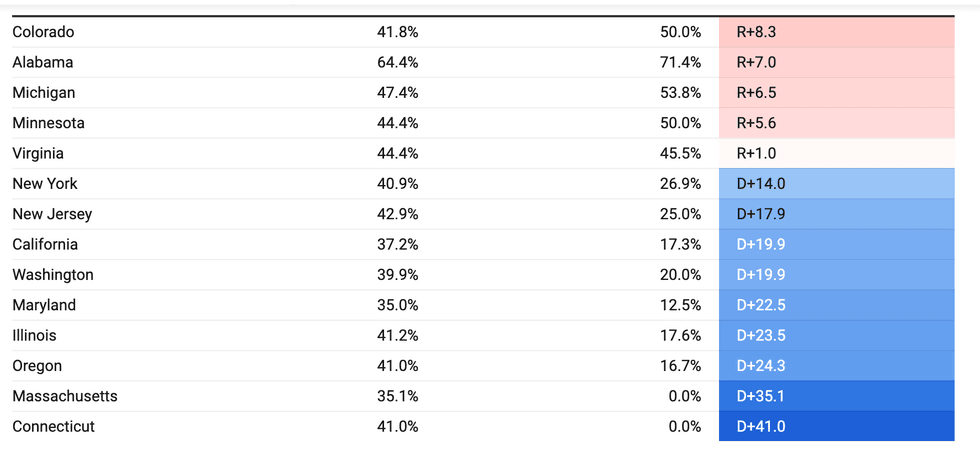
In general, congressional delegations tend to be biased in Republicans’ favor. Among states with at least five House seats, there are five where Republicans regularly receive less than 50 percent of the statewide vote but hold a majority of that state’s House delegation: Arizona, Michigan, North Carolina, Pennsylvania, and Wisconsin.
There is not one state where the same is true for Democrats.
Most House maps are skewed to benefit Republicans
The difference between the Republican Party's share of a state's current House seats and the party's average share of that state's vote in recent statewide elections, among states with at least five seats

 Statewide elections used in the average include the 2016, 2020, and 2024 presidential elections, as well as the state's most recent Senate election and gubernatorial election. Special elections are excluded. For states with ranked choice voting, the most recent election with a Republican and a Democrat in the final round of voting is used.Table: Andrew ManganSource: Dave Leip's Atlas of U.S. Presidential Elections; House of Representatives/Created with Datawrapper
The worst offender may be Wisconsin. Republicans hold 75 percent of the Badger State’s House districts but have won an average of just 48 percent of the vote in the state’s past three presidential elections and its most recent Senate race and gubernatorial race. At least in Virginia, Democrats routinely win a majority of the statewide vote.
Wisconsin’s skewed map is the result of more than a decade of Republican graft, and its effects have been especially egregious in years when Democrats have scored sizable statewide victories. In 2012, then-President Barack Obama won the state by seven percentage points, and Democrat Tammy Baldwin won her Senate race by nearly six points, but the Democratic Party picked up only three of the state’s eight House seats. In the other five districts, every Republican won their race by more than 11 points, showing that Democrats never stood a chance there.
The GOP is proud of their electoral manipulation—and they want to do more of it. In 2022, Republican gubernatorial candidate Tim Michels said at a campaign event, “Republicans will never lose another election in Wisconsin after I’m elected governor.” (Luckily, he lost to Democratic Gov. Tony Evers.)
North Carolina is a stranger case. Republicans hold 10 of 14 House seats, or 71 percent, despite pulling in only 48 percent of the vote in recent statewide elections. The thing is, until very recently, the Tar Heel State had a fair map.
Ahead of the 2022 midterms, the North Carolina Supreme Court ruled that the state’s map violated the law, and forced the adoption of a court-drawn map that resulted in an even split: seven Republicans, seven Democrats. A fair and honest map, no doubt. However, that fall, conservatives won a majority on that court, allowing the Republican-led state legislature to ram through a gerrymander that advantaged them in 10 House seats. And last year, the legislature made the map worse, likely stealing another seat from Democrats this November.
Which brings us back to Old Dominion.
Throughout the past year, GOP-led states took on the highly unusual project of mid-decade redistricting. North Carolina, Ohio, Missouri, and Texas all passed maps that are expected to tear a total of nine seats away from Democrats. But redrawn maps in California and Utah (on a judge’s order) should give Democrats six other seats. Virginia’s proposed map, if it goes into effect, would likely bring that up to 10.
This would render President Donald Trump’s midterm-stealing project a wash.
Mid-decade redistricting has produced incredibly skewed maps
The difference between the Republican Party's project share of a state's House districts and the party's average share of that state's vote in recent statewide elections, among states that completed mid-decade redistricting, plus Virginia
| State | House seats | Projected GOP seats | Projected GOP share of seats | GOP's avg. statewide vote | New map's skew |
|---|
| North Carolina | 14 | 11 | 78.6% | 48.2% | R+30.3 |
|---|
| Missouri | 8 | 7 | 87.5% | 57.2% | R+30.3 |
|---|
| Ohio | 15 | 12 | 80.0% | 54.3% | R+25.7 |
|---|
| Texas | 38 | 30 | 78.9% | 53.6% | R+25.4 |
|---|
| Utah | 4 | 3 | 75.0% | 55.1% | R+19.9 |
|---|
| California | 52 | 4 | 7.7% | 37.2% | D+29.5 |
|---|
| Virginia* | 11 | 1 | 9.1% | 44.4% | D+35.3 |
|---|
* Virginia's map is not in effect. The projections on this table are based on a proposed map, which may go into effect only if voters approve a ballot measure on April 21, 2026.
That is, unless Florida also redistricts. Gov. Ron DeSantis has set a special session to begin on April 28, in which the legislature will consider further tilting the state’s gerrymander against Democrats. The GOP could draw a map to flip up to five Democratic-held seats. The trouble is, such a move would risk watering down red districts too much, which could backfire in a wave election, leading Democrats to win seats they otherwise would not. As such, state Republicans have been hesitant to act.
Whatever transpires, the Sunshine State’s map is already heavily biased. Republicans control 71 percent of its House districts but win only 54 percent of the statewide vote on average.
Of course, Democrats gerrymander too. Massachusetts and Connecticut have a combined 14 House seats, and Republicans hold not one seat in either, though their party regularly wins at least a third of the statewide vote. (The reverse is true in Oklahoma, where the GOP holds all five House seats, despite the fact that it wins just 63 percent of the statewide vote on average.)
The big difference is that only one party—the Democratic Party—is pushing to eliminate partisan gerrymandering altogether.
In March 2019, the House’s freshly minted Democratic majority passed the For the People Act. The bill sought to ban partisan gerrymandering nationwide, in addition to expanding voting rights and curtailing the influence of money in politics. Democrats saw these as their top priorities, bestowing the bill the honor of “H.R. 1,” which means it was the first introduced in the new session of Congress. No Republicans voted for it, and the Republican-controlled Senate refused to even bring it up for a vote.
The bill passed a Democratic-controlled House again, in 2021. Again, it was the party’s H.R. 1, and again, no House Republicans voted for it. Democrats ran the Senate that year but lacked the 60 votes necessary to pass it there.
Joe Manchin, at the time a Democratic senator from West Virginia, persuaded the party to dilute the bill in an effort to get bipartisan backing. The new bill, named the Freedom to Vote Act, would have implemented some voter-ID requirements but would have nevertheless expanded drastically ballot access and ended partisan gerrymandering. When it came up for a vote in the Senate, not one Republican supported it.
Democrats in the House and Senate have continued to introduce the Freedom to Vote Act in subsequent sessions of Congress, but with at least one chamber in the GOP’s hands following the 2022 midterms, it’s gone nowhere.
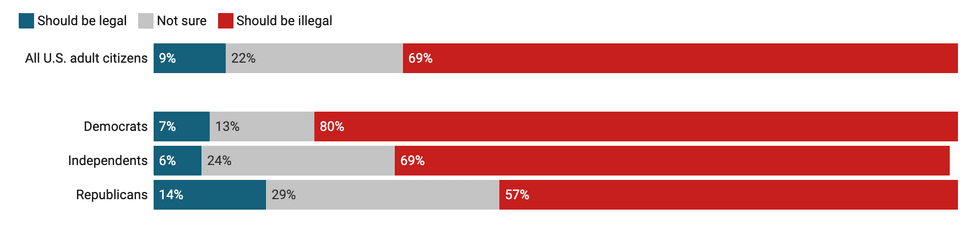
And it’s not as if the public is divided on the issue. Only nine percent of Americans think partisan gerrymandering should be legal, according to a YouGov poll from August. For context, that’s on par with the amount who believe that Bigfoot “definitely” exists.
Partisan gerrymandering is overwhelmingly unpopular
The share of U.S. adult citizens who think partisan gerrymandering should be legal or illegal
 Survey conducted Aug. 1-3, 2025, among 1,116 U.S. adult citizens, with a margin of error of ±4 percentage points. Figures may not total 100% due to rounding.Chart: Andrew ManganSource: YouGov/Created with Datawrapper
Americans hate map-rigging, no matter the reason. The poll also finds that only 1 in 3 Americans says it is fair for states to gerrymander in response to other states doing it—i.e., what Virginia is doing this year.
It makes sense, too. Gerrymandering is deeply unfair at the state level. If Virginia allows Democrats to redraw the state map, Republican voters there will have a weaker voice in Congress than they would in a fair world.
But this is not a fair world. National Democrats are trying to give Americans the fair House elections they want, and Republicans are stopping it. Until gerrymandering is banned across the country, Democrats should make full use of the tools they have at their disposal.
Reprinted with permission from Daily Kos
Americans hate map-rigging, no matter the reason. The poll also finds that only 1 in 3 Americans says it is fair for states to gerrymander in response to other states doing it—i.e., what Virginia is doing this year.
It makes sense, too. Gerrymandering is deeply unfair at the state level. If Virginia allows Democrats to redraw the state map, Republican voters there will have a weaker voice in Congress than they would in a fair world.
But this is not a fair world. National Democrats are trying to give Americans the fair House elections they want, and Republicans are stopping it. Until gerrymandering is banned across the country, Democrats should make full use of the tools they have at their disposal.
Any updates?
- Trump certainly sees China as our enemy, but Americans are warming to the nation. The Pew Research Center finds that 27% of Americans have a favorable view of China, up from a low of 14% in 2023. Funny thing is, that share has risen while the share that thinks Trump can capably deal with China has fallen. Sixty percent of Americans are not confident he can make good decisions regarding China, up from 49% in June 2024.
- As the Trump administration lends a helping hand to our worst polluters, Americans are more negative than ever on the quality of the environment. Just 35% of Americans rate the quality of the environment in the U.S. as good or excellent, per Gallup. Who knew that aiding polluters would make our air and water worse?
Vibe check
As America becomes a hellscape, it makes sense people might turn toward God. What is surprising, though, is how abruptly that has happened with one group that’s typically the least religious: young men.
A new survey from Gallup finds that 42% of men ages 18 to 29 rate religion as “very important” to their lives, up from 28% in the previous round of polling. Those figures reflect two-year-averages, with the new share dating to 2024-2025 and the older share to 2022-2023.
It also marks the highest level of religiosity among young men since 2000-2001 (43%).
Historically, young women have been much more religious than young men. In the 13 rounds of data released by Gallup, young women have led young men 11 times. And their lead has often been quite large. In 2002-2003, young women were 16 points more religious than young men. And on average across all years, they’ve led men by 9 points.
Notably, young women continue their slide in religiosity. The latest round of data shows just 29% consider religion very important to them, a figure that’s tied with 2020-2021 for their all-time low.
The 14-point jump among young men also marks the largest increase between data periods among any age group of men and women. The closest change came among men ages 65 and older, whose religiosity fell 13 points between 2008-2009 and 2010-2011.
Turns out, all those Christ-fluencers on TikTok really are winning converts.
Daily Kos relies on small donations to make ends meet
Ad revenue can't support Daily Kos operations—and it hasn't been able to for more than a decade. Digital ad revenue has declined everywhere, especially for news organizations for whom it was once their lifeblood. Companies are spending less money on ads, and Amazon, Facebook and Google are gobbling up an ever-greater share of what remains. This has left almost nothing for places like Daily Kos. The only reason we've been able to survive is because of the support of readers like you. That's why we're asking: Can you take one minute right now to donate $5 or more to Daily Kos? It would mean so much to us.
One-timeMonthly$5$15$25Other$
ORDonate with

6 Tags
#2026#DonaldTrump#Gerrymandering#Midterms#Texas#VirginiaWas this story worth reading?
Recommending and sharing stories helps us decide which stories are most important to show our readers.
Recommend Story
35Share:
 by TaboolaSponsored Links
FROM THE WEB
Why Bread Never Went Stale in the 1950sOrvixTired of Pre-Mowing? Master Tall and Thick Grass EasilyLymow1.73 Acres. Every Day. Total Lawn Control, Hands-Free.LymowNew #1 Stock Emerges in Tech BloodbathChaikin AnalyticsNeuropathy is Not From Low Vitamin B (Meet The Real Enemy)Try-emsense.comCompact light, huge power—perfect for work, adventures, and everyday tasks.OlightTrending List
 Elections
by
Oliver WillisStaff
219
147
April 15, 2026
 Media and Culture
by
Alix BreedenStaff
191
166
April 15, 2026
 News
Newsby
Alix BreedenStaff
192
67
April 17, 2026
 News
Newsby
Lisa NeedhamStaff
239
196
April 16, 2026
 News
Newsby
Emily SingerStaff
176
152
April 15, 2026
 Announcements
,
Daily Kosby
kosStaff
254
1,003
April 15, 2026
 Elections
by
Emily SingerStaff
274
68
April 17, 2026
 Cartoon
by
Jen Sorensen227
113
April 15, 2026
Power matters.
Sign up for our daily top stories newsletter so you don't miss how it's being used—and what comes next.
Email addressSIGN UP
The share of U.S. adult citizens who think partisan gerrymandering should be legal or illegal
Should be legalNot sureShould be illegalAll U.S. adult citizens9%22%69%Democrats7%13%80%Independents6%24%69%Republicans14%29%57%Survey conducted Aug. 1-3, 2025, among 1,116 U.S. adult citizens, with a margin of error of ±4 percentage points. Figures may not total 100% due to rounding.Chart: Andrew ManganSource: YouGovCreated with Datawrapper





 Chart by Andrew Mangan, created with DatawrapperSource: YouGov

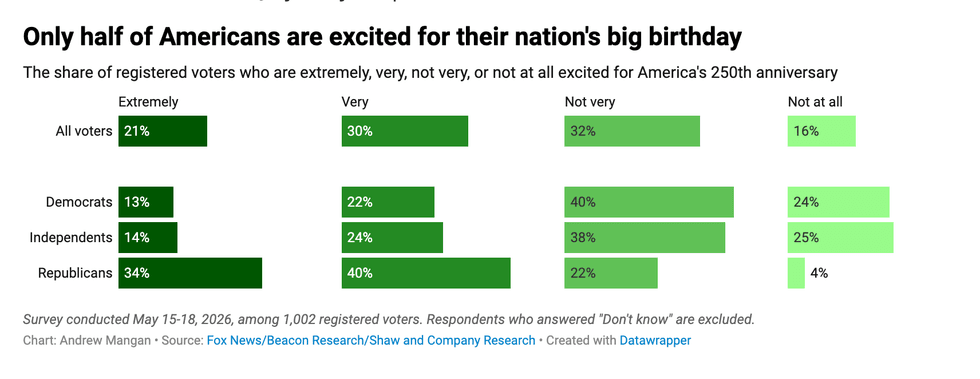 Chart by Andrew Mangan/Source: Fox News/Beacon Research/Shaw and Company ResearchCreated with Datawrapper
 Chart by Andrew Mangan/Source YouGovCreated with Datawrapper
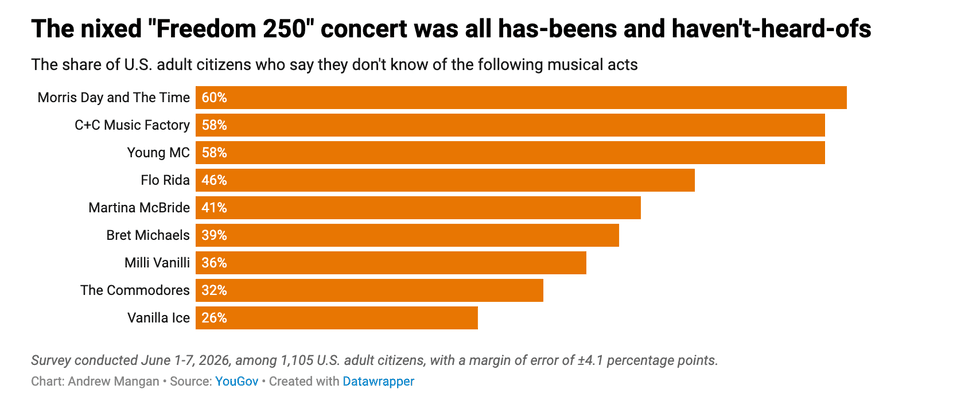 Chart by Andrew Mangan/ Source YouGovCreated with Datawrapper
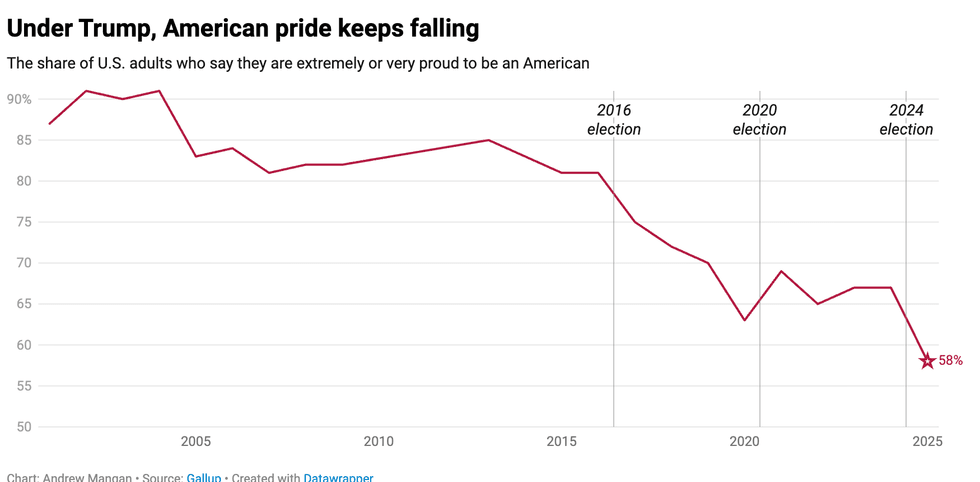 Chart by Andrew Mangan/Source GallupCreated with Datawrapper

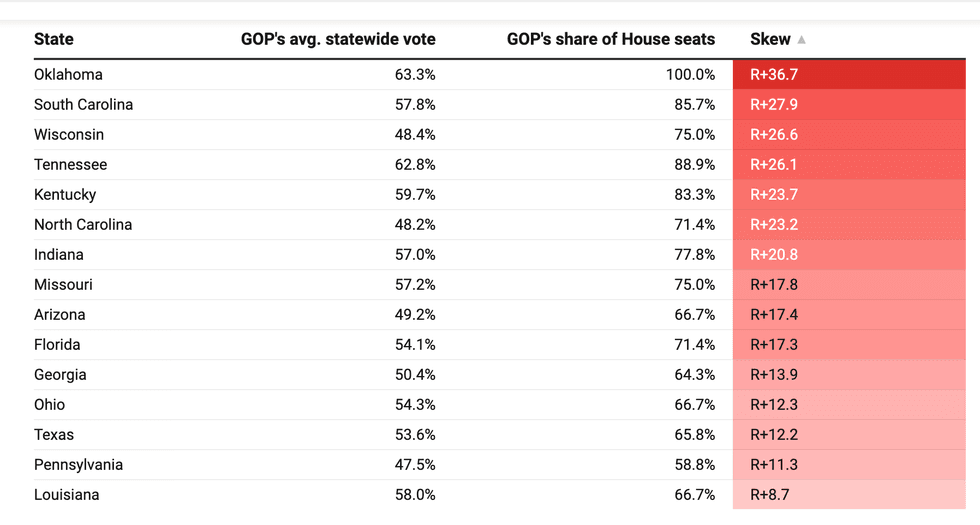
 Statewide elections used in the average include the 2016, 2020, and 2024 presidential elections, as well as the state's most recent Senate election and gubernatorial election. Special elections are excluded. For states with ranked choice voting, the most recent election with a Republican and a Democrat in the final round of voting is used.Table: Andrew ManganSource: Dave Leip's Atlas of U.S. Presidential Elections; House of Representatives/Created with
  Survey conducted Aug. 1-3, 2025, among 1,116 U.S. adult citizens, with a margin of error of ±4 percentage points. Figures may not total 100% due to rounding.Chart: Andrew ManganSource: