@jeremykohler
Exploiting Anti-Trans Fear, Missouri GOP Aims To Repeal Abortion Rights

Exploiting Anti-Trans Fear, Missouri GOP Aims To Repeal Abortion Rights

Two years ago, abortion opponents in Missouri tried to defeat Amendment 3, a ballot initiative to enshrine reproductive rights in the state constitution, by falsely telling voters that it would allow gender transition surgeries for minors — even though it wouldn’t.

Voters approved Amendment 3 anyway, overturning the near-total abortion ban enacted by Missouri’s GOP-dominated legislature that had taken effect after the U.S. Supreme Court struck down Roe v. Wade in 2022.

Now Republican leaders in the state are trying to repeal those rights again, using the same issue. They placed a new amendment on the November ballot, also called Amendment 3, that would restore Missouri’s abortion ban while allowing limited exceptions but also constitutionally prohibit gender transition care for minors — though the state has banned surgeries and new prescriptions of puberty blockers and hormones by law since August 2023.

For the Missouri GOP, Election Day can often seem like Groundhog Day. The party holds a supermajority in the legislature and controls every statewide office, yet voters have repeatedly used the initiative petition process to enact policies Republican leaders oppose. By gathering enough signatures, citizens have placed proposals directly on the ballot, then persuaded voters to expand Medicaid, legalize marijuana, raise the minimum wage and restore abortion rights.

This month, that disconnect became an electoral humiliation for Republican leaders. More than 80% of voters rejected their attempt to make it nearly impossible for citizens to amend the state constitution. It was even worse for Gov. Mike Kehoe’s plan to phase out the state income tax: More than 83 percent voted no.

Missouri Republicans have become “drunk with power,” said Ken Warren, a professor emeritus of political science at Saint Louis University and associate director of the SLU/YouGov Poll. “Because they control everything, they think they can do what they want — and they can’t.”

The new Amendment 3 on the November ballot shows how Republicans, using misleading language, a carefully chosen distraction and even a recycled name, are trying to undo one of those defeats. In 2024, a yes vote on Amendment 3 protected abortion rights. In November, voters will again be asked to vote yes on Amendment 3 — this time to take them away.

Republican leaders say voters never intended to approve a nearly unlimited right to abortion. They argue that Missourians would prefer an abortion ban with limited exceptions for rape, incest, medical emergencies and fetal anomalies — particularly when it is paired with restrictions on gender transition care for minors.

It would not take much to reverse the 2024 result. Abortion rights passed 51.6 percent to 48.4 percent — meaning a shift of about 48,000 voters would have defeated the measure.

Critics call the inclusion of gender care “ballot candy,” a way to make an unpopular proposal easier to swallow. They say the tactic is especially cynical because it promises voters a prohibition that, in large part, Missouri already has. State law already bans gender transition surgery for minors and, through August 2027, bars minors from starting puberty blockers or cross-sex hormones for gender transition. Amendment 3 would place the restrictions in the state constitution without an expiration date.

The two provisions bundled together differ enormously in scope. Repealing reproductive rights would affect the healthcare options available to a state with about 6.3 million people. The restrictions on gender transition care concern a small number of minors receiving highly specialized treatment.

Yet supporters want voters focused on the specter of children being used as lab guinea pigs, not the abortion rights the amendment would repeal. A new billboard in the St. Louis suburbs urges them to vote yes and “ban transgender surgeries for minors.”

A website for the political action committee behind the campaign, Her Health, Her Future — whose treasurer is Missouri first lady Claudia Kehoe — declares “OUR CHILDREN are not LAB EXPERIMENTS.” It says Amendment 3 would protect children from “harmful, sterilizing medical procedures” and restore “common sense health and safety standards” for women’s health clinics.

Neither message explicitly says that the amendment would repeal the constitutional right to abortion that Missourians approved two years ago.

Claudia Kehoe did not respond to requests for comment submitted to the governor’s office and the PAC. In a written endorsement posted on the Her Health, Her Future website, she called the amendment “a critical step toward strengthening our pro-life protections and safeguarding our state’s future.”

In response to a list of questions that ProPublica submitted to the governor’s office, a spokesperson defended the amendment using much the same language that critics call deceptive. The spokesperson emphasized protecting children from “sex-change procedures,” safeguarding women and restoring the state’s power to “regulate” abortion providers. The response did not acknowledge that Amendment 3 would repeal the constitutional reproductive rights Missourians approved in 2024 and replace them with an abortion ban that contains limited exceptions.

Polling suggests the strategy could work. A survey in February of Missouri voters by the SLU/YouGov Poll found that nearly 60 percent supported legal abortion during the first eight weeks of pregnancy. But 67 percent opposed gender transition medications for minors, and 73 percent opposed gender transition surgeries. Presented with the amendment’s provisions together, voters favored it 47 to 40 percent.

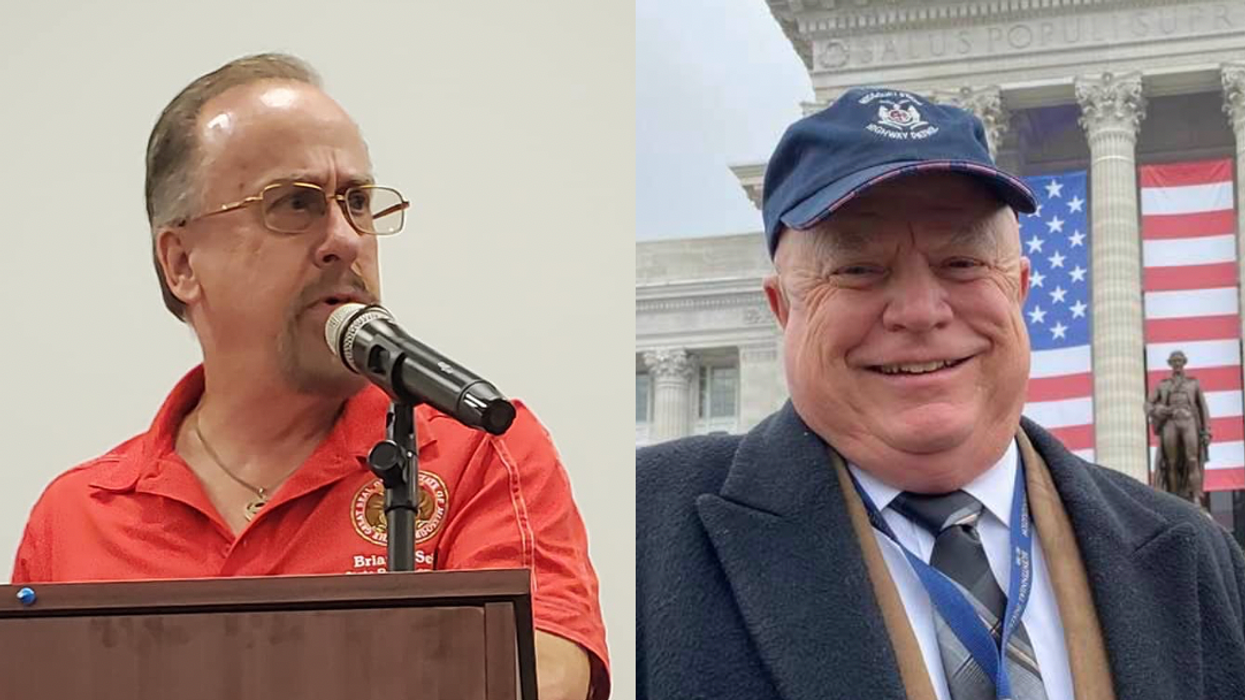
Rep. Brian Seitz, a Branson Republican who guided the amendment through the House, denied that supporters were trying to trick voters. He said the gender-affirming treatment was itself a reproductive issue because some procedures could affect a minor’s ability to have children.

Seitz also disputed that Missourians knowingly approved abortion rights through fetal viability in 2024. He said voters were primarily seeking exceptions for rape, incest, medical emergencies and fetal anomalies — not what he called “abortion on demand.”

The new amendment, he said, better reflects what voters intended.

Abortion rights supporters call that argument a pretext for restoring the state’s abortion ban. A coalition of groups called Stop the Ban has raised more than $5 million to try to explain what the amendment would do and persuade voters to reject it. That total includes $1.25 million contributed on August 3 by former New York City Mayor Michael Bloomberg.

Bloomberg’s office did not respond to a request for comment.

Republicans are always “moving a goalpost to sort of get their way, and it is my hope that actual patriots are growing tired of it,” said Rep. Raychel Proudie, a Democrat from Ferguson. “You shouldn’t have to do this if what you’re planning is righteous and in the best interest of people.”

The effort began with the ballot summary written by lawmakers. It did not tell voters that Amendment 3 would repeal the reproductive rights they had approved two years earlier. Instead, it said the measure would “guarantee access” to emergency care, “ensure women’s safety during abortions” and “protect children from gender transition.”

The summary also mentioned exceptions for rape and incest but omitted that they would apply only during the first 12 weeks of pregnancy.

Michael Wolff, a former chief justice of the Missouri Supreme Court who is advising the campaign against the amendment, said the language appeared to be “intended to deceive people into thinking that they were going to protect women having abortions.”

“If you just flat-out tell them that you’re going to repeal nearly all of the protection for reproductive health,” he said, “the people would vote no.”

A judge ruled the legislature’s summary unfair and ordered it rewritten. He later approved revised language written by Republican Secretary of State Denny Hoskins, a former state legislator who introduced a measure that became part of the 2023 law restricting gender transition care and has publicly endorsed Amendment 3.

But a state appeals court found Hoskins’ language still failed to explain the amendment’s effects and rewrote it to lead with the fact that it would “repeal the 2024 voter-approved amendment providing reproductive healthcare rights, including abortion through fetal viability.”

In an interview, Hoskins defended his initial choice to use the word “amend,” rather than “repeal,” because he felt it was more accurate. Asked how his endorsement of the new Amendment 3 squared with his duty to write neutral ballot language, he said his anti-abortion stance was no secret among Missouri voters.

“I can’t all of a sudden erase my conservative views of the past 16 years in the Missouri Legislature,” he said.

The intervention was hardly an isolated one. During Hoskins’ first 1.5 years in office, courts have rejected or rewritten five ballot summaries from his office involving abortion, education, the initiative petition process and a referendum on the state’s newly gerrymandered congressional map.

Hoskins said in an interview that the rulings reflected differences of opinion over what constitutes fair and accurate language, noting that the appellate courts had also sometimes rejected revisions made or approved by lower courts.

But the disputes have gone beyond language. Hoskins has also unilaterally blocked two citizen-led measures from reaching the November ballot. He rejected a proposed constitutional amendment that would make it harder for lawmakers to alter measures approved by voters, saying it was unconstitutional. And he refused to certify a referendum on Missouri’s new congressional map, drawn at President Donald Trump’s urging to help Republicans gain another U.S. House seat, declaring that putting a congressional map to a public vote would be unconstitutional.

Both campaigns sued in state circuit court, where a judge on Wednesday ruled for Hoskins in both cases. In the initiative case, the judge held that Hoskins had the authority to block an amendment from the ballot because it violated Missouri’s requirements that an initiative address a single subject and amend a single constitutional article. He also found that its restrictions on lawmakers’ ability to reconsider voter-approved policies was unconstitutional. And in the redistricting case, the judge agreed with Hoskins that voters cannot use the state’s referendum power to overturn the legislature’s power to redraw congressional maps.

Both cases are expected to reach the state Supreme Court on expedited appeals.

Hoskins said he disagreed with any suggestion that he and Republican leaders were defying the will of voters, noting they, too, had been elected. He criticized the opponents of Amendment 3 as “liberal special interest groups” financed by “out-of-state sugar daddies” like Bloomberg.

State Sen. Maggie Nurrenbern, a Kansas City Democrat, said Hoskins’ actions reflected a broader pattern of interfering with voters’ ability to use the ballot box to reject the Republican agenda.

“That’s quite frankly what is maddening to me, is that politicians over and over again are trying to trick voters,” she said.

Reprinted with permission from Pro Publica
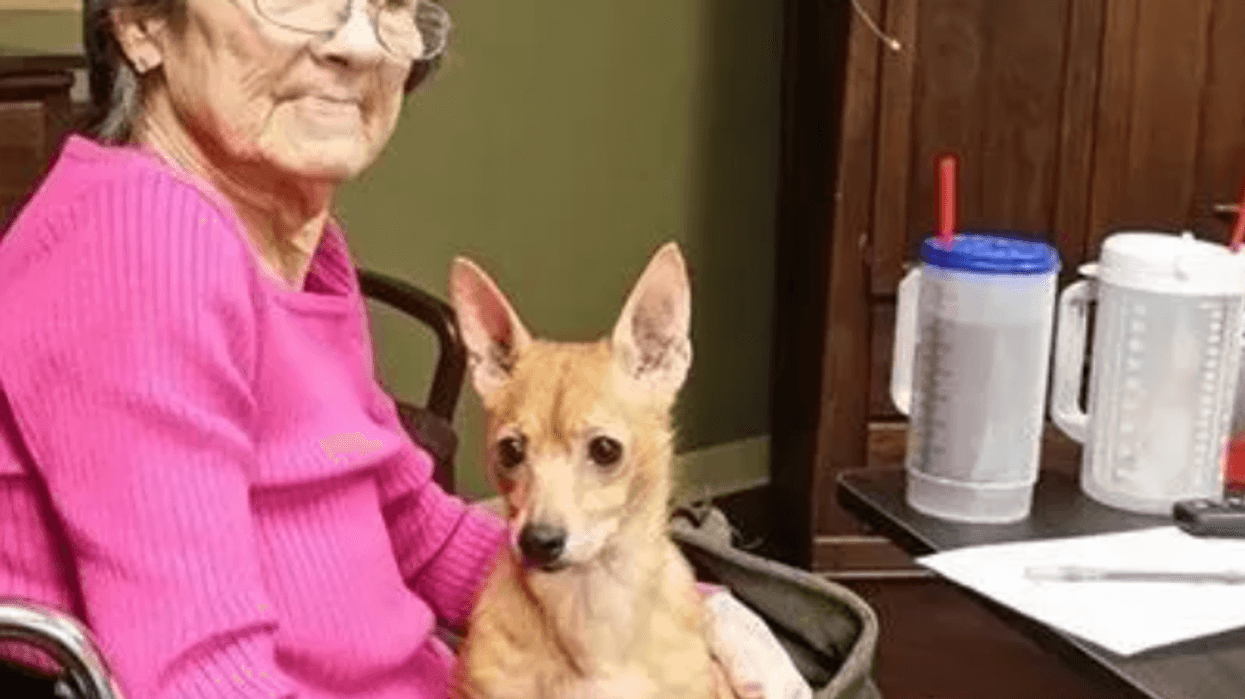
Doris Coulson, nursing home patient

Trump Pardoned Nursing Home Owner Who Owed Over $18 Million To Grieving Family

This story was originally published by ProPublica

When Amanda Coulson was a child, she visited her mother at work at a hospital in Little Rock, Arkansas. Doris Coulson was a nurse, and one memory never left her daughter. A code blue was called, and suddenly her mother was racing alongside a patient’s bed.

“She jumped into the middle of the bed and was doing CPR in the bed as it flew down the hallway,” Amanda Coulson said years later in court. “I realized she didn’t play at work all day.”

That was the kind of caregiver her mother was: someone who understood what quality care meant because she had spent her life giving it to others.

After Doris Coulson retired, she became a patient at a nursing home owned by Joseph Schwartz, a New Jersey businessman who was buying up nursing homes across the country. The staff wasn’t supposed to serve her solid food, but they did, and she died. Doctors told the family they found scrambled eggs in her lungs.

Nine years after Coulson’s death, President Donald Trump pardoned Schwartz in a federal case in which he had admitted to withholding $39 million in employee payroll taxes from his nursing home empire and diverting the money for other purposes. Schwartz’s lawyers argued that his actions were not an attempt at personal enrichment but to save his company. The White House said Schwartz was “an example of over prosecution” and argued that a third-party entity had managed the tax filings and that serving all three years of his prison sentence would have been detrimental for someone of his age and poor health.

Behind the tax charge was a business that families and lawsuits said had left real people neglected, injured and dead.

The Coulson family sued Schwartz and his company for wrongful death. Schwartz did not appear in court to challenge the case. Six years ago, a judge awarded Amanda Coulson and her sister and brother nearly $19 million. (He later claimed he never received key filings and had mistaken the complaint for the same lawsuit first filed in 2017. He argued the company that took over the home was the proper defendant.) Schwartz never paid. Amanda has since died.

Stories about pardons are often told as stories about presidential power — who got mercy, who had access, who persuaded a president to intervene. What drew me to Schwartz’s pardon was the people on the other side of that act of grace: people like Doris Coulson and her family, whose lives had already been shattered long before the White House celebrated Schwartz’s first Shabbat with his family after Trump freed him from prison and a top Justice Department official declared him “free to rebuild.”

The pardon for Schwartz came while I was reporting on Trump’s broader clemency spree, which has favored allies, donors and other well-connected defendants, including people convicted in serious financial fraud cases.

This pardon felt different to me.

To understand the human toll, I turned to court records. In states where Schwartz owned nursing homes, I found harrowing accounts of patients suffering and insiders desperately trying to protect them as problems piled up.

The damage reached workers, too: As facilities fell apart, some employees said they were buying food for residents out of their own pockets. Others were left with medical bills after insurance premiums were taken from their paychecks but the coverage was never funded.

And yet, Schwartz still appears to have money, perhaps even great sums. Lobbying disclosure forms showed he had paid more than $1 million to lobbyists to help secure his pardon. And even after his business collapsed, prosecutors said he still had $58 million in assets, though none was in his own name.

The White House has said the president does not issue pardons at the request of lobbyists.

After the pardon, Schwartz still had to return to Arkansas in late December to serve nine months in prison for defrauding the state’s Medicaid program.

I saw his return as a chance to speak with him. The prison system said I could reach him only by mail. In the first week of January, I sent a letter requesting an interview by phone, email or in person, noting that I could easily drive from my home in Missouri to meet him.

A lawyer for the Coulson family saw that same narrow window as a chance to do something more consequential: serve Schwartz with a subpoena for a deposition and records that might help locate his assets and force payment of judgments he had ignored.

The window for both of us closed almost immediately. One of Schwartz’s lobbyists had also been hired to seek relief for him in Arkansas. Within three weeks, the parole board released him.

My letter came back as undeliverable. The lawyer had no better luck tracking him down.

That episode helped me understand the story more clearly. At first it felt like a reporting failure. The more I sat with it, the more I realized that the missed window was actually a mirror of the broader story. Even after criminal convictions, civil judgments and years of litigation, Schwartz remained elusive to the people seeking answers or accountability.

There was a machinery working to shorten his punishment. But nothing to help the victims.

Missouri state Reps. Brian Seitz, left, and Bill Kidd.

In Hotspot Missouri, Infected GOP Legislators Still Oppose Vaccination

Reprinted with permission from ProPublica

Amid the current surge in COVID-19 cases in Missouri, a recent Facebook conversation between two Republican state lawmakers is telling.

Around Independence Day, State Rep. Bill Kidd, from the Kansas City suburbs, revealed that he has been infected by the coronavirus.

"And no, we didn't get the vaccine," he wrote in a post that has since been deleted. "We're Republicans 😆"

State Rep. Brian Seitz, a Republican from Taney County, home to the tourist destination of Branson, commented on the post by falsely claiming that the virus had been developed by top government scientist Anthony Fauci and billionaire Microsoft founder Bill Gates. They "knew what was coming," Seitz wrote.

"The jury is still out on the 'vaccine' (who knows what's in that)," he wrote.

As the number of coronavirus infections rises around the country, lawmakers like Kidd and Seitz have adopted responses that trouble many health officials. In Tennessee, Republicans legislators threatened to shut down the state health department, saying it was targeting minors for mass vaccinations without the consent of parents. In Ohio, lawmakers allowed a doctor to testify at a legislative hearing last month that coronavirus vaccines could leave people magnetized (they can't). During a hearing in the Montana Senate, a senator said he had read articles about "putting a chip in the vaccine." (There are no chips in vaccines.)

Just as with his insistence that he won the election, former president Donald Trump's attitudes about COVID-19 hold great sway with his supporters. Trump routinely bashed Fauci and infectious disease experts throughout the pandemic and questioned the severity of the coronavirus.

He also strongly carried Missouri's southwest corner in the November election. While Trump beat Joe Biden by 15.4 percentage points statewide, in rural Taney County, the margin was 57.8 points.

Those supporters now tend to oppose efforts to get everyone vaccinated, believing they are being led by Democrats, said Ken Warren, a professor of political science at Saint Louis University who tracks state and local politics. "It's a sad reality," he said. "We can't get together on anything, even fighting COVID."

Such attitudes are accelerating an anti-vaccine sentiment that has run strong in the state legislature for years, particularly with lawmakers from the area of Missouri now facing increased infection rates. In 2018, Republican state Rep. Lynn Morris, a pharmacist from southwest Missouri, pushed a proposal to prohibit discrimination against unvaccinated children. Public school children are required to be vaccinated against several diseases, but families can claim a medical or religious exemption. The legislature took up a similar proposal in 2019. Each failed.

Late last year, state Rep. Suzie Pollock, a Republican from south-central Missouri, proposed a bill to prohibit discrimination against people who choose not to be vaccinated against the coronavirus. She claimed the vaccine against the virus had "been rushed" and that its efficacy was "in question," myths that have been relentlessly amplified by right-wing media.

The bill did not advance, but GOP Gov. Mike Parson signed into law a related bill blocking local governments from requiring proof of coronavirus vaccination for people seeking to access transportation systems or other public services.

It's not enough for some. "Now people are pushing back even against the idea of private employers like hospitals and health care providers telling their employees you have to be vaccinated," said state Rep. Shamed Dogan, a Republican from the St. Louis suburbs. "I think that some of the legitimate concerns of government overreach have turned into this broader resistance to any vaccination, which is something I don't agree with."

Late in this year's legislative session, Pollack pushed a proposal that would allow more parents to opt out of vaccinating their children against diseases including polio, measles, and mumps. Pollock insisted she was not against vaccines, but said that people should have the freedom to choose. The House Elementary and Secondary Education Committee voted 10-6 in favor of the bill.

The full House defeated it on April 28 in a 79-67 vote.

"There is a tremendous skepticism about the good that government can do," said Dan Ponder, a political science professor at Drury University in Springfield and director of the Meador Center for Politics & Citizenship there.

Ponder said many residents of southwest Missouri question the motives behind the policies that governments are pushing and show "a tremendous skepticism about information." He added, "People don't believe the vaccines are working. People don't believe the federal government isn't going to come down here and … basically strong-arm them into taking a vaccine."

Indeed, when the Centers for Disease Control and Prevention deployed a two-person "surge response" team to southwest Missouri this month to combat an outbreak attributed to the dangerous delta variant, both Parson and U.S. Rep. Jason Smith, from south-central Missouri, tweeted opposition to federal agents going door to door to compel vaccines, something President Joe Biden's administration said it never had any intent to do.

On Sunday, Springfield Mayor Ken McClure told CBS' Face the Nation that his community was "being hurt" by rampant vaccine misinformation. He said people were sharing "health-related fears, what it might do to them later on in their lives, what might be contained in the vaccinations. And that information is just incorrect."

Taney County is near the heart of the surge of the delta variant, which health officials say spreads more easily than earlier versions of the virus. The county is leading the state with the highest rate of coronavirus cases over the past seven days, according to Missouri health department data. Surrounding counties have similarly high rates, raising alarms for federal health officials.

Despite the spike, just 28 percent of Taney County's residents are fully vaccinated, below the state average of 40 percent.

Seitz, who once owned a newspaper that promoted Branson's entertainment industry, boasted in an interview that the Ozark tourist town was doing gangbuster business after a year of being mostly shut down.

"There were 27,000 people at our July 3 celebration," he said, noting that he attended with U.S. Rep. Billy Long and "he said something like, 'I'm so glad to see there are very few chin diapers in the crowd.' The roar was huge … we're so happy not to be forced by government to either wear a mask or take a vaccine."

Seitz said he had no business telling his constituents how to live. The media has shifted its focus from deaths to the raw numbers of cases, he said, glossing over that most people who catch the virus don't die. While 600,000 American deaths have been attributed to COVID-19, Seitz questioned whether people were dying from the disease or from existing health problems: "If a person is grossly overweight and caught a very virulent virus, did they die because they were in very ill health or did they die because of the virus?"

Seitz falsely claimed that COVID vaccines have not been tested and are unsafe. He backed down on his comment about Fauci on Kidd's Facebook post, acknowledging that the virology expert did not create the coronavirus but asserting that he had been engaged for years in experiments to make viruses more dangerous or transmissible. Fauci has insisted the U.S. government did not participate in experiments that could have caused the pandemic.

Seitz said he had nothing against people who take the vaccine or wear masks. It's their choice, he said. He said it wasn't his job to keep people safe, but to keep people free.

"I haven't had the flu even since 1994," he said. "Why would I take a vaccine? ... My life was normal for the past year, very few instances of wearing a mask, and so forth, and I'm just fine."

Betsy Fogle, who recently completed her first session as a Democratic state representative from Springfield, said it was "fascinating kind of watching the narrative and the rhetoric" in the state capital of Jefferson City surrounding COVID-19, "and then watching it all get politicized and polarized. And then seeing that real-life impact that has on our neighbors back in Springfield when our hospitals are full and our hospital CEOs are begging people to get vaccinated and people just aren't doing it."

She said there was a mentality among Republican leaders "that COVID is a hoax, or that vaccines are a hoax, and that trickles down."

She said she has several constituents who didn't get vaccinated "because they think that this is a joke, and then these people reach out a month later to say, 'I'm sorry I didn't listen.'"

Kidd, the Republican from the Kansas City area, posted almost two weeks after his initial Facebook post that he was seeking prayers because he was "having a difficult time with COVID" and "really sick." Kidd posted again on Thursday that he was "doing better" after the virus "kicked my butt." He did not respond to a message from a reporter.

Fogle said she hoped Kidd recovered, "but that's the frustrating part about it, is that our hospitals, our doctors, our people who are in charge of making these decisions are telling us how severe it is, and we refuse to accept that severity."

She said she makes daily calls to everyone she knows who isn't vaccinated "and what I hear is, 'No, it's my right, it's my body, it's my choice, like, stop bringing this up.' And it's hard to win those arguments."

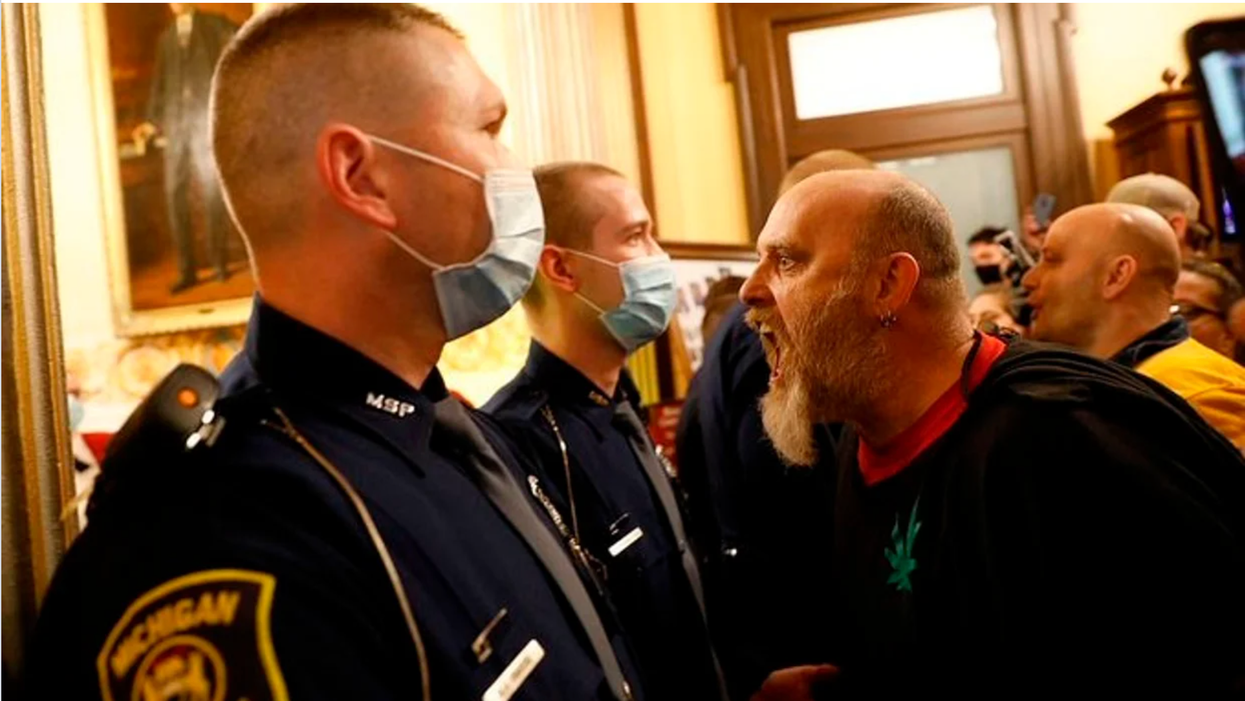
Michigan militia harassing police at  state Capitol.

No Consequences For Invading State Capitols -- So Rioters Turned To US Capitol

Reprinted with permission from ProPublica

The gallery in the Idaho House was restricted to limited seating on the first day of a special session in late August. Lawmakers wanted space to socially distance as they considered issues related to the pandemic and the November election.

But maskless protesters shoved their way past Idaho State Police troopers and security guards, broke through a glass door and demanded entry. They were confronted by House Speaker Scott Bedke, a Republican. He decided to let them in and fill the gallery.

"You guys are going to police yourselves up there, and you're going to act like good citizens," he told the invaders, according to a YouTube video of the incident.

"I just thought that, on balance, it would be better to let them go in and defuse it ... rather than risk anyone getting hurt or risk tearing up anything else," Bedke said of the protesters in an interview last week. He said he talked to cooler heads in the crowd "who saw that it was a situation that had gotten out of control, and I think on some level they were very apologetic."

That late-summer showdown inside the Statehouse in Boise on Aug. 24 showed supporters of President Donald Trump how they could storm into a seat of government to intimidate lawmakers with few if any repercussions. The state police would say later that they could not have arrested people without escalating the potential for violence and that they were investigating whether crimes were committed. No charges have been filed. The next day, anti-government activist Ammon Bundy and two others were arrested when they refused to leave an auditorium in the Statehouse and another man was arrested when he refused to leave a press area.

In a year in which state governments around the country have become flashpoints for conservative anger about the coronavirus lockdown and Trump's electoral defeat, it was right-wing activists — some of them armed, nearly all of them white — who forced their way into state capitols in Idaho, Michigan, and Oregon. Each instance was an opportunity for local and national law enforcement officials to school themselves in ways to prevent angry mobs from threatening the nation's lawmakers.

But it was Trump supporters who did the learning. That it was possible — even easy — to breach the seats of government to intimidate lawmakers. That police would not meet them with the same level of force they deployed against Black Lives Matter protesters. That they could find sympathizers on the inside who might help them.

And they learned that criminal charges, as well as efforts to make the buildings more secure, were unlikely to follow their incursions. In the three cases, police made only a handful of arrests.

The failure to stop state capitol invasions is especially chilling after the attack on the U.S. Capitol last week, which left five dead, including a police officer, as lawmakers met to certify the election of President-elect Joe Biden.

Experts and elected officials said the lack of action by lawmakers and police created an environment that encouraged political violence. The FBI has warned of armed protests occurring in all 50 state capitols in the run-up to the inauguration on Wednesday. Authorities in both Washington and state capitols have dramatically strengthened security.

"Eventually, you get to the point of entitlement where you can get away with anything and there will never be any accountability," the Idaho House minority leader, Ilana Rubel, a Democrat, said. "I don't know that (Bedke) was wrong under the circumstances, but it adds up to creating a sense of entitlement."

Bedke said he saw no correlation between the events in Boise and Washington. But domestic terror experts said in interviews that the statehouse invasions likely created a sense of impunity among right-wing activists. The feeling grew throughout the year as Trump praised gun-carrying activists at state capitols as "very good people" and emboldened the insurrectionists in Washington.

Amy Cooter, a Vanderbilt University sociologist and expert in the militia movement, said the U.S. Capitol attack may have been less likely to occur if the violence in state capitols had been met with harsher punishment.

What's more, she said that authorities who failed to take action against protesters earlier may find it difficult to do so now.

While many Trump supporters already see their First Amendment rights as being under attack, they may see efforts to block them from state capitols as an attack on their Second Amendment rights, she said, further legitimizing their need to stand up to what they perceive as tyranny.

When officials acquiesce to demands, "it typically makes these folks feel like those are 'constitutional' officials who support their general aims, which can then embolden them against officials they believe to be the opposite, that is, officials they believe to be betraying their oaths to the people," Cooter said.

If extremist groups "believe they have been given allowances in the past and are not moving forward, this can further reinforce that notion of officials who are derelict in their duty, officials who should be removed and, depending on what group we're talking about, possibly officials who should be confronted with force."

Days after Trump tweeted "LIBERATE MICHIGAN," protesters taking part in an "American Patriot Rally" outside the Michigan Capitol in Lansing on April 30 swarmed into the building demanding an end to the stay-at-home order put in place by Gov. Gretchen Whitmer to combat the COVID-19 pandemic.

The group, which numbered in the hundreds, included several heavily armed men. Few wore face coverings or observed social distancing. A line of state police troopers and other Capitol employees held the mob back from entering the House floor.

"We had hundreds of individuals storm our Capitol building," state Rep. Sarah Anthony said in an interview. "No, lives were not lost, blood was not shed, property was not damaged, but I think they saw how easy it was to get into our building and they could get away with that type of behavior and there would be little to no consequences."

Some armed invaders entered the Senate gallery. While none of the protesters faced charges, two of the men seen in a photo posted by state Sen. Dayna Polehanki looking down on lawmakers would be among the 14 people charged months later in a plot to kidnap Whitmer and bomb the state Capitol.

"It made national and international news, what happened in our Capitol," Polehanki said in an interview. "People saw that, and it's no coincidence that the storming of the U.S. Capitol on Jan. 6 had the same feel."

Polehanki, a Democrat from Livonia, asked the state's Republican-majority Senate to support a resolution banning firearms in the Capitol. But it wasn't until Jan. 11, five days after the U.S. Capitol insurrection, that the Michigan Capitol Commission voted to ban the open carry of guns inside the building. Open carry is still allowed outside the building, and people who have concealed pistol licenses can still carry concealed weapons inside.

Michigan Attorney General Dana Nessel tweeted that visitors should stay away from the state Capitol because it is "not safe." Some legislators have begun wearing bulletproof vests.

The memories of the April 30 invasion still haunt Anthony, a Democrat from Lansing. "The level of anxiety and fear that was intended to be imposed upon those of us in the building will probably stay with me for the rest of my life."

As the legislators convened to vote, Anthony said she sat next to state Rep. Brenda Carter, Democrat from Pontiac and another Black woman who was afraid of being targeted by the invaders. "We look like Democrats, so I think when you have individuals who are not only carrying large firearms but also carrying Confederate flags and nooses and swastikas, those have specific messages targeted to Black and brown communities."

Days later, she arrived at the Capitol building with an escort from five armed constituents.


More angles detailing Rep. Mike Nearman letting demonstrators breach the Oregon Capitolwww.youtube.com


An angry mob didn't need to break down a door to enter the Oregon Statehouse in Salem to disrupt a one-day special session on Dec. 21. A surveillance video released two days after the U.S. Capitol insurrection revealed that Republican state Rep. Mike Nearman, of Independence, opened a locked side door to let in some violent protesters.

The building, normally open to the public, had been closed since mid-March because of health concerns. But several dozen demonstrators gathered outside in a "flash mob" organized by the far-right group Patriot Prayer, which has been tied to protests in Portland. Dozens of rioters streamed into the building and attacked police officers.

One of the Patriot Prayer supporters who carried an AR-15 rifle into the Statehouse was charged with pepper-spraying six police officers. Five other protesters were also taken into custody.

Nearman would later issue a statement defending his action by noting the state Constitution mandates open public legislative proceedings. He was removed from legislative committees and billed for damages caused by the rioters. House Speaker Tina Kotek, Democrat of Portland, called on him to resign. Nearman and Kotek did not respond to requests for comment.

Nearman's conduct had parallels to concerns among some in Congress that perpetrators of the U.S. Capitol attack had help from police or even lawmakers. Rep. Mikie Sherrill (D-NJ) said she witnessed lawmakers giving "reconnaissance" tours the day before the Capitol attack.

"They couldn't have done what they are doing without some notion of impunity around it," said Lawrence Rosenthal, chair and lead researcher of the Center for Right-Wing Studies at the University of California-Berkeley. He said militants cling to a fantasy that if a civil war were to break out, what some extremists call a boogaloo, police and the military would join their side. Those notions may have been corroborated at the state capitols, Rosenthal said. "The type of wink-wink quality that these guys experienced."

At least three men involved in the effort to invade the Oregon Statehouse appeared to have joined the insurrection at the U.S Capitol, according to Oregon Public Broadcasting.

One of them, Tim Davis, 59, of Springfield, Oregon, told ProPublica he "couldn't comment" about whether the riot in Salem inspired him to travel to the nation's capital. He insisted he did not join those who entered the U.S. Capitol building or break any laws.

"The president asked people to come, and I felt it was my constitutional duty to go," he said.

Alex Mierjeski contributed research.