{{ site.specific_data.Twitter }}
The Accountant's Suitcases: What Really Happened To Contents Of Epstein Safe?

The Accountant's Suitcases: What Really Happened To Contents Of Epstein Safe?

Let’s say you’re a middle-aged accountant who has spent your career working for one very rich, globally connected man. It’s high summer and you’re in the Hamptons when you get word that Number One Client – your only client – has been arrested by the feds. You may or may not have an idea why. You know a lot about Number One Client. You know where his money is, how his hundreds of millions are structured. He pays you handsomely for it. You also pay his bills, including wires totaling hundreds of thousands of dollars over the years to girls. You might even know, as the President of the United States has said, that Number One Client likes girls “on the young side.”

He’s been in trouble before, and authorities never bothered with you. But now, not only is he in jail, federal agents have broken down the baronial door of his Upper East Side mansion and are pawing through everything – the sex toys, the massage tables, the taxidermied dogs… and the safe.

Cutting through it with a diamond-tipped saw took the good part of a night. Inside: 48 loose diamonds, envelopes of cash totaling $70,000, multiple hard drives, binders of CDs, and various passports (Israeli, Austrian, and American – all with Epstein’s photo, but not his name).

Suspicious!

But their warrant – narrowly focused on sex crimes from 2002-2005 – doesn’t allow the feds to seize that stuff on the spot. They could cart off CDs found elsewhere labeled in ways related to their quest, like, for example, “Misc. Girls Nude/Dinner—Scientists.” But they need another warrant for the passports, cash, and unlabeled CDs.

They leave.

You have a choice: Stay at the beach? Go back to the city?

No rush!

With the boss in jail as of July 2019, Jeffrey Epstein’s longtime accountant Richard Kahn really was in no hurry to get back to the city. He says he left it to the house manager to decide how to handle the feds and their quest.

Incredibly, in the two official federal investigations into Epstein, no one seems to have bothered to interrogate Kahn about anything – let alone this episode – until the House Oversight Committee called him in last month.

Kahn told them that “I received a call from Merwin [Dela Cruz, the house manager] … telling me that ‘I packed up two bags of Epstein’s belongings or things that were safe, and I left them with your doorman in New York City. I just wanted to let you know.’ I said to him, ‘I’m not home. I’ll be home in three or four days. And, you know, at that time, I’ll bring it up to my apartment.’” Kahn says he moseyed back to Manhattan, found the suitcases with his doorman, and brought them up. “I never touched them. I never opened them. I left them in my dining room.”

Well, the house manager told a very different story. When the FBI returned to the mansion with a warrant for the safe’s contents, they found it empty. According to the FBI’s handwritten notes, Dela Cruz said that Kahn, who he described as “the money guy,” had instructed him to pack the contents of the safe into two suitcases and deliver them directly to his – Kahn’s – apartment dining room on Sunday, his day off.

The FBI called Kahn to get the suitcases out of his apartment and into their hands. Kahn added his lawyer to the call. He claims he was back in his office that day and had returned the “never touched” suitcases to the mansion within 20 or 30 minutes of hearing that the FBI wanted them.

The New York FBI did eventually get their hands on some of the materials from the safe. But even then, the logging of them was weirdly delayed, by at least a month in some cases, according to the records. Released DOJ records indicate that the FBI’s logged contents included unlabeled hard drives and approximately eight binders containing CDs of photos, in addition to the cash, diamonds, and passports.

But a property receipt from the initial FBI search indicates that the only items seized from the safe at the time were two black binders of CDs and 13 loose CDs. Special Agent Kelly Maguire, the leader of the team that searched the house, testified at Ghislaine Maxwell’s trial that agents did not have the legal authority to seize other CDs at that time.

So where did they go? What else of interest might have been on disks stored in a safe alongside loose diamonds and fake passports?

Former U.S. Attorney for the Southern District of New York, Geoffrey Berman, wrote in his book Holding the Line that the FBI also discovered an Israeli passport inside the safe. We have not found any trace of that passport in the files released by the DOJ.

Michael Wolff has claimed that Epstein kept “a dozen or so” compromising photos of Trump in his safe, and would occasionally take them out to show Wolff and other friends. There is no record of those photos in the DOJ files released so far.

Special Agent Maguire did speak with Richard Kahn on the phone before the suitcases were returned. According to the call’s FD-302 interview form, Kahn was careful to add his attorney, who advised that Kahn had not opened or tampered with the contents of the suitcases and would return them to Epstein’s house in 20-30 minutes, which he reportedly did.

The FBI took the suitcases, gave Kahn a property receipt, and moved them to a secure location at the FBI New York Operations Center.

After Kahn handed over the suitcases, the record reveals more errors, inconsistencies, delays, and general weirdness in the FBI’s handling of the evidence from the safe and their reporting of these events. A “book of CDs” appeared in one inventory of the suitcases on July 11, only to be flagged as an erroneous entry in an “amended inventory” 20 days later.

FBI photographs of the suitcases taken on July 11, 2019 include two black images that are not redactions. Documentation pertaining to Kahn appears to have been entered with significant delays compared to other similar reports. A 302 report and inventory of the suitcases from Kahn were drafted on July 17, 2019, but not entered until over a month later on August 20 – ten days after Epstein’s death.

Kahn’s sworn testimony regarding the safe’s contents and the suitcases directly contradicts an FBI Task Force Officer’s sworn affidavit filed by SDNY in applications for subsequent search warrants (which only include the house manager’s version of events).

A cover-up?

Much like COURIER national correspondent Camaron Stevenson’s reporting on Kahn’s partner in Epstein-world, lawyer Darren Indyke, we find Kahn’s testimony to the Oversight Committee to be seriously undermined by the DOJ’s own files.

At the very least, we know the FBI’s handling of the safe materials and Richard Kahn’s interim possession of them destroyed a clean chain of evidence from the get-go.

Nina Burleigh is a journalist, author, documentary producer, and adjunct professor at New York University's Arthur L. Carter Journalism Institute. She has written eight books including her recently published novel, Zero Visibility Possible.

Katie Chenoweth is associate professor of French at Princeton University and an investigative researcher.

Reprinted with permission from American Freakshow
Continuing Under Bondi And Patel, The Epstein Coverup Is The Crime

Continuing Under Bondi And Patel, The Epstein Coverup Is The Crime

Last week, independent journalist Jacqueline Sweet penned an “exclusive” report in the New York Post on the 37 missing pages tied to a woman making serious allegations against Donald Trump. Sweet is a solid reporter, with works published in Rolling Stone and The Guardian, and has consistently expressed skepticism – both online and personally to us – about the validity of the woman’s claims.

She has been getting access to material that is not public. In an earlier piece for the Guardian, based on information leaked to her, she revealed that the accuser had a criminal record – which the Department of Justice (DOJ) eventually confirmed by releasing the pages.

Now, someone with access to the full Epstein files has leaked again… but only Sweet and the Murdoch tabloid have gotten a look at the pages. As she wrote: “The 37 pages, which aren’t public but have been reviewed by The Post, include sickening claims that Epstein began abusing the woman during a visit to Hilton Head Island when the accuser was just 13 and forced her to perform oral sex on Trump.”

In her Guardian article, Sweet called the claims “outlandish.” Clearly she finds the witness not at all credible. And that’s fine.

But the decision to share “documents that are not public” with a Murdoch tabloid is curious. Maybe other editors weren’t interested? Or maybe the source doesn’t want them widely read quite yet?

We reported on some of these missing pages early – first, in fact – in a post titled “Protect Source,” the tag attached to the unnamed woman’s claims in the available files. We noticed gaps in the DOJ’s numbering system that indicated they were covering up some missing interviews. We reported the lurid allegations with caveats because the Epstein files contain many unproven claims and we resist the Pizzagate, Satanic-panic theorizing that has been re-emerging amidst the online DIY investigation frenzy.

This particular accusation, however, seemed to warrant closer scrutiny from members of Congress, primarily, we thought, because of the unusual “Protect Source” designation. The story of the missing pages drew mainstream attention from NPR to the New York Times. More than a month later, professional Never Trumpers and Epstein-ologists are still devoting tens of thousands of written and spoken words to the topic.

The impetus for this obsession is the belief that the files hold a silver bullet against Donald Trump: Somewhere, a grown woman who, as a teenager, was preyed upon by a younger Trump, will emerge and finally take him down.

I have some doubts about the woman’s Trump story myself, but the behavior of the DOJ is even more suspicious. First they withheld pages. Then they claimed they were duplicative – which they are not. Then someone leaked a few to Sweet and right-wing news site Breitbart.

The DOJ continues to withhold additional pages. Now they appear to be selectively dropping them to a single journalist and two Trump-friendly outlets.

The accuser’s description of Epstein’s MO certainly sounds familiar: lured to a vacation home, plied with booze, talked into bringing other 13-year-olds around. Plus she described Jeff’s snaggletooth, which he hides in most photographs. Sweet has insisted that there is no evidence Epstein was ever in South Carolina in the ‘80s, but of course the absence of a travel record means nothing. We have already uncovered evidence that he was in unexpected places in the ‘80s, like Kuala Lumpur.

He was still just a Coney Island thug then, on his way to becoming James Bondstein.

But let’s be real about our expectations.

First: Trump’s predatory inclinations are baked into his appeal. He survived E. Jean Carroll’s lawsuit as well as dozens of women alleging that he was, at best, a sex pest and at worst, a sexual assaulter. Will a woman now in her late 50s or 60s with decades-old memories be the person who finally takes down the nearly 80-year-old Leader of the Free World? To paraphrase his infamous 2015 boast: he could probably live down an alleged rape on Fifth Avenue.

Second: Attorney General Pam Bondi and FBI Director "K$H" Patel had their hands deep in the Epstein files early on. In March 2025, FBI agents were pulled away from crime-fighting to scour the files, ostensibly for the mythical “client list” that so obsessed the MAGAs (which in fact already existed publicly in Epstein’s black book), but additionally to “flag” mentions of Donald Trump. An FBI whistleblower told Sen. Dick Durbin, Ranking Member of the Senate Judiciary Committee, that agents were working 48-hour shifts and given spreadsheets to fill out.

But the coverup started long before that – in Palm Beach, where prosecutors allowed Epstein’s white shoe powerhouse attorneys to send their own investigators into his mansion to remove evidence, including computers, never to be seen again.

It continued in 2019, when FBI agents inside Epstein’s New York mansion – apparently without the proper warrants – let longtime accountant Richard Kahn remove items from a safe, only to return later with a curated selection of whatever had been in it. FBI records of this are murky and deserve congressional attention. This episode is so suspicious and strange that we will devote an entire newsletter to it next week so stay tuned.

The coverup continues to this minute, with the Bondi DOJ still redacting the names of Epstein’s rich and powerful johns.

So: Eyes on the prize. The Epstein coverup IS the crime. And the closest thing we have to a silver bullet.

Nina Burleigh is a journalist, author, documentary producer, and adjunct professor at New York University's Arthur L. Carter Journalism Institute. She has written eight books including her recently published novel, Zero Visibility Possible.

Katie Chenoweth is associate professor of French at Princeton University and an investigative researcher.

Reprinted with permission from American Freakshow
'Protect Source': Where Are Missing FBI Interviews With Trump Accuser?

'Protect Source': Where Are Missing FBI Interviews With Trump Accuser?

Here at the Freakshow, like everyone else, we sift through the millions of pages in the Epstein files with an eye for the elusive Trump connection, some proof behind the long-circulating rumors about his participation in the frolics Epstein arranged for himself and his coterie of wealthy ogres.

Earlier this week, journalist Roger Sollenberger published a piece examining evidence the FBI appears to have concealed involving Trump. It centers on a July 2019 interview with a woman who claimed to the FBI that she met Epstein in South Carolina in 1983 or 1984, when she was 13 years old. According to her account, Epstein tricked her into showing up at his vacation rental by claiming to need a babysitter. There were, in fact, no children. Instead, she says, he drugged her, took nude pictures, and raped her.

So far, another revolting Epstein story.

But this one scales up.

The redacted victim in that interview has biographical details that closely match those of another redacted-name woman. In separate documents within the Epstein files and in a court filing, that woman alleged that Epstein took her to New York and exposed her to “wealthy older men” as “fresh meat.” She further claimed that he introduced her to a man – Trump – who sexually assaulted and “punched her in the head.”

The Epstein files are full of outrageous allegations that can be dismissed for lack of corroboration: the FBI fielded and recorded wild claims of murder, child sacrifice, and even stories of Trump on a yacht in Lake Michigan tossing a baby overboard. The existence of large victim compensation funds from the Epstein estate to accusers and their attorneys naturally attracts con artists and grifters. It is a magnet for the fantasies and lies of untold numbers of celebrity-seekers and other lunatics. We can see the Satanic panic conspiracy of the Pizzagate era rising again in some of the Epstein DIY research and commentary.

This particular accusation, however, invites a closer look from members of Congress who have access to the unredacted Epstein material.

Here’s why:

  1. It appears that the FBI interviewed this woman four times over a period of a few weeks in the summer of 2019. But only one of the four interviews is in the released files.
  2. The agents clearly believed the woman had something to fear. Her name is always redacted but followed by the words in all caps: PROTECT SOURCE. This designation is nowhere else in the Epstein files. An FBI source we spoke with told us it is typically used for high-risk informants such as mafia rats.
  3. In the single interview included in the release, the woman showed FBI agents a photo of Epstein and Trump on her phone. She then asked if she could crop out the second person. When agents asked about the second man, her lawyer intervened, stating that “[REDACTED] was concerned about implicating additional individuals, and specifically any that were well known, due to fear of retaliation.”


  1. In an October 2019 call between the FBI and her attorney, also logged by the FBI, the attorney referenced “information regarding any investigation into a recent suspicious incident that occurred at [redacted] place of employment.” (Mentions of “suspicious incidents” confronting Trump accusers at work remind us of Stormy Daniels’ account of the creepy thug who threatened her and her baby daughter in a Vegas parking lot when she was preparing to go public about her tryst with Donald).
  2. The DOJ appears to have gone to great lengths to hide the fact that they removed pages of interaction with the woman. The released Epstein files use a secondary numbering system that appears sequential, but in this case conceals significant gaps in the primary record. The woman’s first interview with the FBI, labeled “Interview One,” begins at serial -001. In the released files, the documents then jump to -008, -009, and -010 for a series of photos that include one of Epstein and Trump, with Trump cropped out, followed by images of the accuser as a teenager with friends. Three numbered records then appear relating to her initial FBI phone interview and two contacts with the Bloom firm. The six missing items of evidence could be images or text. If they are text, they could amount to many more pages in total, as the first interview runs nine pages long.
  3. In one undated document that appears to be what the FBI calls a case index, there are four PROTECT SOURCE interviews listed, clearly with the same woman. We only have one of them. Where are serials 252, 264 and 312 – corresponding to Interviews 2,3, and 4?

  1. There is another tell. The one interview we have is titled “Interview One.” The standard FBI practice throughout the Epstein files is to title interviews “Interview of [person]” — unless there are multiple interviews, in which case they are numbered.
  1. We know this woman’s report concerned the DOJ because in July 2025, as the Department was facing calls to release the files, an internal email placed Trump at the top of a list of accused individuals on a PowerPoint presentation. His name was highlighted in yellow for “salacious” accusations, alongside Leon Black, Les Wexner, and others.
  2. Because of that email and an FBI powerpoint also in the files, we know that a search for Donald Trump’s name in July 2025 returned “a positive case hit” in FBI lingo. This email implies it was documented in an attached spreadsheet which is not in the files now.

The details in the internal FBI email and PowerPoint closely align with the allegations made by a South Carolina woman represented as Jane Doe 4 by attorney Arick Fudali of the Lisa Bloom firm, which currently represents 11 Epstein accusers.

From the FBI Power Point:

[Redacted] stated Epstein introduced her to Trump who subsequently forced her head down to his exposed penis which is subsequently bite [sic]. In response, Trump punched her in the head and kicked her out.

From the Bloom firm lawsuit:

Epstein’s sexual abuse of Jane Doe 4 continued across state lines. On information and belief, Epstein flew Jane Doe 4 to New York, New York on approximately three of four occasions. During these trips, Epstein brought Jane Doe 4 to intimate gatherings with other prominent, wealthy men. It was later made clear to Jane Doe 4 that Epstein brought her to these parties to essentially offer her up as “fresh meat” to these other men. Jane Doe 4 was brutally and forcibly battered, assaulted, and raped by these other men she met through Epstein. On one occasion, one of these prominent men forcibly slapped Jane Doe 4 in the face after she was forced to perform oral sex on him. This same man forcibly raped her, penetrating her both vaginally and anally.

Jane Doe 4 settled with the Epstein estate and was paid, according to her attorney, though the Victims Compensation Fund reportedly rejected her claim. Lisa Bloom, in an email to us Sunday night, declined to comment. Bloom also briefly involved herself in the media rollout of the pre-2016 Trump “rape” accusation by the pseudonymous Katie Johnson, which fell apart before the press conference and was never been corroborated nor litigated.

Experienced Epstein researchers, including Thomas Volscho, have stated good reasons why this allegation should be treated with caution.

At the Freakshow, we assume the DOJ aggressively sanitized the Epstein files of anything Trump during the frenzied order from Kash Patel (K$H) and Pam Bondi last March, which put a legion of FBI officers on 24-hour shifts to find mentions of Don. Victims have stated that some of their FBI interviews and naming of names are not in the released files. We also know the release itself has been chaotic, the whole operation carried out in a state of panic, and that mistakes have been made.

To recap: we have an FBI email and an FBI powerpoint both referencing the Trump allegation, but we do not have the records or interviews to which the email and powerpoint refer. We have a victim who asked that Trump be cropped out of a photo with Epstein on her phone. We have missing and renumbered documents.

This could be nothing more than a coincidence due to sloppy panicked document dumping.

Or it could be something else.

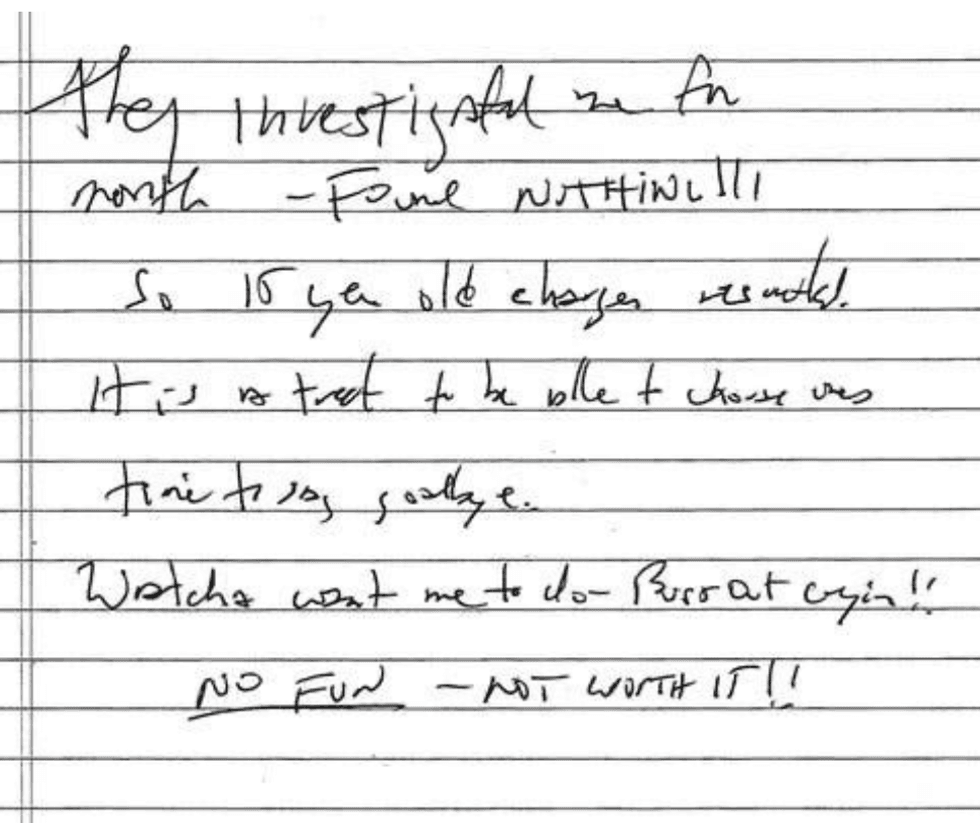
The woman stopped cooperating with the FBI, never filed a civil case, and never publicly mentioned Trump. This chilling note suggests one reason FBI thought PROTECT SOURCE was needed:


We respectfully suggest that our elected officials in DC take a closer look, especially the Congresswoman from South Carolina, Rep. Nancy Mace.

Nina Burleigh is a journalist, author, documentary producer, and adjunct professor at New York University's Arthur L. Carter Journalism Institute. She has written eight books including her recently published novel, Zero Visibility Possible.

Reprinted with permission from American Freakshow