

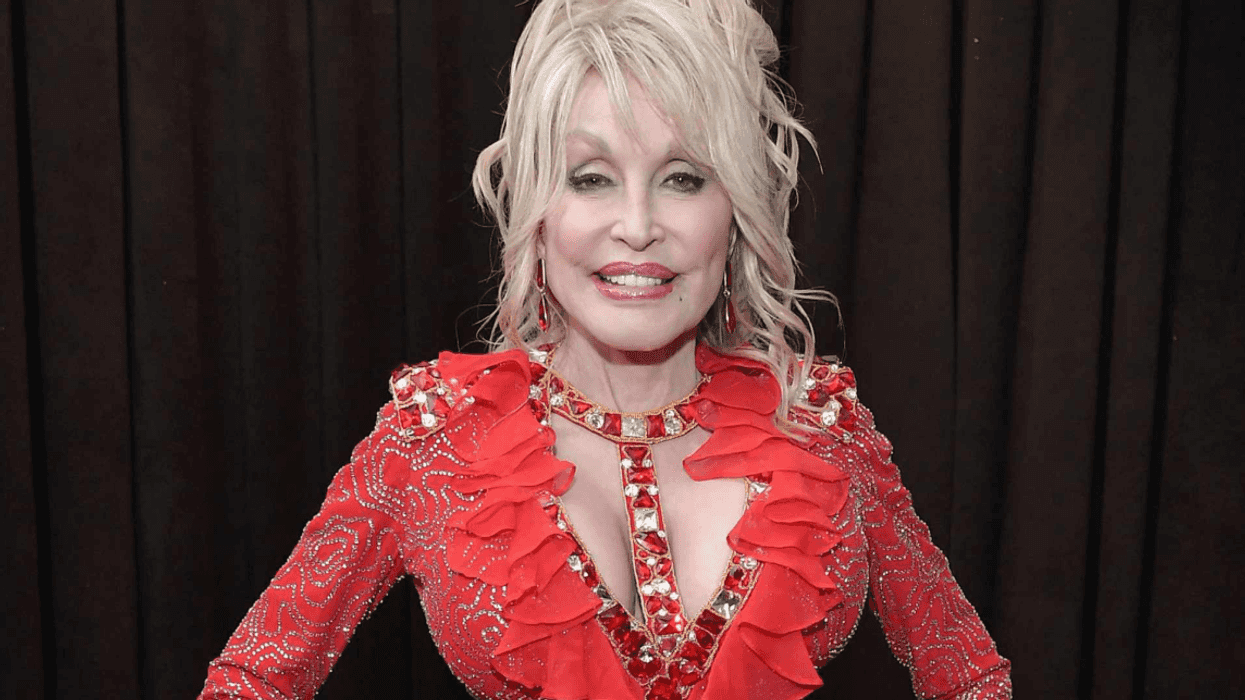
'A Poor Girl From The Mountains': Dolly Parton Musical Will Open On Broadway In 2027
In January 2024 this profile of Dolly Parton, who died on August 25, appeared in The American Independent. A spokesperson for the Parton family said the Broadway opening of Dolly: A True Original Musical is still scheduled for January 19, 2027. Reprinted with permission.
If anyone’s life is big enough to become a Broadway show, that would surely be Dolly Parton. With a classic rags to riches narrative, it’s “like a Cinderella story,” she once said. Now she’s working to bring that remarkable tale to one of New York City’s big stages sometime next year, as she recently revealed to ABC News, after trying to mount a production before the pandemic.
The play will feature her early life and her rise to fame. Born in the rural Appalachian town of Locust Ridge, Tennessee – the subject of her song “My Tennessee Mountain Home” – she grew up in abject poverty. Music ran in the family, and her mother sang and played guitar – and after getting her own first guitar at age ten, Dolly began to write songs, making her debut at the Grand Ole Opry just three years later. Her big Nashville break came on the Porter Waggoner Show, and her 1973 hit single “Jolene” introduced her to a wider audience. Her next huge hit, “Here You Come Again,” climbed to number three on the pop charts.
She made her movie debut in 9 to 5 with Lily Tomlin and Jane Fonda, which made her a household name— and she penned the title song, an anthem of women’s empowerment that was a number one smash hit and won two Grammy awards.
Fans may know all that about their beloved Dolly, but another important part of her life is philanthropy: Most Americans would probably agree that if there’s an angel on earth, it just might be her. The legendary country and western singer, Rock and Roll Hall of Fame inductee, and multiple Grammy winner has long given back to her Tennessee community – and her country – in many ways.
While the right-wing outfit Moms For Liberty aims to take books away from children, Dolly has given American kids more than two hundred million books through her nonprofit foundation, the Imagination Library. Her belief in the power of words goes deep, all the way back to her hardscrabble childhood in the Appalachian mountains, where Dolly was one of 12 children and grew up in poverty. Her father didn’t know how to read, and as she said on her podcast (aptly titled What Would Dolly Do?) her dad’s lack of literacy opened her eyes to the disadvantages that he and others like him faced. She vowed to help them someday when she could.
“They say charity begins at home, and I got a big family,” she said. “We were just mountain people,” she recalls, living so far away from the schoolhouse that her dad’s big farm family could never send him to school. “Daddy was so smart and I've often wondered what all Daddy might have done had he known how to read and write, so I started this little program.”
Almost two decades ago, she founded and launched the Imagination Library locally in Sevier County, Tennessee; since then that “little program” has added 2700 partners—and sends books to children five and under in countries around the world, including the United Kingdom, Australia, and Canada. By 2022, the Imagination Library was mailing two million books a month, and the organization garnered a David M. Rubenstein Prize from the Library of Congress in 2021.
She recently expanded the library to a Western Pennsylvania nonprofit, Reading Ready Pittsburgh.
In addition to the Imagination Library, Dolly’s foundation offers $15,000 scholarships to high school students toward any accredited university and the My People Fund distributed $6,000 a month to Tennessee families who lost their homes in the November 2016 fires in Sevier County, delivering over $12 million to them. And she famously donated a million dollars to research that funded the life-saving Moderna Covid-19 vaccine.
Dolly traces her values to her Christian roots. Though she has always avoided outright political statements, Parton’s strong advocacy for women’s rights has been apparent from the start— in fact, her first single Dumb Blonde mocked people who underestimated her intelligence because of her big, shimmering head of golden hair and impressive bust. The title song she wrote for 9 to 5 became a major hit and a rallying cry for working women.
But, she says, she avoids taking politics head-on, in part because she doesn’t want to alienate half her audience; “I’m not going to insult any of them because I care about all of them,” she told the Washington Examiner. “Even within my own family, especially the last few years since Trump and Biden, all that, it’s like we can’t even go to a family dinner anymore. Especially if people are drinking, they get in a damn fight at the table.”
Dolly prefers not to talk about how she votes or her political opinions and refuses to be pinned down. “Don’t get so trapped where if you’re a Republican, you got to be this way, if you’re Democrat, you got to be that way,” she recently told an interviewer. “You’re not allowed to think nothing else? Well, how crippling is that? I’ve got as many Democrats as I do Republicans as fans, and I’m not going to insult any of them because I care about all of them. I ain’t that good a Christian to think that I am so good that I can judge people. That’s God’s job, not mine.”
She lives by those words: While her own behavior tips her hand toward a more liberal, open-minded way of thinking – for instance, she loves the famed drag queen RuPaul and recently gifted Texas drag queen Brigitte Bandit one of her guitars – she will still share the stage with right-leaning stars like Kid Rock, despite his hostile attitude towards transgender and gay people.
The root of her behavior goes beyond politics—for Dolly, it’s about basic human decency, something that many on the far right seem to have forgotten. She supported the Black Lives Matter movement with a simple shrug. “Of course black lives matter,” she said when asked. “Do we think our little white asses are the only ones that matter? No!” And she put up a million dollars of her own money to support development of the lifesaving COVID vaccine produced by Moderna.
Not long ago she took time out from her busy schedule to serenade LeGrand “LG” Gold, a man dying of cancer, who wanted to meet Parton before he died. Gold and his family are lifelong Dolly fans and had season passes to Dollywood— and his children had received books from the Imagination Library. She serenaded him with “I Will Always Love You.”
Dolly wants her legacy to go beyond her show business success, hoping that something she’s said or done will make a difference to someone and that her fans will think “you know. if she did it I can do it – she was just a poor girl from the mountains,” and she’d like to see that kind of life happen for many more children, too.
Tricia Romano has been a staff writer at the Seattle Times and served as the editor in chief of The Stranger, Seattle’s alternative newsweekly. Her writing has appeared in The New York Times, Rolling Stone, The Daily Beast, Men’s Journal, Elle, Alta Journal, and the Los Angeles Times. She is the author of The Freaks Came Out To Write (Hachette 2024), an acclaimed oral history of The Village Voice, where she was a columnist and staff writer.