Tag: bernie sanders
Primetime Speech: Trump Fabricates Chinese Plot To Rig 2020 Election

Primetime Speech: Trump Fabricates Chinese Plot To Rig 2020 Election

Four months out from the critical November midterms, President Donald Trump delivered a primetime address on Thursday night attempting to sow doubt about the integrity of US elections, repeating well-worn lies about the 2020 contest that he lost and claiming to have uncovered a sprawling Chinese plot to meddle in the voting process.

Trump, who has said his administration should “take over” US elections that are currently run by states, asserted in his speech that the American voting system was “left vulnerable to being rigged and stolen” by his political enemies and accused China of “illicit acquisition of 220 million US voter files” in an effort to undermine him. Trump’s speech coincided with the declassification of intelligence purportedly revealing China’s “sinister” scheme to disrupt US elections as well as attempts by “members of the Deep State” to “suppress and downplay” the scheme.

Experts and critics of the president said his speech cherrypicked intelligence agency findings to concoct a false, self-serving narrative about the vulnerability of US elections and the need for legislation such as the SAVE America Act, a voter suppression bill that Trump has obsessively worked to push through Congress.

“Instead,” Krishnamoorthi added, “he’s reviving conspiracy theories about mail voting, pushing voter suppression, and laying the groundwork for an unprecedented federal takeover of our elections—all while ignoring the real challenges facing American families.”

During his speech, Trump lashed out at major TV news networks for declining to broadcast his speech live and in full, accusing media outlets of being “part of the plot” and calling for the “revocation” of NBC and ABC’s broadcast licenses.

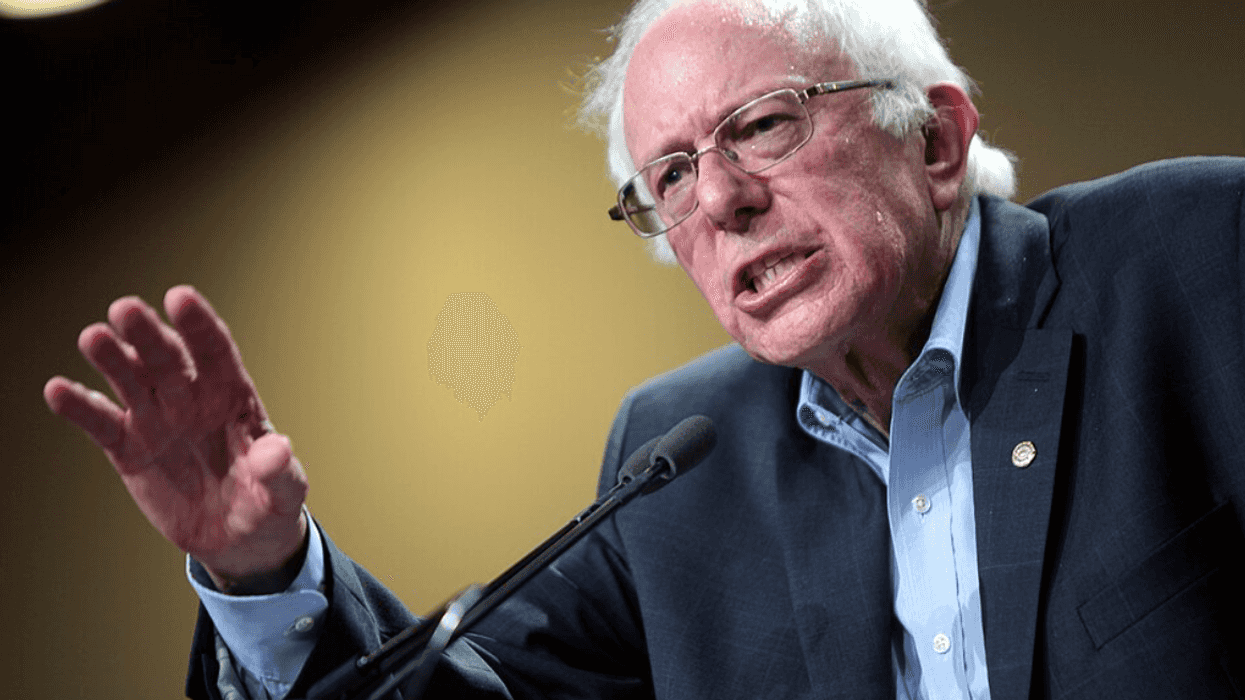
Sen. Bernie Sanders (I-VT) called Trump’s threat “insane.”

“At a time when millions of Americans are finding it harder to pay for groceries, housing, and healthcare, when the climate crisis is causing record heatwaves and forest fires, Donald Trump felt it appropriate tonight to spew conspiracy theories about the 2020 election,” said Sanders. “Pathetically, in true authoritarian fashion, he even threatened to revoke the licenses of ABC and NBC because they would not cover his speech.”

“All of us, regardless of our political views, must stand together against this dangerous president who is seeking to undermine our Constitution and our basic freedoms,” Sanders added.

Trump’s address cited “raw intelligence” that he said shows an attempt by China “to manufacture illegal ballots” for former President Joe Biden. The president claimed, without evidence, that the intelligence was maliciously “buried by rogue bureaucrats.”

But, as The Washington Post observed, “raw intelligence reports are often wrong, incomplete, or contradictory, and spy agencies rely on judgments by expert analysts to vet and piece together the information to make conclusions with different levels of confidence.”

“Officials in 2020 disagreed about whether China wanted Trump to lose and about whether Beijing took any steps to undermine him—a controversy noted in a declassified 2021 report. That report described consensus on the conclusion that neither China nor any other foreign actors had tampered with any votes,” the Post noted. “The hundreds of pages of documents released online by the White House during Trump’s speech did not appear to support Trump’s contention that China interfered in the 2020 election to try to defeat him or that US intelligence officials deliberately hid information about Beijing’s intentions from him.”

Robert Weissman, co-president of the advocacy group Public Citizen, characterized Trump’s speech as an attempt to divert public attention from his administration’s “catastrophic policy failures and plummeting approval ratings.”

“Trump is waging an illegal, unconstitutional, and utterly pointless war that continues to put American and Iranian lives in jeopardy and drive up gas prices. Corporations are setting prices out of reach for people being paid too little,” said Weissman. “Trump rammed through tax cuts for the rich, paid for by cutting healthcare and food assistance for millions and millions of people. An out-of-control paramilitary force is kidnapping people off our streets and killing them at shocking rates. Trump’s delusional rantings tonight are a transparent effort to distract from these realities.”

Living United for Change in Arizona, a pro-democracy organization, warned that “Trump is trying to end our democracy in front of our very eyes.”

“Tonight Donald Trump stood before the nation and attempted to rewrite history, erase the will of the voters, and prepare the country for his next assault on American democracy,” the group said. “We must call this what it is. Donald Trump is laying the groundwork to dismantle our elections, overturn results he does not like, cancel the will of the people, and hold onto power by any means necessary.”

Reprinted with permission from Alternet

Why We Don't Need (Or Want) Bernie Sanders' AI Sovereign Wealth Fund

Why We Don't Need (Or Want) Bernie Sanders' AI Sovereign Wealth Fund

I’m a big fan of Sen. Bernie Sanders (I-VT). He has done an enormous amount to move American politics and especially the Democratic Party to the left. He constantly stands up to the rich in the name of ordinary working people.

But I have to disagree with him on the idea of an AI sovereign wealth fund. This strikes me as wrong-headed from every angle.First and foremost, Donald Trump is doing his best to show us why it is often a bad idea to have the federal government directly involved in running private businesses. He is using the power of the government to stuff his and his family’s pockets in every way imaginable.

He also is using the government to force private businesses to suppress criticism as you’ll see on the Colbert show tonight. Why on earth would any progressive want to give this demented jerk more power?

We can say that Trump is an aberration, which we should all hope he is. But we elected this aberration twice. Does anyone want to say it can’t happen again?

The economics on this look even worse. The job-killing effect of AI exists much more in the minds of our political elite than in the data. Productivity growth, the measure of job killing, has been extremely weak the last two quarters. Quarterly data are erratic and perhaps the future will be different, but if AI is killing off large numbers of jobs, it is doing a great job concealing the evidence.

Most likely the AI sector is in a massive bubble. At its peak value, Nvidia’s market capitalization was roughly 20% of U.S. GDP. In the late 1990s tech bubble, Microsoft’s market cap peaked at less than 6% of GDP.

An AI sovereign wealth fund is likely to end up being a mechanism to shovel yet more money to Elon Musk, Mark Zuckerberg, and the rest of the right-wing billionaire gang. We have already given this crew enough money.

I doubt that we will see massive AI-related job displacement, but if we do, we have old remedies that should work just fine.

1) a workable corporate income tax at a higher rate, for all companies. The best way to do this is to require companies to turn over non-voting shares equal to the targeted tax rate (e.g. 25% of shares for a 25% tax rate).

2) serious anti-trust enforcement. It is likely that Chinese AI will be very competitive, and probably much cheaper, than the domestic stuff. We let in Chinese-manufactured goods to screw large segments of the blue-collar workforce. We should not have protectionism to keep Elon Musk and Mark Zuckerberg ridiculously rich.

3) Stronger labor standards. We set the 40-hour workweek 90 years ago and have not changed it since. Other countries have shortened the work week/work year. If AI is going to give us the promised boom in productivity, let’s lower the threshold to 32 hours, or possibly even lower. We can also double the overtime premium to 100% rather the 50%.

We have all the tools needed deal with an AI productivity boom; we just lack the political will to use them. The sovereign wealth fund idea is a massive leap in the wrong direction.

Dean Baker is a senior economist at the Center for Economic and Policy Research and the author of the 2016 book Rigged: How Globalization and the Rules of the Modern Economy Were Structured to Make the Rich Richer. Please consider subscribing to his Substack.

Affordability Agenda: Would New Tax Cuts Proposed By Democratic Senators Help?

Affordability Agenda: Would New Tax Cuts Proposed By Democratic Senators Help?

Three Democratic Senators have recently proposed big new tax plans.

—Sen. Bernie Sanders (I-VT) (along with California Rep. Ro Khanna) proposed the Make Billionaires Pay Their Fair Share Act, which would set a five percent tax on the wealth of the “938 billionaires in America — who are now collectively worth $8.2 trillion.” They score the tax to raise $4.4 trillion over 10 years (this score has been critiqued as optimistic), some of which would be redistributed to people in households with incomes below $150,000.

—Sen. Chris Van Hollen (D-MD) and Sen. Cory Booker (D-NJ) have each proposed different tax cuts. The core of both proposals is a significant increase in the standard deduction, though important differences exist between the two.

It is these two on which I’d like to focus today (I’ll get back to Sanders/Khanna; I’m sympathetic to the need to tax wealth, which largely goes untaxed; the Constitution, however, is a bit of a hurdle in this regard).

Bottom Line Up Front: I get their motivation, but, with one big exception (tariffs), I don’t think Democrats should engage in big federal tax cuts. For one, because of the way they’re structured, these cuts tend to go pretty far up the income scale, spending scarce resources on folks who arguably don’t need yet another tax cut. For another, we need more, not less revenues if we’re going to implement affordability, anti-poverty, and upward mobility agendas that are more likely to lastingly help struggling families.

The great Chuck Marr posted helpful Twitter threads on each of the two tax cut proposals (Van Hollen, Booker) and the Yale Budget Lab has their typically infomative scores of each (Van Hollen, Booker). The broad strategy in both proposals is to increase the standard deduction enough so that more families would face zero or lower federal tax liabilities (the current standard deduction is ~$16K and ~$32K for individuals and married couples, respectively). Van Hollen sets the no-tax line at $46,000 for individuals and $92,000 for couples, leading to something like half of households paying no federal income tax, vs. around 40 percent now (of course, earners would still pay federal payroll taxes).

Booker more than doubles the current standard deduction and boosts refundable credits for lower-income families, including the child tax credit and the earned-income tax credit. Importantly, Van Hollen phases out his tax break; Booker does not, making his a lot more expensive. The Budget Lab scores Booker’s plan at $5.3 trillion, including his high-end tax increases. They score Van Hollen's cuts as costing $1.6 trillion, but that amount is fully offset by a surcharge on millionaires, ranging from 5 to 12 percent.

Chuck makes a few other points:

Van Hollen:

—Ppl w/ larger affordability challenges will likely get less (or nothing): For example, a low paid worker making well below the $46,000 affordability threshold will get far less than the person w/ income at the threshold (who faces less challenging affordability issues). [JB: Budget Lab has change in after-tax inc flat for bottom fifth (up 0.2%).]
—The tax cut is paid for w/ an excellent revenue-raiser: a surtax on millionaires, who got huge Bush/Trump tax cuts, that raises $1.5T over 10 yrs. A key issue here is opportunity cost - is this the best use of revenue from this offset? [I'll come back to that.]

Booker:

—Despite its high cost, the standard deduction expansion would provide little or nothing to many low-income people and much more to higher-income people who face far fewer challenges affording basic needs and don’t need another tax cut.
—A few examples – assume all married couples with no kids:
- Household w/30k in earnings does not benefit.
- Household w/$50k in earnings gains $1,780.
- Household w/$300k in income gains $10,272.

That last number is really something. The Budget Lab has after-tax income for the fourth income quintile going up a robust five percent and the top fifth gets (yet another) cut of one percent, though that’s all for the 80-90th percentile (the Lab’s 90th percentile is ~$217,000); the top 10 percent gets hit by Booker’s progressive pay-fors. Still, at that point in the income scale, you’re really just adding more after-tax income to those who just got a boost from the Trump tax cuts.

Booker’s plan significantly lifts the after-tax incomes of the bottom fifth through the refundable credit expansions noted above. The Lab has their income up percent, the most of any quintile, on the back of child tax credit/earned income tax credit expansions.

It’s early in the electoral season, and good for them and their staffs for putting out new ideas. I know beyond a doubt that both of these senators are acting in good faith to try to help reconnect economic growth and the living standards of a lot of folks who’ve been left behind.

In fact, whenever I talk about affordability, which is often, I try to remind listeners that yes, affordability is a price issue, but it’s also very much an income issue, and these senators are of course correct that more after-tax income means a greater ability to make ends meet.

And sure, if the only way to help people was to cut their taxes, I’d think differently about this. I’d still worry about deficit financing a tax cut—I like both Senators’ pay-fors—but history is clear that Congress is way more comfortable cutting than raising taxes, so there’s a non-zero chance we get the cuts and not the offsets. As long-term readers know, I used to be a lot more fiscally dovish about such spending but with both sides giving up on anything resembling fiscal rectitude, debt at 100 percent of GDP and climbing quickly, and most concerning of all, interest rates tracking higher, I’m considerably less chill.

But—and this is my key concern about these proposals—I don’t believe that tax cuts are the only way to help people. This is Chuck’s “opportunity cost” point. A dollar spent on a tax cut is not available for what I view as one of the Ds most important contributions to economic policy: identifying and taking action against market flaws and failures.

The affordability agenda is the latest e.g., and it is a good one. It’s also costly, but it’s worth it. A national program that makes childcare affordable, that helps to build affordable housing, that subsidizes health coverage and restores the Rs recent Medicaid cuts, that reduces poverty through refundable tax credits that go to people whose income is too low to incur a federal liability (folks who aren’t helped by raising the standard deduction, though, as noted, Booker's plan extends such credits), that boosts upward mobility through educational support—all of those are policies that good, hardworking Democrats (including Van Hollen and Booker) have long fought for, even if such progress has been stymied in the age of Trump.

To spend trillions on tax cuts, even if they’re better targeted than the Republicans' version, risks hugely underfunding this agenda. I worry that to lead with tax cuts of this magnitude is to implicitly give up on trying to lastingly improve the structure of our economy from the perspective of working families for whom macroeconomic growth has too often been a spectator sport. And if you fail to alter the foundational unfairness in the structure of the economy, you’ll have no other option than to come back to the tax-cut well every few years.

And after reading all that, if you still want to cut a tax, absolutely be my guest: cut the damn tariffs and call it a day, and a very good day at that.

Jared Bernstein is a former chair of the White House Council of Economic Advisers under President Joe Biden. He is a senior fellow at the Council on Budget and Policy Priorities. Please consider subscribing to his Substack.

Reprinted with permission from Econjared.

Too Old? Janet Mills Happens To Be A Lot Younger Than Bernie Sanders

Too Old? Janet Mills Happens To Be A Lot Younger Than Bernie Sanders

So Democrat Janet Mills, governor of Maine, is running against Susan Collins, the state's Republican senator since 1997. An established political figure would be running against another established political figure, yet the current reportage for Mills tends to start off with "77-year-old Janet Mills." Collins happens to be 72.

The Democratic Party is grappling with tensions between its senior leaders and younger challengers who want to replace them — worth a conversation. But to hear the lefties complain that Democratic powerbrokers are too old doesn't quite mesh with their worship of 84-year-old Bernie Sanders, senator from Vermont.

When Sanders ran for reelection last year at age 83, his fan club never raised the age objection. Should Mills win and decide to run for another six years, she would be about the same age as Sanders is now. Another consideration: Maine has the highest share of population 65 and up.

Ageism seems to start at a younger age for women than it does for men. That would make it a form of sexism, too. Would it not?

Mills has announced that if elected, she would serve for only one term. That's undoubtedly to address many Democrats' pain and anger over Biden's running for a second term as his aides hid obvious cognitive decline.

A senator who has slowed down but is experienced and has a good staff can do the job. A president should be able to run on all cylinders.

Mills recently gained national celebrity when she executed a cutting talk-back to Donald Trump at a White House meeting. Speaking before a group of senators, Trump asked: "Is Maine here? The governor of Maine?"

"Yeah," Gov. Janet Mills answered from across the room. "I'm here."

Referring to his executive order banning transgender girls and women from participating in girls' and women's sports, Trump asked, "Are you not going to comply with that?"

Mills parried with, "I'm complying with the state and federal laws."

To which Trump threatened, "You better comply. Otherwise, you're not getting any federal funding."

Mills returned the lob with Yankee directness, "I'll see you in court."

That was a brilliant defense of a state's power to set social policy — even though it came off as a defense of less-than-brilliant policy.

Mills may be treading dangerously on the matter of transgender athletes in sports. No, biological men should not be allowed to compete against biological women. Maine should change its laws to reflect the unfairness of letting athletes with male musculature take part in women's events. It would make athletic competitions a pointless activity for most girls.

The issue is not about how anyone "identifies." If a boy says he's a girl and wears a dress, that's no business of mine. But that doesn't make him physically a girl. Contrary to some claims, hormonal treatments cannot radically change the muscle structure from male to female.

And that reality has shown up on the playing field. In Maine, a transgender girl (that is, someone born male) reportedly took first place in a student girls' track competition. The year before, he placed fifth in a boys' competition.

A similar story has played out in professional tennis. As tennis star Martina Navratilova complained, "women's tennis is not for failed male athletes."

Mills would do well to carefully position herself as a defender of Maine law but advocate changing it.

Mills faces a crowded primary in which she seems the strongest candidate to defeat Collins. "Our Senate race was just upgraded to a Toss-Up!" she just posted on X. "This is the most important race in the country and I'm the only Maine Democrat to win statewide in 20 years."

Years can matter.

Froma Harrop is an award winning journalist who covers politics, economics and culture. She has worked on the Reuters business desk, edited economics reports for The New York Times News Service and served on the Providence Journal editorial board.

Reprinted with permission from Creators.

Shop our Store

Headlines

Editor's Blog

Trending

World