Tag: bond market
Will Bond Market Yields Force Trump To End His Blundering Iran War?

Will Bond Market Yields Force Trump To End His Blundering Iran War?

I’ll be very brief, both because we have very incomplete info on this and because I don’t like to veer too far from my political-economy lane. But one theme of this Substack is to track a point I made at its inception: incompetent leadership has stark consequences.

If what we’re hearing about the negotiations to end the war is correct, then everyone from policymakers to pundits to voters—especially voters—must ask the questions “What was that for? What did thousands of people die for? Why did the global economy have to undergo a massive disruption, elevating prices and interest rates? Why did the US have to further lower its international stature by not only getting dragged into this war, but by not winning it in any recognizable way?”

The answer cannot be regime change or, at least based on what we know, any thwarting of Iran’s nuclear aspirations. From the New York Times on Sunday:

Publicly, both the American and Iranian officials emphasized the concessions they hoped to secure. Mr. Trump said the deal would reopen the Strait of Hormuz, a vital waterway for oil and gas supplies, which Iran has effectively blockaded during the conflict, spurring a surge in global energy prices.
The Iranian officials said the deal Tehran had agreed to would reopen the Strait of Hormuz without any tolls; lift the U.S. naval blockade on Iran; stop the fighting on all fronts, including between Israel and Hezbollah, the Iran-backed armed group, in Lebanon; and release $25 billion in Iranian assets frozen overseas.

Also, this: “The future of Iran’s nuclear program, part of Mr. Trump’s case for launching the war, was unclear.” Summarizing conflicting reports, it appears that they’re going to table the issue for 60-90 days.

If this information is correct, then one narrow point that’s interesting to me is an answer to “why now?” might very well be the bond market. Back in April of last year, when bond yields spiked in response to Trump’s “Liberation Day” tariffs, he quickly backed off. I suspect the recent spike in bond yields is in the mix here as well.

But the real developing story here is that we may be looking at a deal that basically trades reopening the Strait—returning it to pre-war conditions—for economic sanctions relief and the end of our naval blockade.

If that’s even roughly correct, then this whole debacle must not be allowed to fade into the rearview mirror. It must be held up as the deeply costly blunder that it was, one whose accountability extends well past Trump, on to his Congressional enablers.

Stay tuned for further analysis. I’ll also be watching out for evidence of insider trading, which seems to accompany such developments these days. The depth of the incompetence is only matched by the depth of the corruption.

Jared Bernstein is a former chair of the White House Council of Economic Advisers under President Joe Biden. He is a senior fellow at the Council on Budget and Policy Priorities. Please consider subscribing to his Substack, from which this is reprinted with permission.

Trump's Bond Benefactor 'Illegally' Seized Cars Of Service Members

Trump's Bond Benefactor 'Illegally' Seized Cars Of Service Members

Don Hankey, the billionaire who put up Donald Trump's $175 million bond last week for the MAGA hopeful's New York civil fraud trial judgment, was once sued by the former president's Department of Justice, according to an exclusive Daily Beast report.

Hankey gained much of his $7.4 billion net worth, according to the report, by "targeting low-income customers with high-interest auto loans" through his company, Westlake Services.

MSNBC legal correspondent Lisa Rubin reported earlier this week that the billionaire is also "believed to be the largest shareholder in Axos Bank, which "refinanced Trump’s loans on Trump Tower and Doral in 2022."

Furthermore, because "Axos has loaned Trump $100 million in his refinancing of Trump Tower and another $125 million for Doral" Resort, Rubin noted, the ex-president was already indebted to Hankey prior to last week's $175 million bond.

However, the Beast notes, Hankey's "past is important context for his loan to Trump, and his company’s choppy history with federal law enforcement—as well as the fact that his firm would be regulated under a potential second Trump administration—may cast the loan in a new light."

Westlake Services "had systematically violated the rights of military employees over a period of several years," according to the report, having "repossessed dozens of vehicles belonging to military employees without obtaining the necessary court orders required under the law."

Prosecutors said, "Westlake and Wilshire specifically target servicemembers, including junior enlisted servicemembers, as customers for their subprime and near-subprime loan products," while their "complaint noted that the unlawful repossessions were 'intentional, willful, and taken in disregard' for the members’ rights, citing the fact that Hankey’s firms had followed the proper procedures when it was in their interest—like when it came to approving service member requests for interest rate reductions."

Westlake "settled the suit by paying $700,000 to Westlake immediately settled, agreeing to pay $700,000 in damages to the affected service members, along with a roughly $61,000 fine to the federal government," according to the Beast.

The news outlet also notes, a couple of years prior to the Trump DOJ's lawsuit against Westlake "and its wholly-owned subsidiary Wilshire under the SCRA, those same two entities were nailed by the Consumer Financial Protection Bureau for 'illegal debt collection tactics.'"

Reprinted with permission from Alternet.

Senate Republicans Vote To Shut Government And Crash Economy

Senate Republicans Vote To Shut Government And Crash Economy

A report released by Moody's Analytics on September 21 warns that failure to raise the ceiling on the U.S. national debt and to renew the spending authority of the U.S. Treasury when it expires on September 30 will lead to a default that "would be a catastrophic blow to the nascent economic recovery from the COVID-19 pandemic."

Senate Republicans on Monday night blocked the bill that would fund the government and raise the debt ceiling, bringing the United States to the brink of both a government shutdown and an economic recession.

Not a single Republican voted to advance the funding bill, which had passed the House a week ago and would prevent the government from shutting down at the end of Thursday, when the current funding bill expires.

The country will reach the ceiling on its ability to borrow to pay its debts in early October. If it isn't raised, the country will default, sending it into an economic tailspin that Moody's said would cost 6 million jobs and $15 trillion in household wealth.

The report said that a default would particularly hurt the U.S. bond market, generally considered a relatively safe place to invest for retirement.

Treasury bonds are basically loans to the government made by investors that are paid back by a specified date; a default would mean the loans are not repaid on time. "Americans would pay for this default for generations, as global investors would rightly believe that the federal government's finances have been politicized and that a time may come when they would not be paid what they are owed when owed it. To compensate for this risk, they will demand higher interest rates on the Treasury bonds they purchase. That will exacerbate our daunting long-term fiscal challenges and be a lasting corrosive on the economy, significantly diminishing it."

The report said a potential default would be "cataclysmic":

Stock prices would be cut almost in one-third at the worst of the selloff, wiping out $15 trillion in household wealth. Treasury yields, mortgage rates, and other consumer and corporate borrowing rates spike, at least until the debt limit is resolved and Treasury payments resume. Even then, rates never fall back to where they were previously. Since U.S. Treasury securities no longer would be risk free, future generations of Americans would pay a steep economic price.

Democrats slammed their GOP colleagues, with Rep. Adam Schiff of California calling their refusal to close debate on the legislation and move to a vote on it before the deadline "craven."

"Every single McConnell Republican just voted to blow up the entire economy and start a depression for no reason except because the President is a Democrat," Rep. Bill Pascrell (D-NJ) tweeted.

"Mitch McConnell just 2 years ago: 'America can't default. That would be a disaster.' Now he's flirting with that disaster because he thinks it'll notch him a political win," Sen. Sheldon Whitehouse (D-RI) tweeted.

Senate Minority Leader Mitch McConnell said when Donald Trump was in the White House that not raising the debt ceiling would be catastrophic.

But now that President Joe Biden is in office and Democrats control both chambers of Congress, McConnell is refusing to provide any Republican votes, saying Democrats have to do it on their own with a more complicated procedural maneuver.

"We will support a clean continuing resolution that will prevent a government shutdown," McConnell said Monday. "We will not provide Republican votes for raising the debt limit."

Congress raised the debt ceiling three times on a bipartisan basis when Trump was president and McConnell served as Senate majority leader.

"Note that Democrats never filibustered the debt limit under Bush and actually provided most of the votes for cloture under Trump," Seth Hanlon, a senior fellow at the Center for American Progress, tweeted. "What McConnell is doing now is unprecedented, disgraceful, and dangerous."

Republican members are claiming that they don't want to raise the debt ceiling because Democrats are working to pass Biden's economic plan, which would provide funding for infrastructure such as roads and bridges, paid family leave, child care, and added dental and vision benefits under Medicare.

But the raising the debt ceiling means enabling payments on the debt the United States has already accrued, not on future spending. While Trump was in office, Republicans helped add $7.8 trillion to the national debt, the third biggest increase as a share of the size of the economy under any president in U.S. history, the Washington Post reported.

It's unclear what will happen next, as Republicans bring the economy to the brink.

House Speaker Nancy Pelosi tweeted on Monday night, "The full faith & credit of the United States should not be political. Republicans' reckless decision to block government funding & raising the debt ceiling threatens 6 million jobs, financial ruin for countless families, military paychecks & Social Security payments to seniors."

Published with permission of The American Independent Foundation.

‘Trump Thump’ Whacks Bond Market For $1 Trillion Loss

‘Trump Thump’ Whacks Bond Market For $1 Trillion Loss

NEW YORK (Reuters) – Donald Trump’s stunning victory for the White House may mark the long-awaited end to the more than 30-year-old bull run in bonds, as bets on faster U.S. growth and inflation lead investors to favor stocks over bonds.

A two-day thumping wiped out more than $1 trillion across global bond markets worldwide, the worst rout in nearly 1-1/2 years, on bets that plans under a Trump administration would boost business investments and spending while firing up inflation.

“We’ve had a sentiment shift in the bond market. We’ve seen it, too. People have already started reallocating out of bonds and into stocks,” said Jeffrey Gundlach, chief executive officer of Los Angeles-based DoubleLine Capital, which has more than $106 billion in assets.

“The cracks have been forming for five years – we’re in this slow-grinding higher phase in yields,” he said.

The stampede from bonds propelled longer-dated U.S. yields to their highest levels since January with the 30-year yield posting its biggest weekly increase since January 2009, Reuters data showed.

In the stock market, the blue chip Dow Jones industrial average finished out its best week in five years on Friday as it marked a record high close.

The 10-year German Bund yield rose to its highest level in eight months, while the 10-year British gilt yield climbed to its highest level prior to Britain’s decision to leave the European Union on June 23, known as Brexit.

Bank of America Merrill Lynch’s Global Broad Market Index fell 1.18 percent this week, the steepest percentage drop since June 2015, which is equivalent to more than $1 trillion. Its U.S. Treasury index suffered a 1.91 percent decline on a total return basis, the biggest weekly drop since June 2009.

Many investors, who have loaded up on bonds on the belief of protracted easy monetary polices worldwide due to sluggish global economy, are not ready to throw in the towel.

They are counting on insurers and pension plans, together with European and Japanese investors who are struggling with negative yields at home, to preserve the bull run for bonds.

“Are we going to see a dramatic backup in yields? It’s too soon to make a conclusion about that,” said Mihir Worah, chief investment officer in asset allocation and real assets at PIMCO in Newport Beach, California, which manages $1.55 trillion in assets.

Goldman Sachs and BAML forecast the 10-year U.S. yield could climb to 2.50 percent, compared with 2.11 percent at Thursday’s close. The U.S. bond market was closed on Friday for Veterans Day.

BREXIT TWO?

Fund managers at top bond firms and analysts on Wall Street are weighing whether the impact of Trump’s win on financial markets will be similar to Brexit. European stocks sold off violently after the Brexit vote, but by mid-August had recovered all the losses. Even so, there is a great deal of uneasiness as investors wait for details on how Britain will exit the EU – not unlike the waiting game on what Trump will actually do as president.

“We need more of a cushion given the uncertainties. That’s exactly what is being played out in the global debt market,” said Mark Lindbloom, portfolio manager at Western Asset Management in Pasadena, California, which oversees $445 billion.

Trump, who beat Democratic rival Hillary Clinton, campaigned on tax cuts, trade restrictions and fiscal spending on infrastructure. It remains unclear how these promises translate into policy and the degree to which they would affect the economy.

Since Election Day, the U.S. bond market’s gauge on investors’ 10-year inflation outlook jumped to its highest level since July 2015.

Bond and stock markets suggest whatever Trump may do with the help of a Republican-controlled Congress would give a lift to the U.S. economy, which is growing at about 2 percent this year.

“It is a bit early to be calling the Big Rotation,” said Art Hogan, chief market strategist at Wunderlich Securities in New York, referring to the idea that the three-decade-old rally in bonds is ending.

“We’ve been declaring that rotation for years. … I’m afraid it’s hard to think about that happening in the current demographics we have. Baby boomers have more investable assets than millennials do.”

Betting the U.S. economy may fare better on possible tax cuts and more federal spending, investors scooped up financial and biotech stocks, driving the S&P 500 to its best week since 2014 on Friday.

For a rotation into equities from bonds to materialize, it would require “a pick-up in the global economy, and for central banks globally at the very least to halt accommodation -and in our case remove some,” Hogan said.

TIPS APPEAL

While investors dumped most types of bonds after Trump’s victory, they piled into Treasury inflation-protected securities as a hedge against a pick-up in inflation.

“You are seeing interest in TIPS right now from a widening investors base,” said Brian Smith, portfolio manager at TCW in Los Angeles, which has $197 billion in assets.

Investors poured $1 billion into TIPS in the week ended Nov. 9, the second-biggest inflows since records began in October 2002, data from Thomson Reuters’ Lipper service showed on Thursday.

Trump’s win dovetailed with a rise in U.S. yields, reversing the safe-haven trade that stemmed from fears over the fallout of Britain’s vote to leave the EU.

Yields have also risen as some Federal Reserve officials reasserted calls for a rate increase by year-end, a move that is increasingly seen as likely by the market.

Inflation concerns have also been stoked by a recovery in U.S. oil prices, which tumbled to a 12-year low in February due to concerns over a supply glut. That is seen as another factor behind the rise in bond yields.

“The trend was already in play and it has accelerated,” Pimco’s Worah said, adding there is more room for yields to rise but not much further from current levels.

(Additional reporting by Sam Forgione and Rodrigo Campo in New York, Jamie McGeever in London; Editing by Daniel Bases)

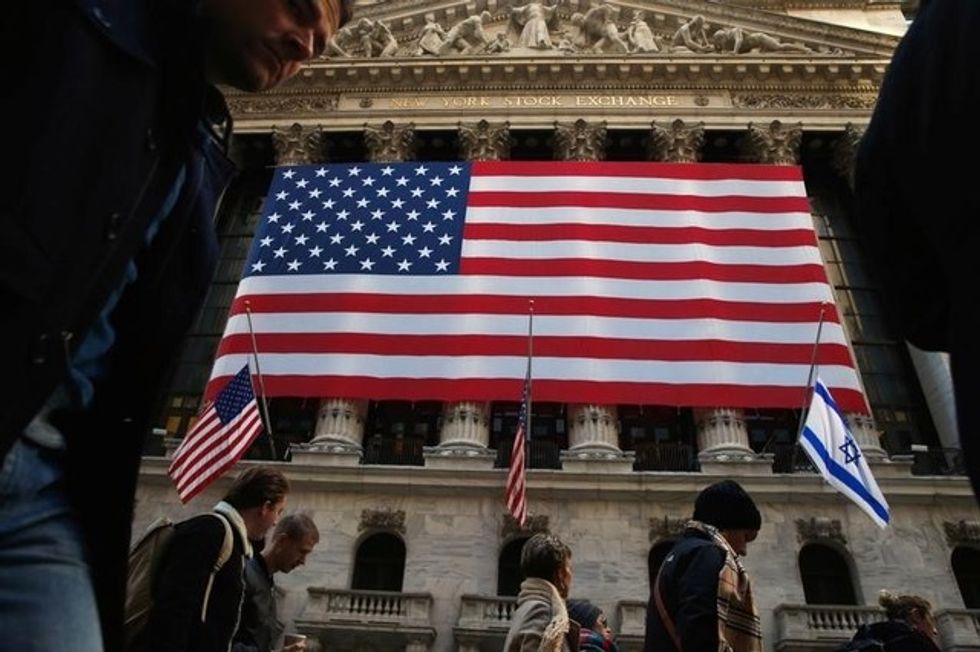
IMAGE: Morning commuters pass by the New York Stock Exchange (NYSE) in New York City, U.S., November 10, 2016.  REUTERS/Brendan McDermid

Shop our Store

Headlines

Editor's Blog

Trending

World