Tag: nasdaq
Warning: Here's Why The Fed Can't Rescue Markets From AI Bubble

Warning: Here's Why The Fed Can't Rescue Markets From AI Bubble

While everything feels political now – a kind of fin de siècle chaos politics – I want to take a brief break from the political today. Instead I want to talk about asset markets and the Fed.

We could say that the US economy in 2025 was schizoid. On the one hand Donald Trump abruptly reversed 90 years of U.S. trade policy, breaking all our international agreements, and pushed tariffs to levels not seen since the 1930s. Worse, the tariffs keep changing unpredictably. This uncertainty is clearly bad for business and is depressing the economy. On the other hand, there has simultaneously been a huge boom in AI-related investment, which is boosting the economy.

As many people have already noted, the AI boom bears an unmistakable resemblance to the tech boom of the late 1990s — a boom that turned out to be a huge bubble. The Nasdaq didn’t regain its 2000 peak until 2014.There’s intense debate about whether AI investment is similarly a bubble, which I would summarize as a shoving match: “Is not!” “Is too!” “Is not!” “Is too!”

While my personal guess is that AI is indeed in the midst of a bubble, I won’t devote today’s post to that debate. Instead, I want to talk about one recent aspect of market behavior that is very striking and carries strong echoes of the tech bubble a generation ago. Namely, AI-related stocks, like tech stocks back then, are reacting very strongly to perceptions about the Fed’s short-term interest rate policy.

Now as then, these strong reactions don’t make sense.

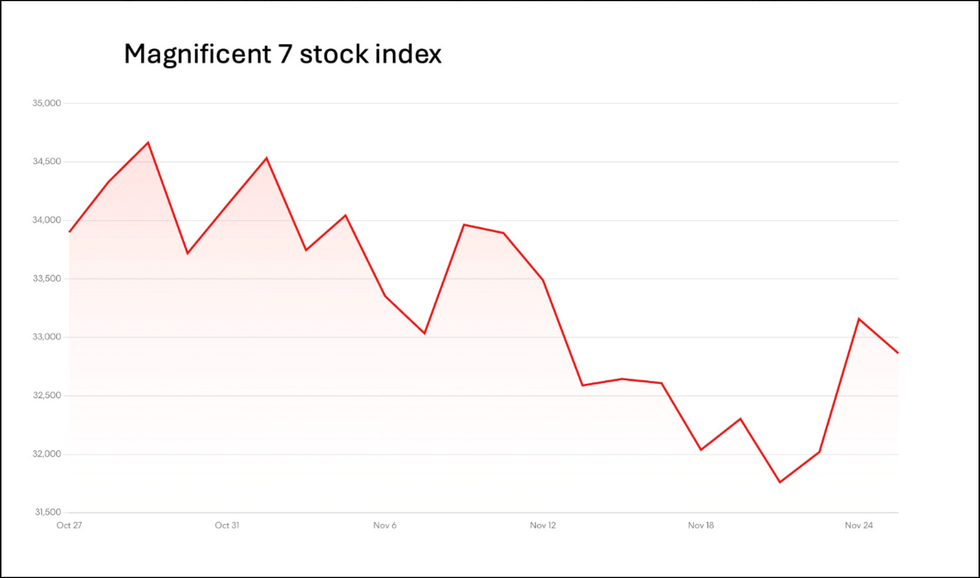
To see what I’m talking about, consider recent moves in stock prices closely related to AI. This chart shows movement over the last month of Bloomberg’s “Magnificent 7” stock index:
bloomberg magnificent 7 Source: Bloomberg News

During most of that month, these stocks were falling, as concerns that AI is a bubble increased. But on Monday the Mag7 index surged, erasing a large fraction of the losses. Why? Analyst chatter about supposed causes of stock market swings should always be taken with many grains of salt. But it’s clear that this surge was catalyzed by remarks by Fed officials which the market interpreted as making a cut in the Fed Funds rate next month more likely.

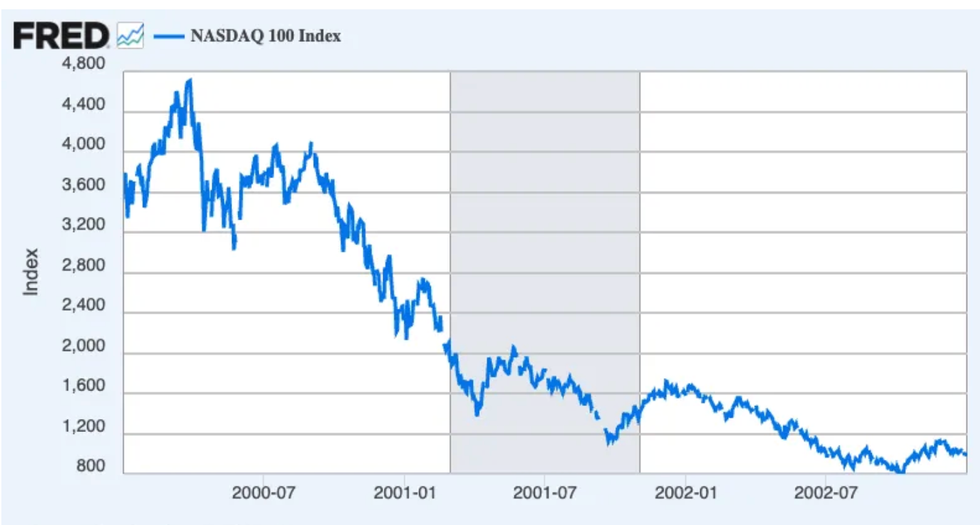
Some of us have seen this movie before. For those who haven’t, there is a pervasive view that the deflation of the 90s tech bubble was something that happened all at once — a Wile E. Coyote moment in which investors looked down, realized that there was nothing supporting those high valuations, and the market plunged. In reality, however, it was a long, drawn-out process, punctuated with some significant dead cat bounces along the way. Here’s the Nasdaq 100 over the relevant period (the gray bar represents the 2001 recession):
FRED NASDAQ 100 index Source: NASDAQ via FRED/St.Louis Federal Reserve (stlouisfed.org)

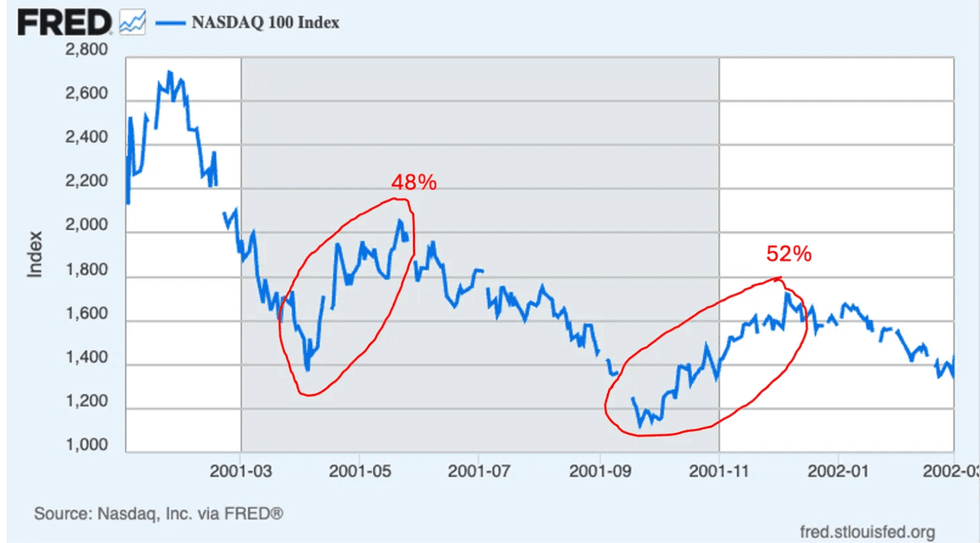
Measured against the awesome scale of the ultimate tech-stock decline, the temporary rallies along the way don’t look that big. But they were actually huge compared with normal stock movements. Let’s look at a closeup:

FRED NASDAQ 100 Index tech bubble Source: NASDAQ via FRED/St.Louis Federal Reserve

What drove these temporary bouts of optimism? At the time the conventional wisdom was that they were the result of Fed interest rate reductions and the prospect of further cuts. In fact, many observers used to argue that the stock market was underpinned by the “Greenspan put”: Don’t worry about a crash, Uncle Alan will ride to the rescue.

And after Monday’s stock price spurt, it’s clear that belief in a “Fed put” has made a modest comeback.

Indeed, the graph below shows the numerous rate cuts as the tech bubble burst:

But while these rate cuts did create brief bouts of, well, irrational exuberance, they did nothing to prevent the tech bubble from eventually deflating.

Why couldn’t Greenspan rescue tech stocks? To answer that question, think about why interest rates matter for asset prices: Lower interest rates reduce the rate at which investors discount expected future returns. A dollar delivered to you X years from now has a higher “present value” (that is, a higher current value) if interest rates are one percent than if they’re six percent. How much higher depends on X, the number of years until you receive it.

For example, a house can last for generations, and it delivers value to its owner in the form of a place to live over the years. That stream of housing consumption over the years is worth more – has a higher present value -- when the interest rate is one percent than when it is six percent. Or to put it another way, if you can make six percent on your money in a bank deposit, you may be better off renting rather than buying. That’s why the demand for houses is strongly affected by mortgage rates.

Interest rates matter much more for the value of assets that will still be yielding returns 10 or 20 years from now than they do for assets that will only yield returns for a few years.

That is, the value of assets that have a short economic life is much less affected by interest rates. Not surprisingly, economists have consistently had a hard time finding evidence for any effect of interest rates on business investment.

Moreover, investments in digital technology tend to have an especially short half-life, precisely because rapid technological progress quickly makes equipment and software obsolete. How valuable will data centers currently under construction be 5 years from now? Will they be worth anything 10 years from now? A realistic answer to these questions surely implies that the Fed’s interest policy should have little to no impact on Mag 7 valuations, or the sustainability of the tech boom.

As we saw on Monday, however, Fed policy and rumors about future Fed policy can sometimes affect AI-stock prices in the short run. But by the straight economics, these movements are more the result of market psychology than of any objective assessment of future returns.

So as doubts about AI creep in, I’m hearing growing chatter to the effect that the Fed can and should save the industry. But the lesson from the last big tech bubble is that it can’t. In fact, I have doubts about whether the Fed can head off a broader recession if the tech boom collapses — but that’s a topic for a future post.

For now, my point is that if you’re worried about an AI bubble, don’t expect Jerome Powell or his Trump-appointed successor — rumors are not encouraging — to come to the rescue. They can’t.

Paul Krugman is a Nobel Prize-winning economist and former professor at MIT and Princeton who now teaches at the City University of New York's Graduate Center. From 2000 to 2024, he wrote a column for The New York Times. Please consider subscribing to his Substack.

Reprinted with permission from Paul Krugman.
S&P 500 Ends At Record High On Retail Sales Cheer

S&P 500 Ends At Record High On Retail Sales Cheer

By Echo Wang

(Reuters) - The S&P 500 index closed at a record high on Monday, its fourth straight session of gains, as strong U.S. retail sales underscored economic strength and eased worries from Omicron-driven flight cancellations that hit travel stocks.

The rally is the longest since an eight-day streak that ended on November 8.

Holiday season retail sales rose 8.5 percent from November 1 to December 24, powered by an e-commerce boom, according to a Mastercard Inc. report, which helped the S&P 500 retailing index gain on the session.

Travel-related stocks, typically sensitive to coronavirus news, declined after U.S. airlines canceled about 800 more flights on Monday after nixing thousands of flights during the Christmas weekend, as Omicron cases soared.

The S&P 1500 airlines index declined. Cruise operators Norwegian Cruise Line Holdings, Royal Caribbean, and Carnival Corp all fell, leading declines on the benchmark S&P 500.

"The market is in this interesting place where we have a strong consumer, with spending up eight percent year over year. Personal consumption makes up 70 percent of our GDP, and that remains flush," said Sylvia Jablonski Kampaktsis, chief investment officer and co-founder at Defiance ETFs in New York.

"Omicron reminds us that we still exist in this corona ecosystem. And it'll probably be one of many things that we will continue talking about with this virus but the doomsday COVID scenario of 2020 feels like it's far behind us."

Monday's climb marks a fourth straight session of gains for Wall Street's main stock indexes after encouraging news last week related to the Omicron variant eased worries about the strain's economic impact.

All 11 main S&P 500 sector indexes advanced, with energy and tech leading percentage gains.

According to preliminary data, the S&P 500 gained 65.21 points, or 1.39 percent, to end at 4,791.00 points, while the Nasdaq Composite gained 216.53 points, or 1.38 percent, to 15,869.90. The Dow Jones Industrial Average rose 350.63 points, or 0.98 percent, to 36,301.19.

The Nasdaq Composite got a boost from megacap companies, including Tesla Inc, Microsoft Corp, Apple Inc and Meta Platform.

Main U.S. stock indexes are on track for a third straight yearly gain, with the benchmark S&P 500 set for its best three-year performance since 1999.

(Reporting by Echo Wang in Taos, New Mexico; Additional reporting by Medha Singh and Anisha Sircar in Bengaluru; Editing by Uttaresh.V and Richard Chang)

How Trump May Be Scheming To Bilk 'Truth' Investors For $340 Million

How Trump May Be Scheming To Bilk 'Truth' Investors For $340 Million

Reprinted with permission from DailyKos

On Wednesday evening, Donald Trump's get-around-the-ban surrogate on Twitter, Liz Harrington, issued a statement announcing the formation of the "Trump Media and Technology Group" (TMTG). Most of the attention focused on this missive has been centered around the announcement of something called "TRUTH Social"—also known as yet-another-Trump-focused-Twitter-clone.
Read NowShow less
President Joe Biden

As Markets Rise, Biden Takes A Bow (And Trolls Trump)

"Biden's Stock Market Returns Continue to Trounce Trump's" reads a recent Forbes headline. Sophisticated investors know this, but most of the public may not because Democrats have this self-defeating aversion to boasting about bull markets during their watch.

That seems to have changed under President Joe Biden.

Recall how former President Donald Trump tied every record high to his alleged brilliance as an economic manager. "The Dow Jones Industrial just closed above 29,000!" he tweeted about six weeks before the 2020 election. "You are so lucky to have me as your president. With Joe Hiden' it would crash."

Not quite. Ten months after Biden was declared winner, the Dow Jones Industrial Average was over 34,500. As for the broad-based S&P 500, that stock index has closed at at least 40 all-time highs since Biden has been president.

Happily for Democrats, Biden has claimed his bragging rights. Even better, he's trolling Trump with Trump-like swagger. "The stock market is surging," Biden crowed in a speech honoring labor unions. "It's gone up higher under me than anybody."

Actually, presidents don't have nearly as much control over the stock market as they may claim. New technology influences economic developments, as do black swan events, such as the September 11, 2001, attacks. Then, there was COVID-19.

That said, stocks have certainly done better so far under Biden than under the previous guy. From the last election to late August, all three major indexes — the Dow, S&P 500 and the NASDAQ — had produced higher percentage gains under Biden than in the same period under Trump, according to Forbes.

Stocks did great under President Barack Obama, too, but you heard nary a peep from him about the Dow. And until recently, Biden didn't talk about it either.

Democrats had reasons, not all good ones, for their reticence. In downplaying gains in stock market wealth, they often note that ownership of shares is heavily weighted toward the richest Americans.

That is true. About 92 percent of stocks owned by Americans reside in the top 10 percent of households. We're including stakes in 401(k)s and other retirement plans, and mutual funds.

Nearly half of all Americans own not a single share of stock. And of the households that do, the median stock value is only $40,000.

But these Democrats often underestimate how many Americans rejoice over a rise in stock prices delivering gains of even a few hundred dollars. And many who don't own any stock associate booming markets with general economic prosperity.

Some liberals, meanwhile, have this sourpuss idea that there's something not quite wholesome about making money in the stock market. After the Trump-era tax cuts favoring rich investors, they want to raise taxes on those with very high incomes, and that makes sense.

But then they must also recognize that stock market rallies produce more taxable income. And the sweet part is that proposals to raise tax rates on capital gains and very high incomes have evidently not depressed Americans' lust for stock investing.

Complicating the messaging for Democrats is that well-to-do Americans account for more and more of their voter base. In 2020, 59 percent of counties with a median household income over $80,000 went for Biden, whereas only 39 percent favored Trump.

Biden later swerved back to his party's earlier talking point that the stock market is not the economy. He complained about some people "seeing the stock market and corporate profits and executive pay as the only measure for our economic growth."

But did Biden use the word "exponentially" to describe rising stock prices under his presidency? He sure did. "I'm glad it's gone up," he added, "no problem." Good for him, and if this change in tone continues, good for Democrats.

Follow Froma Harrop on Twitter @FromaHarrop. She can be reached at fharrop@gmail.com. To find out more about Froma Harrop and read features by other Creators writers and cartoonists, visit the Creators webpage at www.creators.com

Shop our Store

Headlines

Editor's Blog

Corona Virus

Trending

World