Mary Peltola
As the political climate gets increasingly noxious for President Donald Trump and his captured Republican Party, it’s becoming clearer that Democrats are favored to retake the House this November. The Senate is a tougher lift, but it’s no longer just in play. Democrats may now be the slightest of favorites to win it.
That is a remarkable state of affairs. Democrats are operating on largely hostile terrain, while Republicans hold a 53-seat majority in the chamber. Democrats need a net gain of four seats to secure a majority. (If you’re interested, you can look back at our March 29 and May 10 rating updates.)
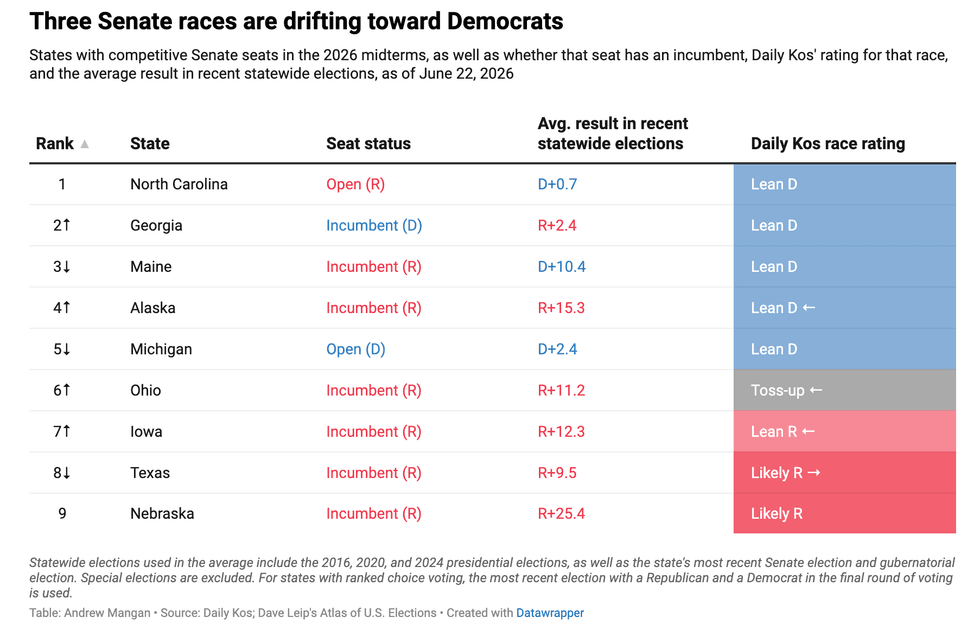
1. North Carolina (R-open, Lean D)
Former Democratic Gov. Roy Cooper has enjoyed big leads in just about every poll so far as he faces former Republican National Committee Chair Michael Whatley in this open-seat race. On June 11, Sabato’s Crystal Ball moved the race to “Leans Democratic,” catching up with Cook Political Report, which shifted the race to “Lean D” in April.
Scandal has screwed Democrats here before, so nothing can be taken for granted. But as for now, this is the Democrats’ most surefire pickup of the cycle.
2. Georgia (D-incumbent, Lean D)
Sen. Jon Ossoff is the most vulnerable Democratic incumbent on the map. Oddly, the most recent poll of the general election was fielded in early April, when Ossoff held a high-single-digit lead. We now have an official Republican challenger in Rep. Mike Collins, so new polling should arrive soon in this reddish-purple state.
I’m moving Georgia ahead of Maine for now. Ossoff’s campaign is firing on all cylinders, without the self-inflicted drama that has engulfed Democrats in the Pine Tree State. Both Cook and Sabato rate the race “Lean D.”
3. Maine (R-incumbent, Lean D)
Democratic nominee Graham Platner is, to put it mildly, controversial. Yet he seems to have entered the kind of political space Trump occupies, where scandal doesn’t just bounce off him but even sometimes seems to strengthen him. Platner is charismatic, with a fiery anti-establishment message tailor-made for the moment. Maine has always had a soft spot for unconventional politicians, and that appears to be helping him.
Unlike Trump, Platner has apologized for his worst excesses. We’re long past the era when candidates were expected to be paragons of purity. At minimum, voters seem willing to reward politicians who show some capacity for growth.
In polling, the race is tight. Platner holds a narrow lead over incumbent Republican Sen. Susan Collins, who has repeatedly survived in this Democratic-leaning state. If you’re looking for evidence that his latest controversies are taking a toll, the data is mixed. In Quantus Insights polling, the race moved from Platner+7 in early March to Platner+1 this month. Meanwhile, Republican pollster Fabrizio, Lee & Associates went from Collins +1 in January to a tie more recently.
My instinct says that Platner ultimately reestablishes a mid-single-digit lead and wins comfortably in a high-turnout Democratic environment. But that’s speculation. For now, “Lean D” remains the appropriate rating. Cook and Sabato both rate the race a Toss-up.
4. Alaska (R-incumbent, Lean D)
In May, this was a toss-up race, which, in itself, seemed ridiculous. We’re talking about Alaska, a state Trump carried in 2024 by 13 percentage points, with an incumbent Republican senator, Dan Sullivan, who isn’t plagued by scandal, though he is somewhat unpopular.
Yet here we are in June, upgrading the race to “Lean D.”
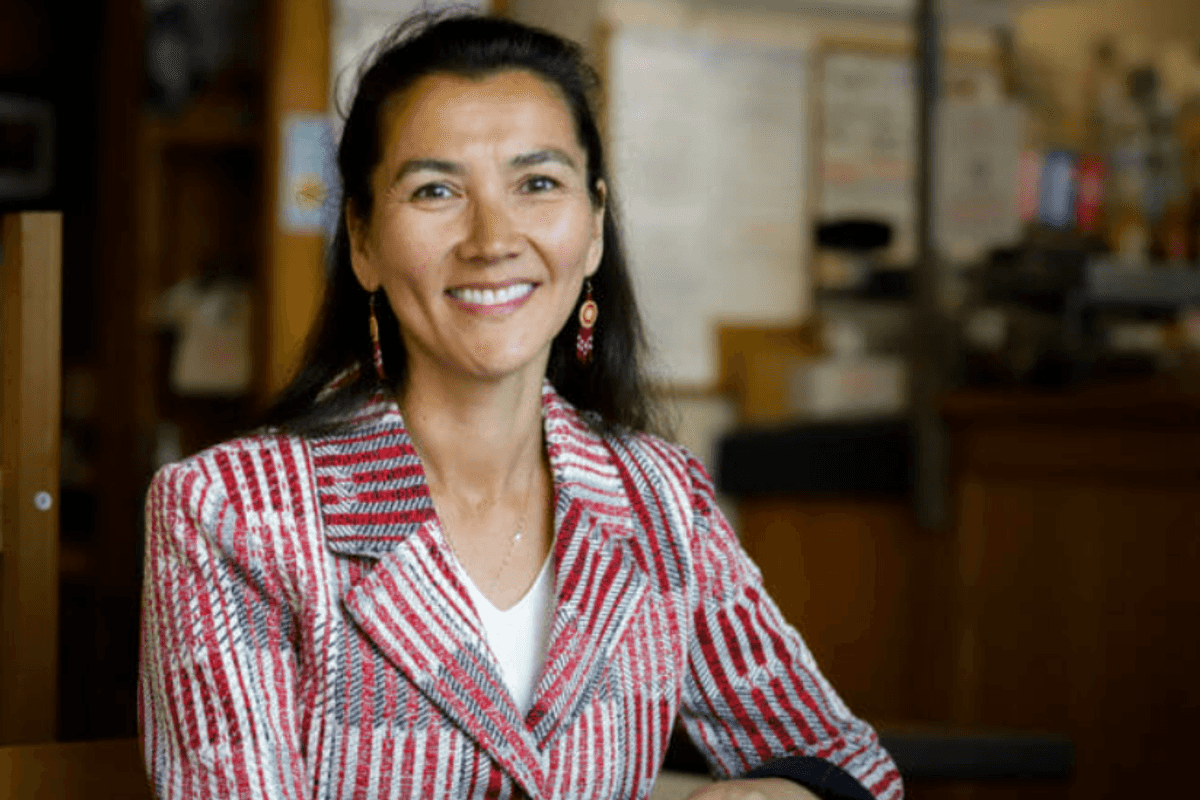
Driving the change is former Democratic Rep. Mary Peltola’s consistent strength in polling. Alaska Survey Research, the state’s gold-standard pollster, has shown Peltola with 5-point leads in its past two surveys, while Sullivan hasn’t scored above 44% support. In April, ranked-choice simulations failed to give Sullivan the boost he needed to clear 50%, while Peltola reached that threshold comfortably in round two. The June results tell essentially the same story.
Cook still has the race at “Lean R,” while Sabato rates it a “Toss-up.”
5. Michigan (D-open, Lean D)
Democratic Sen. Gary Peters’ retirement scrambled the race in one of the country’s premier battleground states. Both Cook and Sabato rate it a Toss-up, which is understandable on paper. But with the primary still ahead on Aug. 4, there remains considerable uncertainty.
On the Democratic side, progressive physician and former Wayne County health director Abdul El-Sayed, backed by Bernie Sanders, Alexandria Ocasio-Cortez, and Justice Democrats, has led most recent polling against Rep. Haley Stevens and state Sen. Mallory McMorrow.
El-Sayed’s strength has predictably unnerved some Democrats, who worry both about his progressive politics and whether his Arab surname could become a liability in a state Trump carried in 2024.
Polling offers little clarity. In some surveys El-Sayed performs better than his rivals in hypothetical general-election matchups; in others he performs worse. While Cook and Sabato’s Toss-up ratings are defensible, I still lean Democratic because of the national environment. In a neutral climate, I would be considerably more pessimistic.
If all of the above races break as I project, Democrats would reach a 50-50 Senate, with Vice President JD Vance holding the tie-breaking vote. To secure a majority, Democrats would need to flip one of the following four seats.
6. Ohio (R-incumbent, Toss-up)
Former Sen. Sherrod Brown of Ohio, shown earlier this year.AP
I love Sherrod Brown. The former senator spent decades outperforming the partisan lean of his increasingly conservative state. His luck finally ran out in 2024, when he lost to now-Sen. Bernie Moreno. Even so, while Trump won Ohio by 11 points, Brown lost by less than 4 points.
Early polling in Brown’s comeback bid was uninspiring, with appointed Republican Sen. Jon Husted either narrowly trailing or narrowly leading Brown. As I often note, undecided voters usually break toward their state’s partisan baseline. A Democrat sitting at 45% in Ohio is rarely in a strong position.
That picture may be changing. The two most recent polls show meaningful movement toward Brown. Fox News’ poll, conducted by Beacon Research and Shaw & Company Research, had Brown up by 8 points, 53% to 45%. That’s difficult to take at face value, but it does reinforce the broader trend.
Do I believe Brown is really up by 8 points? No. Do I believe the national environment is shifting in his favor? Absolutely. Given that both Cook and Sabato also rate the race a “Toss-up,” an upgrade feels warranted.
Winning the above six races is Democrats’ clearest path to a Senate majority. And it bears repeating: That would require Democrats to win two states Trump carried by double digits.
7. Iowa (R-open, Lean R)
Welcome to the list, Iowa! And what a promotion it is, going from “other states to watch,” all the way up to “Lean R.”
Democrats have their nominee in Iowa state Sen. Josh Turek, and he will face Republican U.S. Rep. Ashley Hinson in the general election. The past three polls of the race have had these candidates neck and neck in the mid-40s. Trump carried the state by more than 13 points in 2024, so I still expect those undecideds to lean Republican, but his approval rating is 12 points underwater in the state, according to Civiqs, and Iowa’s agricultural economy has been particularly hard hit by Trump’s tariffs and worker deportations.
8. Texas (R-incumbent, Likely R)
How about that Republican primary between corrupt Texas Attorney General Ken Paxton and incumbent Sen. John Cornyn? By big-footing his way into the race with a Paxton endorsement, Trump guaranteed that Republicans will have to spend tens of millions in the battle for this seat.
Democrats have an outside shot with state Sen. James Talarico. Out of the gate, Republicans seem uncertain how to attack him. First came strained attempts to portray him as gay, complete with insults like “Tofu Talarico” and “low-T Talarico.” Fox News host Jesse Watters called him a “gay vegan.” White House aide Stephen Miller claimed Democrats had nominated “their first transgender senate candidate.”
Weird, but it gels with their hateful brand.
But a week later, Republicans were attacking Talarico for having dated multiple women. Of course, all of the relationships were consensual, public, and unremarkable. Yet Republicans treated the revelation as a major scandal.
Perhaps the strategy is to just scream random nonsense that leaves people so confused they forget that Paxton was impeached by Texas’ overwhelmingly Republican House.
Reprinted with permission from Daily Kos
- 'Sabato's Crystal Ball': Odds Of Flipping Senate Blue Keep Getting Better ›
- New Research Report Accuses GOP Senate Candidates Of Self-Enrichment ›
- As Trump Losses Accelerate, Are Republicans Finally Backing Away From Him? ›
- Democrats Feeling 'Bullish On Ohio' As Buckeye Voters Reject Trump Republicans ›
- What Will It Take For Democrats To Flip The Senate? A State-By-State Cheat Sheet ›
- Midterm Harbinger? Democrats Flip Seat In Deep Red Trump Country ›
- Behind Platner 'Scandal' Headlines, The True Story Of A Combat Marine And His Scars - National Memo ›
- Michigan Democrats Urging Unity After El-Sayed Narrowly Wins Costly Primary - National Memo ›
- Democrats Rapidly Gaining Momentum In Bid To Flip U.S. Senate - National Memo ›
- When JD Vance Calls Abdul El-Sayed 'Evil,' He Should Look In A Mirror - National Memo ›