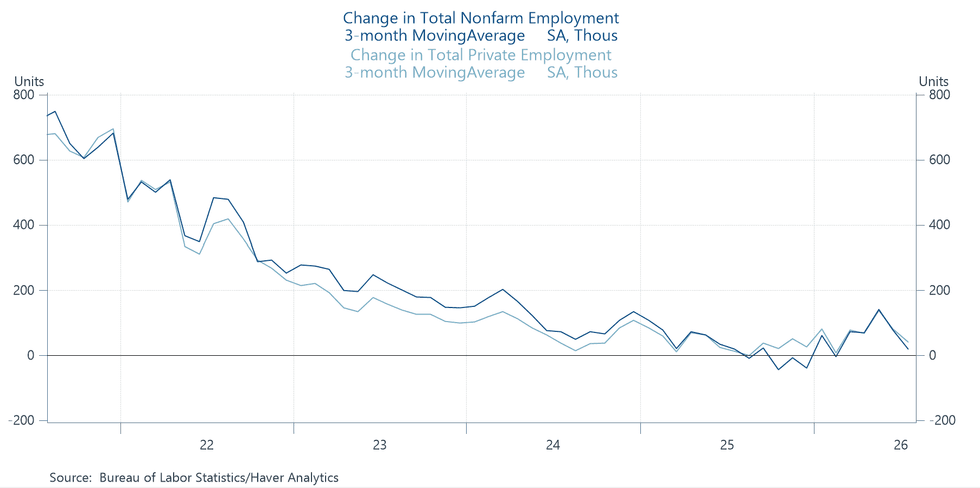
The nation’s payrolls surprisingly fell last month, down 23,000, driven by large losses in government jobs (and not federal, as you might expect, but local education). Revisions to payroll jobs were also negative, down 103,000 cumulatively for May and June, taking the average monthly job gains over the last three months down to a flimsy 20,000 jobs per month. That’s well below most estimates of the “breakeven” rate—the number of jobs needed to keep the jobless rate from rising.
And yet the unemployment rate ticked down to 4.1 percent. Whassup with that? First, this is a noisy indicator, and the breakeven mechanics requires averaging over numerous months to pull signal from noise. But re the monthly tick down, it happened for the wrong reasons: in the survey which tracks unemployment, both jobs and the labor force contracted in July. So that tenth-of-a-point tick down is not a sign of a tighter labor market.
My main message, however, is do not panic! Especially regarding the negative payroll number, the fact that it was partially driven by a 50,000 decline in local government education jobs, in a summer month, makes me wonder if there’s a seasonal adjustment problem here.
On the other hand—I haven’t used up my hands yet, have I?—as a long-time job-market-data whisperer, I’m not dismissing this report. It adds a data point to some longer-term trends that reveal fragility under the surface of what looks like a fairly tight labor market.
First, taking out the government sector and looking only at private-sector, three-month averages show flat job gains for about year, interrupted by a few better months earlier this year.
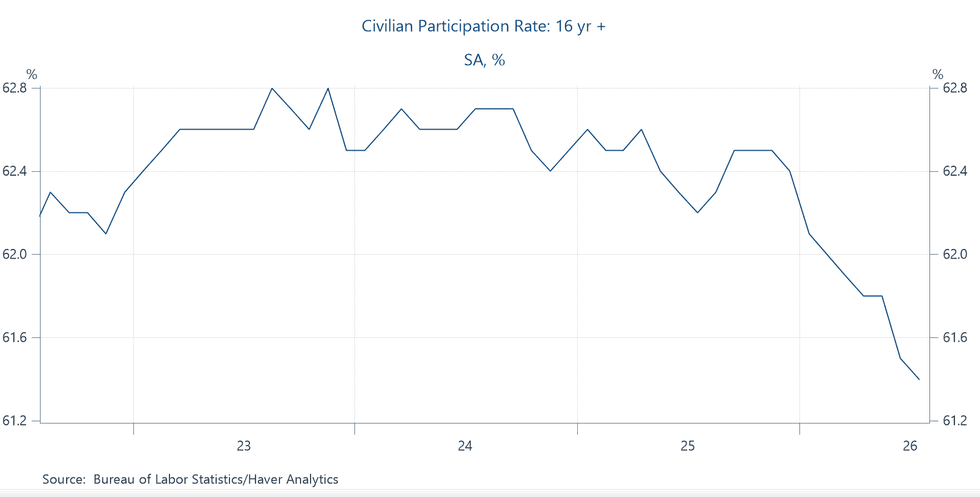
Second, labor force participation, which as noted, ticked down last month, is down by 0.8 percent over the past year. Yes, that series includes aging boomers and much weaker immigration, but it also reflects weaker underlying labor demand.
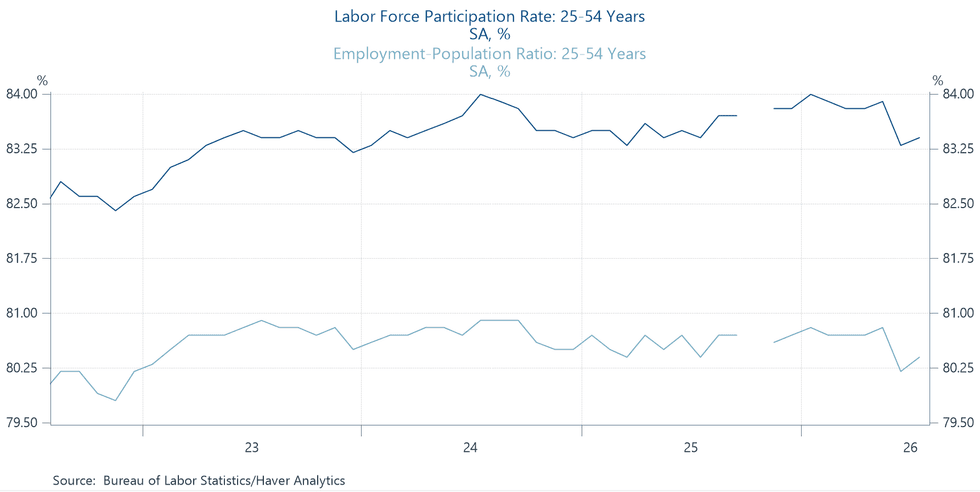
If we shift to prime-age workers (25-54), this labor force indicator along with the employment rate looks better, but there was a big dip in June that only slightly reversed in July.
Third, wage growth has decelerated. These monthly jobs report contain hundreds of statistics from two different surveys. As noted, trends in the key, high-level stats, like jobs added and movements in the unemployment rate, give one a decent sense of the tightness or slack the job market.
But nominal wage growth is also a helpful indicator in that regard. It’s by no means fully a function of labor market conditions—it reflects underlying productivity growth, employer versus worker bargaining clout, discrimination by race, gender, age, etc., minimum wages, tax policy, non-wage benefits, and more. But it definitely has a cyclical component as well, wherein less slack tends to correlate with faster nominal growth.
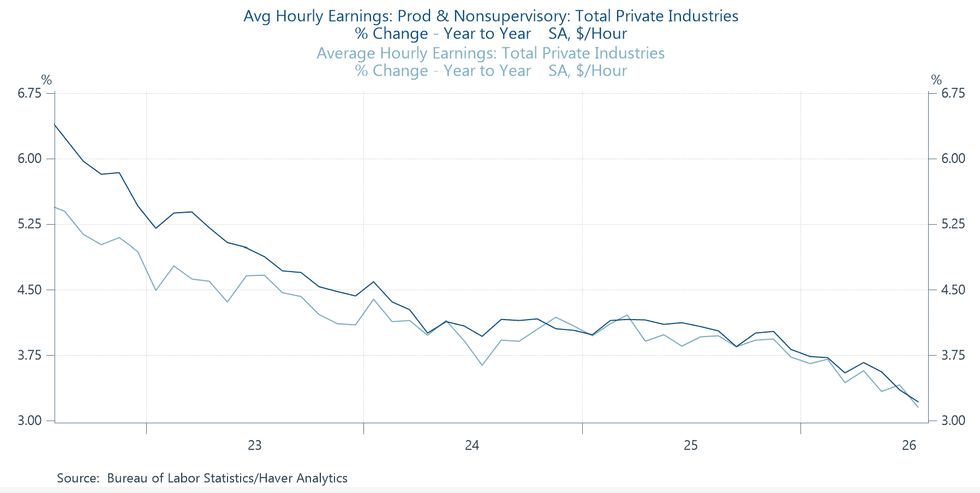
In July, private wages were flat on a monthly basis and up 3.2 percent, year over year. That’s the lowest yearly growth rate since the pandemic. Here’s both all private hourly wages and mid/low-wage.
So as not to be overly dependent on one survey, I also like to gaze at this wage tracker from Goldman Sachs Research, a mash-up of many different wage series (this doesn’t include today’s data). The deceleration is clear here as well, , as well as the above-noted cyclicality.
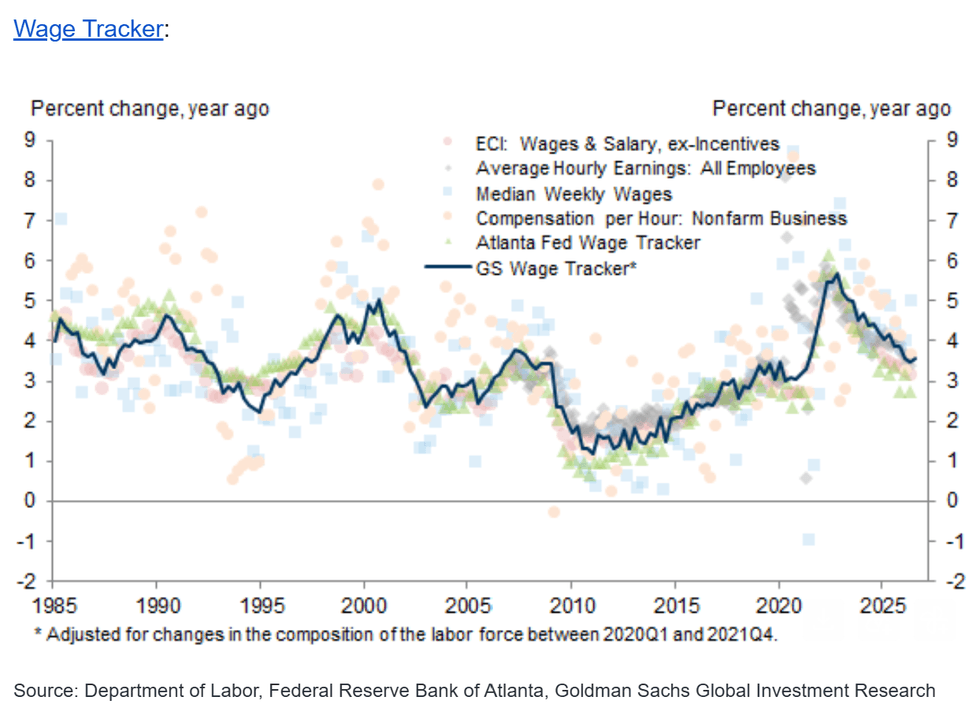
Perhaps most importantly from the perspective of consumers, these wage rates are not reliably outpacing inflation, which has been jumping around a lot due to energy prices and the war, but continue to growth at yearly rates well north of 3%.
Bottom line, 4.1 percent unemployment is low unemployment, any way you cut it, and that’s good. But the job market is more fragile than is usually the case at such an unemployment rate. As best we can tell, employment growth is not great—low-hire, low-fire prevails. Labor force participation looks a bit saggy, and wage growth shows little of the pressure I’d expect if things were all that solid in this space.
Sorry to be the many-handed economist, but it’s a somewhat foggy picture.
Jared Bernstein is a former chair of the White House Council of Economic Advisers under President Joe Biden. He is a senior fellow at the Council on Budget and Policy Priorities. Please subscribe to his Substack, from which this is reprinted with permission.
- Bad Policy, Bad Jobs Data -- So Trump Wants To Erase The Numbers ›
- Will Surging Tide Of Uninsured And Spiking Hospital Costs Trigger A Recession? ›
- Still No Jobs Report, But Trump's Labor Market Isn't Looking Good ›
- New Data Show Trump Tariffs Are Ruining Job Market ›
- Trump Economy's Weak Job Market Is Driving Down Wages As Prices Rise ›
- Trump Economy: July Inflation Index Shows Wages Fell Further Behind Prices - National Memo ›