Tag: 2026 midterm elections
As Midterm Polls Signal Blue Tsunami, GOP Is Frantically Waving The Flag

As Midterm Polls Signal Blue Tsunami, GOP Is Frantically Waving The Flag

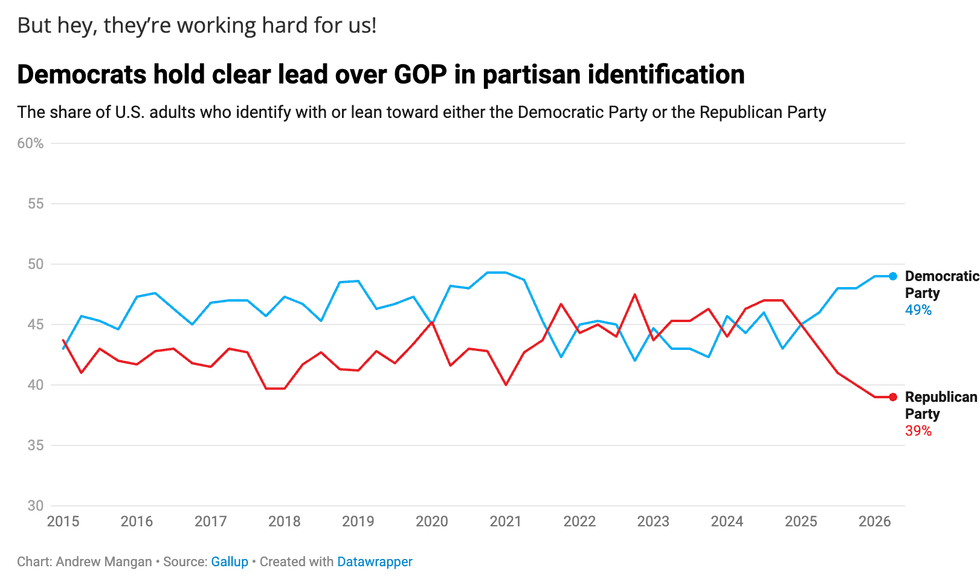
The latest New York Times/Siena University poll has devastating news for the GOP ahead of this year’s midterm elections.

In addition to a record-low approval rating of 37 percent for President Donald Trump, the generic congressional ballot had Democrats up by 10 percentage points, which jumped to a staggering 14 points among voters most likely to cast ballots.

Republicans can’t quit Trump. He won’t let them, even if they wanted to—and most don’t want to anyway. Trump has remade the GOP in his image, and they’re fine with it, no matter what the polls say.

But Republicans aren’t resigned to November losses. They have a dastardly new plan ready to go, one they think will dramatically reshape the political playing field this summer.

“A couple more states redistricting in a way that’s helpful for us, move into the summer with America 250, and a midterm convention at some point,” a “very senior Republican strategist” (Stephen Miller?) told NOTUS. “I think we’ve got some good touch points to kind of keep that momentum rolling.”

[Record scratch.]

Wait, the plan is what?

“We will make sure that people are aware of the fact that we are the party of patriotism and love of country, and the Democrats are just—I mean, there’s polling to support me on this,” a “second Republican strategist” (Dan Scavino?) said. “They are not proud to be Americans. It’s very obvious, and they can’t help themselves.”

Ah, yes. People can’t afford groceries or gas, but “patriotism and love of country” will definitely drive waves of Republicans and independents to the polls to punish Democrats for not, uh, celebrating hard enough?

Top it off with a “midterm convention”—Trump’s seemingly forgotten pre-midterm rally—and sure, Democrats are quaking in their boots.

“Loving America harder” isn’t the closing argument Republicans think it is.

Markos Moulitsas is founder and editor of the blogging website Daily Kos and author of three books.

Reprinted with permission from Daily Kos


Ron DeSantis

Virginia Redistricting: The Case For Democratic Gerrymandering

Virginia is for lovers—of democracy.

On Tuesday, Virginians will vote on whether to temporarily suspend the state’s bipartisan redistricting commission and allow Democrats to redraw its congressional map. Polls suggest the ballot measure will pass. And if that happens, Republicans would likely lose four House seats, leaving them with just one of the state’s 11. That makes for just nine percent of seats in a state where the GOP regularly wins about 44 percent of the statewide popular vote.

Put simply, Virginia will go from having a very fair map to a very biased one. So how is that good for democracy? Because Republicans have rigged maps across the country for decades, skewing the House’s overall partisan makeup, and Virginia’s proposed map would be merely a minor corrective.

In general, congressional delegations tend to be biased in Republicans’ favor. Among states with at least five House seats, there are five where Republicans regularly receive less than 50 percent of the statewide vote but hold a majority of that state’s House delegation: Arizona, Michigan, North Carolina, Pennsylvania, and Wisconsin.

There is not one state where the same is true for Democrats.

Most House maps are skewed to benefit Republicans

The difference between the Republican Party's share of a state's current House seats and the party's average share of that state's vote in recent statewide elections, among states with at least five seats

Statewide elections used in the average include the 2016, 2020, and 2024 presidential elections, as well as the state's most recent Senate election and gubernatorial election. Special elections are excluded. For states with ranked choice voting, the most recent election with a Republican and a Democrat in the final round of voting is used.Table: Andrew ManganSource: Dave Leip's Atlas of U.S. Presidential Elections; House of Representatives/Created with Datawrapper

The worst offender may be Wisconsin. Republicans hold 75 percent of the Badger State’s House districts but have won an average of just 48 percent of the vote in the state’s past three presidential elections and its most recent Senate race and gubernatorial race. At least in Virginia, Democrats routinely win a majority of the statewide vote.

Wisconsin’s skewed map is the result of more than a decade of Republican graft, and its effects have been especially egregious in years when Democrats have scored sizable statewide victories. In 2012, then-President Barack Obama won the state by seven percentage points, and Democrat Tammy Baldwin won her Senate race by nearly six points, but the Democratic Party picked up only three of the state’s eight House seats. In the other five districts, every Republican won their race by more than 11 points, showing that Democrats never stood a chance there.

The GOP is proud of their electoral manipulation—and they want to do more of it. In 2022, Republican gubernatorial candidate Tim Michels said at a campaign event, “Republicans will never lose another election in Wisconsin after I’m elected governor.” (Luckily, he lost to Democratic Gov. Tony Evers.)

North Carolina is a stranger case. Republicans hold 10 of 14 House seats, or 71 percent, despite pulling in only 48 percent of the vote in recent statewide elections. The thing is, until very recently, the Tar Heel State had a fair map.

Ahead of the 2022 midterms, the North Carolina Supreme Court ruled that the state’s map violated the law, and forced the adoption of a court-drawn map that resulted in an even split: seven Republicans, seven Democrats. A fair and honest map, no doubt. However, that fall, conservatives won a majority on that court, allowing the Republican-led state legislature to ram through a gerrymander that advantaged them in 10 House seats. And last year, the legislature made the map worse, likely stealing another seat from Democrats this November.

Which brings us back to Old Dominion.

Throughout the past year, GOP-led states took on the highly unusual project of mid-decade redistricting. North Carolina, Ohio, Missouri, and Texas all passed maps that are expected to tear a total of nine seats away from Democrats. But redrawn maps in California and Utah (on a judge’s order) should give Democrats six other seats. Virginia’s proposed map, if it goes into effect, would likely bring that up to 10.

This would render President Donald Trump’s midterm-stealing project a wash.

Mid-decade redistricting has produced incredibly skewed maps

The difference between the Republican Party's project share of a state's House districts and the party's average share of that state's vote in recent statewide elections, among states that completed mid-decade redistricting, plus Virginia

StateHouse seatsProjected GOP seatsProjected GOP share of seatsGOP's avg. statewide voteNew map's skew
North Carolina141178.6%48.2%R+30.3
Missouri8787.5%57.2%R+30.3
Ohio151280.0%54.3%R+25.7
Texas383078.9%53.6%R+25.4
Utah4375.0%55.1%R+19.9
California5247.7%37.2%D+29.5
Virginia*1119.1%44.4%D+35.3

* Virginia's map is not in effect. The projections on this table are based on a proposed map, which may go into effect only if voters approve a ballot measure on April 21, 2026.

That is, unless Florida also redistricts. Gov. Ron DeSantis has set a special session to begin on April 28, in which the legislature will consider further tilting the state’s gerrymander against Democrats. The GOP could draw a map to flip up to five Democratic-held seats. The trouble is, such a move would risk watering down red districts too much, which could backfire in a wave election, leading Democrats to win seats they otherwise would not. As such, state Republicans have been hesitant to act.

Whatever transpires, the Sunshine State’s map is already heavily biased. Republicans control 71 percent of its House districts but win only 54 percent of the statewide vote on average.

Of course, Democrats gerrymander too. Massachusetts and Connecticut have a combined 14 House seats, and Republicans hold not one seat in either, though their party regularly wins at least a third of the statewide vote. (The reverse is true in Oklahoma, where the GOP holds all five House seats, despite the fact that it wins just 63 percent of the statewide vote on average.)

The big difference is that only one party—the Democratic Party—is pushing to eliminate partisan gerrymandering altogether.

In March 2019, the House’s freshly minted Democratic majority passed the For the People Act. The bill sought to ban partisan gerrymandering nationwide, in addition to expanding voting rights and curtailing the influence of money in politics. Democrats saw these as their top priorities, bestowing the bill the honor of “H.R. 1,” which means it was the first introduced in the new session of Congress. No Republicans voted for it, and the Republican-controlled Senate refused to even bring it up for a vote.

The bill passed a Democratic-controlled House again, in 2021. Again, it was the party’s H.R. 1, and again, no House Republicans voted for it. Democrats ran the Senate that year but lacked the 60 votes necessary to pass it there.

Joe Manchin, at the time a Democratic senator from West Virginia, persuaded the party to dilute the bill in an effort to get bipartisan backing. The new bill, named the Freedom to Vote Act, would have implemented some voter-ID requirements but would have nevertheless expanded drastically ballot access and ended partisan gerrymandering. When it came up for a vote in the Senate, not one Republican supported it.

Democrats in the House and Senate have continued to introduce the Freedom to Vote Act in subsequent sessions of Congress, but with at least one chamber in the GOP’s hands following the 2022 midterms, it’s gone nowhere.

And it’s not as if the public is divided on the issue. Only nine percent of Americans think partisan gerrymandering should be legal, according to a YouGov poll from August. For context, that’s on par with the amount who believe that Bigfoot “definitely” exists.

Partisan gerrymandering is overwhelmingly unpopular

The share of U.S. adult citizens who think partisan gerrymandering should be legal or illegal

Survey conducted Aug. 1-3, 2025, among 1,116 U.S. adult citizens, with a margin of error of ±4 percentage points. Figures may not total 100% due to rounding.Chart: Andrew ManganSource: YouGov/Created with Datawrapper

Americans hate map-rigging, no matter the reason. The poll also finds that only 1 in 3 Americans says it is fair for states to gerrymander in response to other states doing it—i.e., what Virginia is doing this year.

It makes sense, too. Gerrymandering is deeply unfair at the state level. If Virginia allows Democrats to redraw the state map, Republican voters there will have a weaker voice in Congress than they would in a fair world.

But this is not a fair world. National Democrats are trying to give Americans the fair House elections they want, and Republicans are stopping it. Until gerrymandering is banned across the country, Democrats should make full use of the tools they have at their disposal.

Reprinted with permission from Daily Kos


Americans hate map-rigging, no matter the reason. The poll also finds that only 1 in 3 Americans says it is fair for states to gerrymander in response to other states doing it—i.e., what Virginia is doing this year.

It makes sense, too. Gerrymandering is deeply unfair at the state level. If Virginia allows Democrats to redraw the state map, Republican voters there will have a weaker voice in Congress than they would in a fair world.

But this is not a fair world. National Democrats are trying to give Americans the fair House elections they want, and Republicans are stopping it. Until gerrymandering is banned across the country, Democrats should make full use of the tools they have at their disposal.

Any updates?

  • Trump certainly sees China as our enemy, but Americans are warming to the nation. The Pew Research Center finds that 27% of Americans have a favorable view of China, up from a low of 14% in 2023. Funny thing is, that share has risen while the share that thinks Trump can capably deal with China has fallen. Sixty percent of Americans are not confident he can make good decisions regarding China, up from 49% in June 2024.
  • As the Trump administration lends a helping hand to our worst polluters, Americans are more negative than ever on the quality of the environment. Just 35% of Americans rate the quality of the environment in the U.S. as good or excellent, per Gallup. Who knew that aiding polluters would make our air and water worse?

Vibe check

As America becomes a hellscape, it makes sense people might turn toward God. What is surprising, though, is how abruptly that has happened with one group that’s typically the least religious: young men.

A new survey from Gallup finds that 42% of men ages 18 to 29 rate religion as “very important” to their lives, up from 28% in the previous round of polling. Those figures reflect two-year-averages, with the new share dating to 2024-2025 and the older share to 2022-2023.

It also marks the highest level of religiosity among young men since 2000-2001 (43%).

Historically, young women have been much more religious than young men. In the 13 rounds of data released by Gallup, young women have led young men 11 times. And their lead has often been quite large. In 2002-2003, young women were 16 points more religious than young men. And on average across all years, they’ve led men by 9 points.

Notably, young women continue their slide in religiosity. The latest round of data shows just 29% consider religion very important to them, a figure that’s tied with 2020-2021 for their all-time low.

The 14-point jump among young men also marks the largest increase between data periods among any age group of men and women. The closest change came among men ages 65 and older, whose religiosity fell 13 points between 2008-2009 and 2010-2011.

Turns out, all those Christ-fluencers on TikTok really are winning converts.

Daily Kos relies on small donations to make ends meet

Ad revenue can't support Daily Kos operations—and it hasn't been able to for more than a decade. Digital ad revenue has declined everywhere, especially for news organizations for whom it was once their lifeblood. Companies are spending less money on ads, and Amazon, Facebook and Google are gobbling up an ever-greater share of what remains. This has left almost nothing for places like Daily Kos. The only reason we've been able to survive is because of the support of readers like you. That's why we're asking: Can you take one minute right now to donate $5 or more to Daily Kos? It would mean so much to us.

One-timeMonthly$5$15$25Other$ORDonate withDonate with PayPal button6 Tags#2026#DonaldTrump#Gerrymandering#Midterms#Texas#Virginia

Was this story worth reading?

Recommending and sharing stories helps us decide which stories are most important to show our readers.

Recommend Story35Share:
by TaboolaSponsored LinksFROM THE WEBWhy Bread Never Went Stale in the 1950sOrvixTired of Pre-Mowing? Master Tall and Thick Grass EasilyLymow1.73 Acres. Every Day. Total Lawn Control, Hands-Free.LymowNew #1 Stock Emerges in Tech BloodbathChaikin AnalyticsNeuropathy is Not From Low Vitamin B (Meet The Real Enemy)Try-emsense.comCompact light, huge power—perfect for work, adventures, and everyday tasks.Olight

Trending List

Filled with excuses, Trump admits failure in his plot to rig midtermsElections

Filled with excuses, Trump admits failure in his plot to rig midterms

by Oliver WillisStaff

219

147April 15, 2026For Chrissake: Trump posts another Jesus AI picMedia and Culture

For Chrissake: Trump posts another Jesus AI pic

by Alix BreedenStaff

191

166April 15, 2026Trump kicks Kristi Noem while she’s downNews

Trump kicks Kristi Noem while she’s down

by Alix BreedenStaff

192

67April 17, 2026Trump’s panel of religious zealots decides the founders were wrongNews

Trump’s panel of religious zealots decides the founders were wrong

by Lisa NeedhamStaff

239

196April 16, 2026Vance draws embarrassingly small crowd at college eventNews

Vance draws embarrassingly small crowd at college event

by Emily SingerStaff

176

152April 15, 2026Welcome to your new Daily KosAnnouncements,Daily Kos

Welcome to your new Daily Kos

by kosStaff

254

1,003April 15, 2026Republicans are speeding toward doomsday scenario in TexasElections

Republicans are speeding toward doomsday scenario in Texas

by Emily SingerStaff

274

68April 17, 2026Dems should move to the rightCartoon

Dems should move to the right

by Jen Sorensen

227

113April 15, 2026

Power matters.

Sign up for our daily top stories newsletter so you don't miss how it's being used—and what comes next.

Email addressSIGN UP

The share of U.S. adult citizens who think partisan gerrymandering should be legal or illegal

Should be legalNot sureShould be illegalAll U.S. adult citizens9%22%69%Democrats7%13%80%Independents6%24%69%Republicans14%29%57%Survey conducted Aug. 1-3, 2025, among 1,116 U.S. adult citizens, with a margin of error of ±4 percentage points. Figures may not total 100% due to rounding.Chart: Andrew ManganSource: YouGovCreated with Datawrapper

A January 6 Rerun? Inside Trump’s Effort To “Take Over” The Midterm Elections

A January 6 Rerun? Inside Trump’s Effort To “Take Over” The Midterm Elections

This story was originally published by ProPublica.

In mid-December 2020, federal officials responsible for protecting American elections from fraud converged in a windowless, dim, fortified room at the Justice Department’s downtown Washington, D.C., headquarters.

They had been summoned by Attorney General William Barr.

Over the preceding weeks, Donald Trump’s claims that the presidential election had been stolen from him had reached a crescendo. He’d become obsessed with a conspiracy theory that voting machines in Antrim County, Michigan, had switched votes from him to Joe Biden.

With each day, Trump ratcheted up the pressure to unleash the might of the federal government to undo his defeat.

Barr interrogated experts from the Cybersecurity and Infrastructure Security Agency, crammed in beside top FBI officials around a cheap table. He needed the group of around 10 to answer a crucial question: Was it really possible the 2020 presidential vote had been hacked?

ProPublica’s description of the previously unreported meeting comes from several people who were in the room or were briefed on the gathering. Everyone understood that the meeting represented an important moment for the nation, they said. Barr, who did not respond to requests for comment, had walked a delicate line with Trump, instructing the FBI to investigate allegations of election irregularities while declaring publicly there had been no evidence “to date” of widespread fraud.

The nonpartisan specialists from CISA, backed by their FBI counterparts, explained they’d unravelled what had happened in Antrim County. A clerk had made a mistake when updating ballot styles on machines, leading to a software problem that initially transferred votes from Republicans to Democrats, they said. There was no fraud, just human error — which would soon be publicly confirmed through a hand count of the county’s ballots.

Listening intently, Barr seemed to understand both the truth and that telling it to the president would almost certainly cost him his job.

At the end of the meeting, Barr turned to his top deputy, made hand motions as if he was tying on a bandana and said he was going to “kamikaze” into the White House.

What happened next is well known. When Barr met with Trump in the Oval Office on Dec. 14, the president launched into a monologue about how the events in Antrim County were “absolute proof” that the election had been stolen. Barr waited to get a word in edgewise before telling his boss what the experts from CISA had told him.

Then Barr offered his resignation letter, which Trump accepted. Barr left believing he’d done his part to preserve democratic norms.

“I was saddened,” Barr wrote of Trump in his memoir. “If he actually believed this stuff he had become significantly detached from reality.”

Barr was one of many federal officials — most of them Trump appointees — who refused to bend to the president’s demands, which only intensified after Barr was gone. Although rioters inspired by Trump managed to delay the certification of his defeat by storming the Capitol on January 6, 2021, ultimately the institutional guardrails of American democracy held — barely.

But if faced with the same tests today, the guardrails and people that held the line would largely be missing, an examination by ProPublica found.

ProPublica scrutinized what happened the last time Trump lost a national election. Some of that happened in plain sight: After a cascade of defeats in court, Trump began pressuring state and local officials to overturn the results. But more happened behind the scenes, like the meeting that helped persuade Barr to hold the line.

Our reporting uncovered previously undisclosed aspects of a federal effort to safeguard the results of the 2020 vote, which involved at least 75 people across several agencies. Today, nearly all of those people are gone, having resigned, been fired or been reassigned, particularly in the departments of Justice and Homeland Security. That included the cybersecurity specialists who had established that the Antrim County allegations were false and reported their findings to Barr.

The people we identified as resisting attempts to overturn the 2020 results have been replaced by roughly two dozen people Trump has installed in positions that could affect elections. Ten of them actively worked to reverse the 2020 vote, and the rest are associates of such people. In some cases, ProPublica found, officials have been hired from activist groups that are pillars of the election denial movement. Experts warn that shows the movement has merged with the federal government.

These new officials could influence how Trump reacts to the upcoming midterms as polling shows Republicans are approaching what could be a significant electoral loss, with the president’s approval rating nearing record lows, and public concern growing about the weak economy, the administration’s mass deportation effort and the war on Iran. Seemingly in preparation to head off such a blow, Trump has stepped up his efforts to “nationalize” the 2026 elections, saying that Republicans need “to take over” the midterms. Democrats who monitored Trump’s attempts to block his 2020 loss have begun to question whether he will allow a “blue wave,” particularly if it flips control of a House of Representatives that impeached him twice in his first term.

ProPublica’s examination reveals new details on how the president has unleashed his loyalists to transform elections. This includes the background of this year’s FBI raid in Georgia to seize 2020 election materials and how they are using federal resources to search for noncitizens voting. Ultimately, ProPublica’s reporting shows how thoroughly and expansively the Trump administration has overhauled the federal government into what some fear is a vehicle for making sure elections go his way.

ProPublica’s reporting is based on interviews with roughly 30 current or former executive branch officials familiar with the work of Trump loyalists installed in election roles. Most spoke on condition of anonymity because they fear retribution, including those knowledgeable about the December 2020 Barr meeting.

The Trump administration maintains its actions will make U.S. elections fairer and more secure — and keep those prohibited from voting, such as noncitizens, from doing so.

“Election integrity has always been a top priority for President Trump,” White House spokesperson Abigail Jackson said in a statement. “The President will do everything in his power to defend the safety and security of American elections and to ensure that only American citizens are voting in them.”

Spokespeople for the DOJ and DHS emphasized that their departments are focused on ensuring elections are free and fair, and that they are working closely with the states to achieve those goals. Contentions to the contrary, they say, are false.

A few guardrails have endured, preventing Trump from fully realizing his agenda for elections. Judges have blocked key parts of a March 2025 executive order in which Trump attempted to exert greater federal control over aspects of voting, and some Republican state officials have fought back against Justice Department lawsuits demanding state voter rolls.

Late last month, Trump issued another executive order on elections that attempts to exert unparalleled federal control over mail-in voting and voter eligibility, which Democrats and voting rights groups are challenging in court.

Experts say 2026 will serve as an unprecedented stress test of the integrity of American elections.

“Our election system withstood” Trump’s “attacks following the 2020 election,” said Sen. Alex Padilla, a California Democrat who has led the pushback to the administration’s actions on elections, “but this will be an even tougher test, with more election deniers having access to federal power than ever before.”

The Dismantling

Barr has said that in the high-stakes days following the 2020 election, he felt like he was playing Whac-A-Mole with Trump’s “avalanche” of false election claims.

The investigators at DHS’ Cybersecurity and Infrastructure Security Agency supplied intelligence that disproved many of them, not just those involving Antrim County.

CISA was created by Trump in his first term to counter cyber threats in the aftermath of Russia’s efforts to influence the 2016 vote. It soon came to provide crucial expertise and support to thousands of local election officials grappling with increasingly sophisticated attacks.

After the 2020 election, it also played a crucial part in puncturing fallacies spread by Trump supporters, producing a “Rumor Control” website to rebut them. And it partnered with state officials and technology vendors to release a statement calling the election “the most secure in American history.” Trump swiftly fired Chris Krebs, whom he had appointed to lead CISA, but Krebs’ defense of the election’s soundness reverberated widely in the media and on Capitol Hill.

Among Trump’s first actions upon returning to the Oval Office was eviscerating CISA.

Starting in February 2025, DHS leadership put employees focused on countering disinformation and helping safeguard elections on leave. The leadership also froze the agency’s other election security work, which included assessing local election offices for physical and cybersecurity risks, and disseminating sensitive intelligence information on threats. Eventually, all three dozen or so CISA employees specializing in elections were fired or transferred to work in other areas.

“It took years of dedicated, bipartisan, cross-sector partnership to build the security infrastructure we’ve had, and dismantling CISA leaves a gaping hole,” said Kathy Boockvar, an elections security expert who served as Pennsylvania’s secretary of state from 2019 to 2021. “We are making the job of securing our democracy exponentially harder.”

A DHS spokesperson told ProPublica that the changes at CISA were in response to “a ballooning budget concealing a dangerous departure from its statutory mission,” which included “electioneering instead of defending America’s critical infrastructure.” The spokesperson said that CISA’s mission is still to coordinate protection of critical infrastructure, including by supporting local partners against cyber threats.

It isn’t just CISA that’s been gutted.

The Trump administration has discarded or diminished other federal initiatives with roles in protecting election integrity or blocking foreign interference. While many of these actions have been reported, together they reveal the full sweep of the changes.

First, the administration got rid of the National Security Council’s election security group, which convened departmental leaders to coordinate federal actions related to voting. Then in August, the administration dismantled the Foreign Malign Influence Center, a branch of the Office of the Director of National Intelligence that had stymied efforts by Russia, China and Iran to interfere in the 2024 election.

A spokesperson for ODNI said the center was redundant and that its functions were folded into other parts of the office’s intelligence apparatus in ways that “arguably makes our ability to monitor and address threats from foreign adversaries stronger, more efficient and more effective.”

However, former national security officials, including one who had worked at the center, told ProPublica that its functions had largely ceased. Caitlin Durkovich, who led the NSC’s election security work during the Biden administration, said that under Trump the federal government has “abandoned” its traditional role in preserving election integrity and security.

“Nearly every program and capability to stop bad actors and support election administrators has been dismantled,” she said. “Heading into the midterms, this leaves states and localities exposed, without the intelligence support or federal coordination they need to detect and respond to threats in real time — precisely when the stakes are highest.”

The early months of the second Trump administration also brought seismic changes to three parts of federal law enforcement with central roles in elections.

Kash Patel, the FBI’s new director, dismantled the public corruption team, which had been deployed in previous administrations to help monitor possible criminal activity on Election Day. The Foreign Influence Task Force, which aimed to combat foreign influence in U.S. politics, was also disbanded. (An FBI spokesperson said the bureau “remains committed to detecting and countering foreign influence efforts by adversarial nations.”)

Furthermore, the Justice Department substantially reduced the role of its Public Integrity Section, which had been responsible for making sure the department’s inquiries weren’t improperly influenced by politics.

After the 2020 election, senior lawyers in the section warned against having the FBI investigate fraud claims raised by Trump allies, saying that the agency’s involvement could damage its reputation and appear motivated by partisanship. In this instance, they were overruled by Barr and his deputies, but former officials said this was a rare case in which their guidance was ignored. The need to directly overrule the unit, they said, made it a roadblock — one that no longer exists.

A month after Trump returned to the Oval Office, the unit’s top staff resigned when agency leaders directed them to dismiss corruption charges against then-New York City Mayor Eric Adams. More resigned later or were transferred. The 36-person section was reduced to two. The administration no longer mandates that it review politically sensitive cases, according to multiple people familiar with the matter.

Another key DOJ office, the Civil Rights Division’s voting section, had enforced federal laws that protect voting rights, particularly those that combat racial discrimination. In December 2020, the assistant attorney general overseeing the Civil Rights Division was one of the many department leaders who said they would resign if Trump promoted Jeffrey Clark, a leader who supported Trump’s efforts to overturn the election results, to head the department after Barr’s resignation. This mass threat of resignation ultimately led Trump to not promote Clark.

But now, nearly all of the section’s roughly 30 career lawyers have resigned or been moved. This largely started last spring after Harmeet Dhillon, Trump’s assistant attorney general for civil rights, put out a memo saying their mission would shift from ensuring voting rights to enforcing Trump’s executive order on elections.

The Trump administration then filled the section with conservative lawyers who are now litigating against the lawyers they replaced. At least four of those newly appointed lawyers participated in challenging the 2020 vote or have worked with people who helped Trump try to overturn the 2020 election.

“It’s just a shocking and depressing reversal of the federal government’s role in making real the promise of nondiscrimination in voting and racial equality,” said Anna Baldwin, an appellate attorney for the Civil Rights Division who resigned last year and is now one of those litigating against the Justice Department in a new role at Campaign Legal Center.

The Justice Department didn’t respond to specific questions about the dismantling of the Public Integrity Section or the change in mission for the Civil Rights Division.

In all, at least 75 career officials who’d played important roles in elections work at DHS, DOJ and other departments have left or been fired, ProPublica found.

Team America

Late last summer, after the Trump administration had forced out most of the career specialists, a small group of political appointees began convening at the Department of Homeland Security’s headquarters.

The group — which once called itself “Team America,” according to sources familiar with the matter — looked for federal levers it could pull to make Trump’s March executive order about elections a reality, an effort that has not been previously reported.

They represented the new type of people running the show.

Its core members included David Harvilicz, a DHS assistant secretary tasked with overseeing the security of election infrastructure, including voting machines, and three of his top staffers. As ProPublica has reported, Harvilicz had co-founded an AI company with an architect of Trump’s claims about Antrim County.

Despite the setbacks the executive order had met with in court, there “was not a whole lot of discussion or disagreement” about acting on the directive from Harvilicz or one of his deputies, said a former federal official who interacted with group members. “It was just us saluting to do it.”

This small group was part of a wider team at DHS, DOJ and the White House seeking to push forward the president’s agenda. Some of Trump’s new guard are well known: After the 2020 election, Patel pressured military officials to help investigate a conspiracy theory about voting machines, according to a former Justice Department official. (Patel did not respond to a request for comment but claimed in congressional testimony that he did not recall the event.) Others, like Harvilicz, are more obscure but still wield consequential powers.

These newcomers are seeking to carry out Trump’s executive orders and are unlikely to push back against his false claims that American elections are rife with fraud.

Team America members have echoed or spread such material themselves.

Heather Honey, who serves under Harvilicz in a newly created position focused on elections, falsely asserted that there were more ballots cast in Pennsylvania than voters in the 2020 presidential election. Trump cited this claim, which has been traced back to her, while exhorting his followers to march on the Capitol on January 6, 2021.

At least 11 administration appointees, including Honey, have ties to the Election Integrity Network, a conservative grassroots organization seeking to transform American elections. It is led by Cleta Mitchell, a lawyer who tried to help Trump overturn the 2020 election. Gineen Bresso, who holds a top job in the White House counsel’s office, coordinated with the network’s leadership in 2024 as the Republican National Committee’s election integrity chair, ProPublica has reported. Since moving into government, Honey has maintained close ties to Mitchell’s organization, and she and at least two other federal officials have given its members private briefings.

Experts say these former activists who helped forge a movement built on the idea that the 2020 election was stolen from Trump are seeking to make sure that does not happen again.

“The election denial movement is now interwoven within the federal government, and they are working together toward a shared goal of reshaping elections” in ways that undermine the freedom to vote, said Brendan Fischer, a director at the Campaign Legal Center, a nonpartisan, pro-democracy legal organization. “It’s not just last-minute slapdash attempts to overturn the results” as in 2020, “but more systematic efforts to influence how elections are run months ahead of time.”

In response to questions sent to DHS, Harvilicz and Honey, a DHS spokesperson disputed that they were seeking to use the department’s powers to advantage Trump, writing that its employees “are focused on keeping our elections safe, secure, and free” and working to “implement the President’s policies.” In response to questions about their ties to the election denial movement, the spokesperson wrote, “To meet the diverse and evolving challenges the Department faces, we hire experts with diverse backgrounds who go through a rigorous vetting process.”

Mitchell did not respond to detailed questions from ProPublica. The White House answered questions sent to Bresso about her connection to Mitchell’s network by reiterating its commitment to making American elections secure.

Through the fall and winter, as the Justice Department demanded that states turn over confidential voter roll information, Team America worked to solve problems hindering the use of digital tools to comb the lists for noncitizens who had illegally registered to vote. Honey and others ironed out the technical details of merging information from different agencies and crafted data-sharing contracts. When Honey or others hit roadblocks, they’d go to the White House or senior DHS leaders who “would come in hot” to clear her path, said officials who interacted with them.

Initially, the plan was to run voter information obtained by DOJ through a Homeland Security tool called the Systematic Alien Verification for Entitlements system.

More recently, according to two people familiar with the matter, Team America has worked to harness a more powerful tool used by another branch of DHS, Homeland Security Investigations, to increase its ability to search for noncitizen voters and bring criminal charges against them.

While DHS told ProPublica that SAVE has identified more than 21,000 potential noncitizens on voter rolls in the past year, officials who have checked those results in detail have found vast inaccuracies, as ProPublica has reported. Most states — including those with millions of voters — have eventually marked only a few to a few hundred potential noncitizens as registered to vote, and far less have ever voted. The DHS spokesperson also called SAVE “secure and reliable.”

As the election approaches, current and former officials and election security experts expressed concerns that Harvilicz and Honey, who’ve espoused debunked conspiracy theories about elections, are in positions to control the narrative around the vote’s soundness.

It’s hard to debunk false claims “coming with the seal of the federal government,” said Derek Tisler, counsel and manager with the Brennan Center for Justice’s elections and government program. “I certainly worry what damage that could do to voters’ confidence.”

Red Flags

Perhaps nothing better reflects the breakdown of the guardrails that thwarted Trump’s rashest impulses in 2020 than his creation last fall of a special White House post reinvestigating his loss to Biden.

In December 2020, just days after Barr rebuffed Trump’s Antrim County claims, lawyers in the White House counsel’s office helped prevent the president from heeding activists’ call to essentially declare martial law to seize voting machines. This multihour shouting and cussing match has been called the craziest meeting of the first Trump administration.

But the lawyer whom Trump hired in 2025 as his director of election security and integrity, Kurt Olsen, had worked to overturn Trump’s loss in court in 2020 and was later sanctioned by judges, including for making baseless allegations about Arizona elections.

Olsen’s work in the second Trump administration has breached the firewall between the White House and DOJ officials, established after Watergate to prevent law enforcement officers from making decisions based on political pressure, said Gary Restaino, a former U.S. attorney in Arizona.

“This is not a constitutional or even a statutory requirement,” Restaino said, “but it’s a democracy requirement to make sure that citizens throughout America understand that decisions about life and liberty are being made in an objective and consistent manner.”

In a previously unreported series of events, around the end of 2025, Olsen flew to Georgia to meet with Paul Brown, the head of the FBI’s Atlanta field office, according to people familiar with the matter.

Olsen wanted the FBI to seize 2020 ballots from Fulton County, a Democratic stronghold, and gave Brown a report he claimed would justify the extraordinary action. Brown and his team emphasized to Olsen that any investigation his team did would be independent and fair.

When Brown and his team examined the report, they found that Georgia’s election board had already looked into its allegations, dismissing many altogether, and concluding that others came down to human error, not criminal wrongdoing. The report had been assembled by a longtime ally of Olsen’s and participant in the Election Integrity Network who had a history of discredited claims, ProPublica has reported.

Based on their own investigation, Brown’s team submitted an affidavit to their superiors at DOJ that did not make a strong enough case to move forward with what Olsen wanted.

Soon after, Brown was offered a choice: retire or be moved to a new office, people with knowledge of the exchange told ProPublica.

Olsen did not respond to requests for comment.

An FBI spokesperson said that Brown “elected to retire” and that its “work in the election security space is entirely consistent with the law.”

Brown’s ouster after refusing to carry out the seizure of 2020 election materials has been reported, but Olsen’s involvement and the details of their interactions leading to Brown’s retirement have not been previously disclosed.

With Brown gone, the case moved ahead under his replacement.

Trump administration officials also took another step to keep control of the investigation.

Then-Attorney General Pam Bondi chose Thomas Albus, whom Trump had appointed as U.S. attorney for the Eastern District of Missouri, to prosecute the case even though it fell far outside his usual regional jurisdiction. Albus had been meeting with Olsen since around the time the White House lawyer was hired, ProPublica has reported. (Albus declined a request for comment.)

In late January, the FBI carried out an unprecedented raid in Fulton County — and the agency’s affidavit, put together by Albus and Brown’s replacement, cited a version of the report Olsen gave to Brown as evidence supporting the seizure. ProPublica was part of a news coalition that sued to unseal the affidavit.

An FBI spokesperson said that its agents “followed all procedure to ensure everything was in proper order, and FBI evidence team had the necessary court-authorized search warrant before they arrived on site.”

Ryan Crosswell, who worked in the Justice Department’s Public Integrity Section for around half a decade, handling a number of election cases, called Brown’s replacement and Albus’ involvement a “red flag” because of the unusual circumstances of their appointments.

“They’re just moving through people until they find someone who’s willing to do exactly what they want,” Crosswell said.

The Justice Department did not respond to a question about Crosswell’s comment.

The extraordinary raid was also enabled in a previously unreported way by the destruction of the DOJ’s Public Integrity Section.

Multiple former lawyers for the section said they likely would have tried to block the Fulton County investigation because it lacked strong evidence, had a clear political slant and went against department directives that actions should not be taken “for the purpose of giving an advantage or disadvantage to any candidate or political party.”

Crosswell said, “Based on everything we know, if PIN was still there, we’d say no.”

John Keller was principal deputy chief of the Public Integrity Section from 2020 to 2025 and was acting chief when he resigned in early 2025. He worries that allegations of irregularities in the upcoming election will be handled on a partisan basis.

“Without that review and without apolitical, objective, honest brokers involved in the process, there is a much greater risk for intentional manipulation or inadvertent interference,” Keller said.

“Dismantling the Brain”

The week the FBI seized Fulton County’s ballots, about half of the nation’s secretaries of state converged on Washington, D.C., for their winter conference.

They had urgent questions about elections for Bondi, then-DHS Secretary Kristi Noem and other luminaries who had promised to appear at the event. But none of the headline names showed, leaving conference attendees staring at an empty podium, until the session was abruptly canceled.

The breakdown was emblematic of a widening chasm between state officials and the parts of the federal government that had, until recently, worked with them to secure American elections.

Shenna Bellows, Maine’s Democratic secretary of state, said in an interview that the trust between the Trump administration and states is “absolutely demolished.”

This loss of trust reflects that election deniers have assumed so many top roles at federal agencies. Honey sometimes represents DHS on cross-departmental conference calls with state election chiefs, an unsettling reality for those who spent years countering the false claims she made from outside the government.

On a February call, state officials expressed confusion about whether the Cybersecurity and Infrastructure Security Agency would still assess their election systems for physical and cyber vulnerabilities. Honey said it would, but Bellows said she’d been told it wouldn’t.

Two DHS officials told ProPublica that CISA’s remaining staff avoids election work, afraid they could lose their jobs if they engage with state and local officials. “In CISA, elections are a toxic poison,” one said.

A DHS spokesperson said state and federal officials are still working together “every single day” to protect elections and that “The claim that DHS has a broken partnership with states and made our elections less secure is simply false.”

The cuts to career election specialists and their divisions have eliminated information channels that spotlighted threats as voting took place, including Election Day command posts run by the Justice Department and FBI. Another information channel, which DHS used to fund, will still operate but will be available only to state and local election offices, not the federal government.

Jessica Cadigan, a former FBI intelligence analyst who investigated Election Day threats, said FBI headquarters’ command post was critical to her cases.

“That is dismantling the brain, if you will,” she said. “They are the ones that piece the whole thing together.”

An FBI spokesperson said the agency will still have capabilities to monitor the situation on the ground through designated election crimes coordinator experts in all its field offices.

Jena Griswold, Colorado’s Democratic secretary of state, has come to see the federal government as adversarial to elections and election administration, rather than a partner.

Colorado is one of around 30 states the Justice Department has sued for confidential voter roll information. At least four courts that have fully considered those cases so far have dismissed them, although the Justice Department has appealed most of the decisions. (The others are pending.) Griswold told ProPublica she has added another lawyer to her staff to fight whatever comes next from the Trump administration.

“Donald Trump,” she said, “has made American elections less safe.”

Republicans Signaling Fear That Midterm Will End Their House And Senate Majorities

Republicans Signaling Fear That Midterm Will End Their House And Senate Majorities

Republicans have expressed fears both publicly and privately that their congressional majorities are in serious danger in November, as voters angry with President Donald Trump’s war in Iran and the fact that it’s making life even more unaffordable in the United States threaten to punish the GOP at the ballot box.

But now they have moved on from merely talking about those fears to taking concrete steps that make it clear they know their prospects are dire and that they are on track to lose control of not just the House but the Senate, too.

On Tuesday, Senate Majority Leader John Thune said he is taking steps to ensure that Republicans will be ready to replace Supreme Court justice Samuel Alito should he choose to retire this summer, giving a little hint-hint to the 76-year-old with a lifetime appointment who was recently hospitalized with an unspecified illness.

“That’s a contingency I think around here you always have to be prepared for. And if that were to happen, yes, we would be prepared to confirm,” Thune told a reporter from the Washington Examiner.

Even Trump himself brought up the possibility of Alito, as well as famously corrupt Justice Clarence Thomas, retiring before the midterms, telling Fox Business’ Maria Bartiromo on Tuesday that the late Ruth Bader Ginsburg made a mistake by not retiring earlier because he got to fill her seat on the nation’s highest court.

“She decided that she was going to live forever, and about two minutes after the election, she went out, and I got to appoint somebody,” Trump told Bartiromo, in what sounded like yet another nudge at Alito and Thomas.

Indeed, pushing out an aging Supreme Court justice before the midterms is a massive tell that Republicans are worried they will lose the Senate majority, and thus their ability to confirm Trump’s judicial nominees. (It’s also wildly hypocritical, as now-former Senate Majority Leader Mitch McConnell stole a Supreme Court seat by claiming the vacancy came too close to an election, but I digress.)

Back in January, political analyst Jacob Rubashkin, deputy editor of the nonpartisan political handicapping outlet Inside Elections, said that this very situation would be a tell that Republicans were scared of losing the Senate.

“We’re still a ways away from this so keep it saved in your bookmarks, but one way we will know if Republicans become truly concerned about losing the Senate is if there’s chatter or even pressure on Thomas and/or Alito to retire this summer,” Rubashkin wrote in a post on January 6.

Welp …

Meanwhile on Tuesday, Punchbowl News reported that Florida GOP Gov. Ron DeSantis is getting cold feet about rigging—uh, sorry, redrawing -- his state’s congressional map.

While the Trump lackey was previously bullish that Republicans could extract as many as five more House seats in the state, DeSantis is now worried that the midterm environment—including shifts in Florida—will be so bad for Republicans that creating more nominally Republican seats could actually backfire. Spreading out GOP voters could turn Florida’s map into a dummymander—a political term that means an intended gerrymander actually winds up benefitting the other party.

What’s more, Republicans are sending Vice President JD Vance to campaign in Iowa, yet another sign that this otherwise reliably Republican area is slipping away from the GOP as Trump’s tariffs and war in Iran decimate the agricultural backbone of the state. Iowa was also the first state Trump himself traveled to on his midterm campaign tour.If Republicans are having to campaign in a state Trump carried by double digits in 2024, they are in some serious doo doo this fall.

Of course, sending Vance to campaign for vulnerable Republicans is likely not the best idea, as he’s not only unpopular but has also turned out to be bad luck for other candidates he’s stumped for.

Yet desperate times call for desperate measures.

So the midterms are shaping up to be a disaster for the GOP? Good.

Reprinted with permission from Daily Kos

Shop our Store

Headlines

Editor's Blog

Corona Virus

Trending

World