Judge Brian Murphy
So much damage has already been done.
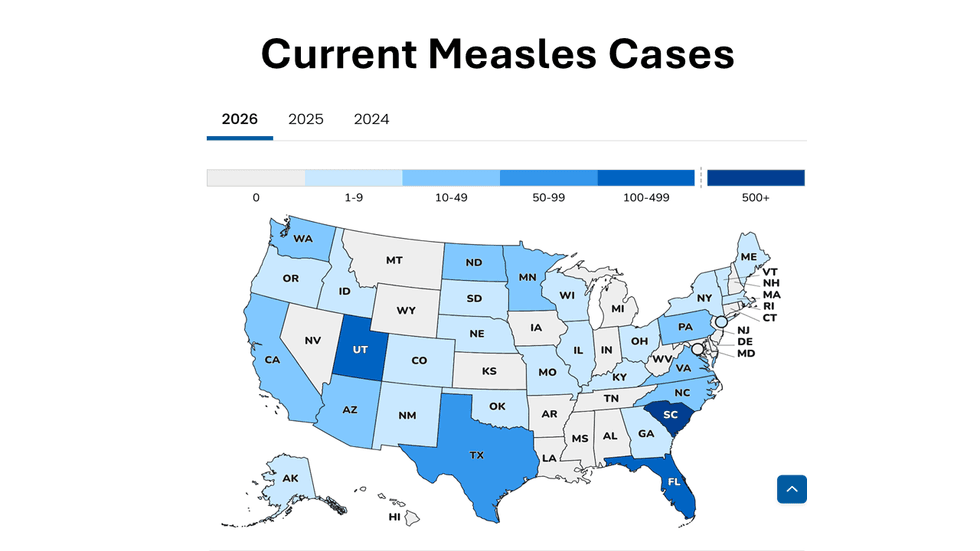
Measles outbreaks are raging in four Red states. The Center for Disease Control and Prevention has dramatically scaled back its vaccine recommendations. Vaccination rates among young children are plummeting, especially in the South and rural West. Manufacturers are backing away from developing new vaccines.
In recent months, the Trump administration’s CDC, under the thumb of Health and Human Services Secretary Robert F. Kennedy Jr., has stopped recommending six routine childhood vaccines, including the flu, hepatitis A, rotavirus and meningococcal shots.
It will take years to undo the damage this already has done and will continue to do to public health until those policies are reversed. Here’s hoping this week marks the beginning of a turnaround.
Yesterday Massachusetts federal judge Judge Brian E. Murphy forbade the CDC’s newly-appointed Advisory Committee on Immunization Practices from taking further action to dismember U.S. vaccine policy. He ruled Kennedy violated federal law last June when he summarily fired the standing 17-member Advisory Committee on Immunization Practices (ACIP) and appointed eight replacement members, most of whom are avowed vaccine skeptics or critics of the Biden administration’s Covid policies. Another two appointed in January are similarly biased.
That’s not how Kennedy described his action nine months ago. He called the standing committee “a rubber stamp for industry profit-taking agendas.” He promised his hand-picked replacement committee would follow “unbiased science—evaluated through a transparent process and insulated from conflicts of interest.”
Kennedy violated both of those legal requirements, the judge ruled in a suit filed last year by the American Academy of Pediatrics and the American Public Health Association. “There is a method to how these decisions historically have been made—a method scientific in nature and codified into law through procedural requirements,” the 45-page order said. “Unfortunately, the Government has disregarded those methods and thereby undermined the integrity of its actions.”
He continued: “The Government bypassed ACIP to change the immunization schedules, which is both a technical, procedural failure itself and a strong indication of something more fundamentally problematic: an abandonment of the technical knowledge and expertise embodied by that committee.”
A Law Nixon Signed
The Federal Advisory Committee Act, signed into law in October 1972, requires agencies vet potential members of outside advisory committees for bias and conflicts of interest. It also requires the public be allowed to review and comment on the nominees. If an agency chooses someone with a conflict of interest, which can include a demonstrated intellectual bias, it must issue a waiver that documents why that particular person’s expertise is necessary before allowing them to serve.
(Full disclosure: I spent 2004 to 2009 at the Center for Science in the Public Interest monitoring science-based federal advisory committees’ compliance with FACA. I also served on Food and Drug Administration advisory committees. I am familiar with the law.)
Kennedy did none of that, drawing a black curtain around his promised “transparent process.” There was no public input before Kennedy made his choices. And there is no evidence (the FACA database, operated by the General Services Administration, has been non-operational for months) that any received waivers despite clear evidence that many had preconceived notions about the direction the committee should take.
Lawyers for the plaintiffs hailed the judge’s ruling. “This is a tremendous victory for science, for public health, and for the rule of law,” Richard Hughes IV, a partner at Epstein Becker & Green, told Stat News. A spokesperson for HHS said the agency would appeal.
Not 'A Reckless Ideologue'
The vice chairman of the new ACIP committee is Robert W. Malone, a physician and adjunct professor at Louisiana State University who has posted numerous articles on his Substack expressing doubts about current vaccine policy. He claimed in his post yesterday that “Kennedy’s reforms are not the work of a reckless ideologue (but) represent a serious effort to apply rigorous scrutiny to vaccine recommendations that have gone largely unquestioned for decades.”
Rigorous scrutiny? The evidence presented at the early December meeting of the reconstituted ACIP compared the U.S. to Denmark, a small, homogeneous country with far fewer health problems. It elevated patient and parental “choice” to a core principle of vaccine policy, not adherence to medical science.
The committee recommended the CDC scale back its vaccine recommendations. The administration formalized that action in a long memo a month later when acting CDC head Jim O’Neill unilaterally reduced the number of recommended childhood vaccines from 17 to 11. That step was taken “without public comment, and without initial review of the evidence by designated advisory bodies,” according to former public health officials now at Manatt Health, a consulting firm. (The CDC only makes recommendations; states are free to set their own policies when it comes to public health.)
It’s likely Trump administration lawyers will find a friendly appeals court to lift the order. Any formal reversal in the destructive vaccine policy that is now official will have to await a change in administration, if and when it comes.
I’ll leave the last word to Families USA executive director Anthony Wright. “When politics override science, our children pay the price. Today’s decision helps ensure that medical evidence – not ideology – guides how we protect kids from preventable diseases. With this decision, patient and consumer advocates will continue to advocate for clear, evidence-based advice and access to key vaccines, fully covered without cost-sharing or other barriers…
“We commend the court for this ruling, but families should not have to depend on litigation to ensure their child can receive a routine vaccine. Evidence-based medicine keeps children alive and in school. Preventing disease should be the foundation of any healthcare system serious about confronting the next disease outbreak or finding the next cure.”
Merrill Goozner, the former editor of Modern Healthcare, writes about health care and politics at GoozNews.substack.com, where this column first appeared. Please consider subscribing to support his work.
Reprinted with permission from Gooz News
- Kennedy Can't Resist The Adulation Of His True Political Base: Online Cranks ›
- Too Little, Too Late: RFK Jr. Suddenly Is Promoting Measles Vaccination ›
- As RFK Jr. Shatters The Promise That Got Him Confirmed, Who's Calling The Shots? ›
- Why Fox News Is Pushing Anti-Vax RFK Jr As A 'Child Health' Advocate ›
- Deadly Outbreak: When RFK Jr's Vaccine Lies Killed Samoan Kids (VIDEO) ›
- As CDC Spirals Into Chaos, Fox Spins For Bobby Kennedy ›
- With New Vaccine 'Guidelines,' Kennedy Makes America Sick Again ›
- Blocking Vaccines, RFK Jr. Guarantees 'A Lot Of Americans Are Going To Die' ›
- Kennedy Violates Agreement On CDC Vaccine Guidance, Putting Millions At Risk ›
- RFK Jr’s pick to review Covid vaccines authored misleading research, experts say | Robert F Kennedy Jr | The Guardian ›
- Federal judge blocks RFK Jr’s overhaul of vaccine recommendations | Robert F Kennedy Jr | The Guardian ›
- U.S. judge upends Kennedy's overhaul of childhood vaccine policies ›
- Judge blocks changes to US government vaccine recommendations | AP News ›