Tag: america 250
Vibes Off: Trump's Tacky Birthday Celebration For America Is Historic Cringe

Vibes Off: Trump's Tacky Birthday Celebration For America Is Historic Cringe

In his second term, Donald Trump scored one of the biggest gimmes in presidential history: His term included America’s 250th birthday. How easy it should have been to unite the nation—at least a little, at least briefly—under a common star-spangled banner.

Instead, he has failed to find popular support for the key events in his semiquincentennial project.

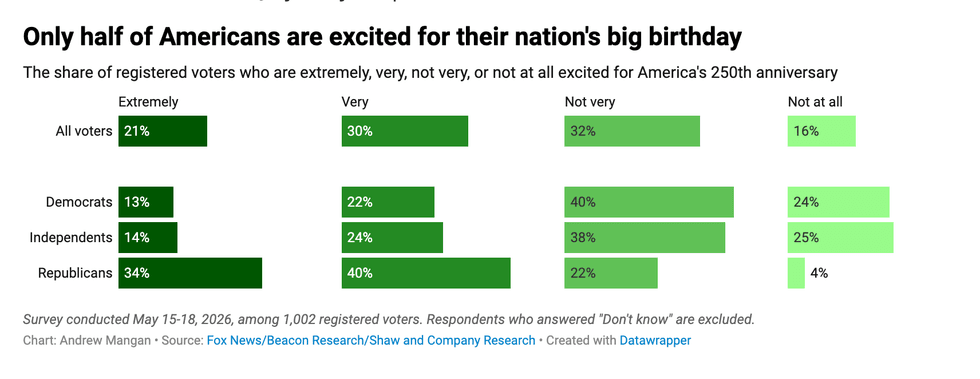
Only 51 percent of voters report being “extremely” or “very” excited for America’s 250th anniversary, according to a poll conducted for Fox News. That’s about the same as the share of Americans who celebrated the Fourth of July last year, per YouGov data.

Chart by Andrew Mangan/Source: Fox News/Beacon Research/Shaw and Company ResearchCreated with Datawrapper

Excitement isn’t matching the occasion, and Trump is the most to blame. He doesn’t know how to throw a party.

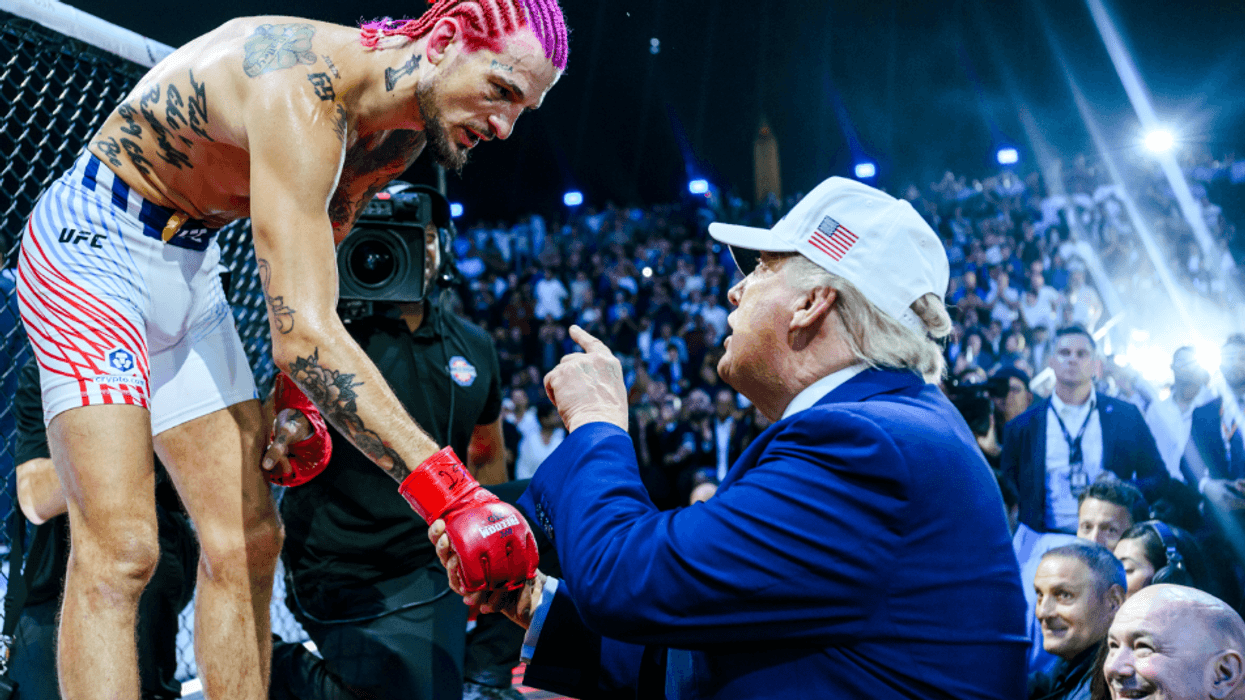
Take the UFC fight. On June 14, on a stage on the White House’s South Lawn, men bloodied each other across seven bouts of mixed martial arts. Trump watched the entire show, despite his penchant for sleeping through or dipping out early from other sporting events.

By and large, though, Americans didn’t care. Only 26 percent told YouGov they were interested in watching the fight. Meanwhile, 67% weren’t interested, including 53 percent who were “not at all interested.” As much as they did care, a majority of Americans (51%) disapproved of the fight being held at all, another YouGov survey found. Only 27 percernt approved.

An average of 7 million Americans streamed the fight. Though that may be a live-event record for Paramount+, it’s only about 18 percent of the live domestic viewership of Netflix’s 2024 boxing match between Mike Tyson and Jake Paul.

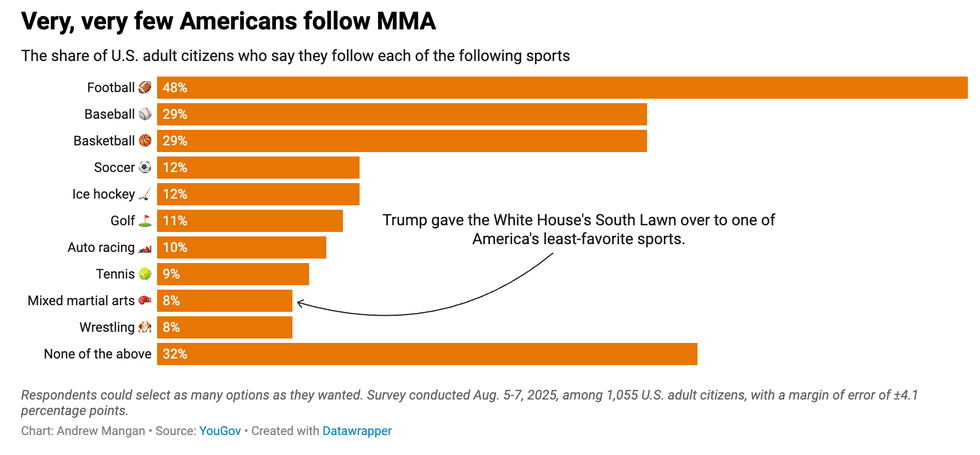
Such paltry numbers shouldn’t surprise anyone. MMA, which the late Arizona Sen. John McCain once derided as “human cockfighting,” is tied with wrestling for the least-popular sport in America, according to a 2025 YouGov poll. The UFC itself has the second-worst favorability of any major U.S. sports organization, after the WWE. And YouGov finds that only 38 percent of Americans know who the sport’s most well-known contemporary personality is (Anderson Silva). Compare that with tennis, which isn’t much more popular in the U.S., and yet 81 percent of Americans know of Venus Williams.

Chart by Andrew Mangan/Source YouGovCreated with Datawrapper

Larry David, the famed TV writer and co-creator of “Seinfeld,” summed up many Americans’ take on the fight, telling Variety on Tuesday, “It was embarrassing. I was embarrassed to be an American.”

And yet the fight may not have been Trump’s biggest misstep on the march toward July 4. After all, at least “UFC Freedom 250” happened. The same isn’t true for the planned concert from Freedom 250—which is the White House initiative working independently of the bipartisan America 250 effort. Trump was forced to cancel that show after nearly all the acts dropped out.

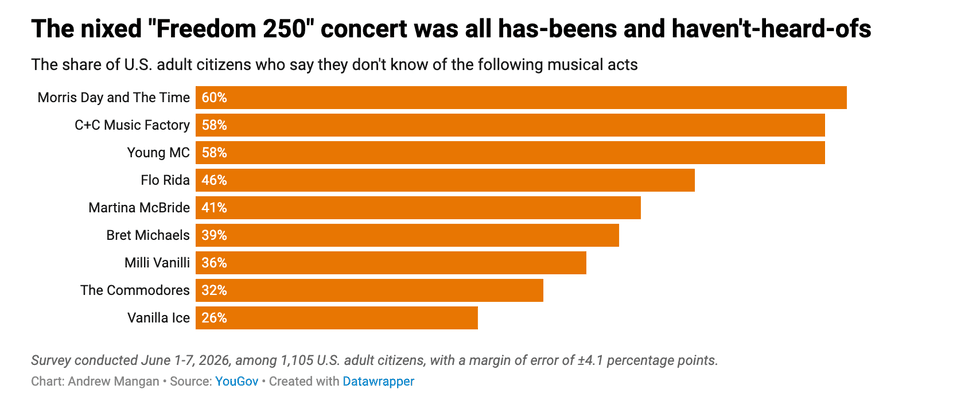
But even if that concert had gone on as planned, it would have been a dud. Roughly 60 percent of Americans hadn’t heard of three of the nine announced acts, per YouGov. Only two—one-hit wonder Vanilla Ice and 1980s funk group Commodores—were known by at least two-thirds of Americans.

Chart by Andrew Mangan/ Source YouGovCreated with Datawrapper

In August, the “Freedom 250 Grand Prix” is scheduled to take place on the streets of Washington, but its viewership may prove less impressive than that of the UFC fight. May’s Indianapolis 500, IndyCar’s centerpiece race, was watched by an average of just 6.6 million viewers. If the D.C. race manages to top that, it may be due to pure gawk factor alone. Our nation’s capital, now the trashy site of car racing and cage fights.

Americans just aren’t hungry for what Trump is slinging. The vast majority (71 percent) say small local events feel like a more authentic way to commemorate the occasion, while just 30 percent prefer large national events, according to a recent Elon University poll.

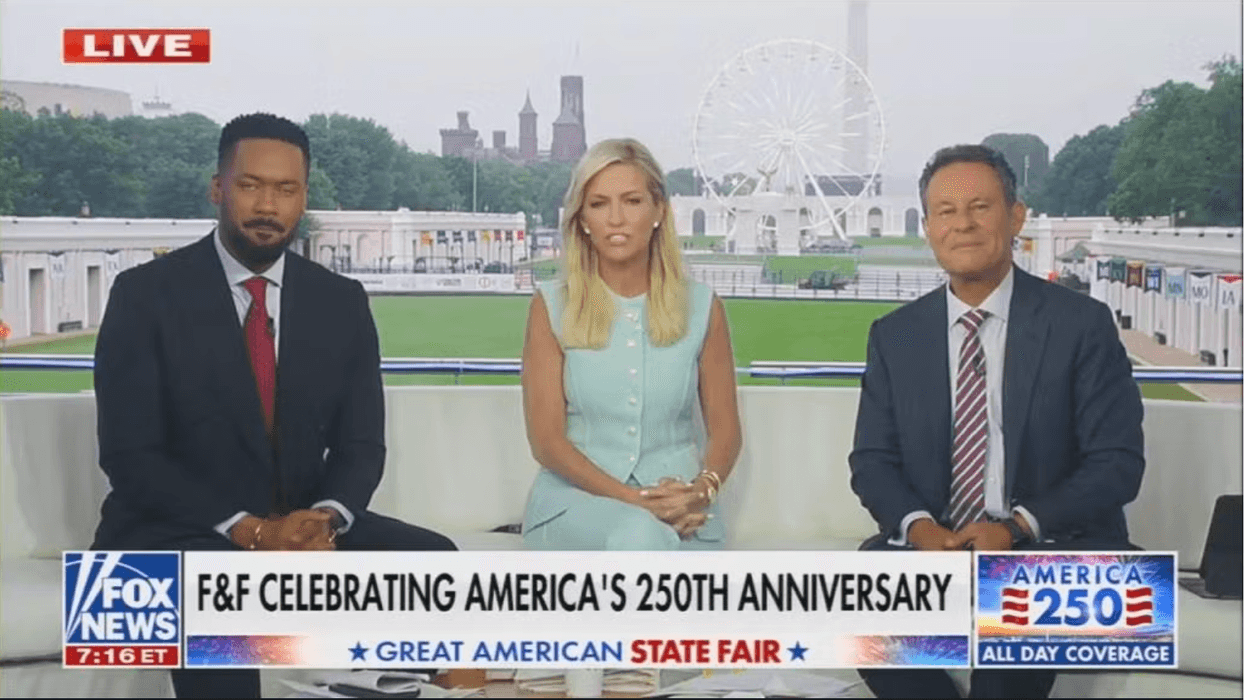
Every vibe is off. His “Great American State Fair,” launched on Thursday, featured empty chairs in place of some state exhibits.

Instead of enjoyable schlock like the nation gobbled up in 1976, we’re faced with ephemera like the single ugliest shirt in human history, some dead ducks at the Lincoln Memorial Reflecting Pool, and a proposed $250 bill with Trump’s mug on it. Though the creation of that currently illegal banknote would require an act of Congress, the president’s top lackeys are pushing for it. Of course, Americans hate the idea: Only 16 percet favor creating the Trump-emblazoned bill, while 70 percent oppose it, per a recent YouGov/Economist poll.

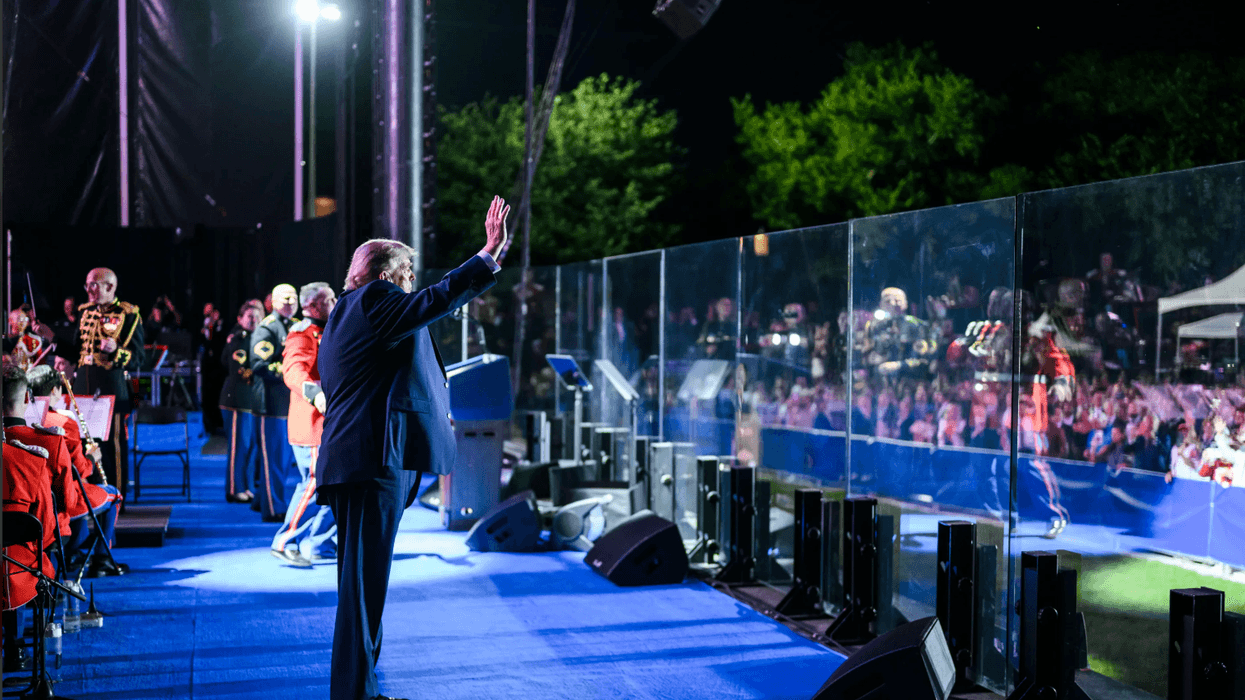
But the $250 bill, as with the events, signifies the core problem: Not only are his marquee events unpopular, they are less a celebration of America than a celebration of himself. After all, in lieu of a big concert this past Wednesday, Trump hosted a Trump rally.

It’s no wonder only 37 percent of Americans told Elon University that America’s 250th anniversary is likely to “bring people together.”

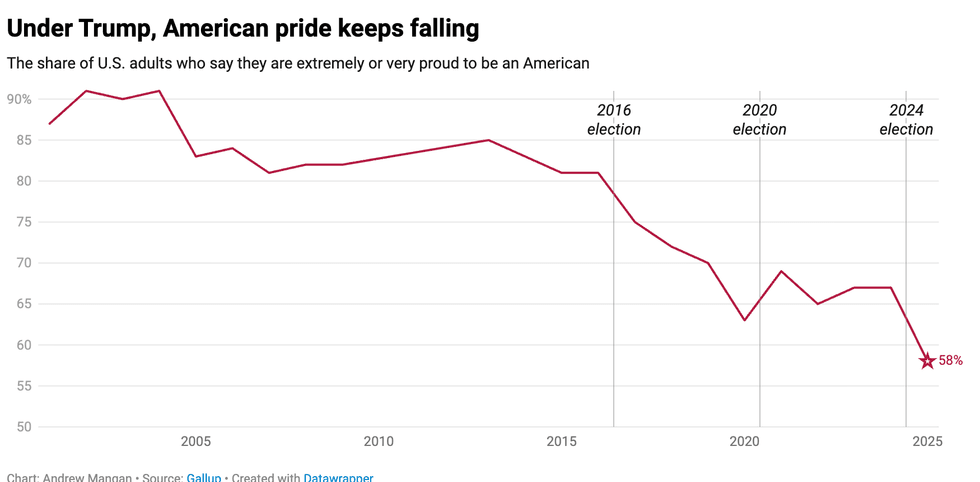
More than anyone in recent history, Trump has degraded America’s view of itself. Between 2001 and 2016, the share of Americans who said they were “extremely” or “very” proud to be an American didn’t dip below 81 percent, according to Gallup. But from 2017 to 2020—spanning Trump’s first term—each year set a new low, slipping to 63 percent in the last full year of that term.

After Trump left the White House, American pride rebounded slightly, hovering in the mid to high 60s. But last year, in the first year of his second term, it plunged to yet another new low: 58 percent.

Chart by Andrew Mangan/Source GallupCreated with Datawrapper

While 65 percent of baby boomers see being American as key to their identity, 58 percent of both millennials and Gen Zers don’t think about that piece of their identity much, a recent Ipsos poll finds. Maybe younger Americans’ sense of national identity will strengthen as they age, but it just as easily may not—especially if these greenest members of our workforce struggle to attain the “American dream.” Only 34 percent of Americans see that dream as currently attainable, according to a poll from The Associated Press-NORC Center for Public Affairs Research. A majority (51 percent) say that dream was once true but is no longer.

And the less that people approve of how Trump is handling his job as president, the less they are interested in celebrating the big 250. A new Marquette University Law School poll finds that while 88 percent of Americans who “strongly approve” of Trump are interested in the occasion, that is shared by only 39 percent of those who “strongly disapprove” of him.

The country is divided and hurting, and the unpopular guy who helped to divide it and hurt it is throwing a big party headlined by events most of the nation has little interest in.

Woo-hoo?

Reprinted with permission from Daily Kos


How Liberals and Progressives Should Celebrate America’s 250th

How Liberals and Progressives Should Celebrate America’s 250th

This is the worst year—and a perfect time—to commemorate the American Revolution. The 250th anniversary of the Declaration of Independence is arriving at a political moment wholly inconsistent with the Declaration itself. Our own leader is a would-be king, responsible for “a long train of abuses and usurpations, pursuing invariably the same Object,” namely his own power and glory, which he confuses with the nation’s. “Neo-royalist” is an apt term for his conduct of the presidency and his posture toward the world.

Donald Trump has so thoroughly appropriated and degraded the celebration of the 250th that liberals and progressives may want to have nothing to do with it. But that’s a mistake. Precisely because America has strayed so far from its founding heritage, this is a perfect time to celebrate, reflect on our revolutionary beginning, and recognize what the Revolution achieved and what it didn’t.

The idea that the American Revolution wasn’t all that revolutionary has long had its advocates on both sides of the ideological spectrum. Some conservatives have argued that the Revolution aimed only to restore traditional British liberties, while some on the left have claimed that it only changed the form of government but left slavery undisturbed and even reinforced social inequalities.

Neither of those views gives the Revolution its due. Although it fell short of abolishing slavery, the Revolution did far more to advance freedom and equality than just restoring traditional liberties. It set in motion radical changes in both social life and government. This is the revolutionary heritage we should be celebrating.

The American colonies were societies of inherited rank, where a wide gulf separated the rich and well-born from commoners, and where colonists with connections to the Crown—future Loyalists—enjoyed patronage and privileges. Birth order remained a critical source of inequality: In much of colonial America, as in Britain, the eldest son in a wealthy family inherited the estate under rules of primogeniture and entail. That system of inheritance in Britain had for centuries locked up landed wealth and power in a small aristocracy.

Cherished stories about the Puritans and other early settlers have misled us about the social status of most of those who crossed the Atlantic to the colonies. Data on colonial migrants on British ships show that the great majority came in an unfree condition. Most of the unfree were enslaved Africans, but more than half the whites arriving in the colonies south of New England came as indentured servants or convicts.

Like the enslaved, they were bound to forced labor, subject to harsh control by their masters, and liable to be bought and sold. Unlike the enslaved, they were bound for a fixed period, generally five to seven years for indentured servants. At any one moment, according to the late historian Gordon Wood, about half the colonial population was legally unfree.

Revolutionary America began overturning these bases of social subordination. As Wood writes in The Radicalism of the American Revolution, “By the time the Revolution had run its course in the early nineteenth century, American society had been radically and thoroughly transformed.”

Amid all the contentious arguments about the Revolution’s impact, certain facts are beyond dispute. The reason the United States became divided between free and slave states is that the states in the North began abolishing slavery in the Revolutionary era, and Congress in 1787 prohibited slavery in the western territories north of the Ohio River. The Constitution barred titles of nobility, and the states in the following years did away with primogeniture and indentured servitude.

Instead of a society stratified by inherited rank, the America that emerged from the Revolution outside the South was unusually fluid and open to mobility. Ordinary white men had less reason to feel resigned to a status assigned them at birth. After visiting America in 1831-1832, the French aristocrat Alexis de Tocqueville reported that the equality of condition had unleashed a surge of energy, ambition, and frenetic activity in nearly every sphere, politics and civic associations as well as the economy.

Washington Irving’s 1819 short story “Rip Van Winkle” describes that postrevolutionary transformation. After falling into a deep sleep before the Revolution, Rip awakens 20 years later, enters his old village during an election, and discovers a changed world: “The very character of the people seemed changed. There was a busy, bustling, disputatious tone about it, instead of the accustomed phlegm and drowsy tranquility.”

Under modern definitions, the early American republic would not qualify as a democracy because the majority of adults still had no right to vote, but the Revolution immediately created a more popular politics. One sign was a more plainspoken, easily grasped political language. Tom Paine’s Common Sense, the February 1776 pamphlet that set the colonies on the path to independence, also set the new standard for popular persuasion, appealing to what in the 18th century was just beginning to be called “public opinion.”

The new government fostered the expansion of the press and the public through the post office. Britain taxed newspapers to make them more expensive and prevent the rise of a dangerous popular press. Congress, however, starting in 1792, subsidized the distribution of newspapers with cheap postal rates and a right for printers to exchange copies free of postal charges. That was the basis for something extraordinary for its time, indeed any time: a government-subsidized but uncensored national news network. Unlike European countries, the United States also extended post roads and post offices to small towns and villages. Many people adopted a new habit, keeping up with the news.

By changing the system of government, the American Revolution had created a new political society. Strikingly, neither the growth of the press nor the energized public life and popular politics developed at that time in Canada, the part of British North America that hadn’t joined the Revolution and instead welcomed the fleeing Loyalists. When Britain’s Parliament granted Canada independence in 1867, it described the federation’s purpose as “Peace, Order, and good Government.”

The American Declaration of Independence had spelled out a different moral theory of government: “Governments are instituted among Men, deriving their just powers from the consent of the governed” to secure men’s “unalienable Rights,” among them “Life, Liberty and the pursuit of Happiness.”

Those electrifying words, written under the immediate pressure to inspire men to risk their lives in war, did two things in the long run. They established founding principles, a founding promise. And they left America with a founding contradiction because the American republic in practice originally denied those rights to Black and indigenous people, women, and even white men without property.

Still, no matter the intent of the Declaration’s signers, their words defined the American project as many in later generations would come to understand it: fulfilling the promise and overcoming the contradiction. At Gettysburg, Lincoln said America was “dedicated” to a “proposition,” the proposition that “all men are created equal,” and that it was “for us the living … to be dedicated here to the unfinished work,” the work required for a “new birth of freedom.”

That conception of America and the continued meaning of the Declaration is not, however, universally held. Last July, JD Vance declared, “This country is not a contradiction … not some unfinished or contradictory project.” He was criticizing a post the previous day, July 4, by Zohran Mamdani, who had said: “America is beautiful, contradictory, unfinished,” words that, in the vice president’s view, showed Mamdani’s lack of gratitude to earlier generations who had “turned [America’s] wilderness into the most powerful nation in the world.”

Vance was defending a different proposition from the one that Lincoln spoke about at Gettysburg. It’s the proposition that those who count America as their ancestral homeland going back to our early history—“heritage Americans,” some call them—have a singular “claim” to the nation: “I think the people whose ancestors fought in the Civil War have a hell of a lot more claim over America than the people who say they don’t belong.”

Of course, neither Mamdani nor liberals who define the core of American identity by its founding ideals say that people whose ancestors fought in the Civil War “don’t belong.” What they say is that America still has work to do to make good on its founding promise.

Donald Trump’s monarchical presidency has made that work more urgent. Unlike originalists in the law, Trump’s governing philosophy might be described as “pre-originalist”: a return to rule by proclamation and prerogative, the very thing America’s founders abhorred and tried to prevent through constitutional restraints. This year’s anniversary ought to reawaken that foundational opposition to arbitrary, personal rule, slumbering in the hearts of the president’s supporters.

The world will surely “little note, nor long remember” what any of us say at the celebrations this July. But it will again be true that it is for “us the living” to do the unfinished work that freedom perennially requires. All those who take up that challenge can count themselves heritage Americans and celebrate the 250th in a spirit faithful to the Declaration.

Paul Starr is co-founder and co-editor of The American Prospect, professor of sociology and public affairs at Princeton University, and a winner of the Pulitzer Prize for general nonfiction and the Bancroft Prize in American history.

Reprinted with permission from The American Prospect.


Dismal Turnout For 'Massive' Trump Rally Dims Fox's 'Freedom 250' Propaganda Push

Dismal Turnout For 'Massive' Trump Rally Dims Fox's 'Freedom 250' Propaganda Push

President Donald Trump’s Fox News propagandists would like to use this summer’s celebration of the 250th anniversary of the signing of the Declaration of Independence to smear Democrats as unpatriotic. But if Wednesday night’s launch of the Great American State Fair in Washington, D.C. — a poorly-attended campaign-style Trump rally — is any indication, the strategy's fatal flaw is the president’s catastrophic unpopularity.

Trump, in collaboration with Freedom 250, the political group he launched to supplant the congressionally established organization overseeing the semiquincentennial, has turned America’s 250th birthday into a celebration of himself. After several musical acts originally slated to perform on Wednesday dropped out earlier this month in response to this politicization, Trump announced that he would be the night’s main attraction at what he termed “the Greatest Rally, EVER.”

Fox, led by Kayleigh McEnany, the former Trump White House press secretary turned network host, set the expectations sky-high in the hours before the event.

McEnany told viewers on Outnumbered that the president would be “kicking off” America 250 “with a massive rally on the National Mall.”

“I'm very excited about tonight because Trump has said this is going to be the greatest rally he has ever done, and I've been to a lot of his rallies,” she added on Jesse Watters Primetime. “But if he's saying this is the greatest rally he's ever done, I'm here for it.”

But the event turned out to be a low-energy dud, with the listless president praising himself and his administration’s accomplishments to a shockingly small audience.

NBC News estimated attendance at “more than 1,000,” while The Washington Post reported that “the crowd thinly covered an area about the length of the National Museum of American History, smaller than some summer outdoor movie screenings.”

The Post further reported that the president “did not appear to enjoy the speech” and “wrapped in under a half-hour,” adding: "He asked for a bigger turnout for his next appearance on July 4."

“Please show up, he said. ”Because if we have two empty seats, you know what’s going to happen: the fake news is going to say he didn’t fill out the arena.”

Trump’s performance, his attempt to refocus the semiquincentennial around himself, and the shrinking percentage of Americans who think he is doing a good job pose a problem for Fox’s effort to use the celebration as a cudgel against Democrats.

On Jesse Watters’ show, contributor Joe Concha used the events on the network to draw purported contrasts between “patriotic” Republicans and Democrats “downright miserable about the country.”

“As we see this communist takeover continue in major American cities, I mean, do you want to be the party that hates this country, they want to tear it all down because some people just want to watch the world burn, or do you want to be the party that embraces what makes this country so awesome?” Concha said.

He then provided a list of such things: “Amazon, Apple, White Castle, Top Golf, the Jersey shore, Savannah Bananas, Sydney Sweeney.” (Notably, he did not mention the Declaration of Independence, the Constitution, or any part of the American creed.)

“So the entire lead-up to July 4, I consider it one big trigger warning to the Mamdani minions out there, because after all they are happiest when foreign flags are flying,” host Laura Ingraham likewise sneered on Wednesday before Trump’s speech. “Because to them, red, white, and blue, the big extravaganza, is like sunshine to a vampire.”

But on Thursday morning, Fox’s coverage of Trump’s rally was as sparse as the previous night’s crowd. The network’s reality distortion machine is unable to countenance their beloved president’s unpopularity, and it will ignore or deny all such evidence in order to carefully shield viewers from the historic levels of dissent Trump faces.

Reprinted with permission from Media Matters

Pool Of Slime Reflects The Depth And Breadth Of Trump's Betrayals

Pool Of Slime Reflects The Depth And Breadth Of Trump's Betrayals

Of all the scandals that have beset the nation during the years of the Trump regime, few have so neatly represented the would-be dictator as his despoliation of the Reflecting Pool between the Lincoln Memorial and the Washington Monument. The overgrowth of green slime caused by Donald Trump's idiotic attempt to refurbish the pool evokes the disgust most Americans now feel at the mention of his name.

This episode includes all the varieties of Trumpian scandal we now anticipate in regular rotation. Scheduled for completion by the Fourth of July's 250th anniversary, it is a shambles and yet another Trump-sponsored national disaster.

From its inception, this was a typical instance of presidential corruption, which saw the White House deliver a no-bid contract to a firm called Atlantic Industrial Coatings, which just happened to have done similar work on swimming pools at the Trump Organization's Virginia golf club.

With no controls and little oversight, the cost of the contract keeps rising: having promised to spend no more than $1.8 million, Trump has paid over $14 million, and no doubt the price will continue to escalate.

Separately, but similarly, the White House gave a $1.7 million no-bid contract to another firm, Greenwater Services, to clean up the algae infestation in the Reflecting Pool. Like the initial contractor, this outfit also did work at a Trump golf club, in Bedminster, New Jersey. Naturally, its principal owner is a shady businessman, sporting a greasy pencil mustache, who happens to be a wealthy Trump donor, a Palm Beach neighbor of the president, and a conspirator in various bribery and illicit donation schemes.

Aside from the slime and sleaze, the Reflecting Pool fiasco captures the environmental ignorance and narcissistic vandalism that Trump embodies. While the administration might reasonably have tried to remedy the pool's longstanding drainage problems, Trump hired his cronies to coat the bottom with a substance in "American flag blue" that quickly began to peel off, causing more trouble.

Having failed to consult scientists — whose wisdom he always disdains — the president made the pool's problems worse by increasing the impact of climate change. Turning the pool dark heated it up and made it even more hospitable to algae growth.

As the Cultural Landscape Foundation noted in a lawsuit filed to stop the painting of the pool, it is an "aesthetic injury" — like so many Trump projects — that will "fundamentally alter the existing harmony, solemnity and dignity of the current memorial landscape.

Although Trump and his minions have lied repeatedly about the Reflecting Pool, claiming it is crystal clear when everyone can gaze upon the murky results, he now needs someone to blame. Having botched this entire process with embarrassing stupidity and venality, he insists that the renovation scheme failed because of "vandalism." Indeed, he has claimed that numerous vandals have been apprehended.

On Monday, the president told reporters that five people had been arrested and another five are suspects, while he sought to shift the blame for his own ineptitude. “I can’t help it if somebody goes in with a knife and starts hacking it up," he said, while offering no evidence at all that any such attack has occurred. Nor would cutting the blue lining explain the recurring algae blooms.

As Andrew Egger noted sardonically in The Bulwark, the villainous alleged vandals "were so cunning, so devastatingly dastardly, that they managed to pull off this shocking act of national blasphemy without once being visible on the cameras embedded in the Washington Monument that transmit a 24/7 public livestream of the Reflecting Pool." Or else Trump was fabricating as usual.

The sole named individual man arrested so far — a former Olympic athlete named David Hearn, who merely reached into the pool to touch a detached piece of the coating — is manifestly innocent. Like others targeted by this impulsive and malignant president, he seems certain to be exonerated.

Not so the White House vandal and his henchmen, however. We will spend many millions and many months cleaning up the destruction he leaves behind.

Joe Conason is founder and editor-in-chief of The National Memo. He is also editor-at-large of Type Investigations, a nonprofit investigative reporting organization formerly known as The Investigative Fund. His latest book is The Longest Con: How Grifters, Swindlers and Frauds Hijacked American Conservatism (St. Martin's Press, 2024). The paperback version, with a new Afterword, is now available wherever books are sold.
Shop our Store

Headlines

Editor's Blog

Corona Virus

Trending

World