Tag: america first
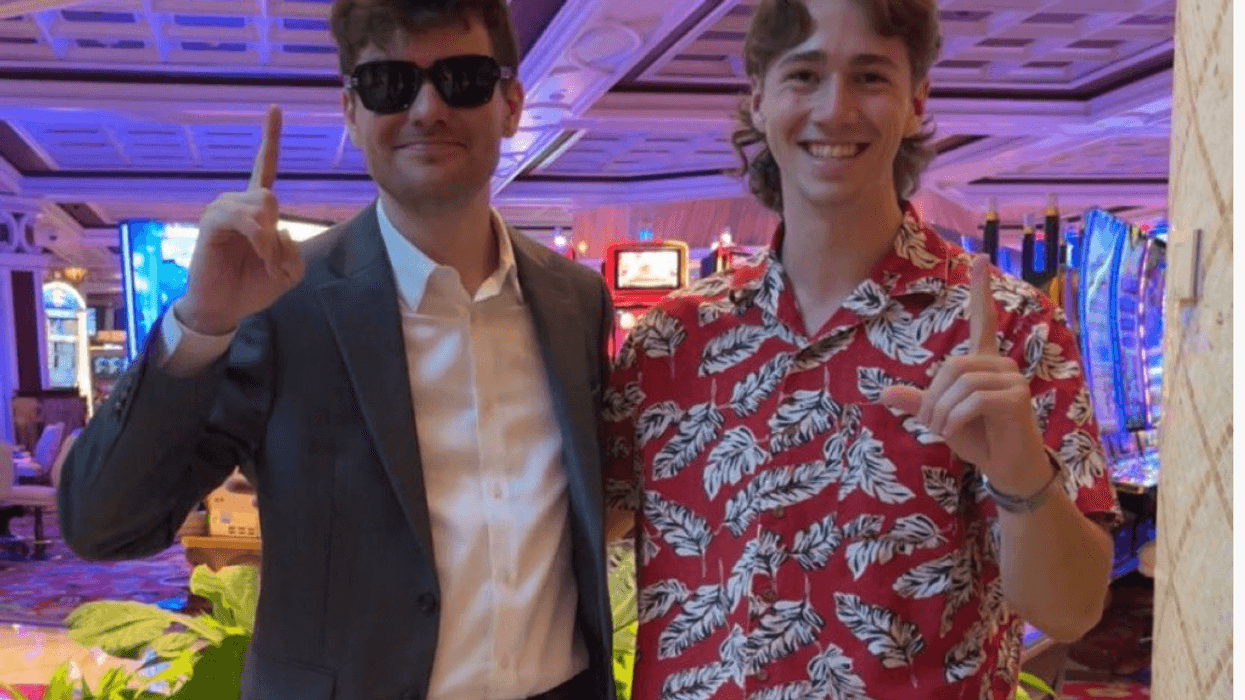
Donald Trump Jr. and Zach Witkoff

America First? Corrupt Trump Family Business Sold Our National Security

The U.S. makes artificial intelligence chips so special, so advanced, that the Biden administration limited their export for national security reasons. They didn't want them to get into the hands of China or Russia.

But days before Donald Trump was sworn in for a second term, go-betweens for an Abu Dhabi royal signed a secret deal that delivered $187 million into Trump family ventures -- so far, as far as we know.

Sheikh Tahnoon bin Zayed Al Nahyan — nickname, the "spy sheik" — had long been frustrated in his campaign to obtain this highly sensitive AI technology. The fear was that our super chips could be diverted to China.

Under the private arrangement, Tahnoon's $1.3 billion fund paid $500 million for 49 percent of World Liberty Financial, the Trump family's crypto enterprise.

A few weeks after Trump returned to power, the United Arab Emirates was given yearly access to about half a million of the most advanced chips. Abu Dhabi is the most powerful of the seven UAE emirates. Tahnoon's brother is the UAE's president.

Zach and Alex Witkoff, both principals in World Liberty, were not left out. They are the sons of Steve Witkoff, the real estate developer whom Trump named U.S. special envoy to the Middle East. The Witkoff family is getting its cut of millions from the deal.

These machinations were complicated and secretive enough to fall under the radar of average Americans. But they amount to an underhanded sale of prized U.S. technology. To wade through the details, read The Wall Street Journal's excellent account of what went on.

Again, these controls were designed to prevent U.S. technology from aiding rival nations in developing military, surveillance and strategic AI expertise.

Another change from the Biden years: Back then, the crypto-based betting platform Polymarket was under a Justice Department probe into money laundering. Now it's made a highly lucrative deal with the New York Stock Exchange's parent company. And its founder, 27-year-old Shayne Coplan, is suddenly a billionaire.

The Commodity Futures Trading Commission considered Polymarket an unregistered exchange open to market manipulation. Thus, it limited Polymarket's U.S. bets to derivative trading.

Polymarket doesn't know the identities of most of the people who trade on its platform. It's been tagged for manipulation on all kinds of bets: What would happen in Russia's war on Ukraine? Who would win the Nobel Peace Prize? Not knowing exactly who's involved lets users trade on insider information. Such activity is illegal, but who would the Securities and Exchange Commission know to go after?

Hours before the "surprise" U.S. military operation to take down Venezuelan leader Nicolas Maduro, bets on that happening surged into Polymarket. One unnamed trader made more than $400,000.

Another form of manipulation is "washing." That's when trades are moved back and forth, creating the impression of an active market. A study out of Columbia University found evidence of wash trading in about 25 percent of Polymarket's volume.

Two months before Trump's second inauguration, FBI agents broke the door of Coplan's Manhattan penthouse apartment. They were probing charges that Polymarket was laundering money. Once Trump was in office, the Justice Department halted its investigation. Why the turnaround? Could it possibly be that Donald Trump Jr.'s venture capital firm is a Polymarket investor? (Junior is now listed as one of the company's advisers.) It should be no surprise that Coplan sat with Donald Jr. during the 2024 Republican National Convention. Thus, things are looking up for Polymarket and its founder.

What's good for America does not necessarily track the Trump family's fortunes. Historians someday will gather a compendium of the Trump era's corruption and self-dealing. And future generations will look on with appalled wonder that all this went on under the public's nose.

Froma Harrop is an award winning journalist who covers politics, economics and culture. She has worked on the Reuters business desk, edited economics reports for The New York Times News Service and served on the Providence Journal editorial board.

Reprinted with permission from Creators.

Behind Tucker Carlson And Nick Fuentes, Neo-Nazi Skeletons Haunt The MAGA Right

Behind Tucker Carlson And Nick Fuentes, Neo-Nazi Skeletons Haunt The MAGA Right

Only on the American right would anyone feign dismay when Tucker Carlson welcomed the frothing neo-Nazi Nick Fuentes last week for a cozy and caressing interview. Long before Carlson began to establish his own white nationalist credentials, he was clearly a product of America's trust-fund country-club reactionary class, where racism and antisemitism run deep.

Until recently, however, this scion of privilege had swathed his hostility toward Jews beneath layers of cable gabble. His old Fox News broadcast first popularized a mildly sanitized version of “The Great Replacement Theory,” concocted by neo-Nazis to blame Jewish leaders for nonwhite immigration – a conspiratorial myth that has incited murderous attacks on Jewish houses of worship as well as Black churches. Carlson has promoted and sanitized antisemites like Fuentes pal Kanye West in recent years, telltale evidence of his own nasty bigotry.

So this moment of reckoning with his Third Reich sympathies is long overdue, ss the right-wing chattering class assuredly knows. What seemed truly startling at first glance however, was the defense of Carlson mounted by Kevin Roberts, president of the Heritage Foundation.

Rather than issue a rebuke or even simply remain silent -- as conservatives often do when confronted with such an embarrassment – Roberts piped up on video to protest the “venomous coalition” that censured Carlson. Ever brimming with clichés, the Heritage boss scolded that “canceling Fuentes is not the answer” and delivered his judgment that “the American people expect us to be focusing on our political adversaries on the left, not attacking our friends on the right.”

Friends? Within hours of that disastrous declaration, Roberts started backpedaling with statements highlighting Heritage’s past statements of opposition to antisemitism and reshuffling staffers who had too quickly and publicly endorsed his own bonehead remarks. By then, prominent Heritage board members were angrily denouncing his video and distancing themselves from him.

Among the offended trustess was Princeton law professor Robert P. George, who wrote: “I will not — I cannot — accept the idea that we have ‘no enemies to the right. The white supremacists, the antisemites, the eugenicists, the bigots, must not be welcomed into our movement or treated as normal or acceptable.”

Laudable sentiments, to be sure, but was it George or Roberts who more fully reflected the history of Heritage and the Republican ultra-right that the powerful foundation has so long embodied? The true answer is less uplifting than Americans might wish. For those of us who have observed the decay of “conservatism” over this past half-century, these latest eruptions of hard-core racism, antisemitism and fascism are the poisonous fruit of old roots.

Those roots were laid in the years when Heritage first became a formidable force in Washington, just as Ronald Reagan was poised to win the presidency. The Heritage leadership welcomed and promoted Roger Pearson, -- a notorious neo-Nazi propagandist and “race science” theorist newly arrived from England -- onto the editorial board of its main publication, Policy Review. Even after the Washington Post exposed Pearson in 1978 for hosting an “anti-communist” conference that swarmed with European and South American fascists as well as American neo-Nazis, Heritage leaders maintained their ties with him (although Policy Journal quietly dropped him from its masthead).

Four years later, his firm connections with Washington's Republican establishment won Pearson a letter of endorsement from the president himself, which in turn became another scandal. Yet neither the White House nor the Heritage Foundation ever renounced Pearson, choosing instead to issue feeble denials of his racism.

Strains of the diseased ideology that Pearson represented can be traced throughout the history of the Republican far right, dating back to the passionate defense of Nazi war criminals by the late Senator Joe McCarthy and the former White House aide Patrick Buchanan, whose unwholesome careers prefigured the rise of Donald Trump. The scandalous presence of Nazi collaborators in the GOP's Eastern European "ethnic heritage" groups briefly embarrassed the first Bush administration. And long before all that, the original “America First,” whose name is so proudly worn by Trump’s MAGA outfit, erected a national front for Nazi spies and homegrown fascists. Those were the original white nationalists.

Today many Republicans are no doubt sincerely alarmed by the hideous and growing cancer in their party and amid what is still somehow known as “conservatism.” This deadly sickness did not suddenly appear from nowhere and it cannot be extirpated until its history is confronted with honesty.

Joe Conason is founder and editor-in-chief of The National Memo. He is also editor-at-large of Type Investigations, a nonprofit investigative reporting organization formerly known as The Investigative Fund. His latest book is The Longest Con: How Grifters, Swindlers and Frauds Hijacked American Conservatism (St. Martin's Press, 2024).

Happy Fourth! Pride In America Plunges Under Trump Presidency (Again)

Happy Fourth! Pride In America Plunges Under Trump Presidency (Again)

Americans’ pride in their country has tumbled to a new low, according to a poll released on Monday. Not only is pride at its lowest point since Gallup began asking the question in 2001, but the share has fallen nine points under President Donald Trump this year alone.

Fifty-eight percent of U.S. adults say they feel extremely or very proud to be an American. A year ago, when former President Joe Biden was in office, that number was 67 percent. The highest level of American pride Gallup has measured came in 2002 and 2004, when 91% of Americans were extremely or very proud following the terrorist attacks of September 11, 2001.

While Republicans’ pride in being American has increased by seven points since last year, the decline was precipitous among Democrats (down 26 points) and independent voters (down seven points).

There was also a generational divide, with 41 percent of people in Generation Z (born between 1997 and 2012) expressing pride in being American, compared with 58 percent of millennials, 71 percent of Generation X, 75 percent of baby boomers, and 83 percent of people in the Silent and Greatest generations (people born before 1946).

The decline comes as Americans, including millions who backed Trump, are now dealing with the fallout from his second presidential term.

He has started an expensive trade war with much of the world, increasing the costs of doing business for American companies and farmers while also making many household staples more expensive. Trump has responded to these concerns with advice like telling little children to purchase fewer dolls.

Another pressing concern is Trump’s wholehearted embrace of authoritarianism. He has instructed Immigration and Customs Enforcement to attack American cities, abducting vulnerable people—including students—off the street in broad daylight.

Trump has even chosen to arrest and charge Democratic officeholders for attempting to provide oversight of his actions, or roughing them up for dissenting from his administration.

Trump is rolling back civil rights gains by LGBTQ+ Americans and using his administration to erase boundary-breaking achievements by Black people and women.

Everyday Americans brace to see what new way Trump and his team will use their positions of power to enrich themselves, abuse others, or make America look clownish on the international stage.

Reprinted with permission from Daily Kos.

Bobby's MAHA Mania: Die Now, Eat Healthier Later

Bobby's MAHA Mania: Die Now, Eat Healthier Later

On Tuesday Robert F. Kennedy Jr. visited Indiana, where GOP Gov. Steve Braun, a former Senator and business owner, unveiled nine executive orders that underscored all the contradictions in the Make America Healthy Again movement.

The positive aspects of his program included:

  • Preventing the Supplemental Nutrition Assistance Program’s low-income beneficiaries from using food stamps to buy sugar-sweetened soda or candy;
  • Annual physical fitness testing in the state’s schools;
  • Subsidies for Indiana farms to grow more nutritious foods; and
  • A study of dyes and chemical additives in the food supply.

On the downside, he ordered:

  • Work requirements for SNAP beneficiaries; and
  • A campaign to root out “improper spending” from “eligibility errors” in the Medicaid program, which he claimed accounts for 28% of all Medicaid spending in the state.

To sum up, then, Indiana, like most GOP-run states, is taking minor steps to improve diets and physical fitness, which will take years to show results in the form of better health and reduced health care spending. Meanwhile, the state, whose businesses spend more on their health insurance than any other state, will be moving quickly to eliminate thousands of people from receiving SNAP benefits or government-funded health insurance. Both moves rely on setting up bureaucratic roadblocks to beneficiaries affirming their eligibility status.

Taken together, the SNAP and Medicaid cutbacks will increase food insecurity among the very poor while forcing many to postpone care for their chronic diseases, which will be treated later, more expensively and with poorer outcomes, including a higher level of mortality. Allowing Medicaid to cover more people “improved health outcomes, including lower mortality rates from cancer, cardiovascular disease, liver disease, and maternal mortality,” a Kaiser Family Foundation issue brief noted in December.

Blue states are doing more to protect health

As with much of his tour to promote MAHA, which kicked off last week in Utah with Kennedy praising its governor for removing fluoride from drinking water, the HHS secretary’s visit to Indiana ignored states that are doing far more to promote the positive aspects of his agenda. Yesterday, in next door Illinois, the state senate passed a bill that would prevent foods containing four harmful additives from being sold starting in 2028. Democratic Gov. Jay Pritzker supports for the bill, which should easily pass the Democratically-controlled House.

The banned additives included brominated vegetable oil (BVO), potassium bromate and propylparaben, which having been linked to cancer or toxic effects on the heart, reproductive, and endocrine systems. Each has been banned in the European Union. The Illinois law also bans use of Red Dye #3, whose elimination starting in 2027 the Biden administration’s Food and Drug Administration finally ruled last December. The FDA concluded more than three decades ago the dye was carcinogenic.

For decades, food industry lobbying has largely paralyzed action by the scientists in the FDA’s food division, which failed to police not just food additives, but excess sugar and salt and other harmful ingredients in processed foods. The Trump administration’s massive cutbacks in personnel at the agency, and the fear that has instilled in those who remain, makes it highly unlikely the FDA will be making regulatory changes at the federal level anytime soon.

Kennedy’s heightened attention to the issue has given states political room to act. Illinois followed in the footsteps of California, which passed a similar law in 2023. Lawmakers in at least 20 states have introduced similar bills. Several, including deep Red West Virginia, are GOP-run.

Proponents are making the same argument everywhere: There are safer, less costly alternatives. After protests in Canada, Kellogg’s changed the dyes used in its Fruit Loops and Apple Jack cereals to concentrated carrot juice, watermelon juice and blueberry juice.

Major food companies, whose CEOs met recently with Kennedy, worry that there will be a patchwork quilt of state regulations that will make it difficult to market products nationally. “What’s happening in the states like Indiana is going to drive change,” he said today.

Actually, Indiana, whose farmers are leery of challenging their major customers in the food processing industry, is only going to “study” the issue. It is mostly the Democratically-run states that are taking the lead and actually doing something about it.

Merrill Goozner, the former editor of Modern Healthcare, writes about health and politics at GoozNews.substack.com, where this column first appeared. Please consider subscribing to support his work.

Reprinted with permission from Gooz News.


Shop our Store

Headlines

Editor's Blog

Corona Virus

Trending

World