Tag: clean energy
Behind Trump's Attacks On Clean Energy Lie Corruption -- And Masculine Insecurity

Behind Trump's Attacks On Clean Energy Lie Corruption -- And Masculine Insecurity

We are now in a global fossil fuel crisis. With oil and liquefied natural gas from the Persian Gulf unable to reach international markets due to Iran’s blockade of the Strait of Hormuz, hydrocarbon prices have been soaring around the world and widespread shortages are emerging. Anyone who thought that the U.S. would be insulated from this dire picture thanks to its large domestic oil production has had a rude awakening: the average retail price of gasoline has risen more than $1 per gallon over the past month, while the price of diesel is up $1.60.

But the Trump administration hasn’t allowed these short-run distractions to divert it from its long-run goals: It remains deeply committed to killing renewable energy, especially wind power, and increasing America’s reliance on fossil fuels.

True, some of the administration’s attacks on wind power have failed: Its efforts to throttle offshore wind development by ordering developers to stop work on projects that are already underway have repeatedly been overruled by the courts. But the administration is continuing to block development of onshore wind and solar power by freezing the issuance of federal permits.

And on Monday the Interior Department unveiled a new tactic in its war on wind: It announced that it will pay TotalEnergies, a French energy giant, almost $1 billion to not produce energy — specifically to abandon its plans to build two large wind farms off the East Coast.

To understand the Trump administration’s motives in its campaign to kill renewable energy, one must realize that this campaign is both economically self-destructive and, despite the best efforts of the fossil fuel industry, deeply unpopular.

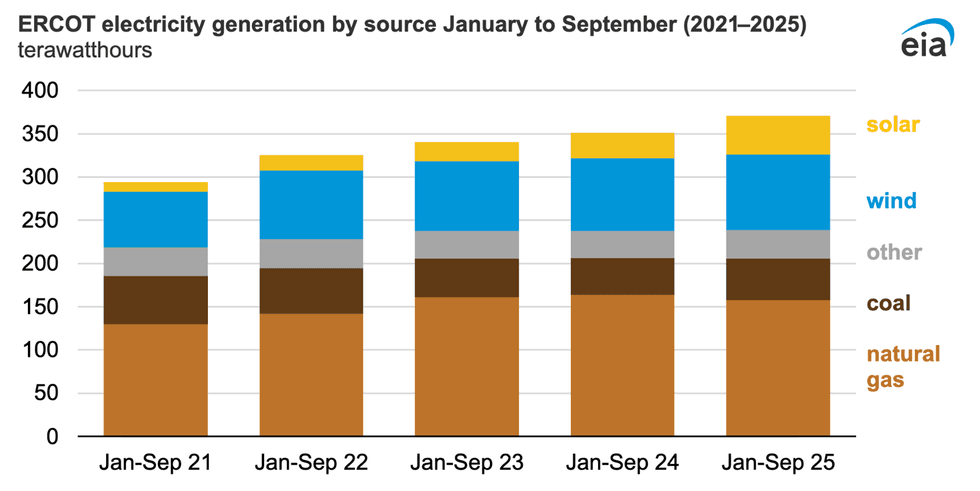
Fifteen years ago wind and solar power were still relatively marginal energy sources, which those hostile to their development could portray as unproven and uneconomic. Today they are major contributors to energy supply in many nations — and in some U.S. states. Perhaps most notably, as the chart at the top of this post shows, renewables — mostly wind, but with a growing role for solar — now account for more than a third of electricity generation in Texas, America’s largest producer of electricity and not exactly a state run by environmental extremists.

Even more impressively, renewables have dominated the growth in Texas’s electricity generation in recent years:

You almost have to admire the administration’s persistence, its determination to turn back the clock on energy even though renewables are big business, its tenacity in trying to block new, secure energy sources even in the face of a global energy crisis. But what’s this all about?

The administration has argued that offshore wind farms are a threat to national security, supposedly interfering with radar. But that doesn’t explain the efforts to block onshore wind and solar, and the courts have remained unconvinced. In announcing the buyoff of TotalEnergies, the Interior Secretary claimed that wind power is expensive and unreliable; but in that case why is it necessary to pay private companies not to develop it?

Campaign finance is part of the story. At this point, political contributions from fossil fuel companies go almost entirely to the GOP, while alternative energy favors Democrats.

Beyond campaign finance, fossil fuel interests, especially but not only the Koch brothers, have spent many decades promoting hostility to renewable energy and any effort to mitigate climate change. They have done so by every means possible, including faux environmentalism. When Donald Trump makes bizarre claims about how wind power is massacring birds and “driving whales crazy,” he’s getting his fantasies, whether he knows it or not, from the fossil-fuel propaganda machine.

Now, this long-term project has had limited success at moving the broader public, which remains favorably disposed toward renewable energy. In fact, as late as 2020 large majorities of rank-and-file Republicans held favorable views of both solar and wind power. Those views have shifted against renewables in Trump’s second term, but even now they aren’t nearly as extreme as the views of the Trump administration. And according to Pew, a substantial majority of Americans still believes that promoting wind and solar is “a more important priority” than promoting fossil fuel production.

But the right-wing elite is completely anti-renewable.

In large part this reflects long-term indoctrination by fossil-fuel backed think tanks and media. In addition, however, to make sense of the right-wing elite’s intense hostility to renewable energy one needs to think about psychology (psychology that the fossil fuel cabal exploits.)

Bear in mind that on the political right wind and solar power are routinely condemned as “woke.” Real men burn stuff.

What this reflects, I believe, is a common factor underlying many right-wing obsessions. Why cling to fossil fuels in the face of a technological revolution in energy? Why valorize “warrior ethos” and bulging biceps in an age of drone warfare? Why build economic policy around a doomed attempt to bring back “manly” jobs? At a deep level, I’d argue, it’s about nostalgia for an imagined past in which brawn mattered more than brains, combined with, yes, a hefty dose of insecure masculinity.

The world keeps declining to cooperate with these macho dreams. Tariffs aren’t bringing back blue-collar jobs. Setting out to “destroy the enemy as viciously as possible” — as Pete Hegseth said Tuesday — isn’t winning an easy victory over Iran. And turning our back on the energy revolution, even paying the private sector to reject new technology, means both making America less secure and ceding the future to other countries that aren’t ruled by MAGA’s obsessions.

But that appears to be a price both fossil fuel interests and the Trump administration are willing to pay.

Paul Krugman is a Nobel Prize-winning economist and former professor at MIT and Princeton who now teaches at the City University of New York's Graduate Center. From 2000 to 2024, he wrote a column for The New York Times. Please consider subscribing to his Substack.

Reprinted with permission from Paul Krugman.

Nation's Electric Bill Jumped In 2025 Despite Trump's Promise To Slash Cost

Nation's Electric Bill Jumped In 2025 Despite Trump's Promise To Slash Cost

During his 2024 campaign, President Donald Trump repeatedly promised that if voters returned him to the White House, his policies would quickly slash everyone’s energy bills in half. A new congressional report, however, finds that the average American family is paying more in electricity costs than before Trump’s second presidential term.

In a report released on March 17, the minority staff of Congress’ Joint Economic Committee says that the average American household’s total annual electric bill rose by $110 between 2024 and 2025, a 6.4 percent increase.

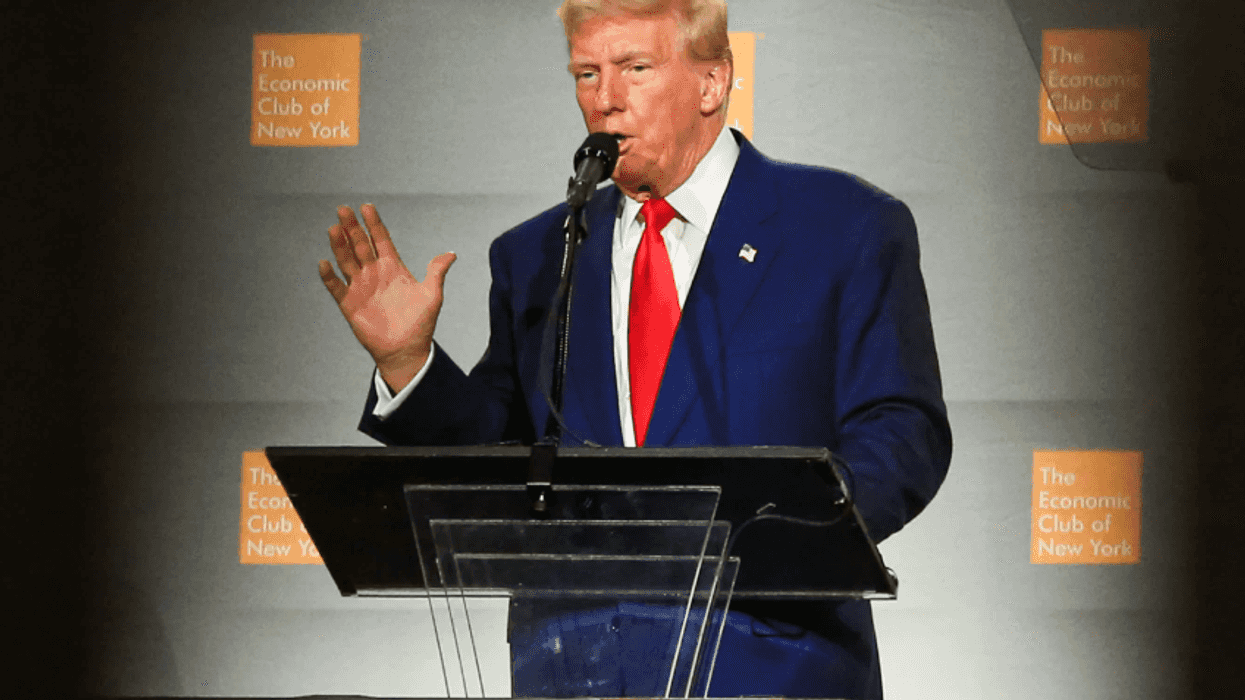
Offering few specifics as to how, Trump told the Economic Club of New York in September 2024: “My plan will cut energy prices in half or more than that within 12 months of taking office. It will be an economic revival of our country like no one has ever seen before. Energy was what caused our problem initially. Energy is going to bring us back. That means we’re going down and getting gasoline below $2.00 a gallon, bring down the price of everything from electricity rates to groceries, airfares, and housing costs.”

Under President Joe Biden, Congress passed the Inflation Reduction Act and the Infrastructure Investment and Jobs Act, both of which included significant federal investments in clean energy infrastructure. The Inflation Reduction Act included billions of dollars in tax credits to lower clean energy costs for consumers and help make their homes more energy-efficient.

Since taking office, Trump has worked to undo as many of those provisions as possible, halting solar and wind energy projects, canceling $8 billion in clean energy projects, and repealing much of the unspent Inflation Reduction Act money for clean energy.

At the same time, Trump’s tariffs on imported goods, grid damage spurred by climate change, and increased power demands from data centers have made electricity more expensive.

“American families don’t need a report to tell them that the President has broken his campaign promise to slash energy costs; they already feel the impact of President Trump’s actions every single day. But this report is yet another indication that sky-high costs are continuing to rise – and are continuing to hurt American families,” said the Joint Economic Committee’s ranking member, New Hampshire Democratic Sen. Maggie Hassan, in a statement.

A White House spokesperson did not immediately respond to a request for comment for this story.

In Virginia, for example, families saw their electricity bills increase 9.5 percent, paying $170 more in 2025.

According to the U.S. Energy Information Administration, average national gasoline prices have not dropped below $2.00 in any week since Trump returned to the White House. The lowest price was $2.779 in January.

According to American Automobile Association data, the average cost of a gallon of regular gas in Virginia rose from $2.823 a month ago to $3.634 following Trump’s launch of military strikes on Iran.

Reprinted with permission from The American Independent

Why Trump Is Driving Our Allies Closer And Closer To China

Why Trump Is Driving Our Allies Closer And Closer To China

In World War II, the United States allied with Stalin to defeat Hitler. No one had any illusions about Stalin being a great supporter of democracy. The reason for the alliance is that the Soviet Union had one of the most powerful militaries on the planet and the United States desperately needed its help to defeat Hitler and the other Axis powers.

The European Union, Canada, and every other country interested in preserving democracy in the age of Trump needs to think in the same way about allying with China. No one would mistake China for a being beacon of democracy, but it does have the largest economy in the world, and its manufacturing capacity, especially in the areas of clean energy and electric vehicles, can be a huge benefit to the rest of the world as it tries to break free of its reliance on the United States.

At this point, it should be apparent to anyone other than the rear-end kissers in Trump’s cabinet that being in any way dependent on Donald Trump is a route to disaster. Trump could not care less about even the mid-term future (he’s 79-years-old and in bad health), much less the longer-term future for the United States and the world. He wants to shake everyone down as much as he can for as long as he can.

That was the story of his “Liberation Day” tariffs. There was no coherence to the various tariff rates imposed on U.S. imports from different countries. He came up with a formula that made zero sense and used this as a starting point. Countries that were nice to him saw some reductions. Countries that Trump felt were being mean, like Brazil, India, and China, saw higher rates.

But the big problem with Trump was not the initial tariffs, it’s that he always wants more. He doesn’t like the tax on digital commerce that the EU has, so he is threatening more tariffs. He doesn’t like their value-added taxes, again more tariffs. And he wants them to join his crusade to wreck the planet by burning more fossil fuels and is threatening more tariffs for countries that won’t go along.

As long as the EU, Canada, and anyone else is prepared to give in to Trump’s demands, he will keep asking for more. In this context, the only strategy that makes any sense is for the rest of the world to integrate as quickly as possible, with the goal of reducing its dependence on the United States as much as possible.

Closer ties with China should feature front and center in this picture. China has cutting edge technology in many areas. The EU and other countries should look to take advantage of this technology, both in getting high quality and low-cost imports, and also by arranging for technology transfers.

The latter is something that would have to be negotiated, but China already has many arrangements with trading partners where it agrees to establish factories there in exchange for access to their markets. Surely the EU, Canada, and other major countries could negotiate the same sorts of deals that Thailand has formally with EVs, and countries like Mexico and Indonesia have informally.

This could lead to a situation where EU consumers could get access to a limited number of high quality Chinese EVs for around $10,000 a piece, while they develop their own production facilities to quickly supply their own markets with EVs. It should be possible to ramp up quickly so that EVs rapidly replace conventional internal combustion cars. EVs already account for more than half of new car sales in China. There is no reason the EU, Canada, and rest of the world, outside of the U.S., can’t do the same in a relatively short period of time.

There is a similar story with wind and solar energy. China’s installations of wind and solar are roughly equal to the rest of the world combined, and growing rapidly. And the cost of electricity generated through these sources is half the cost of energy from coal or gas. The EU, Canada, and the rest can look to quickly build up both their power generation from these sources, as well as their domestic production of wind turbines and solar panels through technology transfers.

Cheap EVs and low-cost electricity should go far towards sustaining living standards through a transition away from dependence on U.S. trade. There will undoubtedly be many issues to iron out in working through trade deals, but at this point it should be clear that closer economic ties to China are preferable to being dependent on the whims of the five-year-old in the White House.

Dean Baker is an economist, author, and co-founder of the Center for Economic Policy and Research. His writing has appeared in many major publications, including The Atlantic, The Washington Post, and The Financial Times. Please consider subscribing to his Substack.

Reprinted with permission from Substack.

Why Trump Can't Repeal The Clean Energy Revolution

Why Trump Can't Repeal The Clean Energy Revolution

"Some may seek to deny or delay the clean energy revolution that's underway in America, but nobody — nobody — can reverse it. Nobody. Not when so many people, regardless of party or politics, are enjoying its benefits." Still-President Joe Biden said that on a recent visit to Brazil.

His administration's Inflation Reduction Act, for example, included $400 billion in subsidies for solar power, electric vehicles and other renewable energy technologies. Its goal is to slash carbon emissions, the main driver of climate change and the environmental chaos it unleashes.

President-elect Donald Trump has called climate change a "hoax." And drilling remains his answer for every energy question.

Never mind whether Trump or anyone else thinks climate change is real. One thing that is very real is the jobs the IRA is creating. It happens that 60 percent of these new jobs are in red states. If their Republican representatives don't want them, no problem. There are plenty of other takers.

But they apparently do want these jobs. At least 18 House Republicans have made clear to House Speaker Mike Johnson their opposition to repealing the IRA. Meanwhile, some of the big oil companies that held fundraisers for Trump have clean energy projects funded by the IRA. They also don't want the IRA canceled, at least the parts that benefit them.

Responsible world leaders regard a warming planet as a security as well as environmental threat. Melting ice glaciers and associated rising sea levels are flooding towns and cities, endangering ports, roads and other infrastructure. Higher temperatures are stoking more intense storms, heat waves, droughts and wildfires. They are wrecking ecosystems.

This is a worldwide problem demanding a worldwide solution. Under Biden, the U.S. has met a pledge to increase international climate financing this year to more than $11 billion.

Obviously, neither Trump's heart nor his brain is engaged in dealing with this threat to our future. And so where can Americans turn for leadership on this existential crisis?

They can turn to California. If it were a country, California would be the world's fifth largest economy. It's not an easy place for Trump to push around, and the Golden State cares a whole lot about climate change.

For example, Trump seems hot to end the electric vehicle tax credit. If that happens, Democratic Gov. Gavin Newsom says, California will offer its own tax rebate. And he seems to be structuring the credit so that some popular Tesla models won't qualify for it.

The governor insists that he merely wants to help other carmakers "take root" in the EV market. But another motive is to stick it to Elon Musk over the Tesla founder's California bashing and his glomming onto Trump.

On this matter, California has a good deal of muscle. About one in three EVs sold in the U.S. are sold in California. As other carmakers bring out new and less expensive EV models, California could help break Tesla's longtime dominance.

Trump says he wants to open the environmentally fragile Arctic National Wildlife Refuge to oil drilling. We'll see.

"I would be surprised if any major oil company, or even any middle oil company, submits bids," Larry Persily, publisher of the Alaska-based newspaper Wrangell Sentinel, said. "It is a high-cost, highly speculative play." And for all the whining about the price of gas, it's already below $3 a gallon in many places. You know, that supply-and-demand thing.

Biden's various legislative accomplishments have unlocked an estimated $1 trillion for green energy technologies and the factories needed to build them.

America is going ahead with the transition. Trump can't stop it. And to those who want to pass on its economic benefits, go ahead. Others will happily take your place.

Reprinted with permission from Creators.

Shop our Store

Headlines

Editor's Blog

Corona Virus

Trending

World