Tag: iran war
Spiking Oil Prices Will Damage Economy Even As US Keeps Pumping Crude

Spiking Oil Prices Will Damage Economy Even As US Keeps Pumping Crude

There has been a lot of sloppy commentary from people who should know better about who is being hit hardest by the runup in oil and natural gas prices since the start of the war in Iran. There’s a simple story where the countries in Europe and East Asia are the big losers, because they produce relatively little of their own oil. By contrast, the United States is supposedly relatively well-off since we are largely self-sufficient and in fact a net exporter of natural gas.

While the point about the U.S. having large oil and gas production is important, it distorts the impact in important ways. The simplest way to think about the surge in oil and natural gas prices is as a big tax on consumers of these products.

When people pay $3.50 at the pumps, instead of the $2.80 we paid a month ago, this would be the same thing to consumers as if the government imposed a 70 cent a gallon gas tax. There would be a similar story with higher prices for home heating oil or natural gas. From the standpoint of consumers, the price increases are the same as if they just got hit with a big tax increase.

The difference is that instead of the money going to the government, as it would with a tax, it’s going to the oil and gas industry, Donald Trump’s campaign contributors. In principle, for a country like the United States, which is largely self-sufficient in oil and gas, if we could just rebate the money people paid in higher prices back to consumers, all would be fine.

But that sort of rebate would require big taxes, like a windfall profit tax, on the oil and gas industry. Since this industry is very powerful politically, this sort of recycling of higher revenue is not very likely. Therefore, for those of us who don’t have a lot of stock in oil and gas companies, the impact of higher prices is what we pay at the pump or for heating our homes. It doesn’t make a great deal of difference whether the people getting that money live in Houston or Saudi Arabia, it’s not going to us.

From that vantage point, if we do a cross-country comparison of the hit from higher oil and gas prices, it really just depends on how much of the stuff we consume relative to our income. By this measure, the United States does not fare especially well.

U.S. oil consumption per unit of GDP is pretty much in the middle of the pack for wealthy countries. We use slightly less oil per dollar than Spain and Japan, and far less than Canada. South Korea uses more than twice as much oil per dollar of GDP than the United States.[1]

By contrast, the other European countries use less oil per unit of GDP. Italy and Germany both use somewhat less oil per unit of GDP, while France uses about one-third as much, and the UK just over half as much. Both China and India using considerably more oil per unit of GDP, with India using more than twice as much.

The story with natural gas is somewhat more complicated. Here, domestic production does matter, since natural gas is far more expensive to ship overseas. Prices in Europe and Asia can be two to four times higher than in the United States. Therefore, the loss of natural gas from the Middle East will be a big hit to Europe and Asia, while having limited impact on the U.S.

Most European countries use considerably less natural gas per unit of GDP than the U.S. Italy uses roughly a quarter less, while Germany, Spain, and the UK all use about half as much. France only uses about a third as much natural gas as the United States.

In East Asia, Japan uses about 30 percent less per unit of GDP, while South Korea uses about 20 percent more. China uses about 25 percent less, while India uses half as much.

In terms of who gets the biggest hit by the flow and oil and gas from the Middle East being cut off, it seems clear that the East Asian countries will see the worst effects. Japan, and especially South Korea, will be hard hit by both higher oil and higher gas prices.

Consumers in European countries will mostly see less of an impact from the rise in oil prices than consumers in the United States. On the other hand, since natural gas prices are likely to rise much more outside the U.S., Europe and Asia are likely to see much more impact, as the huge domestic production limits the impact in the United States.

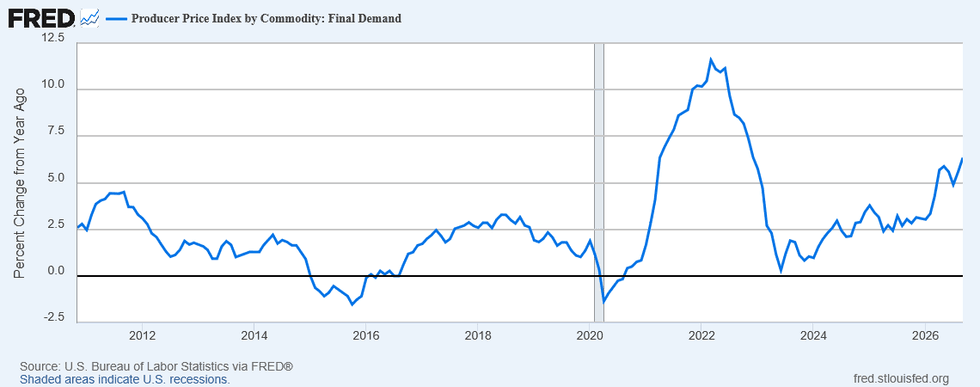
The cutoff of oil from the Middle East is a huge blow to the world economy and will likely cause a recession if it lasts for a long period of time. The takeaway here is that while the large amount of natural gas production in the United States insulates it from the impact seen by European and East Asian countries, greater domestic oil production does not do much to help consumers paying more at the pump.

War On Iran Is Still A War Even When Gutless Republicans Insist It Isn't

War On Iran Is Still A War Even When Gutless Republicans Insist It Isn't

Republican lawmakers spent the past week trying to defend their refusal to give congressional approval for President Donald Trump's poorly planned and ill-conceived war in Iran, insisting that it’s merely a "conflict" that doesn't require a vote—or a spine.

It is painfully obvious that the Trump administration's extended bombing campaign—which may even lead to boots on the ground—to effect regime change in an adversarial country is a war.

Hell, Trump himself even called it a war when he brushed off the deaths of U.S. soldiers as something "that often happens in war."

But because a war would require congressional authorization, GOP lawmakers have twisted themselves into knots to explain why Trump can do whatever he wants in the Middle East—even though the public doesn't support it and it is already destroying the economy.

Indeed, both House and Senate Republicans blocked bills that would have curtailed Trump's war powers this week.

Take a gander at what the likely future Homeland Security secretary and current contender for dumbest U.S. senator Markwayne Mullin (R-OK) said on Tuesday:

Reporter: You'll concede this is war?Mullin: We haven't declared war. They declared war on us
Reporter: The president called it war and Secretary Hegseth called it war
Another reporter: When you walked up just now, you called it war
Mullin: Okay. That was a misspoke.

RAJU: You'll concede this is war?MARKWAYNE MULLIN: We haven't declared war. They declared war on usRAJU: The president called it war and Secretary Hegseth called it war REPORTER: When you walked up just now, you called it warMULLIN: Okay. That was a misspoke.

[image or embed]
— Aaron Rupar (@atrupar.com) March 3, 2026 at 6:14 PM

Fellow moronic Sen. Tommy Tuberville of Alabama also walked into the same trap.

“This is not your Democrat war. This is President Trump’s war, and he’s not going in to be politically correct. He’s going in to protect, first of all, Americans first and then our allies and the people around the world,” he told NewsNation Monday.

Tuberville: "This is not your Democrat war. This is President Trump's war. And he's not going in to be politically correct."

[image or embed]
— Aaron Rupar (@atrupar.com) March 2, 2026 at 10:29 PM

But when CNN later asked why such a war wouldn't need congressional authorization, Tuberville tried to backtrack.

“I wouldn’t call this a war as much as I’d call it conflict that should be very short and sweet, if you can put it that way," he told CNN’s Manu Raju Wednesday.

Similarly, Rep. Anna Paulina Luna of Florida also performed some mental gymnastics to defend Trump’s war, saying that it's not a war because there are no "boots on the ground."

"Strategic strikes are not war," she said on MS NOW.

And the virulently racist Rep. Randy Fine of Florida had the excellent argument that Trump’s war isn’t a war because Congress didn’t say so.

“It’s not a war,” he told The New York Times. “The way you are officially at war is Congress declares war, and we haven’t declared war.”

Anna Paulina Luna: “It is not the intention of the U.S. Government to invade…Targeted strategic military strikes and invasions are two totally different things.”@crampell.bsky.social: “They’re calling it a war. The President called it a war.”Luna: “Strategic strikes are not war.”

[image or embed]
— The Bulwark (@thebulwark.com) March 1, 2026 at 8:38 PM


That’s not how definitions work, Randy.

Meanwhile, Rep. Ken Calvert of California said that the war in Iran couldn’t possibly be a war because it hasn’t gone on long enough.

“This has been about 72 hours,” he told the Times. “I would call it an operation at this point.”

Of course, length of time is not what defines a war either.House Speaker Mike Johnson (R-LA) also tried to thread the same needle, saying that whether it's a war or a conflict is "semantics."

“We’re not at war right now,” Johnson said during a news conference, describing the actions as defensive.

“We’re four days into a very specific, clear mission—Operation Epic Fury,” he added.\

Johnson: “We're not at war right now.”

[image or embed]
— The Bulwark (@thebulwark.com) March 4, 2026 at 10:41 AM

If by “clear” he means not at all clear and by “mission” he means totally conflicting objectives, then sure.

Even MAGA loyalists have slammed GOP leaders for their spinelessness.

“It’s not a war unless it comes from the war region of France, otherwise’s [sic] it’s just sparkling combat,” The Federalist co-founder and CEO Sean Davis wrote on X, mocking Johnson’s sorry attempt to explain away the war.

Ultimately, Republicans will do anything to let their Dear Leader get his way—even light the Constitution on fire to let Trump wage a war they didn't authorize.

When the country is a smoldering heap of ashes by November as gas prices surge, inflation spikes, and the economy craters, good luck defending this “conflict” to voters.

Reprinted with permission from Daily Kos

In Wartime, Trump's National Security Clown Show Endangers Us All

In Wartime, Trump's National Security Clown Show Endangers Us All

The belated dismissal of Kristi Noem – Trump’s woefully unqualified and performatively ridiculous custodian of homeland security --- highlights the perils now faced by all Americans in an increasingly perilous world. Now that the United States is at war with a regime notorious for terror tactics, it is no longer possible to ignore the frightening incompetence of a government that is expected to keep us from harm.

Noem cut an especially clownish figure at the Department of Homeland Security -- with her constant costume changes, soap opera escapades, corrupt expenditures, and abuse of Coast Guard aviation and residential facilities – but the MAGA style of governance is all too visible across our national security agencies.

While it was apparent from the day of her appointment that Noem had no relevant experience or knowledge, she and her “special employee” Corey Lewandowski brought extreme levels of chaos and disrepute to the agencies they oversaw. Like other Trump officials, she imposed senseless waves of cuts, mass firings of veteran officials, useless expenditures, and measures such as polygraph tests that destroyed morale.

And in her zeal to enforce the administration’s absurd deportation schedule, Noem fomented a confrontation with Congress and indeed the entire country that has resulted in the DHS shutdown. With most of its staff forced to work unpaid, all of its security functions are now subject to staffing shortages, rising absences, and declining resolve.

It’s not a good time for that to be going on: The Iranian regime, along with allies in Hezbollah and kindred terror groups, is assuredly seeking means of revenge for the killing of Ayatollah Ali Khamenei and the wider war. Given Iran’s known capabilities in cyber warfare, the reduced defensive capacity of the DHS-based Cybersecurity and Infrastructure Agency is troubling.

Yet the president has replaced Noem with another politician whose Fox News appearances he enjoys, rather than a serious figure with military, intelligence or even government experience. Oklahoma Sen. Markwayne Mullin may be popular among his peers, but his resume for this position is thinner than paper.

As Kevin Carroll, a former senior DHS official, told CNN on Thursday, ““I'm not sure that Senator Mullin is really qualified. I mean, most of the other secretaries of Homeland Security have had substantial experience in federal law enforcement or the military, or have held senior executive positions… He was a successful, small businessman. But we're in a severe threat environment right now [with the invasion of Iran]. It’s probably the highest threat environment since 9/11 … I really don't think it's time for him to be in his first national security position or his first executive position.”

That disturbing vacuum of professional leadership and skill is reflected throughout Trump’s government, with potentially ruinous consequences. It is especially glaring at the Federal Bureau of Investigation, where the comedy team of Director Kash Patel and former Deputy Director Dan Bongino achieved so much destruction in the span of a few months. Their dismantling of FBI divisions tasked with protecting the country showed a reckless enthusiasm that must have excited our foreign enemies.

Patel has done grave harm to the bureau’s national security branch, which encompasses its divisions of counterterrorism, intelligence and counterintelligence, and its special directorate for weapons of mass destruction – all vital to protecting us at this moment of heightened threats. The FBI cyber division, like CISA at DHS, has likewise suffered from the firings and fear that have destroyed confidence among agents in Washington and in FBI offices around the country and abroad.

The impact of Patel’s recurrent displays of idiocy, arrogance, and abuse are felt far beyond our borders – although the damage has become obvious in major, highly publicized cases like the Brown University murders and the Guthrie abduction. Early in his tenure, at the request of the head of the United Kingdom’s MI5 intelligence agency, Patel agreed to maintain a London FBI station where both countries monitor adversary activities. He violated the pledge almost immediately, earning distrust among the “Five Eyes” intelligence consortium, which includes Australia, Canada, and New Zealand as well as the US and UK and is critical to our counterterrorism effort.

The barely disguised contempt for Patel (and Bongino, whose position was crucial to everyday operations) among foreign security officials is a serious hindrance to the bureau’s international operations division – which depends on our foreign allies to provide actionable information about threats originating overseas.

So toxic is Patel’s presence in the FBI that the bureau may be better off with him spending most of his time far from headquarters, whether at his home in Las Vegas, with his country-singer girlfriend on a government jet, or at the Olympics, car races or other sporting events where he weirdly shows up.

The pattern of dubious political appointees extends into the top levels of every sector, from Tulsi Gabbard at the Directorate of National Intelligence – whom even Trump no longer pretends to respect – to Pete Hegseth at the Pentagon, where security breaches and outright lies have become routine.

Will we pay a hideous price for the misconduct of all these MAGA bozos? In Trump’s second term, America has so far escaped the sort of deadly disaster that arises from stupid, amateurish government -- whether in an intelligence snafu like 9/11 or a botched pandemic response like Covid-19. By now we should know that our luck won't hold forever.

Joe Conason is founder and editor-in-chief of The National Memo. He is also editor-at-large of Type Investigations, a nonprofit investigative reporting organization formerly known as The Investigative Fund. His latest book is The Longest Con: How Grifters, Swindlers and Frauds Hijacked American Conservatism (St. Martin's Press, 2024). The paperback version, with a new Afterword, is now available wherever books are sold.

Reprinted with permission from Creators

Fox Hosts Urge Flooding Iran With Small Arms To Incite Regime Change (Or Civil War)

Fox Hosts Urge Flooding Iran With Small Arms To Incite Regime Change (Or Civil War)

Fox News hosts Sean Hannity, Brian Kilmeade, and Jesse Watters have suggested flooding Iran with small arms to incite regime change, a reckless proposal that even some of their guests have rejected.

The United States and Israel last week launched an unprovoked war on Iran with shifting stated goals, one of which is regime change — or, perhaps more accurately, regime collapse. That could take several forms, including a mass uprising of the population in Iran or possibly the introduction of proxy forces, such as Kurdish militias, whom the CIA is reportedly working to arm. (The United States has a decadeslong history of encouraging Kurds across several countries to rise up and then betraying them.)

The risks of such a development are numerous, the most obvious being the threat of sending Iran into a spiral of violence that could turn into a civil war like in Syria after the Arab Spring or Iraq during the U.S. occupation. The United States poured weapons into both of those countries, helping to fuel the violence and worsen the internal conflicts.

Although such an outcome would appear disastrous on its face, there is ample evidence that the United States and Israel want to turn Iran from a regional power into a failed state incapable of countering their influence. Flooding the country with weapons could do that, and Fox News personalities are leading the charge.

Host Sean Hannity is the network’s most vocal supporter of the idea, both on his Fox prime-time show and on his radio program, which airs on Premiere Radio Networks.

“I already know” that arming Iranians is “part of the plan,” Hannity said on his March 2 radio show, telling a caller that “if you have millions of Iranians that, in fact, do have weapons and they rise up against the remnants of this regime — and there's not a lot — or for those Revolutionary Guard forces that will not put their weapons down, there's only one way to get rid of them.” (Whether Hannity’s claim to “already know” President Donald Trump’s war plans was bluster or not, the administration has been leaking insider information to its allies in right-wing media.)

Hannity returned to the topic several times during that show. “The Iranian people need to have elections, and they need to get armed, and they need to be able to fight back” against the Islamic Revolutionary Guard Corps, he said. Later, he added, “I’m hoping that the students, the people in Iran, I’m hoping that they get the arms for any remaining Revolutionary Guard forces that won't lay down their weaponry.”

“You can't win a revolution with a slingshot — at some point they are going to need to be armed to take out the remaining loyalists,” he said the following day.

That evening, Hannity broached the idea on his Fox show during an interview with network contributor and retired Army Gen. Jack Keane, one of the war’s most vocal cheerleaders outside the Trump administration.

“Do we need to arm the civilians that had taken to the streets, that were being mowed down by the tens of thousands?” Hannity asked.

“In terms of arming the people themselves, I would pause on doing that,” Keane said. “I wouldn’t rush into that.” He added, “I don’t think just arming them and creating that — upgunning that level of violence is what we need.”

Seemingly unsatisfied with that answer, Hannity later in the same show asked retired Army Gen. David Petraeus, who oversaw the arming of U.S.-backed “death squads” in Iraq during the so-called surge, what he thought of the idea.

“Should part of the plan be to arm the people that have been slaughtered on the streets that were looking for freedom and change, so that it won’t take any American or Israeli forces?” Hannity asked. “I’ve got to believe there is going to be holdovers that are loyal to the former regime.”

“Well, I agree with my old boss and mentor and friend, Gen. Jack Keane, who earlier said that he’s not certain about that given there’s no organization there.”

Fox & Friends co-host Brian Kilmeade has floated the idea too.

“I just wonder at some point is the CIA or Mossad going to be able to arm the people?” Kilmeade said on March 3. “If you arm the people so they're not slaughtered in the streets, that would begin to get the IRGC’s attention.”

“We've got to find a way to arm that population and open up these prisons,” Kilmeade said on March 4, referring to Kurds in Iran.

His colleague Jesse Watters made a similar suggestion.

“Trump has even been on the phone with the Kurds," Watters said on March 3. “We might be able to arm them and use them as boots on the ground.” (Defense Secretary Pete Hegseth, formerly a co-host of Fox & Friends’ weekend edition, said on March 4 that “none of our objectives are premised on the support of the arming of any particular force.”)

The Trump administration has done such a poor job explaining its war on Iran that even right-wing media allies are having a hard time articulating the conflict’s larger strategy and goals. Predicting the direction any war will take is a fool’s errand, but it doesn’t take a crystal ball to know that flooding Iran with weapons is a recipe for disaster and potentially state collapse. For Fox News hosts, that appears to be an acceptable outcome.

Reprinted with permission from Media Matters

Shop our Store

Headlines

Editor's Blog

Corona Virus

Trending

World