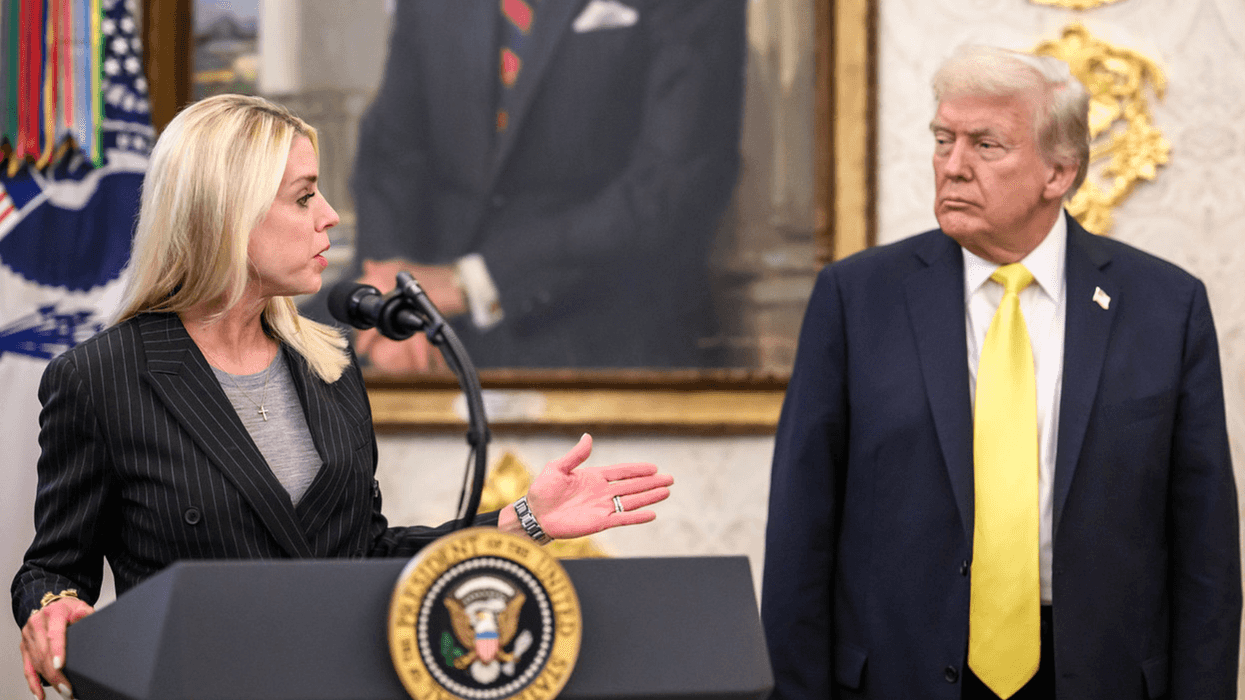
President Donald Trump has fired Attorney General Pam Bondi after he was apparently displeased with her performance in using the Department of Justice to pursue his personal vendettas.
Trump is reportedly planning to replace her with current Environmental Protection Agency Administrator Lee Zeldin, a Trump loyalist known for pursuing a pro-pollution agenda.
Bondi wasn’t Trump’s first pick to serve as attorney general. The original plan was to install former Rep. Matt Gaetz of Florida, but a sex-trafficking scandal pushed him out, forcing Trump to pivot to Bondi.
Under Bondi, attempts have been made to pervert the criminal justice system to go after Trump’s ideological enemies. Charges were filed against figures like New York Attorney General Leticia James—who successfully prosecuted Trump—and former FBI Director James Comey—who exposed Trump’s role in the pressure campaign that led to his first impeachment.
But those cases have faced roadblocks from skeptical judges and grand juries who stand in the way of Trump using the court system as his plaything.
Bondi has also been a disaster while serving as the most public face attached to the Jeffrey Epstein scandal. She touted Trump’s line early on, hinting that disclosures about the accused sex trafficker and his reported client list would be exposed. But Bondi quickly became the leader of Trump’s refusal to come clean about the lurid details of Epstein’s operation and his victims. Testifying before Congress, she was repeatedly defiant about the administration’s efforts to hide the Epstein files from the public.
The suddenly dumped attorney general has operated as a loyal foot soldier for Trump, pushing to silence his critics and rushing to defend his allies like racist billionaire Elon Musk. But like ousted Homeland Security Secretary Kristi Noem—another woman in Trump’s Cabinet who has been pushed out—Bondi has apparently outlived her usefulness.
House Oversight Committee Democrats issued a warning to Bondi after news of her firing broke.
“Attorney General Pam Bondi has been leading a White House cover-up of the Epstein files,” Rep. Robert Garcia (D-CA), the highest-ranking Democrat on the committee, said in a statement.
Garcia said that Bondi weaponized the DOJ to protect Trump in the Epstein case, accusing her and Trump of putting survivors in harm’s way by exposing their identities.
“She must answer for her mishandling of the Epstein files and the special treatment she has given [Epstein accomplice] Ghislaine Maxwell,” he added.
Deputy Attorney General Todd Blanche, who was also Trump’s personal lawyer, will operate as interim attorney general. Blanche has demonstrated his willingness to use the publicly funded DOJ as a tool of Trump’s personal interests.
Meanwhile, during his time in Congress, Zeldin was a zealous defender of Trump. And after a failed bid for New York governor, Zeldin was appointed to the EPA, where he has pushed for relaxing rules meant to keep environmental resources clean—endangering the lives of millions of Americans.
But whether he chooses Blanche, Zeldin, or another sycophant, Trump has made it clear that his priority is to bend the justice system to his will to continue his cover-ups and corruption.
Deputy Attorney General Todd Blanche, who was also Trump’s personal lawyer, will operate as interim attorney general. Blanche has demonstrated his willingness to use the publicly funded DOJ as a tool of Trump’s personal interests.
Meanwhile, during his time in Congress, Zeldin was a zealous defender of Trump. And after a failed bid for New York governor, Zeldin was appointed to the EPA, where he has pushed for relaxing rules meant to keep environmental resources clean—endangering the lives of millions of Americans.
But whether he chooses Blanche, Zeldin, or another sycophant, Trump has made it clear that his priority is to bend the justice system to his will to continue his cover-ups and corruption.
Bad news: Daily Kos’ revenue is down.
Good news: You are a big part of the solution, and small donors have never let us down.
Donating $5 today can help us out in a big way so we can continue to bring you the coverage you enjoy most!
One-timeMonthly$5$15$25Other$
ORDonate with
 7
7 tags
#Corruption#DOJ#DonaldTrump#PamBondi#LeeZeldin#ToddBlanche#EpsteinFiles1 group republished
Was this story worth reading?
Recommending and sharing stories helps us decide which stories are most
important to show our readers.Recommend Story293Share
Men Can’t Get Enough of These Cozy Linen ShortsWalkergrey|SponsoredBest walking shoes for seniors with balance issuesveloraea|SponsoredComfy Orthopedic Walking Shoes for Seniorsveloraea|SponsoredMemory Loss Linked to a Food Millions ConsumeThe Modern Health Report|SponsoredThis Popular Food May Be Influencing Memory Retention In Every ServingDaily Health Report|SponsoredWhy Your Rotator Cuff Won’t Heal (What Most Doctors Miss)Shoulder Relief News|SponsoredThere are no unread comments at this time.245 CommentsClose Settings
Auto refreshCollapse on loadKeyboard navigation:
- ( L ) Recommend
- ( r ) Reply
- ( p ) Parent
- ( o ) Open/Close
- ( j ) Next
- ( k ) Prev
- Show all hotkeys...
CathyMApr 02, 2026 at 02:20:28 PMYES!! 😄😄😄😄
Now — some lawsuit to PRESERVE THE EVIDENCE against her so we can prosecute when sanity returns!! THANKS for the good news!
tmseattleCathyMApr 02, 2026 at 02:30:11 PMIt won’t make a bit of difference. She did exactly what Trump wanted, and was fired because she got backlash for following his orders. He’ll just find another sycophant to replace him, unless the Senate blocks him.
ktoztmseattleApr 02, 2026 at 02:32:18 PMunless the Senate blocks him
🤣🤣🤣🤣🤣
Like that’s going to happen.
AstronutktozApr 02, 2026 at 02:50:31 PMThe Senate Guardians Of Pedophiles are probably already shivering with delight at the prospect of handing Dear Leader what he wants.
alterego55AstronutApr 02, 2026 at 04:05:57 PMIt’s Trump’s fault because he never told Blondi that releasing the Epstein files was nothing more than a campaign lie. She thought she had the holy grail in her and Trump would appreciate her initiative. He’d shower praise all over her. But now he blames her.
That’s how Trump operates.
Noodlesalterego55Apr 02, 2026 at 06:09:22 PMShe made him look bad. “Sorry, now you have to go, that's the ultimate crime”. Also she probably complained. Trump doesn't need any nattering like that.
SpancosktozApr 02, 2026 at 03:04:13 PMOtherwise, let the cavalcade of 120-day rotating, interim, acting AGs commence!
Nothing good can come of the good that’s just occurred.
Zeldin, a practicing lawyer for THREE years before entering politics.
Truly a shitshow in a rolling dumpster fire in a fourteen-ring circus.
SimnsaysSpancosApr 02, 2026 at 04:44:06 PM...with a demented Ring Leader!
niemanntmseattleApr 02, 2026 at 02:56:58 PMThat seems to be the pattern:
Sell your soul to Donald Trump for power and money.
He throws you under the bus anyway.
They never learn that, for Trump, loyalty is a one-way thing.
RenderBotniemannApr 02, 2026 at 03:08:58 PMIn announcer her kick to the curb, Trump said she will be going to “the private sector”, which suggests his friends may have set up a sweet, golden job for her so she doesn’t … talk.
Should we expect anything less here?
PissedGruntyRenderBotApr 02, 2026 at 03:16:47 PMOr that he’s just making up shit. He does frequently.
TRsCousinPissedGruntyApr 02, 2026 at 03:34:04 PMApparently Bondi will start at the important new job in “two to three weeks.” We know what “in two weeks” usually means.
PissedGruntyTRsCousinApr 02, 2026 at 03:47:55 PMWhat is “never”?
RenderBotPissedGruntyApr 02, 2026 at 03:58:38 PMAs many other comments in this post have said, Trump or his handlers would want Pambi to go quietly and obediently. She knows some things about him, going way back and Epstein-deep. What better way than to prearrange a cushy landing for her? I am just speculating, no inside knowledge of how this exit was structured.
PissedGruntyRenderBotApr 02, 2026 at 04:01:03 PMI’m not saying its impossible. I’m just conditioned to assume with a 90% confidence that anything he says is a lie, unless he’s promising to hurt innocent people.
FiresidemanPissedGruntyApr 02, 2026 at 08:24:07 PMWhat is: “A good bet?”
for 💯
RepublicanAirPollutionRenderBotApr 02, 2026 at 05:50:43 PM"She knows some things about him"
Yeah and now watch her get her revenge!
ILoveBatsRepublicanAirPollutionApr 02, 2026 at 06:38:31 PMAnother one who needs a secret safe-deposit box to be opened in the event of her death.
MadLibrarian9RepublicanAirPollutionApr 03, 2026 at 12:38:29 AMAwaiting the race. Who gets ahold of Bondi first, Faux Newz or Mother Jones? You can guess which I’d prefer.
Too ShyRenderBotApr 02, 2026 at 11:11:27 PMDoes anyone else think that she’s made copies of every single epstein file, but she never told tfg?
walkshillsRenderBotApr 03, 2026 at 12:05:00 AMAs a former Florida AG, I bet she know a lot of shit about a lot of people aside from Trump and his gang. Florida is rather notorious for its range of crimes.
RepublicanAirPollutionRenderBotApr 02, 2026 at 05:48:49 PMEveryone in Trump's orbit goes down to the private sector.
Trump's "private sector” that is (meaning kissing his ass)😘
Desert ScientistniemannApr 02, 2026 at 04:27:13 PMBingo! And some of his MAGA buddies are starting to realize that! One reason his polls are going into the toilet. He should have stayed out of the 2024 race, if he wanted ti actually not get caught in his own lies!
Too ShyDesert ScientistApr 02, 2026 at 11:12:57 PMHe ran in the 2024 race in the first place so that he wouldn’t go to prison.
Blue Choir SingerniemannApr 02, 2026 at 04:28:44 PMI Guess She Failed to Indict Senator Schiff,
I guess super-loyalist Bondi “failed” to appease “Dear Leader” because she failed to indict Senator Adam Schiff my fine junior Senator. I’m sure anyone else who takes her place will be just as wacko. But again, it couldn’t have happened to a nicer person.
SimnsaysniemannApr 02, 2026 at 04:49:33 PMI keep trying and trying and trying to figure out why these folks who are willing to debase themselves on international TV, never think he will throw them under his bus. It’s like the women who think the married men who cheated on their wives with them won’t cheat on them too. It’s seems like a type of arrogance where they think they are some kind of special so the same thing won’t happen to them.
poalcat51niemannApr 02, 2026 at 07:18:22 PMYep. The scuttle is that Bondi and Trump got into a heated argument last week and despite her begging him to keep her job, she was out the door and on her way back to Florida by the time he stood in front of the TV cameras last night.
These folks just don’t seem to grasp the fact that if you agree to go to work for DJT you had better be good at knowing how to cover up for him and make him look good, because he sure as hell isn’t going to take the blame if anything goes wrong (which it usually does).
They just don’t get it.
Desert ScientisttmseattleApr 02, 2026 at 04:23:59 PMExactly! Siding with T***p doesn’t keep you safe. He demands loyalty, but never gives it. He sees the world like most extreme narcissists, as composed of enemies and fools.
NickyZCathyMApr 02, 2026 at 03:07:48 PM skippppppApr 02, 2026 at 02:21:48 PM
So Trump is mad at her for releasing too much from the Epstein files?
abydenusskippppppApr 02, 2026 at 02:29:26 PMIt is hard to say. From what I heard Trump wanted to his please his Qanon base by releasing even more of the Epstein files. At the same time the Epstein files made Trump look bad and so he wanted Bondi to release less of them. It was basically a Schrodinger’s Epstein Files. Bondi was given an impossible task, obviously failed, and was canned for not being able to complete a contradictory and impossible mission.
Kevo2007abydenusApr 02, 2026 at 02:52:38 PMHow to please Trump enough in this job to not get fired:
Good: Redacting Trump from files and releasing them. This one is risky because sleuths could determine the subject to be Trump.
Better: Selectively releasing the files that Trump is not in and releasing all the files where he does not appear.
Best: Rewrite the files and make up fake files using AI to incriminate Democratic policitians and anyone that Trump considers an enemy.
Because Bondi was unable to perform to Trump’s demands (best), she is gone. It didn’t help that she said “Fifty thousand DOLLARS”.
abydenusKevo2007Apr 02, 2026 at 03:03:22 PMThe problem is that Trump’s supporters are morons (that is why they are Trump supporters). They were convinced that the unedited Epstein Files would vindicate Trump and convict the “perverted Dummicrats”:
The fact that Bondi did not release all the Epstein files made them conclude that she was too stupid to realize this or worse was evil and had been corrupted by the Dummicrats:
Basically good tsar, bad boyars:
https://en.wikipedia.org/wiki/Good_tsar,_bad_boyars
In other words, Trump is wonderful and everything that goes wrong is because of his bad Cabinet. The doublethink is mind-boggling...
2nd balconyabydenusApr 02, 2026 at 03:46:33 PMyeah, bad boyars…whatcha gonna do? anyway, although you invoke uncertainty, or indeterminancy, you also intimate that the maga version of the copenhagen interpretation is to just put a pinch between the cheeck and gum. j’approuve.
LeftleanerabydenusApr 02, 2026 at 02:55:26 PMWhat she was probably supposed to do was to replace the idiot with Clinton, or better yet Obama, and then release them.
niemannabydenusApr 02, 2026 at 03:03:16 PMShe didn’t know that Trump is the only person who is allowed (for some reason) to get away with brazenly lying and claiming two completely contradictory things at the same time.
MammadiquattroniemannApr 02, 2026 at 06:06:26 PMYou forgot machine gun lips who can lie with impunity even better than her felon boss!
skippppppabydenusApr 02, 2026 at 05:01:08 PMThat sounds about right.
Sort of like how we’ve already won the war, yet we still have to get the job done.
And shame on NATO allies for not helping us win a war that we don’t need their help winning.
mungleyskippppppApr 02, 2026 at 02:30:53 PMI read on RawStory that it was over Bondi telling Congressperson Swalwell that they are reopening an investigation about his fundraising.
(An alleged Chinese spy helped him raise funds. Orig investigation was dropped because there was no “there” there.)
CathyMmungleyApr 02, 2026 at 02:44:44 PMI doubt that was the real reason; either she said something he took wrong, or some other toady (Blanche?) convinced him to replace her, or his dementia just took hold and he’s lashing out randomly.
I want to know what bribe (job) she got — is it big enough to keep her quiet? She’s got a lot on him… does he have enough on her to keep her from monetizing her knowledge? Stay tuned.
TKO333CathyMApr 02, 2026 at 02:59:29 PMShe took the bribe for the Trump University thing in Florida, but I heard she may have been involved with Trump and Epstein before that. I always figured the bribe in Florida was her primary qualification for this job, but I do not know if there is more in her history.
AstronutCathyMApr 02, 2026 at 03:01:08 PMOr is he just getting rid of women? I heard that Tulsi Gabbard may be next. Or not; she’s as clearly a puppet for Putin as T**** and he’d need Pooty’s permission.
mungleyCathyMApr 02, 2026 at 03:10:47 PMAs with Noem there is no traditional TACO “I’ve never met the woman/she’s dead to me” bluster.
He said “transitioning to a much needed and important new job in the private sector.”
Bondi has to have enough dirt on TACO to bury him. He’ll have to keep her happy.
A Noah CountmungleyApr 02, 2026 at 06:13:07 PM“Bondi has to have enough dirt on TACO to bury him. He’ll have to keep her happy.”
On the other hand, he sees himself as being just like a mafia Don. He may well have “made her an offer she couldn't refuse”, if she has any ideas about getting even with him, if you know what I mean.
Too ShyA Noah CountApr 02, 2026 at 11:29:33 PMI’m sure she has a HUGE insurance policy set up so that doesn’t happen. Just like Ghislane Maxwell.
A Noah CountToo ShyApr 03, 2026 at 08:35:09 AMI’d love it if she not only showed up for her appearance before Congress on the 14th, but she also “spills ALL the beans” on the Pumpkin Pinochet when she’s there.
That would be SOOOO sweet!
NYVeganmungleyApr 02, 2026 at 03:04:37 PMMeidas just published this:
Attorneys for Rep. Eric Swalwell, D-Calif., sent a formal cease and desist letter to FBI Director Kash Patel on Sunday, demanding he immediately halt any effort to publicly release a decade-old investigative file related to the congressman — and threatening to haul him into federal court if he refuses.
... It was copied to Attorney General Pamela Bondi and FBI General Counsel Sam Ramer — a deliberate, public paper trail that signals Swalwell’s legal team is prepared to escalate fast.
The three-page letter alleges Patel directed the FBI to dig up and release the file on Swalwell, who is currently a leading candidate in California’s June 2 gubernatorial primary. Swalwell’s lawyers say the file relates to a counterintelligence matter in which the congressman cooperated with and assisted the FBI — and that he was never accused of any wrongdoing.
skippppppmungleyApr 02, 2026 at 05:00:15 PMWhy would Trump fire her over that?
I would bet he directed her to open the investigation.
mungleyskippppppApr 03, 2026 at 12:55:39 AMShe allegedly tipped Swalwell off. TACO wouldn’t like that.
Too ShymungleyApr 02, 2026 at 11:20:06 PMThey just wanted to dirty him up, because he spoke out against the kleptocrats.
nilaskippppppApr 02, 2026 at 02:50:31 PMDonny fired her because she’s weakening the brand...but Pam did her best with the hair...he should use it, Bondi’s hair is better than his at half the cost
Roger MexiconilaApr 02, 2026 at 03:15:46 PMNo, no, no — She needed long extensions, draped down the bosom, and “work” on her lips, eyebrows, and face in general. Plus higher heels. So she just didn’t fit in with Drumpf’s ideas about “beautiful.” Failure.
Brian3nilaApr 03, 2026 at 08:21:25 AMShould have used a better dye.
gfpskippppppApr 02, 2026 at 03:19:27 PMDid he consult with Laura Loomer before making this decision?
Methinks They LieApr 02, 2026 at 02:22:10 PMHAHAHAHAHAHAHAHAHAHAHAHA!!!!!!
Oh no! Does this mean she has to go back to chasing ambulances???????
CathyMMethinks They LieApr 02, 2026 at 02:45:24 PMNo — he’s set her up in a “private sector job” — paying her off somehow. Media needs to get on this and find the job…
MemoryCellsMethinks They LieApr 02, 2026 at 02:50:41 PMShe got paid big money by Qatar to be a lobbyist. Maybe Iran might need to hire someone connected to Trump to hash out the bribes?
eyesoarsMemoryCellsApr 02, 2026 at 05:40:27 PMI gather they’re trying to get their beautiful 747 back. Maybe they can pay her to do that, but it might not sit well with Hair Furor.
RenderBotMethinks They LieApr 02, 2026 at 03:12:39 PMShe still has a Congressional subpoena to answer to, that should be fun.
A Noah CountRenderBotApr 02, 2026 at 04:31:01 PMEven if she complies with the subpoena, she’ll just do her Junior High School mean girl shit.
Roger MexicoMethinks They LieApr 02, 2026 at 03:18:04 PMHuh? I thought only excitable pooches do that.
exlrrpApr 02, 2026 at 02:23:06 PMThe only bad thing about Bondi getting the boot is her replacement (Lee Zeldin? Todd Blanche??) will be worse. Trump's giving her the boot because--unbelievably-- she wasn't fascist enough.
TomPaineEsqexlrrpApr 02, 2026 at 02:25:37 PMIt’s Blanche, at least temporarily.
NepentheRisingTomPaineEsqApr 02, 2026 at 02:58:09 PMGet him to testify under oath!!!
tightlikethatexlrrpApr 02, 2026 at 02:27:10 PMOr at least she was not effective enough at imposing fascism...
exlrrptightlikethatApr 02, 2026 at 02:29:11 PMMaybe wouldn't let him grab her whatever
SpaceElevatorexlrrpApr 02, 2026 at 02:37:54 PMShe has been at tRump’s side for a long time; odds are pretty good they have ‘bumped uglies’ in the past. She adores Fat Donnie.
barneydoggSpaceElevatorApr 02, 2026 at 02:47:19 PMJust lost my lunch.
Will Smirk 4 FoodSpaceElevatorApr 02, 2026 at 03:30:18 PMJesus did you have to say that?? I was reading this while eating. Now I have to scrape chip dip off my computer screen!!!
A Noah CountWill Smirk 4 FoodApr 02, 2026 at 04:33:59 PMYou’ve been here long enough that I would think that you’d know by now this can be a “dangerous” place.
; ]
Too ShyA Noah CountApr 02, 2026 at 11:41:32 PMLOL
tmseattleexlrrpApr 02, 2026 at 02:32:24 PMShe was plenty fascist. She was just unable to make the Epstein files go away and get retribution on Trump’s enemies, thanks to the remaining ethical judges in the justice system.
KarmalaexlrrpApr 02, 2026 at 02:34:06 PMPlus that upcoming April 14 Oversight Committee deposition, though I didn’t really think she’d appear. There are plenty of law firms that will hire her at a much higher salary.
CathyMKarmalaApr 02, 2026 at 02:58:11 PMwww.theguardian.com/…1h ago13.33 EDTMaxwell Alejandro Frost, a Democratic representative from Florida, released a statement noting that Bondi is still expected to testify before the House oversight committee, noting that her ouster “does not get her out of that bipartisan, lawful subpoena. We will see her soon.”
CathyMCathyMApr 02, 2026 at 02:59:17 PMsame post: 2h ago13.27 EDT...Robert Garcia, the top Democrat on the House oversight committee, welcomed Bondi’s ouster and said that she led “a White House cover-up of the Epstein files”.
..Today, Garcia said that he still expects the ousted attorney general to testify.
“She will not escape accountability,” he said. “She must answer for her mishandling of the Epstein files and the special treatment she has given Ghislaine Maxwell.”
...“If they think we are moving on because they were fired, they are gravely mistaken,” Garcia said of the Democrats’ ongoing investigations into the former officials.
KarmalaCathyMApr 02, 2026 at 03:04:41 PMI’m skeptical that she will show.
Saint StephenKarmalaApr 02, 2026 at 04:03:39 PMAs well all know, rules and laws don’t apply to Republicans.
quiet thoughtCathyMApr 02, 2026 at 03:09:31 PMShe should show up to the hearing and throw Trump under the bus. He’s earned it.
RenderBotquiet thoughtApr 02, 2026 at 03:14:52 PMThen goodbye cushy job “in the private sector” for Pam.
CathyMRenderBotApr 02, 2026 at 07:55:35 PMSadly… as long as they think they are safer together, no one will rat on the other…
DartagnanApr 02, 2026 at 02:23:09 PMNancy Mace is a lickspittle idiot.
“Bondi handled the Epstein Files in a terrible manner and made this situation far worse than it had to be for President Trump,” Mace said.
“Far worse than it had to be?” Exactly how much worse should it have been?
PissedGruntyDartagnanApr 02, 2026 at 02:37:11 PM“Life in prison” worse, though I doubt Mace agrees with me.
gfpDartagnanApr 02, 2026 at 03:27:30 PMBecause the most important consideration is not justice or closure for the survivors or accountability among the guilty, but whether it makes things better or worse for Trump.
They aren't even trying to pretend to care any more.
A Noah CountgfpApr 02, 2026 at 04:37:45 PMWhen she flat out refused to acknowledge the Epstein victims seated right behind her showed she didn’t care one bit.
ClytemnestraApr 02, 2026 at 02:24:20 PMWhat position in the “Shield of the Americas” will she now inhabit?
DurabilityClytemnestraApr 02, 2026 at 02:26:19 PMCar Shield
Roger MexicoDurabilityApr 02, 2026 at 02:37:41 PMI hear that car shields can be easily replaced, eh? Says so on TV.
Don DumitruClytemnestraApr 02, 2026 at 02:26:37 PMThe bleet had her being dumped into the private sector.
Olds88Don DumitruApr 02, 2026 at 02:31:11 PMA “much needed” private sector job.
She must be hard up. Guess she didn’t charge enough to her brother’s pardon clients.
Roger MexicoOlds88Apr 02, 2026 at 02:38:50 PMFloor mop girl at a Taco Bell. It’s a sort of living.
shabbedolleRoger MexicoApr 02, 2026 at 06:47:14 PM“Floor mop girl at a Taco Bell” — its a honest job (that I’ve done — my roommates made me change out of the uniform on the porch tho). Much more honest and less “ewww” than covering for Trumpstein, i.e., changing his diapers.
BobRROlds88Apr 02, 2026 at 02:40:18 PMA “much needed” private sector job.
She must be hard up. Guess she didn’t charge enough to her brother’s pardon clients.
My local Wal Mart is hiring. $20 an hour to start, $23 an hour for the optical department, no experience necessary.
Too ShyBobRRApr 02, 2026 at 11:46:38 PMWhere is your Walmart? My husband has been there for 15 yrs, and he’s making less than that.
BobRRToo ShyApr 03, 2026 at 01:32:35 AMWhere is your Walmart? My husband has been there for 15 yrs, and he’s making less than that.
It’s in Kona, Hawaii. Of course, the cost of living is higher here. Hawaii’s minimum wage is $16 an hour, and will be $18 an hour in 2028.
I’m sure the pay is also higher because the available work force is smaller.
Too ShyBobRRApr 03, 2026 at 02:24:33 AMProbably. We live in the eastern part of the state, and the town is all about the service industry. Snowing in the winter (when we get snow) and the snooty rich valley people come up here during the summer to escape the heat.
Too ShyToo ShyApr 03, 2026 at 02:52:09 AMbtw. the minimum wage is $15.50 in arizona. Years ago, when I worked at Walmart, arizona raised its minimum wage to $9/hr. I had been at Walmart for about 10 years, and I was really aggravated that the new cashiers were making 50cents/hr less than me. You would think that if they were going to follow the new minimum wage policy of the state that they would adjust other people’s wages. Walmart is way too cheap to do that. It might hurt the corporate profits.
CathyMDon DumitruApr 02, 2026 at 02:47:19 PMSome kind of bribe job… or maybe somewhere she’ll be watched closely. I shudder to think of the treachery involved in working anywhere near Rump…
tightlikethatApr 02, 2026 at 02:25:43 PMCan't wait to see which ghoulish MAGA Monstrosity is appointed to replace her...
ontheleftcoasttightlikethatApr 02, 2026 at 02:31:10 PM^^ THIS ^^
Every time, every damn time, Shitler replaces someone they turn out to be some new form of horrible.
Baby SealtightlikethatApr 02, 2026 at 02:31:31 PMWord is that it will be Lee Zeldin.
Load more
by TaboolaSponsored LinksFROM THE WEB
Why Your Rotator Cuff Isn't Healing (It’s Not Just Age)RejuvaCareThe Best Walking Shoes For Women To Wear All DayWalkergreyBrain Doctors Connect Cognitive Decline to This Daily Food - Is It on Your Plate?Memory and Health12 Expenses Retirees Are Quietly DroppingGreensprout12 Things To Cut When Living On RetirementGreensprout$25 Patch Is Going Viral After Shocking Weight Loss PhotosBetterLivingTrending List
Abbreviated Pundit Roundup: Lame duck president quacks upby Greg Dworkin,Community
1422182h
Thursday Night Massacre . . . 12 senior military officials firedby Clytemnestra,Community
23810611h
So let me get this straight—by GregryJ,Community
1735510h
10 Gems of Bluesky Today - Day 301by ZenTrainer,Community
5896h
L - O - S - E - R, and other Iranian propaganda videos show they know us better than we know themby Clytemnestra,Community
3952h
Bwahahahahahahaha....Bwahahaha....snort...snickerby LaFeminista,Community
3071h
GNR for Friday, April 3, 2026: Good Fridayby chloris creator,Community
47292h
ADAPTIVE INDOMITABLE UKRAINE Creates 24/7 "Hungarian Radio Ukraine" To Counter Orban Propagandaby Decimus,Community
47