Reprinted with permission from TomDispatch
At this moment of unprecedented crisis, you might think that those not overcome by the economic and mortal consequences of the coronavirus would be asking, "What can we do to help?" A few companies have indeed pivoted to making masks and ventilators for an overwhelmed medical establishment. Unfortunately, when it comes to the top officials of the Pentagon and the CEOs running a large part of the arms industry, examples abound of them asking what they can do to help themselves.
It's important to grasp just how staggeringly well the defense industry has done in these last nearly 19 years since 9/11. Its companies (filled with ex-military and defense officials) have received trillions of dollars in government contracts, which they've largely used to feather their own nests. Data compiled by the New York Times showed that the chief executive officers of the top five military-industrial contractors received nearly $90 million in compensation in 2017. An investigation that same year by the Providence Journal discovered that, from 2005 to the first half of 2017, the top five defense contractors spent more than $114 billion repurchasing their own company stocks and so boosting their value at the expense of new investment.
To put this in perspective in the midst of a pandemic, the co-directors of the Costs of War Project at Brown University recently pointed out that allocations for the Food and Drug Administration, the Centers for Disease Control and Prevention, and the National Institutes of Health for 2020 amounted to less than one percent of what the U.S. government has spent on the wars in Iraq and Afghanistan alone since 9/11. While just about every imaginable government agency and industry has been impacted by the still-spreading coronavirus, the role of the defense industry and the military in responding to it has, in truth, been limited indeed. The highly publicized use of military hospital ships in New York City and Los Angeles, for example, not only had relatively little impact on the crises in those cities but came to serve as a symbol of just how dysfunctional the military response has truly been.
Bailing Out The Military-Industrial Complex In The Covid-19 Moment
Demands to use the Defense Production Act to direct firms to produce equipment needed to combat Covid-19 have sputtered, provoking strong resistance from industries worried first and foremost about their own profits. Even conservative Washington Post columnist Max Boot, a longtime supporter of increased Pentagon spending, has recently recanted, noting how just such budget priorities have weakened the ability of the United States to keep Americans safe from the virus. "It never made any sense, as Trump's 2021 budget had initially proposed, to increase spending on nuclear weapons by $7 billion while cutting Centers for Disease Control and Prevention funding by $1.2 billion," he wrote. "Or to create an unnecessary Space Force out of the U.S. Air Force while eliminating the vitally important directorate of global health by folding it into another office within the National Security Council."
In fact, continuing to prioritize the U.S. military will only further weaken the country's public health system. As a start, simply to call up doctors and nurses in the military reserves, as even Secretary of Defense Mark Esper has pointed out, would hurt the broader civilian response to the pandemic. After all, in their civilian lives many of them now work at domestic hospitals and medical centers deluged by Covid-19 patients.
The present situation, however, hasn't stopped military-industrial complex requests for bailouts. The National Defense Industrial Association, a trade group for the arms industry, typically asked the Pentagon to speed up contracts and awards for $160 billion in unobligated Department of Defense funds to its companies, which will involve pushing money out the door without even the most modest level of due diligence.
Already under fire in the pre-pandemic moment for grotesque safety problems with its commercial jets, Boeing, the Pentagon's second biggest contractor, received $26.3 billion last year. Now, that company has asked for $60 billion in government support. And you undoubtedly won't be surprised to learn that Congress has already provided Boeing with some of that desired money in its recent bailout legislation. According to the Washington Post, $17 billion was carved out in that deal for companies "critical to maintaining national security" (with Boeing in particular in mind). When, however, it became clear that those funds wouldn't arrive as a complete blank check, the company started to have second thoughts. Now, some members of Congress are practically begging it to take the money.
And Boeing was far from alone. Even as the spreading coronavirus was spurring congressional conversations about what would become a $2 trillion relief package, 130 members of the House were already pleading for funds to purchase an additional 98 Lockheed Martin F-35 jet fighters, the most expensive weapons system in history, at the cost of another half-billion dollars, or the price of more than 90,000 ventilators.
Similarly, it should have been absurdly obvious that this wasn't the moment to boost already astronomical spending on nuclear weapons. Yet this year's defense budget request for such weaponry was 20 percent higher than last year's and 50 percent above funding levels when President Trump took office. The agency that builds nuclear weapons already had $8 billion left unspent from past years and the head of the National Nuclear Security Agency, responsible for the development of nuclear warheads, admitted to Representative Susan Davis (D-CA) that the agency was unlikely even to be able to spend all of the new increase.
 Boosters of such weapons, however, remain undeterred by the Covid-19 pandemic. If anything, the crisis only seems to have provided a further excuse to accelerate the awarding of an estimated $85 billion to Northrop Grumman to build a new generation of intercontinental ballistic missiles (ICBMs), considered the "broken leg" of America's nuclear triad. As William Hartung, the director of the Arms and Security Project at the Center for International Policy, has pointed out, such ICBMs "are redundant because invulnerable submarine-launched ballistic missiles are sufficient for deterring other countries from attacking the United States. They are dangerous because they operate on hair-trigger alert, with launch decisions needing to be made in some cases within minutes. This increases the risk of an accidental nuclear war."
And as children's book author Dr. Seuss might have added, "But that is not all! Oh, no, that is not all." In fact, defense giant Raytheon is also getting its piece of the pie in the Covid-19 moment for a $20-$30 billion Long Range Standoff Weapon, a similarly redundant nuclear-armed missile. It tells you everything you need to know about funding priorities now that the company is, in fact, getting that money two years ahead of schedule.
In the midst of the spreading pandemic, the U.S. military's Indo-Pacific Command similarly saw an opportunity to use fear-mongering about China, a country officially in its area of responsibility, to gain additional funding. And so it is seeking $20 billion that previously hadn't gained approval even from the secretary of defense in the administration's fiscal year 2021 budget proposal. That money would go to dubious missile defense systems and a similarly dubious "Pacific Deterrence Initiative."
How Not To Deal With Covid-19
Along with those military-industrial bailouts came the fleecing of American taxpayers. While many Americans were anxiously awaiting their $1,200 payments from that congressional aid and relief package, the Department of Defense was expediting contract payments to the arms industry. Shay Assad, a former senior Pentagon official, accurately called it a "taxpayer rip-off" that industries with so many resources, not to speak of the ability to borrow money at incredibly low interest rates, were being so richly and quickly rewarded in tough times. Giving defense giants such funding at this moment was like giving a housing contractor 90 percent of upfront costs for renovations when it was unclear whether you could even afford your next mortgage payment.
Right now, the defense industry is having similar success in persuading the Pentagon that basic accountability should be tossed out the window. Even in normal times, it's a reasonably rare event for the federal government to withhold money from a giant weapons maker unless its performance is truly egregious. Boeing, however, continues to fit that bill perfectly with its endless program to build the KC-46 Pegasus tanker, basically a "flying gas station" meant to refuel other planes in mid-air.
As national security analyst Mark Thompson, my colleague at the Project on Government Oversight (POGO), has pointed out, even after years of development, that tanker has little hope of performing its mission in the near future. The seven cameras that its pilot relies on to guide the KC-46's fuel to other planes have so much glare and so many shadows that the possibility of disastrously scraping the stealth coating off F-22s and F-35s (both manufactured by Lockheed Martin) while refueling remains a constant danger. The Air Force has also become increasingly concerned that the tanker itself leaks fuel. In the pre-pandemic moment, such problems and associated ones led that service to decide to withhold $882 million from Boeing. Now, however, in response to the Covid-19 crisis, those funds are, believe it or not, being released.
Keep all of this behavior (and more) in mind when you hear people suggest that, in this public health emergency, the military should be put in charge. After all, you're talking about the very institution that has regularly mismanaged massive weapons programs like the $1.4 trillion F-35 jet fighter program, already the most expensive weapons system ever (with ongoing problems galore). Even when it comes to health care, the military has proved remarkably inept. For instance, attempts of the Department of Veterans Affairs and the Department of Defense to integrate their health records were, infamously enough, abandoned after four years and $1 billion spent.
Having someone in uniform at the podium is, unfortunately, no guarantee of success. Indeed, a number of veterans have been quick to rebuke the idea of forefronting the military at this time. "Don't put the military in charge of anything that doesn't involve blowing stuff up, preventing stuff from being blown up, or showing up at a place as a message to others that we'll be there to blow stuff up with you if need be," one wrote.
"Here's a video from Camp Pendleton of unmasked Marines queued up for haircuts during the pandemic," tweeted another. "So how about 'no'?" That video of troops without masks or practicing social distancing even shocked Secretary of Defense Esper, who called for a military haircut halt, only to be contradicted by the chairman of the Joint Chiefs of Staff, desperate to maintain regulation cuts in the pandemic moment. That inspired a mocking rebuke of "haircut heroes" on Twitter.
Unfortunately, as Covid-19 spread on the aircraft carrier the USS Theodore Roosevelt, that ship became emblematic of how ill-prepared the current Pentagon leadership proved to be in combatting the virus. Despite at least 100 cases being reported on board -- 955 crewmembers would, in the end, test positive for the disease and Chief Petty Officer Charles Robert Thacker Jr. would die of it -- senior Navy leaders were slow to respond. Instead, they kept those sailors at close quarters and in an untenable situation of increasing risk. When an emailed letter expressing the concerns of the ship's commander, Captain Brett Crozier, was leaked to the press he was quickly removed from command. But while his bosses may not have appreciated his efforts for his crew, his sailors did. He left the ship to a hero's farewell.
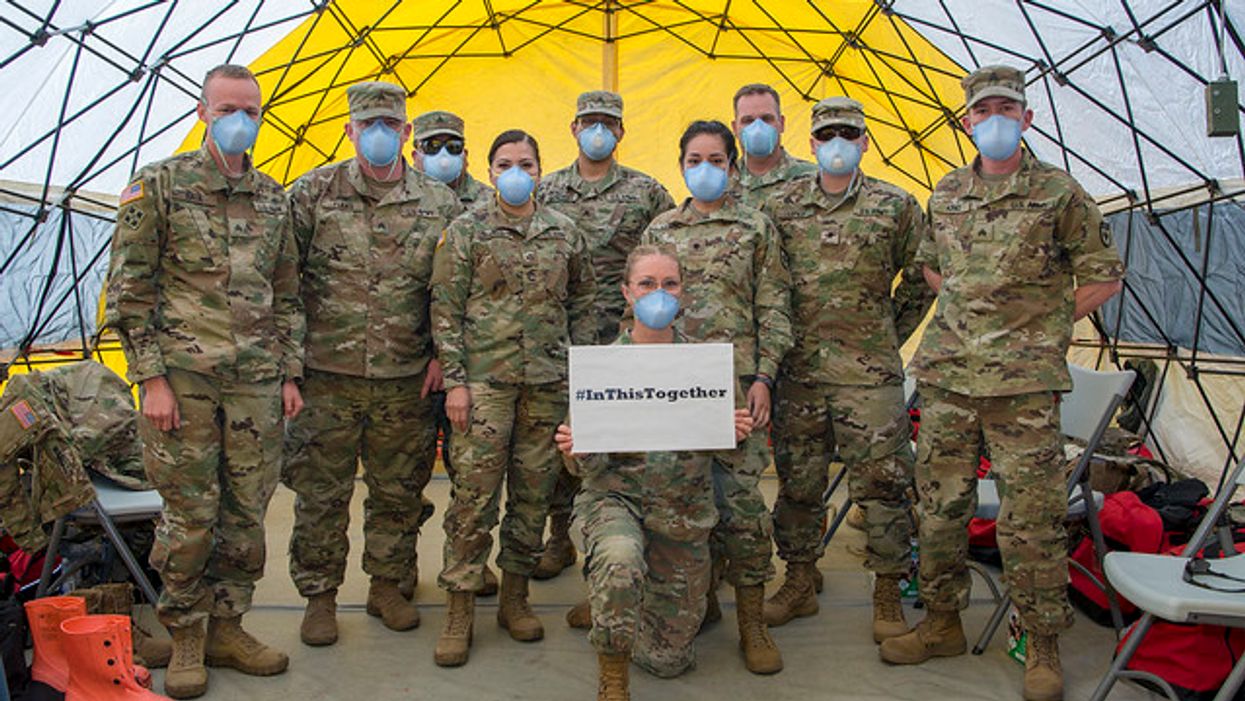
All of this is not to say that some parts of the U.S. military haven't tried to step up as Covid-19 spreads. The Pentagon has, for instance, awarded contracts to build "alternate care" facilities to help relieve pressure on hospitals. The Uniformed Services University of the Health Sciences is allowing its doctors and nurses to join the military early. Several months into this crisis, the Pentagon has finally used the Defense Production Act to launch a process to produce $133 million worth of crucial N95 respirator masks and $415 million worth of N95 critical-care decontamination units. But these are modest acts in the midst of a pandemic and at a moment when bailouts, fraud, and delays suggest that the military-industrial complex hasn't proved capable of delivering effectively, even for its own troops.
Meanwhile, the Beltway bandits that make up that complex have spotted a remarkable opportunity to secure many of their hopes and dreams. Their success in putting their desires and their profits ahead of the true national security of Americans was already clear enough in the staggering pre-pandemic $1.2 trillion national security budget. (Meanwhile, of course, key federal medical structures were underfunded or disbanded in the Trump administration years, undermining the actual security of the country.) That kind of disproportionate spending helps explain why the richest nation on the planet has proven so incapable of providing even the necessary personal protective equipment for frontline healthcare workers, no less the testing needed to make this country safer.
The defense industry has asked for, and received, a lot in this time of soaring cases of disease and death. While there is undoubtedly a role for the giant weapons makers and for the Pentagon to play in this crisis, they have shown themselves to be anything but effective lead institutions in the response to this moment. It's time for the military-industrial complex to truly pay back an American public that has been beyond generous to it.
Isn't it finally time as well to reduce the "defense" budget and put more of our resources into the real national security crisis at hand?
Mandy Smithberger, a TomDispatch regular, is the director of the Center for Defense Information at the Project On Government Oversight (POGO).
Copyright 2020 Mandy Smithberger