Tag: strait of hormuz
Why America Is On Its Own: Slavery, Tariffs And Trump's Dire Strait

Why America Is On Its Own: Slavery, Tariffs And Trump's Dire Strait

Donald Trump is now pleading with other countries to rescue his war on Iran by helping to open the Strait of Hormuz — although Trump being Trump, his pleas for assistance take the form of threats. Regardless, help is not on the way. Germany, Australia and Japan have flatly said no, while Britain and France have been slightly equivocal but at most hinted at willingness to supply forces after the fighting stops.

Why this effectively unanmous rejection? A large part of the answer is that other countries couldn’t secure the Strait even if they wanted to. Boris Pistorius, Germany’s defense minister, was outright caustic in remarks Monday:

What does (...) Donald Trump expect a handful or two handfuls of European frigates to do in the Strait of Hormuz that the powerful U.S. Navy cannot do?

Beyond that, who wants to take risks in support of a U.S. government that nobody trusts, a government that neither shows gratitude for aid nor punishes those who do America harm?

Indeed, even as Trump begs in his graceless way for help, his administration is preparing to hit the very nations he is appealing to with another round of tariffs — tariffs that will be imposed based on an obviously false, bad faith, totally insulting argument.

As most readers probably know, almost a year ago Trump imposed tariffs on almost every other nation, including islands inhabited only by penguins, by invoking the International Emergency Economic Powers Act. This use of IEEPA was blatantly illegal, and after dragging its heels for many months, the Supreme Court finally agreed with lower courts that the tariffs were, in fact, illegal.

One important point that isn’t emphasized enough is that in addition to being illegal under U.S. law, the IEEPA tariffs were a gross breach of contract. Most U.S. tariff rates were set in 1995, as part of the negotiations that among other things created the World Trade Organization. These tariffs were “bound” by international agreements, which have almost as much force as treaties. But the U.S. just ripped those agreements up, without even trying to make a case for its actions.

Now the IEEPA tariffs are gone, but Trump isn’t giving up. On Sunday night he posted a long, falsehood-filled rant about the Court, beginning with a condemnation of its tariff ruling. And while he can’t simply defy Supreme Court rulings — not yet, anyway — his officials have been scrambling for legal strategies to reimpose high tariffs.

And the main one they’ve come up with is a doozy. Under U.S. law the executive branch has the authority to impose tariffs without new legislation in certain specified circumstances. These include Section 232 tariffs to protect national security, the (spurious) basis for most of the tariffs that survived the Supreme Court’s ruling. (I’m ignoring the Section 122 tariffs currently in place to deal with a nonexistent balance of payments crisis, not because they’re legal — they clearly aren’t — but because they will expire this summer.)

Looking forward, however, Trump officials are planning to impose another major round of tariffs using Section 301, designed to cope with unfair foreign trading practices. In particular, they’re proposing tariffs on 60 (!) countries, including Canada, the UK and the European Union, that they accuse of violating rules against international trade in goods produced with forced labor.

Wait — is the administration accusing Canada and Europe of using slave labor to produce their exports? No, they’re saying that these countries’ governments are guilty of “failure to impose and effectively enforce a ban on the importation of goods produced with forced labor,” and that these failures “burden or restrict U.S. commerce.” In other words, they’re going to slap tariffs on Canada, not because they claim that Canada uses slave labor, but because China does, and they claim that Canada is hurting America because it isn’t doing enough to stop those slave-produced goods from entering its own market.

Nobody, and I mean nobody, believes this story. Nobody believes that Canada or Europe are worse at policing global slave labor than the U.S. is. In fact, nobody believes that the Trump administration even cares about slave labor. After all, the alleged concerns that are about to be used to raise tariffs were nowhere to be found until the Court ruled against IEEPA.

So this is nothing but an excuse for another attempted end-run around the law — an end-run that is also a massive insult to other democratic nations, the same nations Trump is pleading with for help in undoing the disaster he has created in the Persian Gulf.

The point is that it’s all of a piece. The current U.S. government has, as Trump would say, treated our erstwhile allies very, very badly in multiple ways, with the arbitrary, illegal imposition of tariffs the most consequential. And now those erstwhile allies have no inclination to help Trump out of the Iran trap he created for himself. Funny how that works.

Paul Krugman is a Nobel Prize-winning economist and former professor at MIT and Princeton who now teaches at the City University of New York's Graduate Center. From 2000 to 2024, he wrote a column for The New York Times. Please consider subscribing to his Substack.

Reprinted with permission from Paul Krugman.

Spinning Trump's Oil Crisis, Energy Secretary Flails And Apologizes

Spinning Trump's Oil Crisis, Energy Secretary Flails And Apologizes

Energy Secretary Chris Wright attempted to do some damage control Thursday, as oil prices continue their rollercoaster climb. But unfortunately for Wright, it’s hard to sell a flaming bag of manure.

“Ultimately, this is going to help us fill the reserve, but we need the oil in the short term for the—short term pain for long term gain,” he told CNBC, defending the release of 172 million barrels of oil from the Strategic Petroleum Reserve.

Wright’s own department says it doesn’t expect gas prices to return to pre-war levels until well into 2027.

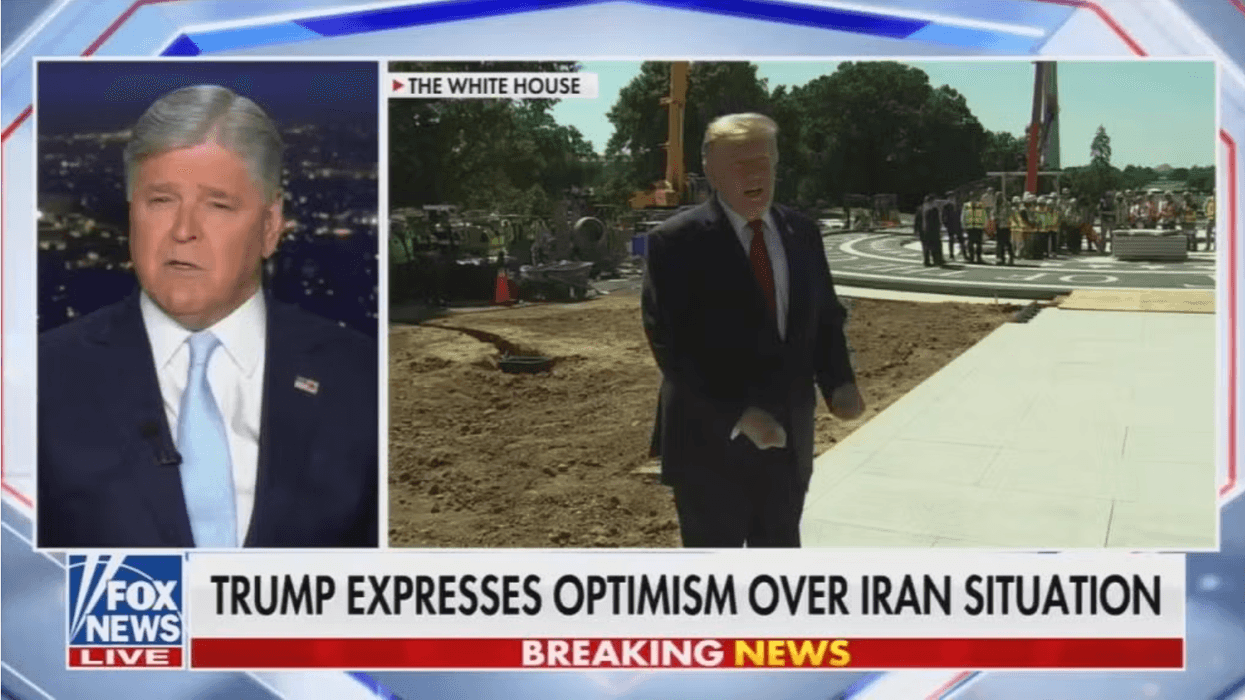
Also in the interview, Wright claimed that President Donald Trump’s war on Iran makes energy markets safer—which was quickly undercut by footage aired alongside him, showing Iran's strikes on oil tankers in the Strait of Hormuz.

Wright then appeared on CNN, where he worked his ass off trying to spin what is clearly an oil crisis of Trump’s own making.

“We're in the midst of a significant disruption in the short term to fix the security of energy flow for the long term,” he said, downplaying an International Energy Agency report released Thursday, which found that Trump’s Iran war “is creating the largest supply disruption in the history of the global oil market.”

And then when Wright appeared on the usually friendly shores of Fox News, he was forced to apologize for posting—and then deleting—a claim that the Trump administration had successfully escorted an oil tanker through the Strait of Hormuz, throwing the markets into chaos.

“I take full ownership of that as the person in charge of the department,” Wright said. “Very unfortunate. It will not happen again.”

Wright also acknowledged Thursday that the U.S. Navy currently has no way to escort tankers safely through the waterway.

“It can’t happen now,” he said. “We’re simply not ready.”

'One-Hit Wonder': Trump's Military Adventurism Is Sinking In Strait Of Hormuz

'One-Hit Wonder': Trump's Military Adventurism Is Sinking In Strait Of Hormuz

I’ve only time for a quick note, trying to put together some coherent thoughts on what’s going on with the war/econ nexus on which I’ve been focusing in recent days.

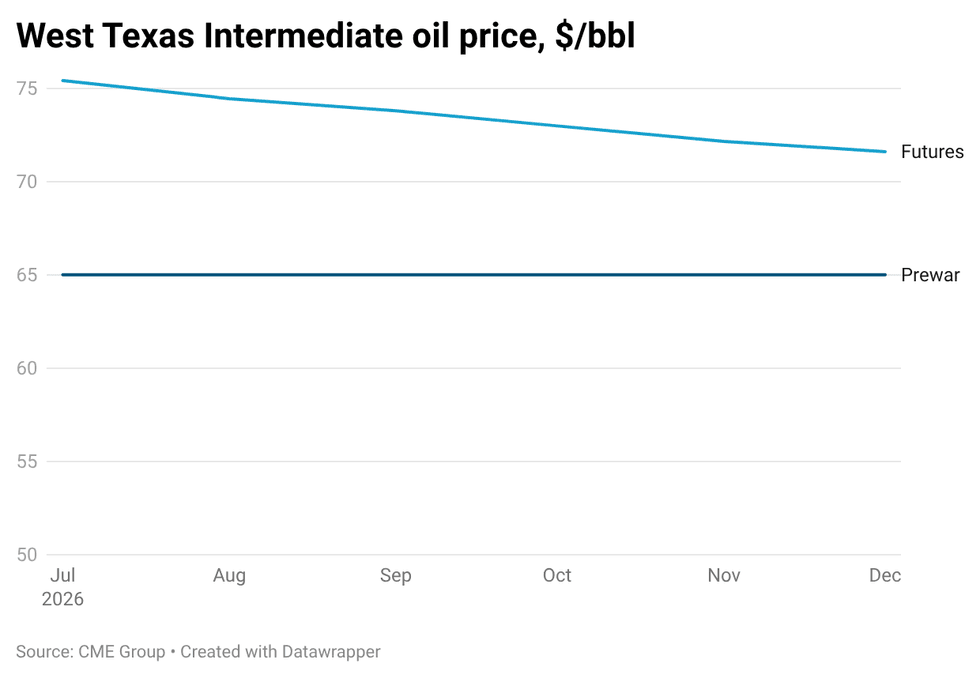
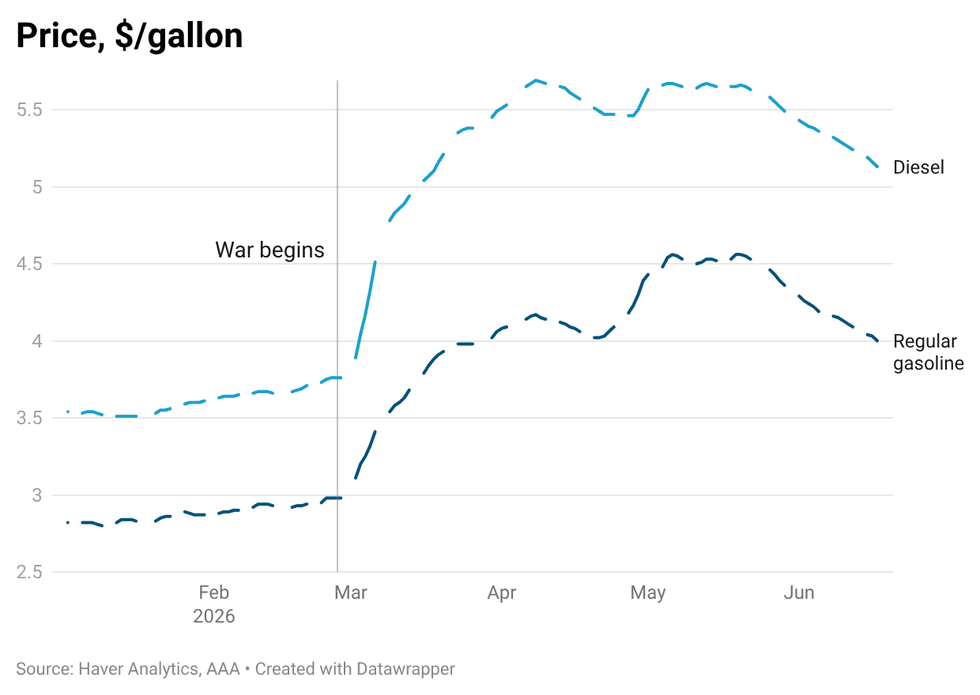
The right place to start is the oil price, which has been on a crazy ride and as I write, is well off its peak.

The gas price, however, hasn’t gotten the memo and is up to $3.54 today, up from $3.48 yesterday and $2.92 a month ago.

So, where do we go from here? Here’s the bottom line, as I see it. Warning: this requires understanding Trumpian psychology; do not try this at home.

Trump viewed the Maduro operation as pretty much perfection from his perspective. A literal one-night intervention of shock-and-awe to take out a bad guy, impeccably implemented by our armed forces. No spillover into markets, and, if anything, a play for more oil supply. Never mind that the original Venezuelan regime remains intact.

Iran isn’t that. Yes, there was the same decapitation of an enemy leader—and the same intact regime problem—but there’s this problem called the Strait of Hormuz (SoH). By shutting that down, leavened with attacks on other Gulf energy-providing states, Iran was able to hit us, and even more so Europe, in the wallets. All totally predictable, of course, but these folks don’t do that sort of planning.

When confronted with costs, Trump often backs off. That’s the root of the whole TACO [Trump Always Chickens Out] thing, but also the source of his gentle treatment of China, who used their almost absolute control of the refining of “rare earths”—key inputs into much of our tech and defense production—to back him down.

In this case, Iran is flexing its Strait of Hormuz control, and this raises the economic costs for the rest of the world and the political costs for the Trump admin and their Congressional allies. We can’t know which way this will bounce, but markets seem convinced that the admin is truly about done with this adventure.

If so, what a mess! Iran will have learned that, yes, the US/Israel coalition can hit hard (which they already knew), but at least the senior partner will back off if you shock the oil supply. They need not worry about regime change or even about dialing back of their nuke pursuits.

The provisional punchline is this: give a world-class army to an authoritarian leader who a) faces no constraints from Congress and is served by a bunch of yes-man lackeys and b) fully discounts the future, meaning doesn’t do the geopolitical chess exercise of weighing the many possible implications of his interventions, and he will deploy that army to do one-hit wonders. Take out a global bad guy, claim credit, move on to the next bad guy.

That “worked,” from his perspective, in Venezuela. It did not work in Iran.

Jared Bernstein is a former chair of the White House Council of Economic Advisers under President Joe Biden. He is a senior fellow at the Council on Budget and Policy Priorities. Please consider subscribing to his Substack.

Reprinted with permission from Econjared.

Shop our Store

Headlines

Editor's Blog

Corona Virus

Trending

World