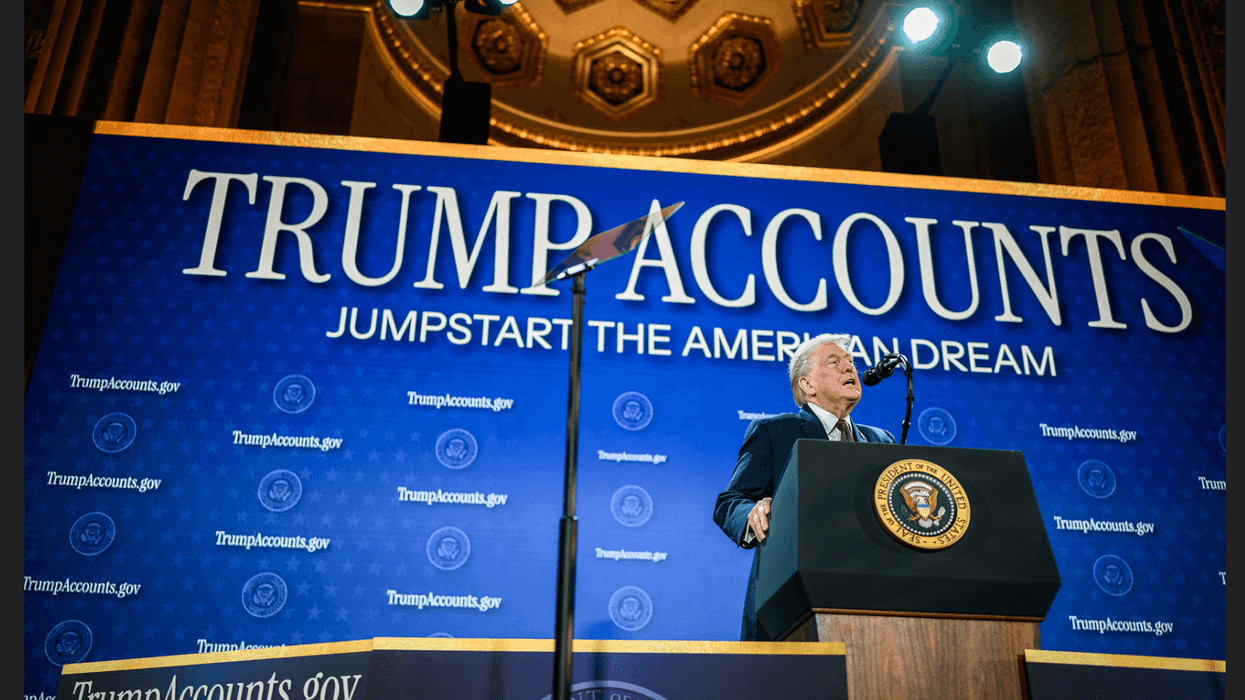
Fire Any Financial Adviser Who Suggests Investing In Trump Accounts
I’m serious, and this is not just my disgust with everything Trump. There is no good reason for the overwhelming majority of people in the country to ever put a dollar in a Trump account for their kids.
To be clear, I’m not in favor of tax-sheltered accounts in general. They strike me mostly as a very inefficient way to accomplish public goals, in this case making education more affordable. The more efficient route would be to have more public funds go to support public colleges and community colleges.
The tax-sheltered account route also favors higher-income people. Over a quarter of households owe no income tax, meaning they would get no benefit whatsoever from putting money in a tax-sheltered account. Another 20 percent are in the 10 percent bracket, meaning the account would just save them just 10 cents on every dollar invested. By contrast, the highest income households save 37 cents on every dollar invested in a tax-sheltered account.
In addition, tax-sheltered accounts put a lot of money in the hands of the financial industry. Tens of billions of dollars go to the people and companies who administer these accounts, creating a pointless layer of wasteful bureaucracy.
To be fair, the Trump accounts limit fees to 0.1 percent of assets, far lower than is charged by many accounts. This is an important point. People can get low-cost funds in other accounts also. Stock index funds generally have the lowest fees, and most people would be wise to take advantage of them. People will tell you that they will beat the market, but most won’t, and you’ll just end up wasting money in higher fees and trading costs.
But that has nothing to do with individuals’ decisions on where to put their money. For better or worse, Trump accounts exist. The question is whether people will be helping their kids by putting money into them. And, as I said above, the answer for almost everyone is no.
The main reason is that we already have 529 accounts for the purpose of saving for a kid’s education. The big difference between the accounts for this purpose is that it is possible to withdraw money from a 529 account, if it’s needed, where it is not possible to withdraw money from a Trump account for any reason, until the kid turns 18.
People do pay a penalty for taking money out of a 529 early, but at least they can have access to it, if they need it. And unexpected events do happen. People can lose a job, have serious medical expenses, or get divorced. These and other unanticipated situations can require people to dip into whatever savings they have. With a 529 plan, they can use the money if they really need it. With a Trump account, they are out of luck.
It is important to recognize that withdrawals for non-education purposes are fairly common. A recent study by Vanguard found that 2% of accounts had an unqualified withdrawal in an average year. If an account is open on average for 20 years, this would mean that 40% of accounts have an unqualified withdrawal. People don’t expect bad things to happen, but they do.
Also, since the penalty is based only on the earnings portion of the 529 plan, not the whole sum in the plan, in most cases it is likely to be small. Suppose someone pulls $5000 out of a 529 plan, where earnings are currently 40 percent of the money in the plan. That means they would pay taxes on $2,000, plus a penalty of 10 percent.
If they are in the 10 percent bracket, their taxes would be $200, and their penalty would be $200. If they were in the zero bracket, say because they had lost their job, they would only pay the $200 penalty. That compares to being unable to touch their money at all in a Trump account. (The money in a 529 is not taxable at all if used for educational purposes. The earnings in a Trump account are taxable.)
It’s also worth mentioning that it’s not even possible to change asset allocations in a Trump account. Suppose your kid is 17, one year too young to make a withdrawal. If you’re worried there is an AI bubble likely to burst, and you would rather have your money in Treasury bonds, you’re out of luck. Trump accounts won’t let you make the switch; you have to go down with Elon Musk and the rest of the market.
The silliest argument given by proponents of Trump accounts is that they can be rolled over into an IRA to allow for lifelong wealth accumulation. So can the money in 529 accounts, up to a ceiling of $35,000.
The Trump gang makes a big issue of the $35,000 ceiling, but this is something only elite types with lots of money would care about. Very few people ever accumulate more than $35,000 in a 529 account, and the vast majority of people who do will find some education-related expense that would reduce the value of the account to less than $35,000. Remember, even food and housing can count as education-related expenses.
But let’s say someone ends up with an amount over $35,000 that they can’t use for education-related expenses. Suppose they have $40,000 that they want to roll over into an IRA. In this situation they would have to pay a 10% penalty on the amount over $35,000. That would be $500 on the $5,000 difference.
They would also have to pay taxes on the $5,000. The beneficiary is the one receiving the money, so they would be paying the tax. Since they are just beginning their working career, they likely have a relatively low income. This means they will almost certainly be in the 10% or 15% tax bracket, and quite possibly the zero bracket.
So, this is the bad scenario that Trump account proponents say it is important to avoid, and therefore skip a 529 and put your money in a Trump account instead? That seems pretty whacky, and why you need to fire your financial adviser if they suggest putting money in a Trump account.
To be clear, take the $1000 that Trump wants to give newborn kids. It would be a much better use of tax dollars if we provided food and medical care to kids from low-income families than giving out $1000 checks to millions of families that don’t need it. But you aren’t going to change the policy by turning down the money. If it bothers you, donate the money to a good cause, but do take the money and don’t ever put another penny in a Trump account.
Dean Baker is a senior economist at the Center for Economic and Policy Research and the author of the 2016 book Rigged: How Globalization and the Rules of the Modern Economy Were Structured to Make the Rich Richer. Please consider subscribing to his Substack.